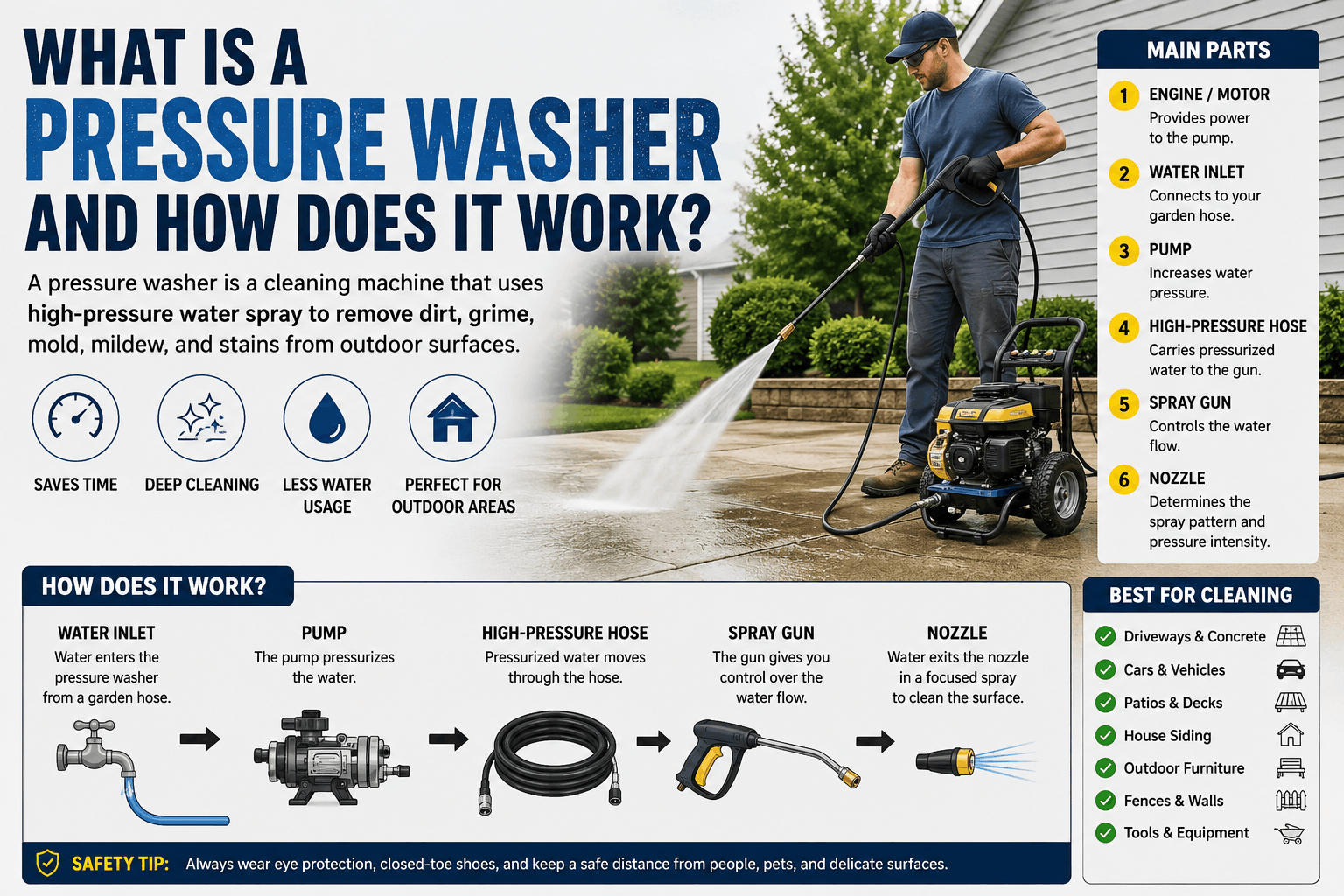
What Is a Pressure Washer and How Does It Work?
Choosing a pressure washer looks simple at first. You see a machine, a hose, a spray gun, and a strong jet of water. But once you start comparing PSI, GPM, electric models, gas models, nozzles, pumps, motors, and cleaning jobs, it becomes clear that a pressure washer is more than just a powerful garden hose.
If you are new to outdoor cleaning, the first question is simple: what is a pressure washer, and how does it actually work?
A pressure washer is a cleaning machine that uses a motor or engine to push water through a pump at high pressure. That high-pressure water then comes out through a hose, spray gun, and nozzle to remove dirt, mud, algae, mildew, grime, loose paint, and stains from outdoor surfaces.
For homeowners, car owners, DIY cleaners, and small cleaning business owners, understanding how a pressure washer works can save time, reduce mistakes, and help prevent surface damage. More pressure is not always better. The right pressure, water flow, nozzle, distance, and cleaning method matter more than simply buying the strongest machine.
In this guide, you will learn what a pressure washer is, how it works, what PSI and GPM mean, which parts matter most, where pressure washers are useful, and what safety mistakes beginners should avoid.
What Is a Pressure Washer?
A pressure washer is a machine designed to clean surfaces by spraying water at much higher pressure than a regular garden hose.
A normal garden hose can rinse dust and loose dirt, but it does not have enough force to remove deep grime from concrete, brick, siding, patio stones, decks, or outdoor equipment. A pressure washer increases the force of the water so it can break dirt loose from the surface.
Most pressure washers have four basic things:
- A power source
- A water inlet
- A pump
- A high-pressure outlet system
The power source may be an electric motor or a gas engine. The water usually comes from a garden hose. The pump increases the pressure. The hose, spray gun, and nozzle control how the water reaches the surface.
In practical cleaning situations, a pressure washer helps when normal rinsing is not enough. For example, a driveway may look permanently stained, but sometimes the problem is built-up dirt sitting in the pores of the concrete. A pressure washer can loosen and rinse away that buildup when used correctly.
How Does a Pressure Washer Work?
A pressure washer works by taking water from a regular supply, increasing its pressure through a pump, and forcing it out through a small nozzle opening.
Here is the simple process:
- Water enters the machine from a garden hose.
- The motor or engine powers the pump.
- The pump pressurizes the water.
- Pressurized water moves through the high-pressure hose.
- The spray gun controls the water flow.
- The nozzle shapes the spray pattern.
- The water hits the surface and breaks dirt loose.
The nozzle is very important because it controls how concentrated the pressure feels. A narrow spray pattern feels stronger because the force is focused on a smaller area. A wider spray pattern feels gentler because the water spreads out.
This is why the same pressure washer can clean concrete with one nozzle and rinse a car with another. The machine may be the same, but the nozzle and technique change the result.
Main Parts of a Pressure Washer
Understanding the main parts helps you choose, use, and maintain the machine better.
1. Motor or Engine
The motor or engine gives power to the pump.
Electric pressure washers use an electric motor. They are usually lighter, quieter, easier to start, and better for general home cleaning.
Gas pressure washers use a gasoline engine. They usually produce more power and are better for heavy-duty cleaning like large driveways, concrete, farm equipment, and professional jobs.
2. Water Inlet
The water inlet connects the pressure washer to your garden hose.
This is where water enters the machine. If the water supply is weak, blocked, or dirty, the machine may lose pressure, pulse, or damage internal parts. A clean inlet filter helps protect the pump from dirt and small debris.
3. Pump
The pump is the heart of the pressure washer.
It takes low-pressure water from the hose and turns it into high-pressure water. The pump is one of the most important parts of the machine because it controls performance, durability, and repair cost.
A weak or damaged pump can cause low pressure, pulsing, leaking, or poor cleaning power.
4. High-Pressure Hose
The high-pressure hose carries pressurized water from the machine to the spray gun.
This hose is different from a normal garden hose. It must be strong enough to handle high pressure. Hose length, flexibility, fitting size, and kink resistance all matter.
A longer hose gives more reach, but it must still match the machine’s pressure rating and fittings.
5. Spray Gun and Wand
The spray gun gives you control over the water.
When you press the trigger, water comes out. When you release the trigger, water stops. The wand gives distance between your hand and the spray tip, helping you control the cleaning angle and direction.
Some users prefer short spray guns for car detailing, while longer wands are useful for general cleaning.
6. Nozzles
Nozzles control the spray angle and pressure concentration.
Common pressure washer nozzle colors include:
- Red: 0-degree narrow spray
- Yellow: 15-degree spray
- Green: 25-degree spray
- White: 40-degree spray
- Black: Soap nozzle
The red nozzle is very strong and can damage surfaces quickly. Beginners should be careful with it. For most home cleaning, wider spray patterns are safer and easier to control.
PSI and GPM Explained in Simple Words
Two numbers matter a lot when choosing a pressure washer: PSI and GPM.
What Is PSI?
PSI means pounds per square inch.
In simple words, PSI tells you how strong the water pressure is. Higher PSI means the water hits the surface with more force.
For example:
- Lower PSI is better for cars, outdoor furniture, and delicate surfaces.
- Medium PSI works well for patios, siding, and general cleaning.
- Higher PSI is useful for concrete, driveways, and heavy dirt.
But PSI alone does not tell the full story.
What Is GPM?
GPM means gallons per minute.
It tells you how much water the pressure washer uses per minute. Higher GPM helps rinse dirt away faster and cover larger areas more efficiently. Several pressure washer buying guides explain PSI as pressure force and GPM as water flow, and both affect cleaning performance.
A pressure washer with high PSI but low GPM may break dirt loose but rinse slowly. A machine with balanced PSI and GPM usually feels more effective for real cleaning.
What Are Cleaning Units?
Cleaning units are often calculated by multiplying PSI by GPM.
For example:
3,000 PSI × 2.4 GPM = 7,200 cleaning units
This gives a rough idea of cleaning power, but it still does not replace practical judgment. Surface type, nozzle angle, water distance, soap, and technique all affect the final result.
Electric vs Gas Pressure Washers
Most beginners choose between electric and gas pressure washers.
Both can be useful, but they are not the same.
Electric Pressure Washers
Electric pressure washers are best for lighter and medium home cleaning.
They are commonly used for:
- Cars
- Patio furniture
- Small patios
- Decks
- Light siding cleaning
- Trash bins
- Garden tools
- Small walkways
Electric models are usually easier to start and maintain. You plug them in, connect water, and start cleaning. They are also quieter than gas models.
The limitation is power. Electric models may not clean large concrete driveways as quickly as stronger gas machines.
Gas Pressure Washers
Gas pressure washers are better for heavier work.
They are commonly used for:
- Concrete driveways
- Large patios
- Brick surfaces
- Farm equipment
- Heavy outdoor grime
- Commercial cleaning jobs
Gas models usually offer higher PSI and GPM. They are powerful, but they are also louder, heavier, and require more maintenance. They also produce exhaust, so they should not be used indoors or in enclosed spaces. Gas-powered pressure washers can create carbon monoxide hazards indoors, so they should only be used in properly ventilated outdoor areas.
What Can You Clean With a Pressure Washer?
A pressure washer can clean many outdoor surfaces, but the setup must match the material.
Driveways and Concrete
Concrete is one of the most common pressure washer jobs.
Driveways collect tire marks, mud, algae, oil stains, and dirt. A pressure washer can remove a lot of surface grime, especially when paired with a surface cleaner.
For concrete, many users prefer gas pressure washers or stronger electric models. The right nozzle and steady movement help prevent uneven cleaning lines.
Cars and Vehicles
Pressure washers can be used for car washing, but carefully.
For car detailing, more pressure is not always better. A safer setup usually includes moderate pressure, a wider nozzle, good distance, and proper car soap. A foam cannon can also help apply soap evenly.
Avoid spraying too close to paint, badges, sensors, seals, tires, or damaged areas.
Patios and Decks
Patios and decks need careful pressure control.
Concrete patios can usually handle more pressure than wood decks. Wood can be damaged if the spray is too strong or held too close. A fan nozzle and steady movement are safer than a narrow, aggressive spray.
House Siding
Pressure washers can clean siding, but this job requires caution.
Vinyl siding, painted siding, windows, vents, and gaps can be damaged if water is forced behind them. For house siding, lower pressure and proper technique are important. In many cases, soft washing may be safer than high-pressure washing.
Outdoor Furniture
Plastic, metal, and some outdoor furniture can be cleaned with a pressure washer, but delicate materials need care.
Use lower pressure, a wider nozzle, and enough distance. Avoid spraying directly at fabric cushions, weak joints, peeling paint, or soft wood.
When Should You Use Soap?
Water pressure alone can remove loose dirt, but soap helps break down grease, road film, algae, mildew, and stubborn grime.
Soap is useful for:
- Car washing
- Siding cleaning
- Outdoor furniture
- Trash bins
- Greasy equipment
- Mild mildew or algae buildup
The important thing is to use detergent designed for pressure washers and the surface you are cleaning. Regular household cleaners may not be safe for the machine, the pump, the surface, or the surrounding plants.
Always check the detergent label and your pressure washer manual.
Why the Nozzle Matters So Much
A common mistake is thinking the machine does all the work. In reality, the nozzle changes how the machine behaves.
A narrow nozzle can feel aggressive even on a moderate-pressure machine. A wider nozzle can make a stronger machine safer and easier to control.
For beginners:
- Avoid starting with the red nozzle.
- Test in a hidden area first.
- Start with a wider spray.
- Keep the wand moving.
- Do not spray too close.
- Use the lowest effective pressure.
What matters more than raw power is matching the spray pattern to the surface.
Common Mistakes People Make
Choosing PSI Only and Ignoring GPM
Many buyers look only at PSI. That is a mistake.
PSI helps break dirt loose, but GPM helps rinse it away. For large surfaces like driveways and patios, water flow can make cleaning faster and more even.
The correction: compare both PSI and GPM, not pressure alone.
Using Too Much Pressure on Delicate Surfaces
More power can damage paint, wood, siding, and car surfaces.
The correction: start with a wider nozzle, keep distance, and test first.
Holding the Spray Tip Too Close
Holding the nozzle too close increases the risk of damage. It can leave lines, marks, or cuts in softer materials.
The correction: begin farther away and move closer only if needed.
Using the Wrong Nozzle
The wrong nozzle can turn a simple cleaning job into a repair problem.
The correction: use a nozzle suitable for the surface. Wider spray angles are usually safer for beginners.
Ignoring Hose and Fitting Compatibility
A pressure washer hose, spray gun, or foam cannon may not fit every machine.
The correction: check fitting type, size, PSI rating, and connector style before buying accessories.
Forgetting Pump Maintenance
The pump needs clean water and proper care. Dirty water, blocked filters, and poor storage can shorten pump life.
The correction: clean the inlet filter, use clean water, and store the machine properly.
Buying the Wrong Machine for the Job
Some people buy a small electric washer for large concrete jobs. Others buy a powerful gas model for light car washing.
The correction: match the machine to your main cleaning tasks.
Skipping Safety Gear
High-pressure water can cause injury, and flying debris can hit your eyes or skin.
The correction: wear closed-toe shoes, eye protection, and suitable clothing.
Safety Tips Before Using a Pressure Washer
A pressure washer is useful, but it is not a toy. High-pressure water can cause serious injury, even when the outside wound looks small. Safety guidance warns that high-pressure spray wounds may need urgent medical attention because the damage can be deeper than it appears.
Follow these basic safety tips:
- Never point the spray gun at people or pets.
- Do not spray your hands, feet, or skin.
- Wear eye protection.
- Wear closed-toe shoes.
- Keep children away from the cleaning area.
- Avoid using ladders with pressure washers.
- Be careful around electrical outlets and extension cords.
- Do not use gas pressure washers indoors.
- Read the pressure washer manual before use.
- Test on a small hidden area before cleaning the full surface.
The safer approach is to start gently and increase cleaning power only when needed.
Simple Action Plan
Before You Start
- Check the surface you want to clean.
- Choose the right nozzle.
- Inspect the hose, gun, fittings, and water connection.
- Make sure the water supply is clean and strong enough.
- Read the machine instructions.
- Move people, pets, and fragile items away from the area.
During Use
- Start with a wider nozzle.
- Keep the spray tip at a safe distance.
- Move the wand steadily.
- Do not stay too long in one spot.
- Use soap only when suitable for the surface and machine.
- Watch for surface damage, streaks, or loose material.
After Cleaning
- Turn off the machine properly.
- Release pressure from the spray gun.
- Disconnect hoses safely.
- Clean the inlet filter if needed.
- Drain water from the hose and machine.
- Store the pressure washer in a dry place.
Who Needs a Pressure Washer?
A pressure washer is useful for many people, but not everyone needs the same type.
Homeowners
Homeowners use pressure washers for driveways, patios, siding, fences, outdoor furniture, and general outdoor cleaning.
A medium electric pressure washer is often enough for small homes, while larger properties may benefit from a gas machine.
Car Owners
Car owners may use a pressure washer with a foam cannon for easier washing.
The key is controlled pressure, proper nozzle choice, and car-safe soap.
DIY Cleaners
DIY users often need a pressure washer for seasonal cleaning.
For them, ease of use, storage, safety, and accessory compatibility are important.
Small Cleaning Business Owners
Small business users usually need stronger machines, better hoses, durable pumps, and professional accessories.
For business use, reliability and cleaning speed matter more than the cheapest price.
What to Check Before Buying a Pressure Washer
Before buying, ask yourself these questions:
- What will I clean most often?
- Do I need electric or gas?
- What PSI is suitable for my surfaces?
- What GPM does the machine offer?
- Is the hose long enough?
- Are the fittings standard?
- Does it include useful nozzles?
- Can I add a foam cannon or surface cleaner?
- Is it easy to store?
- Is maintenance simple?
- Are replacement parts available?
For most homeowners, the best pressure washer is not always the strongest one. It is the one that matches the cleaning job, is easy to use, and does not create unnecessary risk.
FAQs
What is a pressure washer used for?
A pressure washer is used to clean outdoor surfaces such as driveways, patios, cars, decks, siding, fences, outdoor furniture, and equipment. It removes dirt, grime, algae, mud, and loose buildup using high-pressure water.
Is a pressure washer stronger than a garden hose?
Yes. A pressure washer is much stronger than a normal garden hose because it uses a pump to increase water pressure. A garden hose is useful for rinsing, but a pressure washer can remove tougher dirt from hard surfaces.
What does PSI mean on a pressure washer?
PSI means pounds per square inch. It tells you how strong the water pressure is. Higher PSI means more force, but too much pressure can damage delicate surfaces.
What does GPM mean on a pressure washer?
GPM means gallons per minute. It tells you how much water the machine moves. Higher GPM helps rinse dirt away faster and clean larger areas more efficiently.
Is electric or gas better for beginners?
Electric pressure washers are usually better for beginners because they are easier to start, quieter, lighter, and require less maintenance. Gas pressure washers are better for heavy-duty jobs but need more care and safety awareness.
Can a pressure washer damage concrete?
Yes, it can damage concrete if the wrong nozzle, too much pressure, or poor technique is used. It can also leave lines if moved unevenly. For driveways, many users prefer a surface cleaner for a more even finish.
Can I use any soap in a pressure washer?
No. You should use soap or detergent made for pressure washers and suitable for the surface you are cleaning. The wrong cleaner can damage the pump, surface, plants, or finish.
Is a pressure washer dangerous?
A pressure washer can be dangerous if used carelessly. High-pressure water can injure skin, eyes, and feet. It can also damage surfaces. Always follow safety instructions, wear protection, and never point the spray at people or pets.
Conclusion
A pressure washer is one of the most useful outdoor cleaning tools, but it works best when you understand what it is doing. It is not just about strong water pressure. The pump, motor, hose, spray gun, nozzle, PSI, GPM, soap, and technique all work together.
For beginners, the most important lesson is simple: choose the right pressure for the surface, start carefully, and let the machine do the work without forcing it.
If you are buying your first pressure washer, do not chase the highest PSI immediately. Think about what you will clean most often. A car, patio, siding, and driveway do not all need the same setup. A balanced pressure washer with the right accessories can often be more useful than a powerful machine used the wrong way.
Start with safe technique, learn your nozzles, understand PSI and GPM, and build confidence slowly. That approach will help you clean better, protect your surfaces, and get more value from your pressure washer.