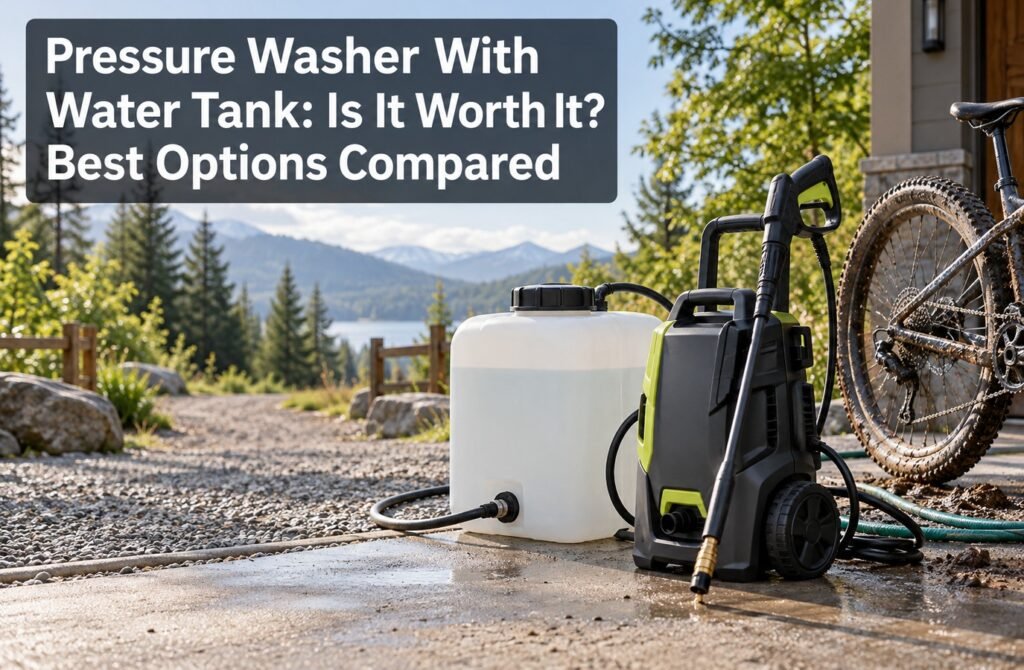
Pressure Washer With Water Tank: Is It Worth It? Best Options Compared
A Pressure Washer With Water Tank sounds like the easiest way to wash anywhere. Fill the tank, load the washer, and skip the garden hose. That can work well for a muddy bike, outdoor gear, or a small job away from a water connection. For a driveway or regular home cleaning, however, a small tank may run out much sooner than expected. The phrase also covers different products. Some have a built-in reservoir, some connect to a separate container through a suction hose, and others are full trailer systems for commercial crews. These options do not deliver the same pressure, flow, or cleaning time. This guide compares five representative setups, explains what a water tank does and does not change, and helps match the tank to the job. The comparison uses manufacturer-published specifications and product information; these models were not hands-on tested for this article. Availability and specifications can vary by region, so confirm the exact model and manual before buying. What Does a Pressure Washer With Water Tank Mean? A water tank supplies water to the pump. It is different from a detergent reservoir, which holds soap. Check the product description: “built-in tank” can refer to either one. Common setups include: A tank does not increase PSI or GPM. PSI is spray pressure; GPM is water flow. A larger tank only supplies water longer. Full-size washers can clean more aggressively, but may empty a small tank quickly. That is the key point when comparing any pressure washer with water tank. Built-in reservoirs, separate feed tanks, and trailer systems solve different water-supply problems. Is a Pressure Washer With Water Tank Worth It? A tank is useful when a tap is unavailable, the work area is far from the house, or you need a portable rinse for bikes, tools, boots, or outdoor equipment. A built-in reservoir saves repeated trips with a bucket. A trailer tank supports longer jobs away from a water connection. Keep this in mind while you shop for a pressure washer with water tank. It is less useful when a garden tap is nearby. A hose gives a continuous supply without tank weight, refills, or extra storage. Large flat surfaces also use much more water than a quick spot rinse, so a compact battery unit may be too slow for a long driveway. It is one more reason to check the manual for any pressure washer with water tank. Plan what happens after the first tank empties. You may need a refill point, a larger supply, or a washer that can also connect to a pressurized source. If your main concern is choosing a machine for routine house and yard jobs, our home pressure washer buying guide covers the wider choices. This matters whenever you plan to use a pressure washer with water tank. A portable tank suits short rinses away from home, but does not replace an unlimited water supply. Best Pressure Washer With Water Tank Options Compared These products are not direct substitutes. The comparison shows what each setup is designed to do and where it may fall short. Option Water supply Published details Best fit Muc-Off Mobile Pressure Washer Explorer Bundle 20 L built-in tank; extra 20 L tank available in selected bundles 40 V battery, 500 W motor; up to 942 PSI maximum, 652 PSI Boost / 507 PSI Eco; runtime up to 15 / 24 minutes Bike and motorcycle cleaning away from a tap Kärcher OC 3 Plus 7 L built-in tank Low-pressure outdoor cleaner with battery power Shoes, bikes, pets, and small items Kärcher K5 with approved suction hose Separate tank or standing source; tank not included 2,000 PSI pressure rating; use a filtered suction hose and follow the exact manual Homeowners wanting a full-size electric washer Simpson Mobile Trailer 95001 49-State 150-gallon trailer tank 3,800 PSI at 3.5 GPM; 100 ft high-pressure hose; 900 lb unit weight Mobile professional cold-water cleaning Mi-T-M PWR Series trailer package 200-gallon tank Hot-water configuration listed at 3,500 PSI and 4.2 GPM; water recovery equipment Commercial sites needing a large supply and water recovery Muc-Off Mobile Pressure Washer Explorer Bundle Best for: Riders washing bikes or motorcycles away from a tap. The 40-volt, 500-watt unit has a 20-liter reservoir. The manufacturer lists up to 15 minutes in Boost mode or 24 minutes in Eco mode; an extra 20-liter tank is available separately or in selected bundles. Muc-Off lists up to 942 PSI maximum and mode figures of 652 PSI in Boost and 507 PSI in Eco; it does not publish a GPM figure on the product page. It is not a direct substitute for a driveway washer. Pros: Portable, self-contained, and supplied with lances intended for bike and motorcycle cleaning. Cons: Its tank is small for large surfaces, battery time is limited, and published PSI/GPM data is absent. It is a specialty mobile washer, not a full-size home replacement. Kärcher OC 3 Plus Mobile Outdoor Cleaner Best for: Light rinsing of shoes, bikes, pets, and small outdoor items. The OC 3 Plus has a 7-liter tank and integrated battery. It is a low-pressure mobile cleaner, not a conventional washer for stripping dirt from concrete. Pros: Self-contained, easy to move, and suited to gentle on-the-go rinsing. Cons: Low pressure and limited water capacity rule out patios, siding, and heavy grime. Check the product type before expecting full-size washer performance. Kärcher K5 With a Separate Tank and Suction Hose Best for: Homeowners who need an alternate water source for occasional full-size cleaning. The corded K5 family lists a 2,000 PSI pressure rating; it does not include a large supply tank. The manufacturer says K4 and K5 models can draw from standing water with a filtered suction hose, subject to the exact model manual. Pros: Use the washer for home jobs, then connect an approved hose and separate tank when needed. Cons: The tank and suction kit are separate, and not every washer can self-prime. For cordless models, our cordless pressure washer accessories guide explains why hoses, filters,