Milwaukee M18 cordless pressure washer: Is One Available?
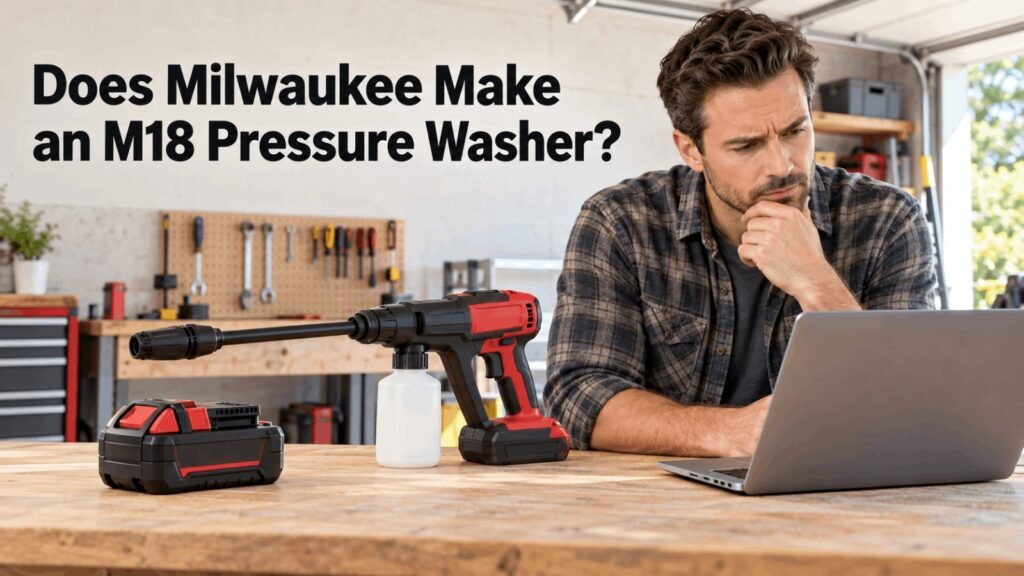
Searching for a Milwaukee M18 cordless pressure washer makes sense if you already own M18 batteries and want a washer without an extension cord. The key is to confirm that a product advertised under this search phrase is a pressure washer, rather than a sprayer or a third-party tool claiming battery compatibility. That distinction matters because some products advertised online as “M18 compatible” may be third-party tools or battery adapters, rather than Milwaukee-made washers. Milwaukee’s current M18 backpack sprayer listings are for applying liquids. A sprayer is not the same as a pressure washer, even when its product page gives a PSI figure. That is the key point when researching a Milwaukee M18 cordless pressure washer. This guide explains what to check before buying, how to tell a pressure washer from a sprayer, what a cordless washer can realistically do, and which type of alternative may fit your cleaning jobs. If you already use M18 tools, you’ll also find practical advice for avoiding battery compatibility and safety problems. Keep this in mind while you search for a Milwaukee M18 cordless pressure washer. Is There an Official Milwaukee M18 Cordless Pressure Washer? In the Milwaukee Tool U.S. catalog checked for this article, I found M18 sprayer products but no dedicated M18 pressure washer listing. Therefore, this guide does not assign PSI, GPM, runtime, nozzles, or a price to a Milwaukee M18 pressure washer. Catalogs and regional availability can change; check your country’s official Milwaukee site before buying. It is one more reason to verify any listing for a Milwaukee M18 cordless pressure washer. This is different from saying Milwaukee could never introduce one. Product ranges change, and availability can vary by country. Before buying, check the current official product listings in your region, along with the model number and manual. If a seller claims to offer a Milwaukee M18 washer, ask for the exact model number and verify that it appears in official product information. This matters whenever a seller advertises a Milwaukee M18 cordless pressure washer. Be especially careful with listings that use a familiar battery name but provide few details about the tool maker, warranty, pressure rating, or replacement parts. A battery connector that appears to fit is not proof that a product is genuine or safe to use with that battery. Use it as a checkpoint before you buy anything described as a Milwaukee M18 cordless pressure washer. Why the Product Name Can Be Confusing A product advertised for washing may be a pressure washer, a power cleaner, a pump, or a sprayer. These tools move water in different ways and are built for different jobs. A pressure washer sends water through a pump and nozzle to produce a directed spray. Its PSI rating describes pressure, while GPM describes flow. A garden sprayer may use a pump to dispense liquid, but it is designed to apply a spray or mist—not to clean surfaces with a pressure-washer jet. It helps explain why a Milwaukee M18 cordless pressure washer search can be confusing. Milwaukee currently lists M18 backpack sprayers, including the SWITCH TANK™ 4-Gallon Backpack Sprayer and the 4-Gallon Backpack Sprayer with SWITCH TANK™. Their product pages identify them as sprayers for liquid application. The former listing gives adjustable pressure up to 120 PSI; the latter gives up to 140 PSI and a flow rate of 0.1–0.52 GPM. Those figures do not make either product a pressure washer: follow its intended applications and manual. Do not attach a pressure-washer hose or nozzle to a sprayer. Remember it when comparing listings for a Milwaukee M18 cordless pressure washer. Look for a complete product specification sheet that clearly states maximum and working PSI, GPM, water temperature limits, battery requirements, included accessories, and operating instructions. If these details are missing, pause before ordering. What PSI and GPM Tell You PSI (pounds per square inch) measures pressure; GPM (gallons per minute) measures water flow. Both are useful when comparing pressure-washer specifications, but ratings alone do not predict results on every surface. Actual cleaning depends on the machine, nozzle, distance, surface, detergent, and technique. This detail separates a real Milwaukee M18 cordless pressure washer from a lookalike. Nozzle orifice and spray pattern affect the pressure and coverage delivered at the surface. More pressure is not automatically better: a concentrated spray can damage paint, wood, mortar, siding, vehicle trim, or seals. Use the machine manual and the surface maker’s guidance, begin with a wider pattern at a greater distance, and test a hidden area. Think about it before you order a so-called Milwaukee M18 cordless pressure washer. If you’re comparing cordless and full-size machines, consider both ratings alongside your surfaces and cleaning method. This beginner’s guide to PSI and GPM explains how to compare the two without relying on a single headline number. Do not infer a washer’s PSI or flow from another brand’s tool, battery voltage, or seller description; use the figures stated for the exact model. What a Cordless Pressure Washer Can Realistically Do Cordless washers and compact power cleaners are most useful when portability and quick setup matter more than long operating time or heavy cleaning capacity. Depending on their actual specifications, they may work for: Their limits often become clear on broad or heavily soiled surfaces. Washing a large driveway, removing stubborn buildup, or cleaning a commercial site may require more water flow and longer running time than a compact battery tool can provide. The job itself matters too. Rinsing off loose dirt is different from removing grease, algae, or old stains. A suitable detergent and dwell time may do more than increasing pressure. If a surface needs more force than the tool is designed to provide, use a more appropriate washer or cleaning method. That is why any Milwaukee M18 cordless pressure washer claim deserves a second look. Why a Cordless Washer Needs the Right Battery and Water Setup A cordless washer still needs a reliable water source. Some compact cleaners connect to a garden hose; others can draw from