
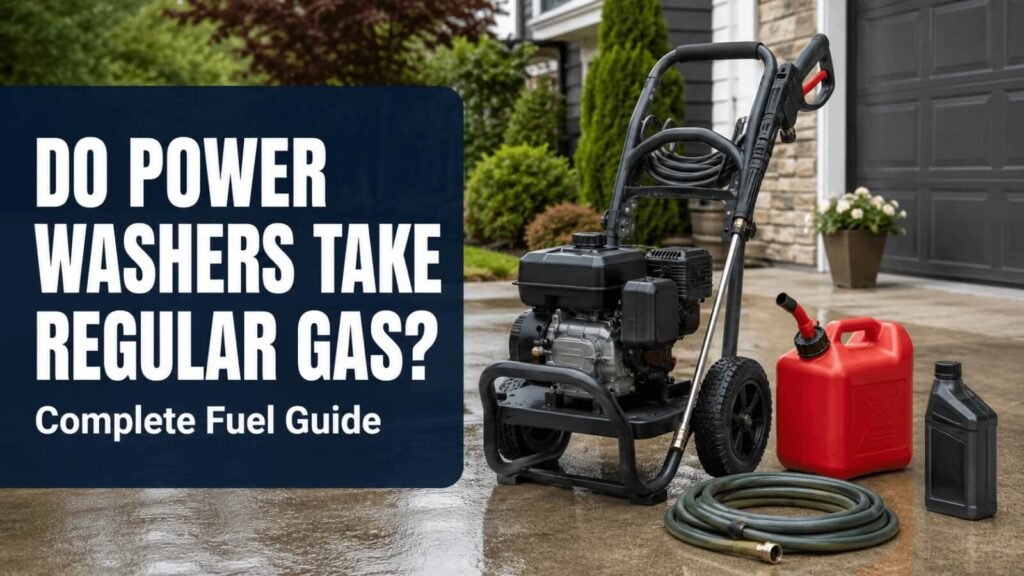
Do Power Washers Take Regular Gas? Complete Fuel Guide
Editorial note: This educational guide explains common small-engine fuel practices; it is not a substitute for the fuel label or owner’s manual for your exact engine. Fuel requirements were checked against official Honda and Briggs & Stratton guidance, and safety advice was checked against the CDC. You arrive at a gas station with an empty fuel container and suddenly face several choices: regular, mid-grade, premium, E15, or perhaps ethanol-free gasoline. Do power washers take regular gas, or does a small engine need something more expensive? For most residential gas pressure washers, the answer is yes. They normally use fresh regular unleaded gasoline. Many small engines require at least 87 AKI in the United States, roughly 91 RON in countries using the RON system. Up to 10% ethanol is often permitted, but the engine manual is the final authority. These common figures are supported by Briggs & Stratton’s small-engine fuel guidance Choosing the right fuel matters because a pressure washer may sit unused for weeks. Old or unsuitable gasoline can cause carburetor deposits, hard starting, and expensive repairs. This guide explains what to buy, what to avoid, whether to mix oil with gas, and how to refuel and store the machine safely. Do Power Washers Take Regular Gas or Premium Gas? Most gas-powered pressure washers are designed to run on regular unleaded gasoline. Unless the engine manufacturer specifies otherwise, premium fuel usually provides no useful advantage. Octane measures resistance to engine knocking; it does not make gasoline fresher or cleaner. A typical pressure-washer engine does not need the extra knock resistance of premium fuel. For many machines, the practical starting point is: Fresh, clean, unleaded gasoline At least 87 AKI in the United States About 91 RON where fuel is sold using the RON scale No more than 10% ethanol, unless the manual sets a different limit No oil mixed into the gasoline for a standard four-stroke engine The exact requirement can vary by engine, model, country, altitude, and fuel formulation. Check the pressure-washer manual, the separate engine manual, and any marking near the fuel cap before filling the tank. Is Premium Gas Better for a Pressure Washer? Premium gasoline is not a performance upgrade when an engine is designed for regular fuel. It normally will not increase PSI, GPM, cleaning speed, or pump life. Those results depend on the engine, pump, nozzle, water supply, and condition of the machine—not on paying for a higher octane than required. Using premium is generally unnecessary rather than automatically harmful. Fresh regular gasoline that meets the manual is usually better than old premium fuel that has sat for months. When Might a Different Grade Be Required? Some models have special instructions. High-altitude use may require an engine adjustment rather than a different gasoline grade. If the engine knocks, loses power, or becomes hard to start with correct fresh fuel, review the manual or contact an authorized service provider. Which Pressure Washers Need Gas? Only pressure washers powered by an internal-combustion engine need gasoline. Corded electric models use household electricity, while cordless units use rechargeable batteries. They still need water, but they do not have a gasoline tank. Gas pressure washers suit driveways, masonry, equipment, fences, and demanding outdoor jobs. They often offer higher flow and do not need a nearby outlet. If you are comparing power types, our guide to the best gas pressure washers explains where these machines make practical sense. Professional hot-water machines can be more complicated: one tank may feed the engine while a separate burner uses another approved fuel. Never fill a tank based only on its location or cap color. Understanding Octane, AKI, and RON Fuel labels can create confusion because not every country displays octane in the same way. AKI in the United States American pumps normally show the Anti-Knock Index, or AKI. Regular unleaded is commonly marked 87. RON in Other Countries Many other markets display Research Octane Number, or RON. Around 91 RON is broadly comparable to 87 AKI; the numbers differ because the testing systems differ. Why the Manual Still Matters In an unfamiliar country, read the local manual or ask an authorized dealer which pump grade meets the requirement. Regional guidance may differ for fuel blends and altitude. Can You Use Gasoline With Ethanol? Many small pressure-washer engines permit gasoline containing up to 10% ethanol, labeled E10. However, ethanol can attract moisture, especially during poor or lengthy storage. E10 Gasoline E10 contains up to 10% ethanol and is widely sold as regular gasoline. Use it only when the manual allows it, and keep it in a clean, sealed, approved container. Honda’s official fuel recommendations permit E10 in Honda engines but still direct owners to check the model’s manual. E15 and E85 E15 contains up to 15% ethanol, while E85 contains much more. They are unsuitable for most pressure-washer engines and can harm fuel-system parts. Do not choose them because the octane looks high or the price looks attractive. Ethanol-Free Gasoline Ethanol-free gasoline may help equipment used infrequently, but it costs more and is not required by every engine. It must still be fresh, the correct octane, and stored properly. It will not cure a dirty carburetor or poor maintenance. Do You Mix Oil With Gas for a Pressure Washer? Most modern gas pressure washers use a four-stroke engine. In this design, gasoline goes into the fuel tank and engine oil goes into a separate crankcase. Do not mix oil into the gasoline unless the manual clearly says the engine is a two-stroke design and provides a mixing ratio. Adding oil to the fuel of a four-stroke engine can cause smoke, spark-plug fouling, poor combustion, deposits, and engine damage. Running a four-stroke engine without enough oil can also cause severe internal damage. Check both fluids separately before operation. Engine Oil and Pump Oil Are Different A gas pressure washer may contain two separate oil systems: Engine oil lubricates the gasoline engine. Pump oil lubricates certain serviceable pressure-washer pumps. Check Whether the Pump Is Serviceable