
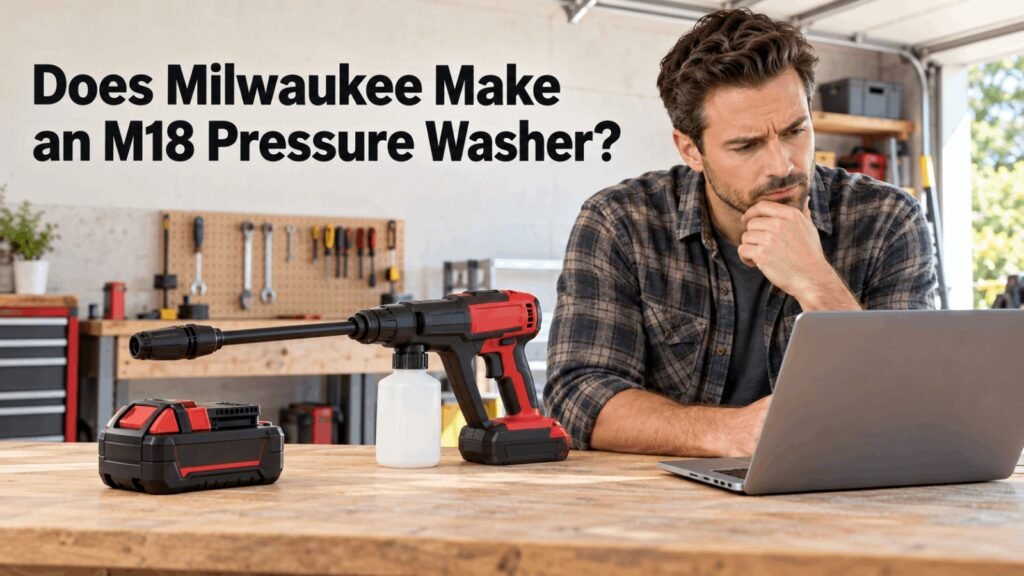
cordless pressure washer

Does Milwaukee make an M18 pressure washer? Milwaukee M18 cordless pressure washer search with battery and sprayer
Cordless Pressure Washers

Milwaukee M18 cordless pressure washer: Is One Available?

Searching for a Milwaukee M18 cordless pressure washer makes sense if you already own M18 batteries and want a washer without an extension cord. The key is to confirm that a product advertised under this search phrase is a pressure washer, rather than a sprayer or a third-party tool claiming battery compatibility. That distinction matters because some products advertised online as “M18 compatible” may be third-party tools or battery adapters, rather than Milwaukee-made washers. Milwaukee’s current M18 backpack sprayer listings are for applying liquids. A sprayer is not the same as a pressure washer, even when its product page gives a PSI figure. That is the key point when researching a Milwaukee M18 cordless pressure washer. This guide explains what to check before buying, how to tell a pressure washer from a sprayer, what a cordless washer can realistically do, and which type of alternative may fit your cleaning jobs. If you already use M18 tools, you’ll also find practical advice for avoiding battery compatibility and safety problems. Keep this in mind while you search for a Milwaukee M18 cordless pressure washer. Is There an Official Milwaukee M18 Cordless Pressure Washer? In the Milwaukee Tool U.S. catalog checked for this article, I found M18 sprayer products but no dedicated M18 pressure washer listing. Therefore, this guide does not assign PSI, GPM, runtime, nozzles, or a price to a Milwaukee M18 pressure washer. Catalogs and regional availability can change; check your country’s official Milwaukee site before buying. It is one more reason to verify any listing for a Milwaukee M18 cordless pressure washer. This is different from saying Milwaukee could never introduce one. Product ranges change, and availability can vary by country. Before buying, check the current official product listings in your region, along with the model number and manual. If a seller claims to offer a Milwaukee M18 washer, ask for the exact model number and verify that it appears in official product information. This matters whenever a seller advertises a Milwaukee M18 cordless pressure washer. Be especially careful with listings that use a familiar battery name but provide few details about the tool maker, warranty, pressure rating, or replacement parts. A battery connector that appears to fit is not proof that a product is genuine or safe to use with that battery. Use it as a checkpoint before you buy anything described as a Milwaukee M18 cordless pressure washer. Why the Product Name Can Be Confusing A product advertised for washing may be a pressure washer, a power cleaner, a pump, or a sprayer. These tools move water in different ways and are built for different jobs. A pressure washer sends water through a pump and nozzle to produce a directed spray. Its PSI rating describes pressure, while GPM describes flow. A garden sprayer may use a pump to dispense liquid, but it is designed to apply a spray or mist—not to clean surfaces with a pressure-washer jet. It helps explain why a Milwaukee M18 cordless pressure washer search can be confusing. Milwaukee currently lists M18 backpack sprayers, including the SWITCH TANK™ 4-Gallon Backpack Sprayer and the 4-Gallon Backpack Sprayer with SWITCH TANK™. Their product pages identify them as sprayers for liquid application. The former listing gives adjustable pressure up to 120 PSI; the latter gives up to 140 PSI and a flow rate of 0.1–0.52 GPM. Those figures do not make either product a pressure washer: follow its intended applications and manual. Do not attach a pressure-washer hose or nozzle to a sprayer. Remember it when comparing listings for a Milwaukee M18 cordless pressure washer. Look for a complete product specification sheet that clearly states maximum and working PSI, GPM, water temperature limits, battery requirements, included accessories, and operating instructions. If these details are missing, pause before ordering. What PSI and GPM Tell You PSI (pounds per square inch) measures pressure; GPM (gallons per minute) measures water flow. Both are useful when comparing pressure-washer specifications, but ratings alone do not predict results on every surface. Actual cleaning depends on the machine, nozzle, distance, surface, detergent, and technique. This detail separates a real Milwaukee M18 cordless pressure washer from a lookalike. Nozzle orifice and spray pattern affect the pressure and coverage delivered at the surface. More pressure is not automatically better: a concentrated spray can damage paint, wood, mortar, siding, vehicle trim, or seals. Use the machine manual and the surface maker’s guidance, begin with a wider pattern at a greater distance, and test a hidden area. Think about it before you order a so-called Milwaukee M18 cordless pressure washer. If you’re comparing cordless and full-size machines, consider both ratings alongside your surfaces and cleaning method. This beginner’s guide to PSI and GPM explains how to compare the two without relying on a single headline number. Do not infer a washer’s PSI or flow from another brand’s tool, battery voltage, or seller description; use the figures stated for the exact model. What a Cordless Pressure Washer Can Realistically Do Cordless washers and compact power cleaners are most useful when portability and quick setup matter more than long operating time or heavy cleaning capacity. Depending on their actual specifications, they may work for: Their limits often become clear on broad or heavily soiled surfaces. Washing a large driveway, removing stubborn buildup, or cleaning a commercial site may require more water flow and longer running time than a compact battery tool can provide. The job itself matters too. Rinsing off loose dirt is different from removing grease, algae, or old stains. A suitable detergent and dwell time may do more than increasing pressure. If a surface needs more force than the tool is designed to provide, use a more appropriate washer or cleaning method. That is why any Milwaukee M18 cordless pressure washer claim deserves a second look. Why a Cordless Washer Needs the Right Battery and Water Setup A cordless washer still needs a reliable water source. Some compact cleaners connect to a garden hose; others can draw from
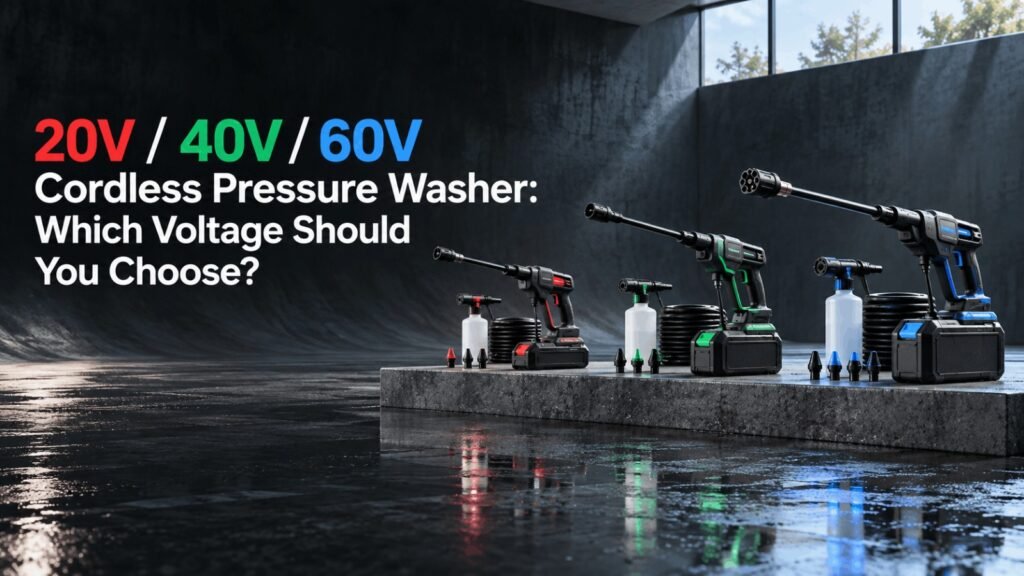
20V / 40V / 60V cordless pressure washer lineup showing three battery voltage options
Cordless Pressure Washers

20V / 40V / 60V cordless pressure washer: Which Voltage Should You Choose?

A 20V / 40V / 60V cordless pressure washer search can lead to an easy-to-make buying mistake: assuming that the highest voltage automatically means the best washer. Voltage tells you something about the battery system, but it does not tell you how much pressure or water flow the machine delivers, how long it will run, or whether it suits your cleaning jobs. A compact 20V power cleaner may be convenient for rinsing a car or outdoor furniture. A 40V or 60V label does not guarantee a particular level of cleaning performance. Current manufacturer examples include light-duty power cleaners as well as larger battery-powered pressure washers. Check the exact model, power setup, and published ratings. This guide explains how to compare the three voltage labels, what PSI and GPM mean, how to think about runtime and total cost, and which type of washer may fit different jobs. The goal is to help you choose by the work you need to do—not by the biggest number printed on a battery. What Does Voltage Mean on a Cordless Pressure Washer? Voltage describes the electrical potential of a battery system. In simple terms, it is one part of how the battery supplies power to the motor. It is not a direct measurement of cleaning strength. Voltage is one electrical specification, not a performance score. The pump, motor, flow rate, battery design, and tool controls also shape a washer’s output. DEWALT, for example, states that its 20V MAX battery has an 18V nominal voltage and that its 60V MAX system has a 54V nominal voltage. This is one brand’s naming convention; use the battery maker’s own documentation when comparing platforms. That is the key point when comparing any 20V / 40V / 60V cordless pressure washer. Battery labels and product configurations vary between brands. Compare the manufacturer’s stated voltage, battery count, capacity, and exact model details rather than treating “20V,” “40V,” and “60V” as universal performance classes. Compare PSI and GPM Before Comparing Voltage Two ratings matter more directly to cleaning than the battery voltage label: PSI affects how forcefully water hits a surface. GPM affects how much water is available to rinse away loosened dirt. A high PSI number alone does not guarantee fast cleaning, and high pressure can damage delicate materials if the nozzle is too narrow or held too close. Keep this in mind while you shop for a 20V / 40V / 60V cordless pressure washer. A headline PSI rating on its own does not show the whole picture. Compare pressure and flow on the same stated basis, then consider the surface, nozzle, water source, and cleaning method. This beginner’s guide to PSI and GPM explains the two ratings in more detail. It is one more reason a 20V / 40V / 60V cordless pressure washer should be judged by its full specifications. Before buying, check whether the listed PSI and GPM are maximum or working figures and how the manufacturer defines them. Compare the figures on the same basis whenever possible. 20V, 40V, and 60V: Compare Real Models, Not Just Labels The examples below show why voltage alone is not a reliable way to rank cordless pressure washers. They are manufacturer-listed U.S. products checked on September 29, 2026; product availability and specifications can change. “Power cleaner” is the manufacturer’s product name and may indicate a different intended duty level from a larger pressure washer. This matters whichever 20V / 40V / 60V cordless pressure washer you are considering. Platform label Manufacturer-listed example Published pressure and flow What the example tells you 20V MAX DEWALT DCPW550 power cleaner 550 PSI maximum Its listing identifies it as a power cleaner; check the manual for intended tasks. Two 20V MAX batteries DEWALT DCPW1600Y2 cordless pressure washer 1,600 PSI maximum; 1.2 GPM A “20V” search can include equipment designed around two batteries, so check the complete power arrangement. 40V RYOBI RY40HPPW12B pressure washer 1,200 PSI; 1.0 GPM in high mode; 900 PSI and 0.8 GPM in ECO mode One model’s output can change by operating mode; runtime and cleaning output may trade off. 60V MAX DEWALT DCPW1000 power cleaner 1,000 PSI maximum Its listing calls it a power cleaner; confirm intended tasks rather than assuming it is a full-size washer. The values above are the manufacturers’ stated ratings, not a direct performance test across brands. Model designs, nozzle conditions, test methods, and battery kits differ. Use the linked product page and manual for the exact configuration you are considering. What to expect from a 20V model The DEWALT DCPW550 is listed as a 20V MAX power cleaner with a 550 PSI maximum rating. Check its manual and stated applications before deciding which jobs it can handle. DEWALT also lists a separate cordless pressure washer kit powered by two 20V MAX batteries and rated at up to 1,600 PSI and 1.2 GPM. These examples show why “20V washer” is not a single product category. Use it as a checkpoint before choosing a 20V / 40V / 60V cordless pressure washer. What to expect from a 40V model The RYOBI RY40HPPW12B is listed at 1,200 PSI and 1.0 GPM in HIGH mode, or 900 PSI and 0.8 GPM in ECO mode. RYOBI states up to 40 minutes of runtime using a 40V 12Ah battery; the product page notes the battery is not included with the tool-only version. Treat runtime as tied to the specified battery and conditions, not as a promise for every cleaning session. It helps explain why no single 20V / 40V / 60V cordless pressure washer suits every household. What to expect from a 60V model DEWALT lists the DCPW1000 as a 60V MAX power cleaner with a maximum rating of 1,000 PSI. The listing calls it a power cleaner, so do not assume it is a full-size pressure washer. Check whether the manufacturer publishes a GPM rating, what battery is included, its operating modes, and the manual’s intended applications before deciding whether it fits your jobs. Apply this when you compare

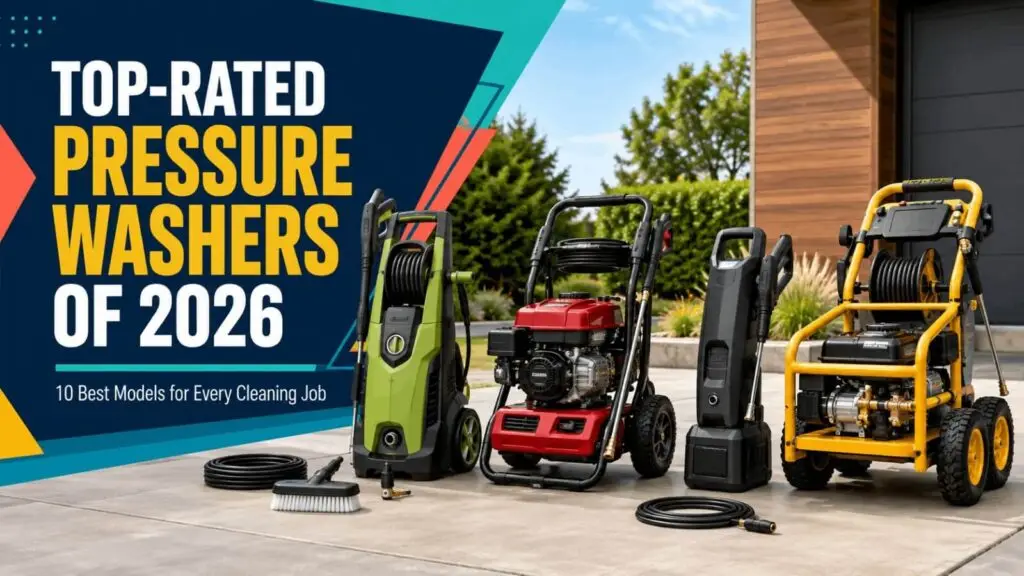
Top-rated pressure washers of 2026 graphic showing 10 best gas, electric, and cordless models.
PSI & GPM Guides

Top Rated Pressure Washers of 2026: 10 Models Compared

The top-rated pressure washers are not simply the machines with the highest PSI. A powerful gas washer may be ideal for a long concrete driveway but inconvenient for washing one car. A compact electric model is easier to start and store, while a cordless washer offers freedom from a power outlet at a higher purchase price. This guide compares ten pressure washers for different buyers and cleaning jobs. Our selections include corded electric, battery-powered and gas machines, from entry-level homeowner units to professional models with triplex pumps. Quick recommendation: Based on published specifications and task suitability, the Greenworks Pro GPW3002A is our best overall choice for most homeowners. Choose the Westinghouse WPX3400 when you need residential gas power, or the SIMPSON PowerShot PS3228 for frequent professional work. Top Rated Pressure Washers briefly Category Model Power source Published output Best use Best overall Greenworks Pro GPW3002A Corded electric 3,000 max PSI at 1.1 GPM Regular home cleaning Best residential gas Westinghouse WPX3400 Gas 3,400 PSI, 2.6 GPM Driveways and heavy dirt Best professional SIMPSON PowerShot PS3228 Gas 3,300 PSI, 2.5 GPM Contractors and frequent use Best cordless EGO HPW3204-2 Dual-battery 3,200 PSI at 1.2 GPM Portable cleaning Best easy-to-use electric RYOBI RY142500 Corded electric 2,500 PSI, 1.2 GPM General residential work Best high-flow electric Kärcher K5 FC Corded electric 2,000 max PSI; up to 2.0 GPM Large home-cleaning areas Best compact DEWALT DWPW2100 Corded electric 2,100 PSI, 1.2 GPM Small homes and storage spaces Best entry-level Sun Joe SPX3000 Corded electric 2,030 rated PSI, 1.2 rated GPM Cars, furniture and patios Best accessory system Generac Speed Wash 3200 Gas 3,200 PSI, 2.7 GPM Versatile outdoor cleaning Best heavy-duty Generac G0088730 Gas 4,200 PSI, 4.0 GPM Large and commercial jobs Published output figures come from the manufacturers. “Maximum” PSI and GPM may be measured under different operating conditions and may not occur together. How We Selected the Top-Rated Pressure Washers This is a research-based buying guide; we did not perform hands-on testing. We compared manufacturer specifications, pressure and flow, pump and motor design, hose length, nozzle selection, detergent delivery, portability, maintenance needs, warranty coverage and suitability for common cleaning jobs. Manufacturer product pages were verified on August 20, 2026. Category winners are editorial recommendations based on their intended use, not laboratory rankings. Prices, stock, specifications and included accessories can change, so confirm the exact model, package and warranty before ordering. 1. Greenworks Pro GPW3002A — Best Overall Pressure Washer The Greenworks Pro GPW3002A is our best overall choice for homeowners who want strong cleaning without gasoline maintenance. Its brushless motor supplies up to 3,000 PSI at 1.1 GPM, while its high-flow mode reaches 2.0 GPM at 100 PSI. Those figures should not be combined as one operating point. The package includes a 25-foot kink-resistant hose, 35-foot GFCI power cord and five nozzles: 15°, 25°, 40°, soap and turbo. Ten-inch wheels make the open-frame machine easier to move, and vertical storage reduces its garage footprint. Pros Strong performance for a residential electric washer Brushless motor with automatic pressure and flow adjustment Five useful nozzles and long power cord Ten-year motor and three-year tool warranty stated by Greenworks Cons Bulkier than compact electric machines Maximum PSI and maximum flow do not occur together 2. Westinghouse WPX3400 — Best Residential Gas Pressure Washer The Westinghouse WPX3400 delivers 3,400 PSI and 2.6 GPM from a 212cc four-stroke engine. That output is well suited to concrete, brick, fences, siding and other demanding residential jobs. It includes a 25-foot hose, five quick-connect tips and a 0.5-gallon detergent tank. The steel frame and 12-inch never-flat wheels are practical for uneven outdoor surfaces. Its axial-cam pump needs less attention than a serviceable triplex design, although it is aimed more at homeowner use than daily contracting. Pros High cleaning output at a competitive gas-machine level Five nozzle tips and large onboard soap tank Strong wheels and steel frame Cons Recoil starting and normal gas-engine maintenance Manufacturer lists this version as not CARB compliant 3. SIMPSON PowerShot PS3228 — Best for Professionals The SIMPSON PowerShot PS3228 is designed for contractors and serious users. Its Honda GX200 engine powers an AAA triplex pump at 3,300 PSI and 2.5 GPM. Unlike a basic residential axial pump, the triplex design is intended for more demanding and frequent work. The package provides a 25-foot MorFlex hose, five nozzles, welded steel frame and 10-inch pneumatic tires. At 77 pounds, it is not lightweight, but its build is better matched to deck restoration, paint preparation and repeated property cleaning. Pros Honda GX200 engine and serviceable triplex pump Flexible, abrasion-resistant MorFlex hose Commercial warranty coverage on engine, pump and frame Cons Heavy and more expensive than homeowner models This PS3228 version is not sold in California 4. EGO HPW3204-2 — Best Cordless Pressure Washer The EGO POWER+ HPW3204-2 removes the need for both fuel and a wall outlet. Two included 56V 6.0Ah batteries provide up to 3,200 PSI at 1.2 GPM, with a maximum-flow mode of up to 2.0 GPM. EGO states a runtime of up to 60 minutes, although actual runtime depends on the selected mode and workload. The washer can use a garden hose or draw clean water through its included siphon hose. ECO, High and Turbo modes are selected through the wand display. A foam cannon, five nozzles and 25-foot hose are included. Pros True cordless operation with strong peak pressure Can draw from a clean portable water source Good accessory package and five-year tool warranty Cons Much more expensive than most corded machines Runtime and maximum output depend on battery charge 5. RYOBI RY142500 — Best Easy-to-Use Electric Model The RYOBI RY142500 is a sensible middle-ground choice for decks, fences, siding, sidewalks and small driveways. Its brushless electric motor produces 2,500 PSI at 1.2 GPM without the starting, fuel and oil requirements of a gas engine. It has a 25-foot hose, metal wand, onboard soap tank and 12-inch flat-free wheels. The machine stores its hose, wand, cord and nozzles onboard, which helps reduce setup

Scroll to Top