
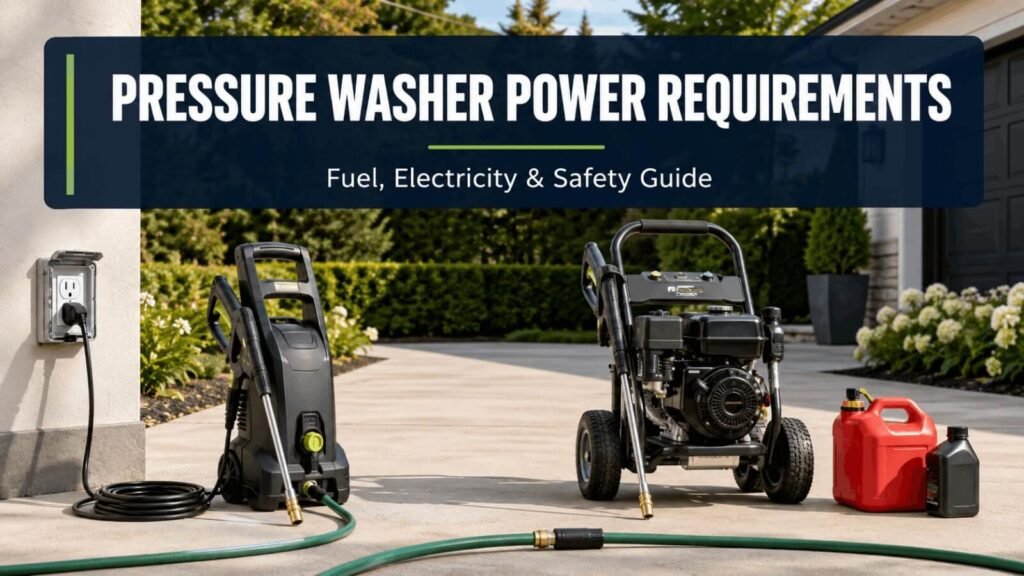
Pressure Washer Power Requirements: Fuel, Electricity, and Safety Guide
A pressure washer needs the right power source before it needs a good nozzle. An electric model needs a 120-volt outlet on a 15-amp circuit that has GFCI protection. A gas model needs fresh 87-octane unleaded petrol with no more than 10% ethanol, plus separate engine oil. A battery model needs a charged pack and enough water flow. This guide covers pressure washer power requirements for all three types. You will get the numbers, the limits and the safety rules. We also say plainly where the sources disagree. Why you can trust this guide We did not test these machines. Every figure comes from maker manuals, spec sheets, dealer listings and safety agencies. We name each source in the text. Source order: maker manuals first, then safety agencies such as the CDC and CPSC, then dealer listings. Forum posts were used only to spot questions, never as proof. Limits: We could not open the full electrical code text. The circuit math below is standard arithmetic, and we mark it as ours. Always read your own manual and ask a licensed electrician about your wiring. Last checked: 7 November 2026. Pressure Washer Power Requirements at a Glance Start here if you only want the short answer. The table compares the three power types. Type Power source Key number Biggest risk Electric 120 V outlet, GFCI protected About 11 to 15 amps on most labels Tripped breakers, thin extension cords Gas Petrol plus 4-stroke engine oil 87 octane, E10 or less Stale fuel, carbon monoxide Battery Lithium pack (Ryobi uses 40V) Runtime depends on pack size Short run time, low flow Amp ranges vary by model. Read the rating label on your own unit before you plug anything in. Electricity Requirements for Electric Pressure Washers Electric pressure washers sold for home use run on standard household power. That means 120 volts in the United States. You do not need a special plug for most of them. Three numbers matter. They are volts, amps and watts. They are linked by one formula: watts = volts x amps. Voltage Must Match the Machine A US home outlet gives 120 volts. Most consumer electric washers are built for exactly that. A few heavy units want 240 volts, and those need a different outlet. The label on the motor or the manual will tell you. Never adapt a plug to force a fit. A wrong voltage can burn out the motor. Amps Tell You the Circuit Load Amps show how much current the motor pulls. Most home washers list somewhere between 11 and 15 amps. Check your label, because lighter models draw less. A standard bedroom or garage circuit is often 15 amps. A 20-amp circuit exists in many garages and kitchens. Your breaker panel shows which one you have. Here is the math, and it is our own arithmetic. A 15-amp circuit at 120 volts can deliver 1,800 watts. Many electricians size a long-running load to about 80% of that. That gives 1,440 watts, or 12 amps, for work that runs for hours. So a 13-amp washer on a 15-amp circuit may trip if anything else is running on it. A freezer, a shop light or a second tool is enough. Watts Help With Generator Planning Watts matter most when a generator is involved. An 11-amp washer pulls about 1,320 watts. A 15-amp washer pulls about 1,800 watts. Motors need a bigger jolt to start than to run. We cover that in the generator section below. Do Electric Pressure Washers Need a Dedicated Circuit? Not by law for a portable unit, but it helps. A dedicated circuit means nothing else shares the breaker. That removes the most common cause of nuisance trips. If you cannot do that, make sure the washer is the only load on that circuit while you work. Unplug the garage freezer only if you can check it again within a few hours. Frozen food is not worth a tripped breaker. GFCI and Outdoor Electrical Safety Water and electricity are a bad mix. A GFCI is a device that cuts power in a fraction of a second when current leaks to ground. That can prevent a shock. The National Electrical Code requires GFCI protection on outdoor 125-volt, 15- and 20-amp outlets at homes. Check your local code for exceptions. Many electric pressure washers also ship with a GFCI plug on the cord. Can You Use an Extension Cord With a Pressure Washer? Yes, but the cord is where many people go wrong. A thin cord drops voltage. The motor then runs hot and can burn out. Makers do not agree on the limits, so your manual wins. The table shows what the ones we found say. Source Gauge Length rule Sun Joe support page 14 AWG or heavier 25 ft max extension; combined with the built-in cord, no more than 60 ft Wen PW21 manual 14 AWG recommended No extension over 25 ft (washer has a 36 ft cord) Simoniz S1700 manual 14 AWG 50 ft maximum Chicago Electric chart (12 to 16 A load) 12 AWG minimum at 50 ft Never use 16 or 18 gauge Lower AWG numbers mean thicker wire. A 12-gauge cord is thicker than a 14-gauge one. Our takeaway is simple. Buy a 12-gauge, outdoor-rated cord and keep it as short as you can. Never go past the length in your manual, whatever the gauge. Uncoil the whole cord, because a coiled cord traps heat. Can You Run an Electric Pressure Washer on a Generator? Yes, if the generator is big enough. Size it to the starting watts, not the running watts. A motor can pull much more current for the first moment. Sizing guides we checked say the surge is roughly 1.5 to 2.5 times the running wattage. They commonly use a 2x multiplier. At 1,800 running watts, that is about 3,600 starting watts. One guide lists compact units rated 1,500 to 1,800 running watts with 3,000 to 3,600 surge. One rule of thumb in