
How to pressure wash a deck without damaging it
You can pressure wash a deck without damaging it if you match the pressure to the wood, use a wide fan tip, and keep the wand moving with the grain. Most softwood decks need only 500 to 600 PSI. Pressure-treated boards take 800 to 1,200 PSI, and dense hardwoods take 1,000 to 1,500 PSI. Start at the low end of the range for your boards, test a hidden corner, and raise the pressure only if the dirt stays put. A deck is not a driveway. Concrete forgives a hard jet. Wood does not. A narrow tip held too close cuts lines into soft boards, lifts the fibres into a fuzzy surface, and leaves lap marks that only show up once the boards dry.

What PSI do you need for a deck?
The right PSI depends on the boards. Softwood is the most common deck material in the United States, and it is also the easiest to damage. Start low and test. The table below gives the ranges that deck and contractor guides agree on.
| Board type | PSI range | Notes |
|---|---|---|
| Cedar, pine, redwood, sound boards | 500 to 600 | Wide fan tip, slow pass with the grain |
| Pressure-treated softwood | 800 to 1,200 | Start near 800, raise only if soil stays |
| Hardwood such as ipe, tigerwood, cumaru | 1,000 to 1,500 | Short strokes, do not linger at edges |
| Composite decking | 1,500 max | Fan tip, spray along the grain, check the maker first |
Sources do not agree on one PSI number for pressure-treated lumber. One deck guide lists 800 to 1,200 PSI, and a second guide lists up to 1,200 to 1,500 PSI for pressure-treated boards. Trust the lower range first. Start at 800 PSI and move up in small steps only if the grime holds on.
Cleaning units give you one number to compare machines: cleaning units = PSI x GPM. GPM is gallons per minute, and it does the rinsing while PSI does the cutting. A unit that delivers 1.8 to 2.4 GPM clears lifted dirt so you do not feel tempted to crank the PSI. A small electric washer rated near 1,450 PSI and 1.76 GPM, such as the Sun Joe SPX3000, gives about 2,550 cleaning units at its rated pressure. That is enough for a softwood deck when the tip and distance are right. Check the rated pressure in the manual, not the max pressure on the box. Rated pressure is the working pressure. Max pressure is a short peak figure.

Which nozzle should you use on a deck?
Fit a wide fan tip. A 25 degree green tip or a 40 degree white tip spreads the spray so the force lands soft on the boards. The 40 degree white tip is the gentle choice for softwoods, railings and spindles. The 25 degree green tip adds bite for dense wood or stubborn grime. Keep the spray moving at all times, and never let the tip sit in one spot.
Never use the red 0 degree tip or the yellow 15 degree tip on a deck. Their concentrated spray will gouge wood almost at once, and the damage is hard to sand out. If your washer came with a turbo or rotary nozzle, keep it in the box for this job. It spins a 0 degree jet in a circle, and that is too harsh for boards.
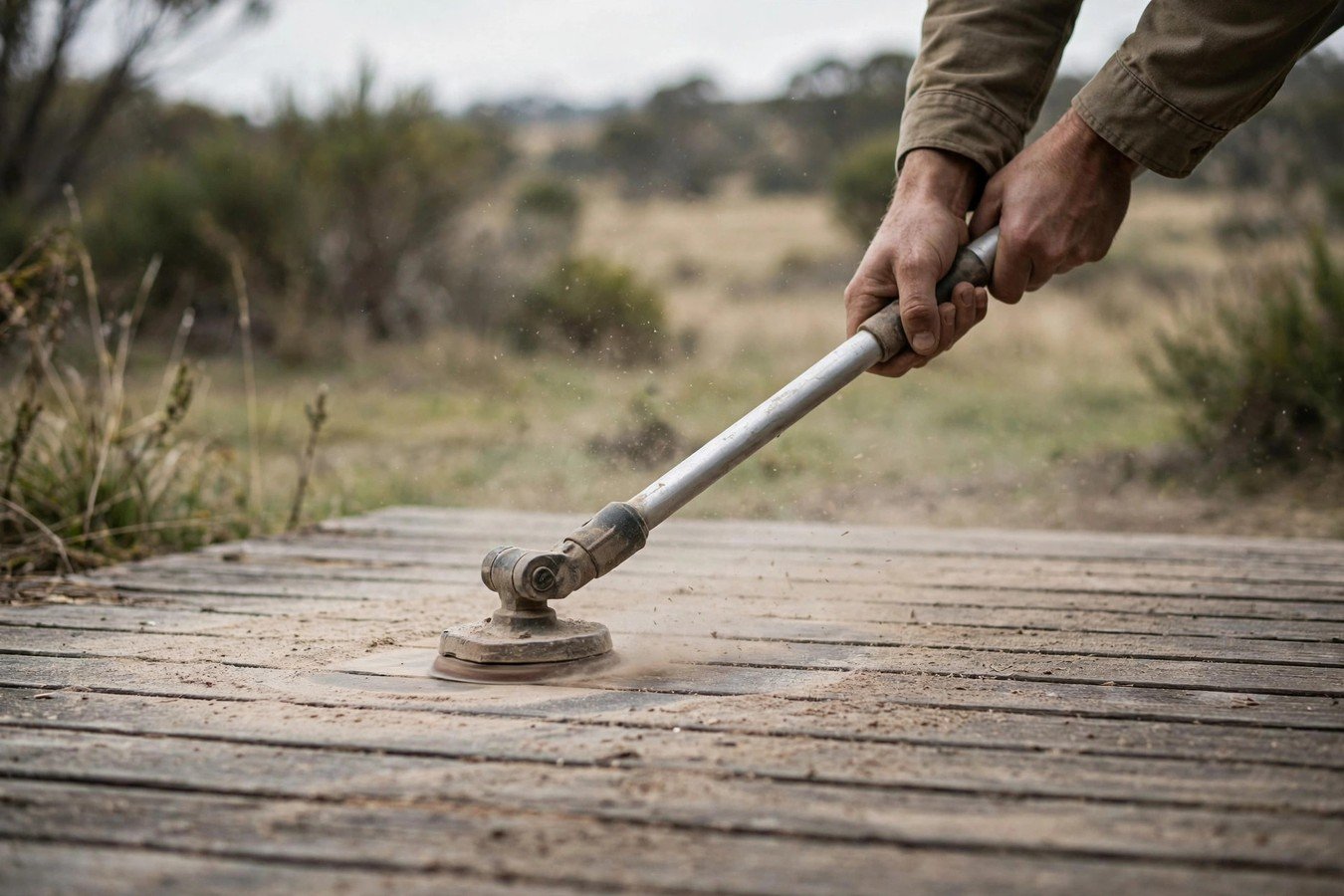
A rotary surface cleaner attachment is a different story. It holds two nozzles under a round cover and spreads the pressure evenly, which helps avoid the stripes that a hand wand can leave. It suits large, flat deck areas. It does not suit stairs, railings, or boards with gaps, where the wand still does the work. If you use one, keep it moving at the same slow pace and do not press it down onto the boards.
How to tell what your deck is made of
Look at the boards before you pick a PSI. Cedar and redwood are light, soft, and easy to dent with a fingernail. Pine is pale with clear grain and knots. Pressure-treated lumber is often greenish or brownish when new, and it feels harder than cedar. Hardwood boards such as ipe are dark, dense, and heavy, with a tight grain. Composite boards have a uniform colour and a plastic feel, with no grain you can dent. For composite, the maker matters more than the look, since Trex and TimberTech publish different limits. Check the care page for your line before you start.
Check the deck for damage before you wash it. Look for loose boards, popped nails or screws, cracked boards, and soft spots that sink under your foot. A soft spot means rot, and a pressure washer will tear rotted wood apart. Fix loose fasteners first and replace any board that feels soft.
What you need before you start
Gather the gear first so you are not hunting for it with a wet deck half done.
- A pressure washer you can turn down to 500 PSI, gas or electric, with a 25 degree and a 40 degree tip
- A deck cleaner or wood cleaner made for decks, plus a brightener if the boards are grey
- A stiff broom, a garden hose, and a bucket
- Safety glasses, closed shoes, gloves, and long sleeves
- Plastic sheeting for plants, outdoor furniture, and the house wall near the deck
- A screwdriver or drill for popped fasteners, and spare screws
Pick a mild, dry day with no wind if you can. Wind blows spray back at you and dries cleaner unevenly. Avoid washing in strong sun, which dries the cleaner before it has time to work. Clear the deck of furniture, planters, grills, and toys, and sweep it clean before you wet anything. Cover plants and the house wall next to the deck, wet the plants with a hose before you start, and rinse them again after you finish.
How to pressure wash a deck, step by step
Step 1: Inspect the deck and fix fasteners
Walk every board. Mark soft spots with chalk. Tighten or replace popped screws and nails. If a board moves when you step on it, fix it now. Water forced under a loose board lifts it further and drives dirt into the gap.
Step 2: Sweep and pre-wet the boards
Sweep the whole deck, including the gaps between boards. Then wet the boards with a garden hose. Pre-wetting stops the wood from drinking the cleaner unevenly. Work in sections you can finish in about 10 minutes, so nothing dries out mid-wash.
Step 3: Apply deck cleaner and let it sit
Apply the deck cleaner with a pump sprayer or the soap tip on your washer, following the label for dilution. Deck cleaners break down mildew, grease, and tannin marks so the pressure does not have to. Give it the dwell time on the label, usually 5 to 10 minutes. Do not let it dry on the boards. Scrub heavy black spots with a stiff brush while the cleaner sits. Use a cleaner made for decks, not a general house wash or a bleach mix. Bleach can harm wood fibres and kill plants, and you should never mix bleach with other cleaners.
Step 4: Test a hidden corner
Fit the 40 degree white tip, set the washer to the low end of the range for your boards, and test a corner that stays hidden under furniture. Hold the tip about 18 inches from the boards to start. Pull the trigger while the wand is already moving. If the surface stays smooth and the dirt lifts, that setting is right. If fibres lift or the wood looks fuzzy, back away, widen the fan, or drop the PSI. Test again before you touch the open deck.
Step 5: Wash with the grain, one board at a time
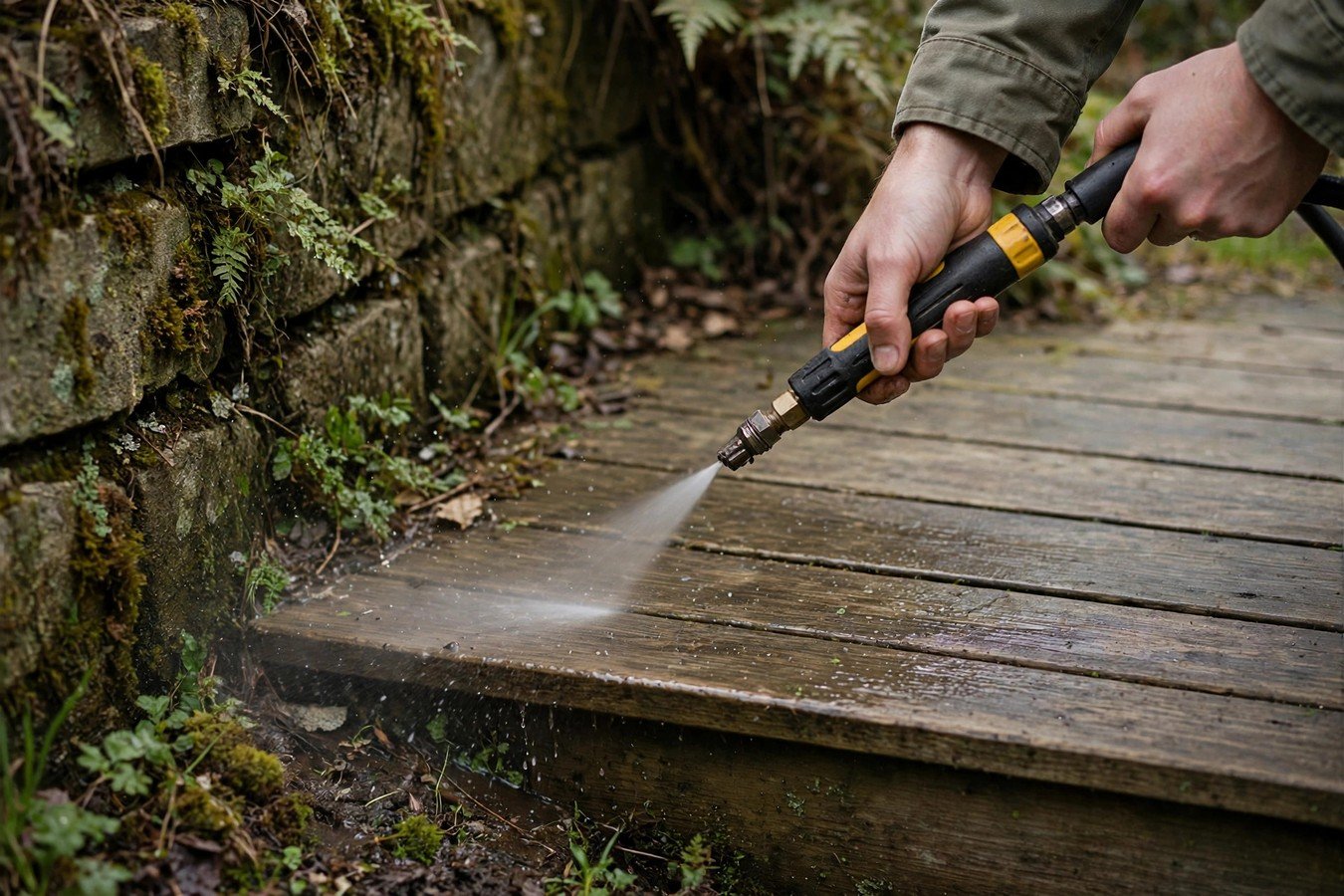
Work along the length of one board at a time, moving with the grain, never across it. Spraying across the grain cuts the fibres and leaves a rough, fuzzy texture. Hold the wand about 12 to 18 inches from the boards. Sources differ here. Decks.com advises starting about 18 inches back and never coming closer than 12 inches. A second deck guide advises 8 to 12 inches. Trust the more careful number on softwood, and never go closer than 12 inches on cedar, pine, or redwood.
Move at a slow walk, about one foot per second, and overlap each pass by about a third so you do not leave stripes. Keep the wand level and steady. Never let the nozzle linger in one spot, even on a stubborn stain. A parked jet cuts wood fast. If a stain will not lift, stop, apply more cleaner, scrub it, and rinse again at the same low setting. Wash the railings and spindles last, at the lowest setting, with the 40 degree tip. They are thinner than the floor boards and they fur faster.

Step 6: Rinse at low pressure
Rinse the whole deck at low pressure, board by board, with the 40 degree tip. Rinse until the water runs clear and no cleaner foam sits in the gaps. Leftover cleaner dries into a white film and can stop stain or sealer from sticking later. Rinse the house wall, plants, and furniture you covered as well.
Step 7: Let the deck dry, then sand and seal
Washing almost always raises the wood fibres a little, even at the right PSI. Give the deck at least 48 hours to dry. In damp or shaded spots, wait longer. Test dryness by sprinkling a few drops of water on a board. If the water soaks in within a few minutes, the wood is dry enough to sand and seal. If it beads or sits on top, wait another day.
Sand the dry deck lightly with 80 grit paper to smooth the raised fibres. Sweep and blow the dust off after sanding. Then seal or stain the deck within 2 to 4 weeks of washing. An unsealed deck after cleaning absorbs water and rots faster than a deck that was never washed at all.
How to pressure wash composite decking
Composite decking follows different rules from wood, and the maker page is the authority. TimberTech advises a fan tip, a limit of 1,500 PSI, and the spray along the grain. Trex allows a fan tip at no more than 3,100 PSI and no closer than 8 inches on its newer Transcend, Enhance, and Select boards, and it does not recommend pressure washing its early generation boards at all.
That Trex number looks high next to the 1,500 PSI limit for other composite. It is a maximum for specific lines, not a starting point. Start at 1,000 to 1,500 PSI with a fan tip, hold it at least 8 inches off the surface, and raise it only if the maker page for your line says so and the dirt stays put. Never use a 0 degree or 15 degree tip on composite. It can cut the cap layer and leave a permanent mark. Wash board by board, rinse well, and check the warranty page before you start. A wash that breaks the maker guidance can void a warranty.
Mistakes that damage a deck
Most deck damage comes from five mistakes, and all five are easy to avoid.
Too much PSI. The number on the box is a peak, not a setting. A 3,000 PSI washer turned all the way up will fur softwood in one pass. Start at the low end for your boards and test first.
The wrong tip. The red 0 degree tip and the yellow 15 degree tip are for concrete and brick, not wood. A 25 degree or 40 degree tip is the only choice on a deck.
Holding the tip too close. Closer is not cleaner. It is stronger, and stronger cuts wood. Stay at least 12 inches back on softwood.
Spraying across the grain. Water driven across the grain lifts fibres and leaves a fuzzy surface that needs sanding. Always move with the grain.
Letting the wand sit still. A parked jet etches a line in seconds. Keep the wand moving, and pull the trigger only while it is already in motion.
Other mistakes are smaller but still common. Washing in strong sun lets cleaner dry into patches. Skipping the cleaner means you lean on pressure instead of chemistry, which is how boards get furred. Forgetting to rinse leaves a film that stops sealer from sticking. And washing a deck with loose boards or rot spreads the damage further.
How long does it take to pressure wash a deck?
A small deck of about 200 square feet takes about 1 to 2 hours to wash, including setup, cleaner dwell time, and rinsing. A large deck of 400 to 500 square feet takes about 2 to 4 hours. Drying adds at least 48 hours before sanding and sealing. The whole job, wash to sealed deck, spans about 3 to 4 days with drying time in the middle.
The wash itself is the fast part. Prep takes longer than people expect: clearing furniture, fixing fasteners, covering plants, and applying cleaner. Do not rush the prep. It is what keeps the wash from turning into a repair job.
How much does it cost to pressure wash a deck?
Hiring a pro to wash a deck costs about $0.50 to $1.50 per square foot in most United States markets, so a 300 square foot deck runs about $150 to $450. Prices vary with the deck size, the amount of mildew, and whether sanding and sealing are included. Doing it yourself costs the price of a deck cleaner, about $15 to $30, plus the washer. A small electric washer costs about $100 to $200 to buy or about $40 to $70 a day to rent. If you already own a washer, the wash costs little more than cleaner and water.
When not to pressure wash a deck
Some decks should not be pressure washed at all. Skip the washer and wash by hand if any of these apply.
- The boards are old, grey, and already splintering. Pressure will lift more splinters.
- The deck is painted and the paint is peeling. A washer strips loose paint and leaves a patchy surface.
- The maker page says not to pressure wash your composite line.
- The boards feel soft or spongy underfoot. That is rot, and water will tear it apart.
- The deck is new pressure-treated lumber that is still wet from the yard. Let it dry for a few months first, then wash it.
For these decks, the hand wash method works well: sweep, wet, apply deck cleaner, scrub with a stiff brush, and rinse with a garden hose. It takes longer, but it cleans without cutting the wood.
Questions people ask
What PSI is safe for a wood deck?
For softwoods such as cedar, pine, and redwood, 500 to 600 PSI is safe. Pressure-treated boards take 800 to 1,200 PSI, and dense hardwoods take 1,000 to 1,500 PSI. Start at the low end, test a hidden corner, and raise the pressure only if the dirt stays.
What tip do I need to pressure wash a deck?
Use a 25 degree green tip or a 40 degree white tip. The 40 degree tip is the gentle choice for softwoods and railings. Never use the red 0 degree tip or the yellow 15 degree tip on wood.
Will pressure washing damage my deck?
It will if the pressure is too high, the tip is too narrow, the wand is too close, or the spray runs across the grain. It will not if you match the PSI to the boards, use a wide fan tip, keep the tip at least 12 inches back, move with the grain, and keep the wand moving. Test a hidden corner first.
How long should a deck dry before sealing?
Wait at least 48 hours after washing, longer in shade or damp weather. Sprinkle water on a board to test. If it soaks in within a few minutes, the deck is dry enough to sand and seal. Seal within 2 to 4 weeks of washing so the clean wood does not soak up rain.
Can I pressure wash a composite deck?
Check the maker page first. TimberTech allows up to 1,500 PSI with a fan tip along the grain. Trex allows a fan tip up to 3,100 PSI and no closer than 8 inches on Transcend, Enhance, and Select boards, and does not recommend pressure washing early generation boards at all. Start low, use a fan tip, and never use a 0 degree or 15 degree tip on composite.
Should I use soap or just water?
Use a deck cleaner. It breaks down mildew, grease, and tannin marks so the pressure does not have to. Apply it, let it sit for the dwell time on the label, scrub heavy spots, and rinse at low pressure. Water alone leaves grime in the grain and tempts you to raise the PSI.
This guide was built from deck maker guidance and contractor guides first, then from retailer pages. TimberTech and Trex care pages were checked for composite limits, and Decks.com was checked for nozzle distance. Where sources disagree on a number, this guide shows both numbers and says which one to trust. We did not test these machines on a deck for this guide, and we did not test the cleaners named here. Last checked: 19 November 2026.