Pressure Washer Accessories

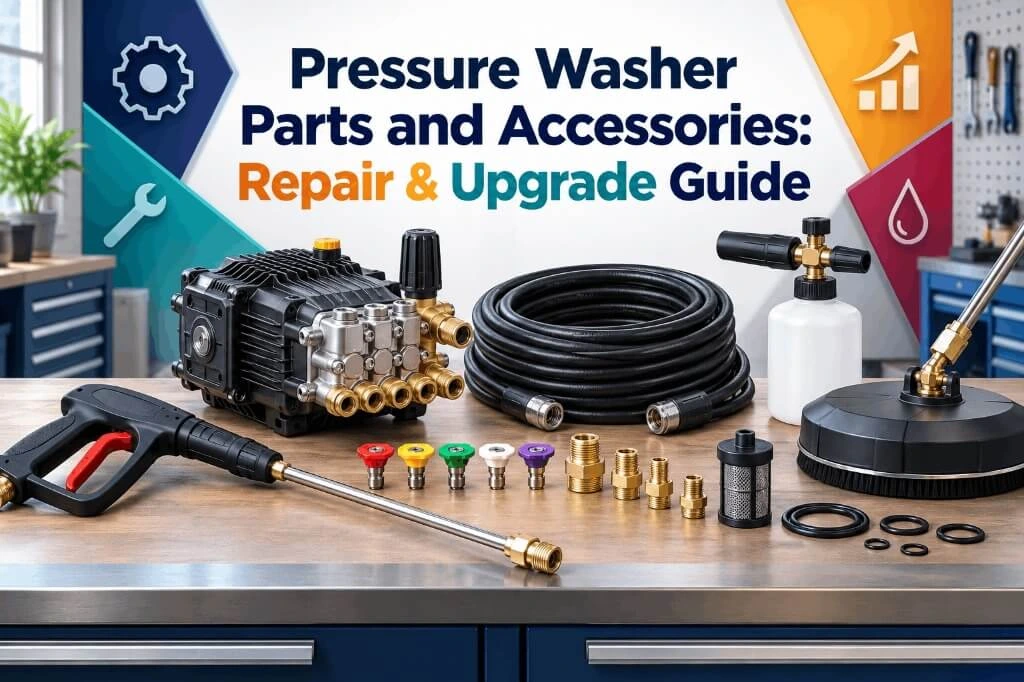
Pressure washer parts and accessories including a replacement pump, spray gun, nozzles, hose, foam cannon, and surface cleaner on a workbench for repair and upgrade.
Maintenance Guides

Pressure Washer Parts and Accessories: Repair & Upgrade Guide

A weak spray can send you shopping for a new pump when the real problem is a worn nozzle. A dripping connection can lead to a replacement hose when only the correct seal is needed. Buying before identifying the fault makes pressure washer ownership more expensive than necessary. Quick answer: Buy pressure washer parts and accessories only after identifying the complete machine model and the job the component must perform. For replacement parts, confirm the part number and revision. For external accessories, check the working PSI, GPM requirement, temperature limit, connector dimensions, and intended surface. This guide covers safe first checks, compatibility requirements, common replacement components, and useful upgrades. It is designed for homeowners maintaining an occasional-use washer and small businesses keeping equipment ready for work. The guidance is based on manufacturer information and recognized safety sources; it does not claim hands-on product testing. Pressure Washer Parts and Accessories: What Is the Difference? A replacement part restores an existing function. An accessory changes how you use the machine or expands the jobs it can handle. The distinction is not always strict. A hose replaces a failed component, while a more manageable approved hose can also improve reach and handling. What matters is knowing your reason for buying. Component or accessory Main purpose Typical buying reason Inlet screen and supply fittings Bring clean water into the machine Missing screen, damaged fitting, or supply connection problem Pump and internal seals Produce and contain pressurized flow Confirmed mechanical fault High-pressure hose Carry pressurized water to the gun Damage, leakage, or unsuitable reach Spray gun and wand Control and direct water Trigger fault, damaged connection, or handling need Nozzle tips Shape the spray and provide the specified outlet opening Wear, blockage damage, or another approved spray pattern Detergent pickup components Draw and deliver cleaning solution Split tube, blocked filter, or confirmed injector fault Surface cleaner or foam cannon Adapt the washer to a specific cleaning task More suitable coverage or detergent application Compatibility Checklist Before You Buy Use this checklist for every purchase instead of relying on appearance or a “universal fit” claim: Complete pressure washer model, revision, and serial range Exact current or superseded part number Maximum working pressure—not merely burst pressure Required water flow in GPM or L/min Cold-water or hot-water temperature rating Connector type, thread, insert, plug, socket, and sealing method Package contents, required adapters, and replacement seals Intended surface, detergent, and duty level Start with the original equipment in safe working order. Optional attachments should come after damaged hoses, faulty triggers, and unreliable water connections are addressed. Pressure Washer Replacement Parts: Identify Before Ordering Record the complete machine model Find the washer’s identification label and record the model, revision, and serial number where available. Take a photograph so you can check the information while shopping. A gas engine may have a separate model identification. That helps with engine parts, but it does not automatically identify the pump, gun, or hose supplied by the equipment maker. Use the illustrated parts list for the complete machine. It shows how assemblies relate and helps distinguish a small seal from a complete fitting or manifold. Match the diagram number to the orderable part A number beside an item in a diagram may be only its position in the drawing. Find the corresponding entry in the parts table to obtain the actual part number. Check any serial-number or revision restrictions. If an old part has been replaced by a newer number, ask the supplier to confirm the change against your model. Before ordering, also check what the package includes. A bare assembly may exclude seals, bolts, adapters, or other components shown nearby in the illustration. Inspect previous modifications Used equipment may have a replacement pump or aftermarket gun. Compare the actual assembly with the original diagram before relying on factory specifications alone. Keep photographs of both ends of a hose or fitting. A clear view of the sealing surface is often more useful to a supplier than a distant photograph of the whole washer. Diagnose the Symptom Before Buying a Part A symptom points to possible causes; it does not establish which component has failed. Begin with checks allowed by the operator’s manual, with the machine safely stopped whenever you inspect or disconnect anything. Symptom Beginner-safe first check When to seek help Weak or uneven spray Supply flow, hose kinks, inlet screen, and correct nozzle Problem remains after approved basic checks Leak at an external joint Correct connection and accessible seal condition Cracked housing, damaged threads, or uncertain sealing dimensions Detergent will not draw Required soap mode, pickup tube, and detergent filter Suspected internal injector fault Electric washer will not start Approved outlet and startup/reset checks in the manual Repeated tripping, damaged wiring, or burning smell Gun does not stop water correctly Stop using it Suspected trigger or valve fault Do not keep operating a pulsing or leaking machine while trying unrelated accessories. Write down when the fault occurs: only with one nozzle, only during detergent use, or with every approved attachment. That detail helps narrow the next check. Avoid adjusting a pressure regulator to disguise poor output. A worn tip or water-supply issue needs its own correction; turning a control without the proper procedure can create another problem. Pressure Washer Hose and Fittings The supply hose and high-pressure hose work on opposite sides of the pump. Their fittings are not interchangeable merely because an adapter can join them. Check pressure, temperature, and hose ends A replacement high-pressure hose must be rated for the washer’s specified maximum pressure and water temperature. Use the working-pressure rating, not a higher burst-pressure claim. For threaded connections, confirm the thread and sealing dimensions. M22 fittings can use different internal insert sizes even when the outer threads look similar. For quick connections, match the plug, socket, nominal size, profile, and intended location. Measure carefully or ask the manufacturer or supplier to verify the connection. A 3/4-inch garden-hose fitting belongs on the supply side. Do not place ordinary garden-hose couplers
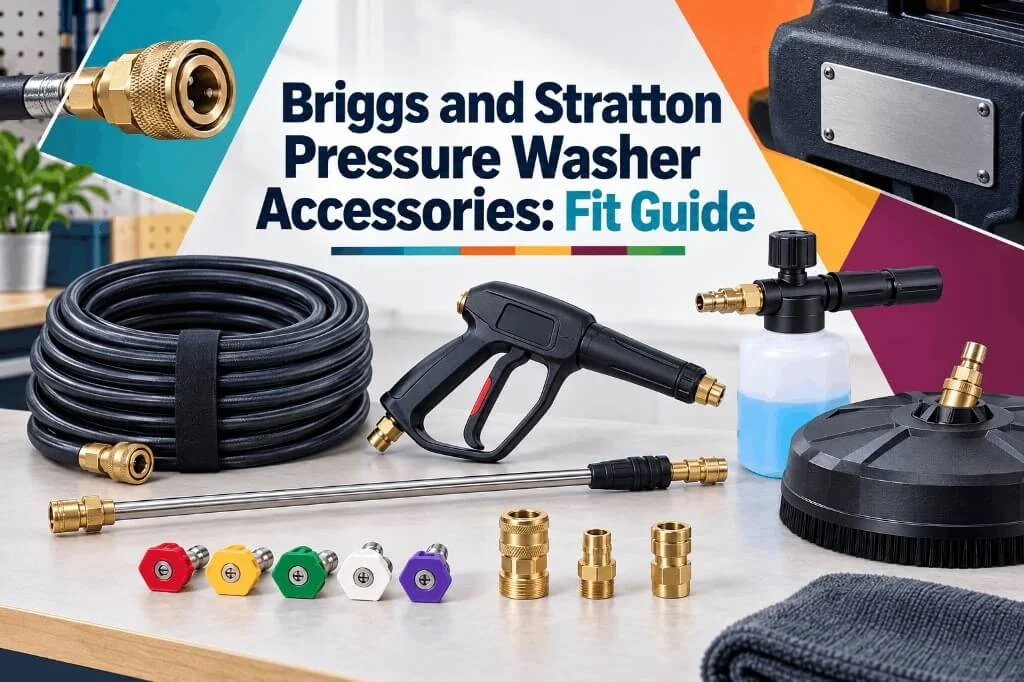
Complete collection of Briggs and Stratton pressure washer accessories including hoses, spray guns, and nozzles
Guides & Tips

Briggs and Stratton Pressure Washer Accessories: Fit Guide

The engine starts normally, but the hose has split near its connector. You search using the name on the engine cover and find dozens of replacements that look almost identical. Which one belongs on your machine? Quick answer: Choose Briggs and Stratton pressure washer accessories by the complete pressure washer model—not only the engine name. Before buying, verify the part number, connector type, working PSI, required GPM, water-temperature rating, and intended cleaning surface. This guide explains how to choose replacement hoses, spray guns, nozzle tips, fittings, surface cleaners, and detergent accessories for car washing, driveway cleaning, and general outdoor work. It uses manufacturer catalog information and established safety guidance. It is an independent, research-based guide and does not claim hands-on testing. Briggs and Stratton Accessory Compatibility Checklist Record these details before you shop: What to verify Where to find it Why it matters Complete washer model and revision Product identification label Identifies the correct manual and factory parts list Current part number Parts diagram or component label Helps locate an exact replacement or confirmed successor Maximum working pressure Washer manual and accessory label Prevents use of an underrated hose, gun, wand, or fitting Water flow in GPM Washer specifications Helps match surface cleaners and foam cannons Connector at both ends Existing hose, pump, gun, and wand Confirms thread, insert, plug, and socket dimensions Water-temperature limit Manual and accessory specifications Separates cold-water components from hot-water-rated parts Intended surface and task Attachment instructions Reduces the risk of surface damage or poor results Start With the Briggs and Stratton Pressure Washer Model Number A pressure washer combines several systems: the power source, pump, high-pressure hose, gun, and cleaning attachment. Their parts are related, but they are not identified by the same information. Identify the washer and engine separately For a gas machine, photograph both the washer’s identification label and the engine’s identification markings. Label positions vary, so use the identification instructions for your equipment. The engine details help identify engine service parts. The complete washer model and revision help locate its operator’s manual and illustrated parts list. Use the official Briggs & Stratton manual and parts lookup when the washer is a Briggs & Stratton product. If another equipment brand built the washer around a Briggs & Stratton engine, start with that equipment maker for the hose, gun, and pump assembly. Do not search only by horsepower, engine series, or advertised PSI. Different machines can share those details while using different parts. Check whether the equipment is still original On a used washer, a previous owner may have replaced the gun, pump, or hose. The original parts diagram then describes the factory setup, which may differ from what is attached today. Compare the current connections with the diagram before ordering. If they differ, send a supplier clear photographs and the identification details rather than guessing from a product thumbnail. Keep the information in a short equipment note on your phone. This makes future seal, nozzle, and hose purchases much easier. How to Match Briggs and Stratton Pressure Washer Accessories Pressure rating and water flow PSI describes pressure; GPM describes gallons of water delivered per minute. Both matter when choosing attachments. A hose, gun, wand, or high-pressure connector must have a working-pressure rating suitable for the washer’s maximum specified pressure. A higher burst rating is not permission to exceed the working rating. Flow matters especially for rotating surface cleaners and foam cannons. An attachment may tolerate the pressure while needing more water than the machine supplies. Also check temperature limits. A replacement listed for cold-water washing is not automatically suitable for hot water. An accessory cannot increase the rated capacity of the existing pump. Connector shape, size, and sealing method M22 threaded fittings and quick connectors appear on many setups, but do not assume every machine uses identical dimensions. For M22 connections, confirm the sealing insert size as well as the thread. M22-14mm and M22-15mm are different. For quick connectors, verify the plug and socket size and profile at the exact connection point. An adapter can solve a confirmed connection mismatch. It cannot correct an inadequate pressure rating or flow requirement. Long chains of adapters also add weight and potential leak points. Your power source does not establish accessory fit Electric and gas washers can have different hose systems, detergent arrangements, and operating requirements. The presence of an engine does not mean every “gas washer” accessory fits. If you are also considering replacing the machine, our guide to electric versus gas pressure washers can help separate machine selection from accessory selection. Briggs and Stratton Pressure Washer Hose: What to Check A replacement hose should restore safe operation and give you enough room to move without constantly pulling the washer around. A verified example: part 6188 The official Briggs & Stratton 6188 product listing identifies it as a 30-foot, 1/4-inch pressure washer hose for up to 3,000 PSI, with connections for male M22 threaded pump and gun fittings. It is intended for cold-water pressure washers. That makes it a candidate for a matching setup, not a blanket recommendation for every Briggs & Stratton washer. Confirm the sealing dimensions and model suitability before ordering. A machine rated above 3,000 PSI needs a different hose with the appropriate rating. The hose’s 1/4-inch size describes the hose bore, not a promise that its ends are 1/4-inch nozzle quick connectors. Product size descriptions often refer to different parts of the assembly. Length, flexibility, and routing Measure the route around your car or patio, including corners. More length can reduce machine movement, but it also increases storage bulk and friction loss. Choose a length and internal diameter permitted for your washer. For frequent use, look beyond the advertised length. Consider flexibility, abrasion resistance, connector strain relief, and how easily the hose coils. Keep it away from a hot muffler, sharp edges, and vehicle traffic. Replace hoses with bulges, exposed reinforcement, serious cuts, or high-pressure leaks. Tape and ordinary hose clamps are not suitable repairs. Replacement Spray Gun and Wand

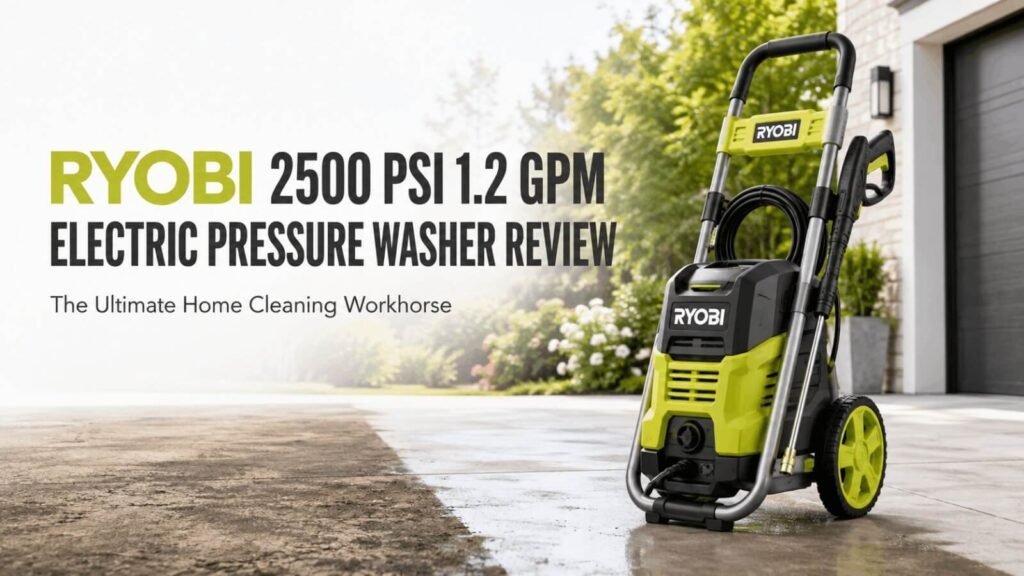
RYOBI 2500 PSI 1.2 GPM electric pressure washer review cover image on outdoor driveway
Buying Guides, Safety Tips

RYOBI 2500 PSI 1.2 GPM Electric Pressure Washer Review: The Ultimate Home Cleaning Workhorse

Maintaining a clean, spotless home exterior often feels like an endless battle against stubborn dirt, grime, mildew, oil leaks, and seasonal weathering. While residential garden hoses lack the force needed to dislodge deeply set contaminants, commercial gas pressure washers can be overly loud, cumbersome, fume-heavy, and aggressive enough to damage delicate finishes. Enter the RYOBI 2500 PSI 1.2 GPM Electric Pressure Washer. Engineered to bridge the gap between lightweight domestic sprayers and heavy industrial machines, this high-performance unit promises professional-grade electric cleaning power without the maintenance headaches of gas engines. In this comprehensive review, we will break down its technical specifications, core features, practical real-world applications, maintenance needs, and how it stacks up against top competitors. Technical Specifications Overview Feature / Specification Details Brand & Model RYOBI 2500 PSI Electric Pressure Washer Max Pressure Output 2500 PSI (Pounds per Square Inch) Water Flow Rate 1.2 GPM (Gallons per Minute) Cleaning Power Index 3,000 Cleaning Units (PSI × GPM) Onboard Soap Tank Volume 1 Gallon High-Pressure Hose 25 ft. Reach Hose Power Source Corded Electric Standards Met EPA Compliant Item Weight 40 lbs Included Accessories 15° Nozzle, Soap Nozzle, Turbo Nozzle Why Choose the RYOBI 2500 PSI Electric Pressure Washer? The electric pressure washer segment is crowded with entry-level machines delivering lower pressure. The RYOBI 2500 PSI 1.2 GPM model stands out by offering genuine medium-to-heavy residential cleaning capability powered purely by electricity. It eliminates common pain points associated with gas equipment: Instant Push-Button Start: No pull cords, chokes, or stubborn cold-weather engine starts. Zero Emissions & Quiet Operation: Ideal for enclosed patios, townhomes, and garages without exhaust fumes or excessive noise. Minimal Maintenance: No oil changes, spark plug replacements, fuel stabilizers, or carburetor rebuilds required. Key Features & Product Performance 1. 2500 PSI Output with 1.2 GPM Flow Rate Cleaning effectiveness relies on the combination of pressure (PSI) and water volume (GPM). Generating 3,000 Total Cleaning Units, this machine delivers ample impact force to dislodge compacted grime while remaining far more water-efficient than a standard outdoor spigot. 2. Integrated 1-Gallon Soap Tank The built-in 1-gallon detergent tank lets you quickly apply foam cleaners, vehicle soaps, and surface degreasers without hauling external buckets around the yard. 3. Quick-Connect Pro-Grade Nozzles The included quick-connect nozzle set covers a variety of cleaning tasks: Turbo Nozzle: Employs an oscillating pinpoint stream for maximum circular cleaning impact—ideal for deep concrete stains and weathered brick. 15° Fan Nozzle: Provides a balanced spray pattern ideal for general surface stripping and house siding cleanup. Soap Applicator Nozzle: Siphons detergent directly from the onboard 1-gallon tank at low pressure. Practical Applications: What Can You Clean? Automotive Care & Car Detailing Electric pressure washers offer smooth, consistent pressure delivery. Paired with the low-pressure soap nozzle or an optional 40° wide-angle nozzle (sold separately), it applies cleaning foam evenly across paintwork. Safety Tip: Maintain a distance of at least 2 to 3 feet from painted automotive panels and avoid targeting delicate trim pieces with narrow spray angles. Concrete Driveways, Sidewalks, & Slabs Porous concrete easily absorbs motor fluids, dirt, and algae. Utilizing the included Turbo Nozzle allows you to lift deep-seated grime and restore discolored walkways quickly. Wood Decks, Fences, & Composite Surfaces Softwoods can splinter easily under direct pressure. Always test an inconspicuous area first, starting at a conservative distance and moving closer only as needed to clean without damaging delicate wood grain. House Siding & Soffits With its combined cord-and-hose reach, this unit lets you easily maneuver around the property perimeter to strip pollen, bug nests, and mildew from vinyl siding and brick foundations. RYOBI 2500 PSI vs. Market Competitors Feature RYOBI 2500 PSI Greenworks Pro 2300–2500 Typical Gas 2500 PSI Power Source Electric Electric Gas Engine (4-Stroke) Max Pressure 2500 PSI 2300–2500 PSI 2500 PSI Flow Rate 1.2 GPM 1.2 GPM 2.3 GPM Maintenance Minimal Minimal Oil, Filters, Fuel Prep Total Weight 40 lbs ~45 lbs 65–75 lbs Best Used For Home & Auto Care Residential DIY Heavy Commercial Work Operating Instructions & Winterization Guide 1.Connect Water Source:Check for leak-free connections. Attach a standard 5/8-inch garden hose securely to the water inlet on the unit and turn on the water spigot fully. 2.Purge Trapped Air:Prevents pump cavitation. Before connecting to electrical power, squeeze the spray gun trigger for 30–45 seconds until a steady, continuous stream of water flows out of the wand. 3.Power On:Direct wall outlet recommended. Plug the power cord directly into a grounded outdoor receptacle and turn the power dial to the ON position. 4.Winterization & Storage:Protect internal seals from freezing. Flush the detergent system with fresh water for 60 seconds after using soap. Disconnect hoses, squeeze the trigger to drain remaining internal water, and apply an aerosol pump protector before cold-weather storage. Pros and Cons Pros: Zero Gas Maintenance: No fuel mixing, oil checks, or spark plug replacements. Lightweight Frame: At only 40 lbs, it is easy to transport around yards and up deck stairs. Versatile Soap System: Integrated 1-gallon onboard tank streamlines foam application. Included Turbo Tip: Accelerates deep cleaning on hard concrete surfaces. Cons: 1.2 GPM Flow Rate: Slower rinsing speed compared to high-volume commercial gas models. Electrical Outlet Bound: Requires proximity to a functional outdoor power source. Frequently Asked Questions (FAQs) Q1. Can I use an extension cord with the RYOBI 2500 PSI pressure washer? The official manual recommends plugging the power cord directly into a wall outlet. If an extension cord is strictly unavoidable, use only a heavy-duty 12-AWG outdoor-rated cord no longer than 25 feet. Extension cords measuring 50 feet or longer are not permitted due to severe risk of voltage drop and motor damage. Q2. Is 2500 PSI safe for washing cars? Yes, when used with the low-pressure soap nozzle or an optional compatible 40° wide fan nozzle at a safe distance (2–3 feet). Never use the 0° red tip or Turbo Nozzle on vehicle paint or glass. Q3. Can I feed hot water into this unit? No. The RYOBI 2500 PSI pressure washer is designed strictly for

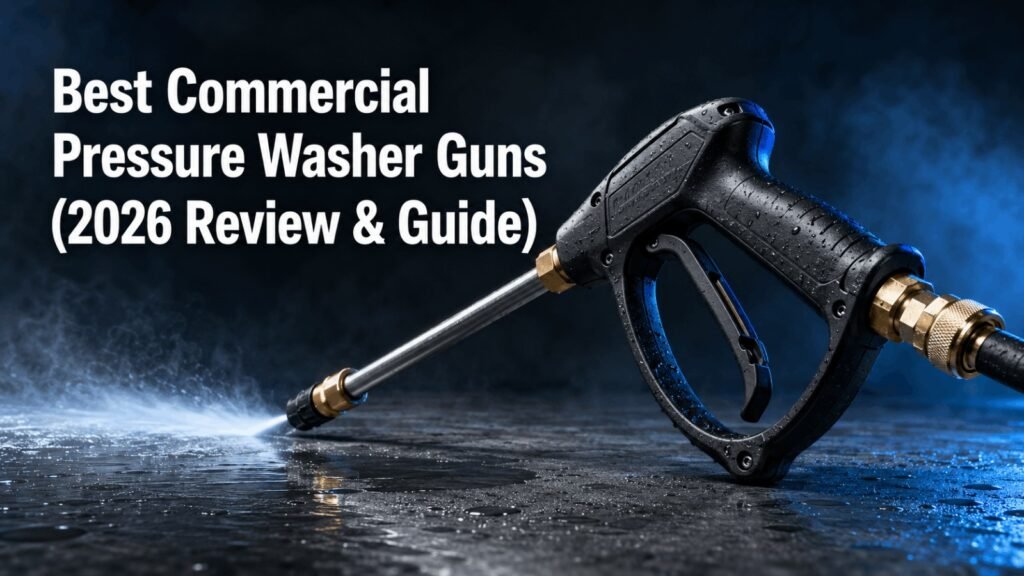
Best Commercial Pressure Washer Guns 2026 Review and Guide featured banner showing heavy duty spray gun
Accessories

Best Commercial Pressure Washer Guns (2026 Review & Buying Guide

Commercial pressure washing demands reliable, high-performance equipment that can withstand hours of heavy-duty operation. While heavy-duty pumps and high-horsepower engines get most of the attention, your commercial pressure washer gun is the primary interface between the machine and the surface you are cleaning. Using a cheap, residential-grade spray gun with a commercial machine leads to rapid wear, hand fatigue, leaks, and potential safety hazards. Upgrading to a professional-grade pressure washer trigger gun ensures smooth operation, precise flow control, and maximum durability on job sites. In this comprehensive guide, we will break down the top commercial pressure washer spray guns, explore key features like PSI/GPM ratings, discuss ergonomics, and help you select the exact gun for your rig. Why Upgrading to a Commercial Pressure Washer Gun Matters If you are running a professional exterior cleaning or surface restoration business, your trigger gun takes a beating. Residential guns rely on plastic internal valves and low-spec seals that fail under continuous high pressure. Here is why investing in a true commercial-grade spray gun is essential: 1. High PSI and GPM Capacity Commercial units generate extreme output. Standard guns cap out at lower pressure levels, whereas commercial trigger guns easily handle 4000 PSI to 5000+ PSI and flow rates from 8 to 12+ GPM. Match your gun’s limits to your machine to prevent internal seal blowouts. Internal Link Suggestion: If you are running a high-output unit, make sure your pump is up to the task. Read our detailed guide on choosing a [Triplex Pressure Washer Pump]. 2. Hot Water Compatibility Many commercial cleaning jobs—such as grease removal, oil stain treatment, and gum removal—require hot water machines. Commercial spray guns feature thermal-resistant internal seals (Viton or ceramic) that withstand temperatures up to 300°F (148°C) without degrading. 3. Reduced Operator Fatigue Contractors spend 6 to 10 hours a day holding a pressure washer wand. Standard triggers require continuous finger force, leading to severe hand cramping and repetitive strain injuries. Commercial anti-fatigue guns use Easy-Pull or Zero-Force technology, allowing you to hold the trigger with minimal effort. 4. Rugged Construction High-grade brass manifolds, stainless steel internal pipes, impact-resistant outer casings, and forged valve housings protect commercial guns from accidental drops, truck bed bumps, and rough job site environments. Top Features to Look for in a Heavy-Duty Spray Gun Before selecting a spray gun, review these crucial specifications to ensure full compatibility with your pressure washing setup. +————————+————————————+————————————-+ | Feature                | Commercial Grade Standard          | Why It Matters                      | +————————+————————————+————————————-+ | Max Pressure (PSI)     | 4000 PSI – 5000+ PSI               | Prevents internal valve rupture     | | Max Flow Rate (GPM)    | 7.0 – 12.0 GPM                     | Ensures unrestricted water flow     | | Temperature Rating     | Up to 300°F (148°C)                | Safe for hot water units            | | Inlet/Outlet Threads   | 3/8″ FNPT Inlet, 1/4″ FNPT Outlet  | Standard commercial fitting sizing  | | Trigger Mechanism      | Linear/Easy-Pull or Zero-Force     | Reduces hand strain during long shifts| +————————+————————————+————————————-+ Pressure (PSI) and Flow Rate (GPM) Ratings Always pick a spray gun whose maximum PSI and GPM ratings exceed your pressure washer’s output. For instance, if you operate a 4000 PSI Honda-powered commercial unit, select a gun rated for at least 4500 PSI or 5000 PSI. Running a gun right at its peak threshold shortens seal life. Internal Link Suggestion: Pair your high-PSI gun with the right delivery system. Check out our guide on selecting a heavy-duty [Commercial Pressure Washer Hose]. Inlet and Outlet Connection Types Commercial spray guns typically feature a 3/8″ Female NPT (FNPT) inlet at the bottom of the handle to attach your pressure hose, and a 1/4″ FNPT outlet at the front to attach a lance or quick-connect coupler. 3/8″ Quick-Connect Swivels: Installing a brass or stainless steel quick-connect swivel at the base allows the gun to rotate independently of the hose, eliminating kinks and twists while working. Heat Resistance & Internal Valve Materials For cold water washing, standard Buna-N or EPDM seals suffice. However, for fleet washing or industrial grease cleaning, choose a gun with Viton seals or ceramic ball valves designed for high-temperature applications. Detailed Reviews: Best Commercial Pressure Washer Spray Guns Here is a breakdown of the leading commercial pressure washer guns trusted by professional contract cleaners. 1. Suttner ST-2300 / ST-2600 Series (Best Overall Commercial Gun) The Suttner ST-2300 series is widely regarded as the industry standard for commercial pressure washing. Engineered in Germany, Suttner guns are renowned for structural durability and effortless operation. Max Pressure: 4500 PSI – 5000 PSI Max Flow Rate: 12.0 GPM Max Temp: 300°F Inlet/Outlet: 3/8″ F x 1/4″ F Key Strengths: Features Suttner’s signature Easy-Pull trigger design, dramatically reducing hold force. Impact-resistant plastic housing protects internal forged brass components. Fully rebuildable—replacement valve kits are widely available, extending total product lifespan. Best For: Daily commercial cleaning contractors, fleet washers, and property maintenance crews needing long-term reliability. 2. General Pump Spray Gun DG5010 (Best High-Pressure Workhorse) When dealing with ultra-high pressure applications, the General Pump DG5010 delivers extreme performance and rugged internal construction. Max Pressure: 5000 PSI Max Flow Rate: 10.5 GPM Max Temp: 320°F Inlet/Outlet: 3/8″ F x 1/4″ F Key Strengths: Extra-heavy-duty forged brass housing built for grueling environments. Exceptional heat tolerance, making it ideal for continuous hot-water applications. Precise trigger response with smooth shutoff to avoid pressure spikes. Best For: Heavy industrial cleaning, oil stain removal, and high-PSI hot-water washing rigs. 3. Pressure-Pro / Giant Linear Trigger Gun (Best Ergonomic Design) For technicians suffering from hand fatigue or arthritis, Linear (Zero-Force) style trigger guns are game-changers. Unlike standard pistol-grip guns where the trigger pivots at the top, linear guns push

Scroll to Top