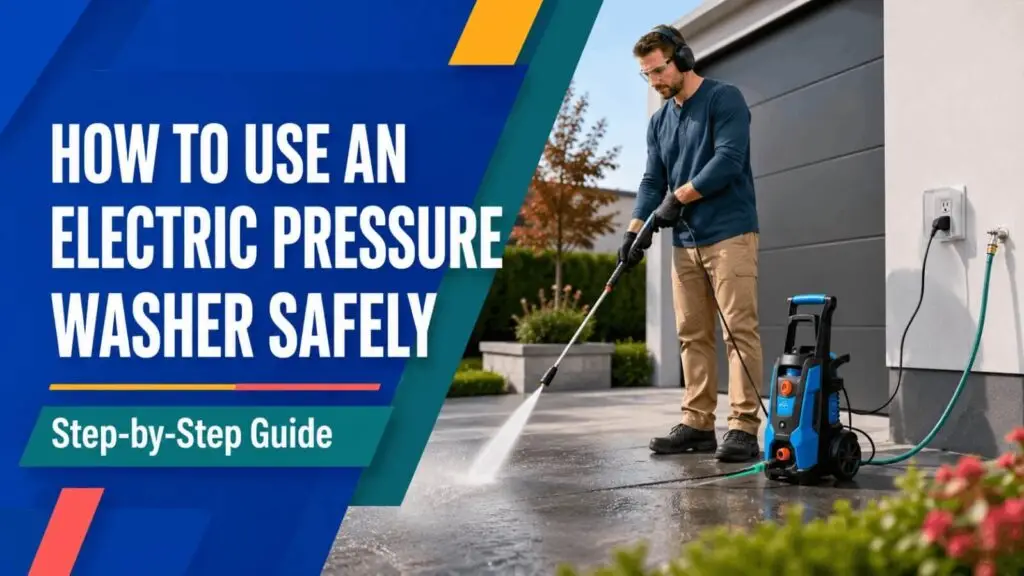
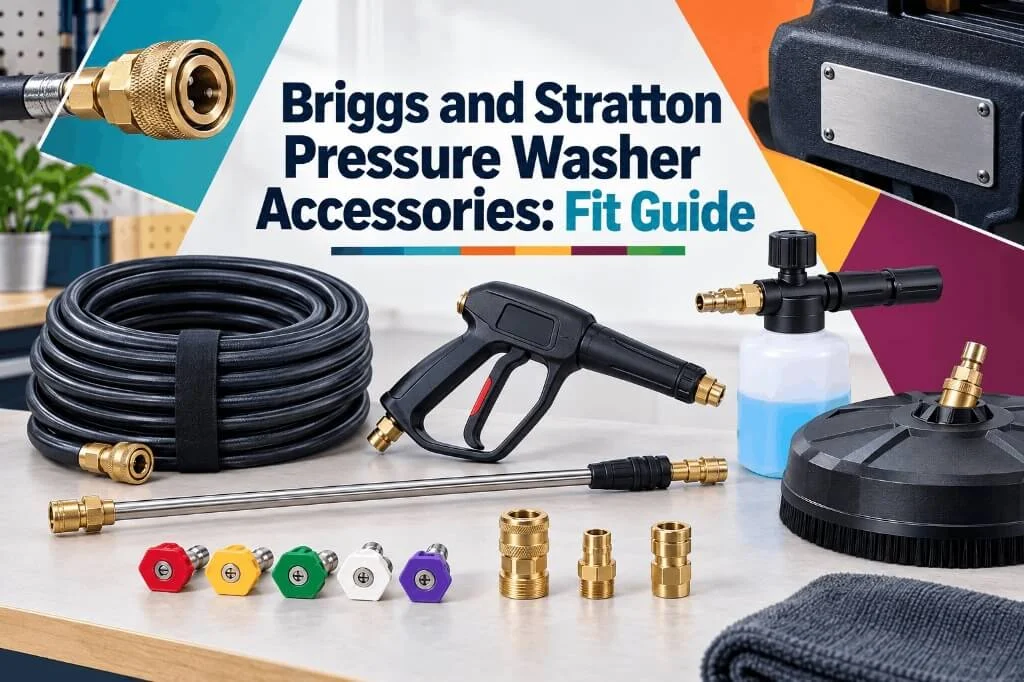
The engine starts normally, but the hose has split near its connector. You search using the name on the engine cover and find dozens of replacements that look almost identical. Which one belongs on your machine?
Quick answer: Choose Briggs and Stratton pressure washer accessories by the complete pressure washer model—not only the engine name. Before buying, verify the part number, connector type, working PSI, required GPM, water-temperature rating, and intended cleaning surface.
This guide explains how to choose replacement hoses, spray guns, nozzle tips, fittings, surface cleaners, and detergent accessories for car washing, driveway cleaning, and general outdoor work. It uses manufacturer catalog information and established safety guidance. It is an independent, research-based guide and does not claim hands-on testing.
Briggs and Stratton Accessory Compatibility Checklist
Record these details before you shop:
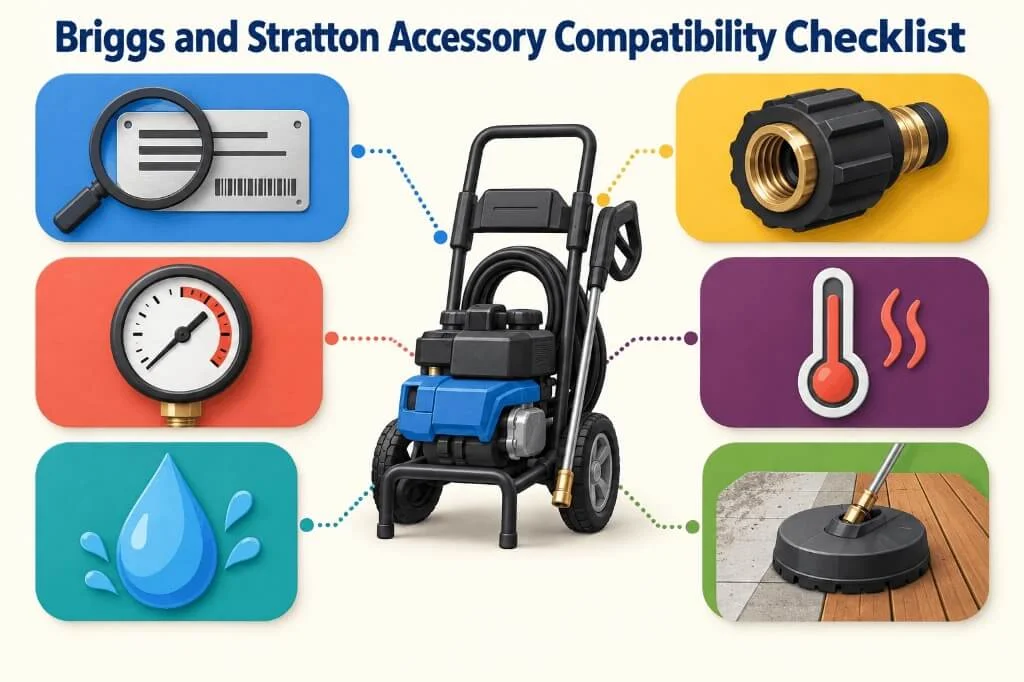
| What to verify | Where to find it | Why it matters |
|---|---|---|
| Complete washer model and revision | Product identification label | Identifies the correct manual and factory parts list |
| Current part number | Parts diagram or component label | Helps locate an exact replacement or confirmed successor |
| Maximum working pressure | Washer manual and accessory label | Prevents use of an underrated hose, gun, wand, or fitting |
| Water flow in GPM | Washer specifications | Helps match surface cleaners and foam cannons |
| Connector at both ends | Existing hose, pump, gun, and wand | Confirms thread, insert, plug, and socket dimensions |
| Water-temperature limit | Manual and accessory specifications | Separates cold-water components from hot-water-rated parts |
| Intended surface and task | Attachment instructions | Reduces the risk of surface damage or poor results |
A pressure washer combines several systems: the power source, pump, high-pressure hose, gun, and cleaning attachment. Their parts are related, but they are not identified by the same information.
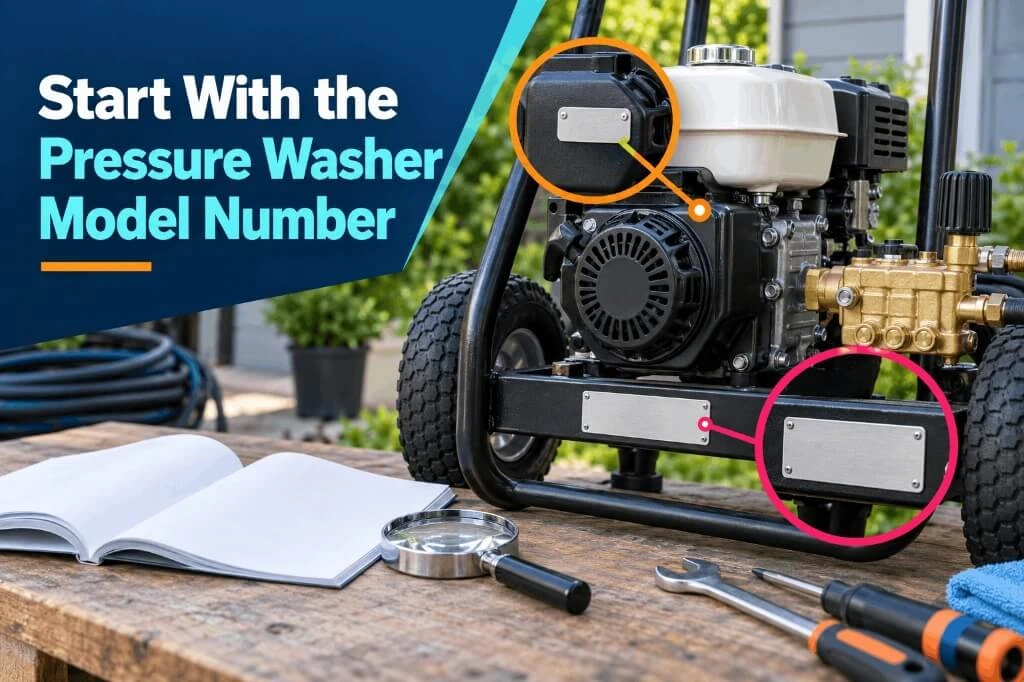
Identify the washer and engine separately
For a gas machine, photograph both the washer’s identification label and the engine’s identification markings. Label positions vary, so use the identification instructions for your equipment.
The engine details help identify engine service parts. The complete washer model and revision help locate its operator’s manual and illustrated parts list. Use the official Briggs & Stratton manual and parts lookup when the washer is a Briggs & Stratton product. If another equipment brand built the washer around a Briggs & Stratton engine, start with that equipment maker for the hose, gun, and pump assembly.
Do not search only by horsepower, engine series, or advertised PSI. Different machines can share those details while using different parts.
Check whether the equipment is still original
On a used washer, a previous owner may have replaced the gun, pump, or hose. The original parts diagram then describes the factory setup, which may differ from what is attached today.
Compare the current connections with the diagram before ordering. If they differ, send a supplier clear photographs and the identification details rather than guessing from a product thumbnail.
Keep the information in a short equipment note on your phone. This makes future seal, nozzle, and hose purchases much easier.
How to Match Briggs and Stratton Pressure Washer Accessories
Pressure rating and water flow
PSI describes pressure; GPM describes gallons of water delivered per minute. Both matter when choosing attachments.
A hose, gun, wand, or high-pressure connector must have a working-pressure rating suitable for the washer’s maximum specified pressure. A higher burst rating is not permission to exceed the working rating.
Flow matters especially for rotating surface cleaners and foam cannons. An attachment may tolerate the pressure while needing more water than the machine supplies.
Also check temperature limits. A replacement listed for cold-water washing is not automatically suitable for hot water. An accessory cannot increase the rated capacity of the existing pump.
Connector shape, size, and sealing method
M22 threaded fittings and quick connectors appear on many setups, but do not assume every machine uses identical dimensions.
For M22 connections, confirm the sealing insert size as well as the thread. M22-14mm and M22-15mm are different. For quick connectors, verify the plug and socket size and profile at the exact connection point.
An adapter can solve a confirmed connection mismatch. It cannot correct an inadequate pressure rating or flow requirement. Long chains of adapters also add weight and potential leak points.
Your power source does not establish accessory fit
Electric and gas washers can have different hose systems, detergent arrangements, and operating requirements. The presence of an engine does not mean every “gas washer” accessory fits.
If you are also considering replacing the machine, our guide to electric versus gas pressure washers can help separate machine selection from accessory selection.
Briggs and Stratton Pressure Washer Hose: What to Check
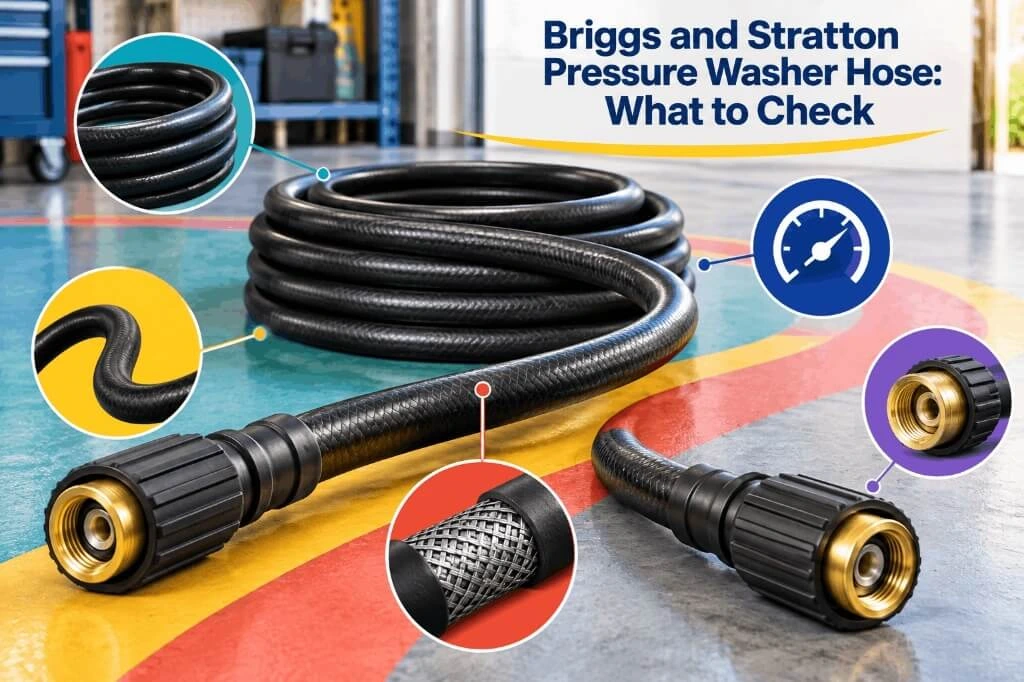
A replacement hose should restore safe operation and give you enough room to move without constantly pulling the washer around.
A verified example: part 6188
The official Briggs & Stratton 6188 product listing identifies it as a 30-foot, 1/4-inch pressure washer hose for up to 3,000 PSI, with connections for male M22 threaded pump and gun fittings. It is intended for cold-water pressure washers.
That makes it a candidate for a matching setup, not a blanket recommendation for every Briggs & Stratton washer. Confirm the sealing dimensions and model suitability before ordering. A machine rated above 3,000 PSI needs a different hose with the appropriate rating.
The hose’s 1/4-inch size describes the hose bore, not a promise that its ends are 1/4-inch nozzle quick connectors. Product size descriptions often refer to different parts of the assembly.
Length, flexibility, and routing
Measure the route around your car or patio, including corners. More length can reduce machine movement, but it also increases storage bulk and friction loss. Choose a length and internal diameter permitted for your washer.
For frequent use, look beyond the advertised length. Consider flexibility, abrasion resistance, connector strain relief, and how easily the hose coils. Keep it away from a hot muffler, sharp edges, and vehicle traffic.
Replace hoses with bulges, exposed reinforcement, serious cuts, or high-pressure leaks. Tape and ordinary hose clamps are not suitable repairs.
Replacement Spray Gun and Wand Options
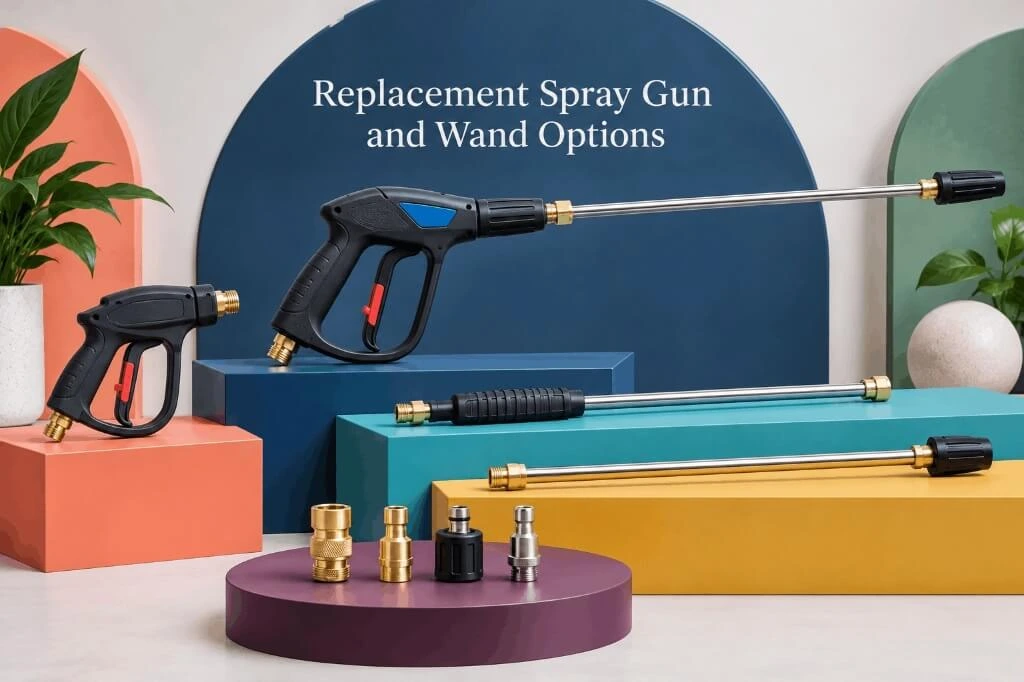
A leaking or sticking gun deserves attention before you buy a new cleaning attachment. The trigger is a safety control, not merely a handle.
Check both ends of the gun
The hose connects at the inlet, while the wand or attachment connects at the outlet. A replacement must work at both points and meet the required pressure, flow, and temperature ratings.
For example, the official pressure-washer parts catalog lists spray gun 316299GS as a 2,300 PSI gun and includes other gun assemblies under different numbers. This illustrates why the brand name alone is insufficient: a genuine part can still be wrong for a more powerful washer.
Confirm the exact replacement through the equipment parts list. Do not bypass a safety lock or tie the trigger open because a replacement feels harder to operate.
Match the wand to the task
A conventional wand provides distance between your hands and the cleaning surface. A short detailing gun can improve access around a car, while an extension increases reach but makes handling harder.
Check overall assembly length, grip, and balance. An awkward gun-and-adapter combination can be tiring even when every connection seals properly.
For high siding, choose a method you can control from stable ground. Added reach does not make pressure washing from a ladder safe.
Pressure Washer Nozzle Compatibility
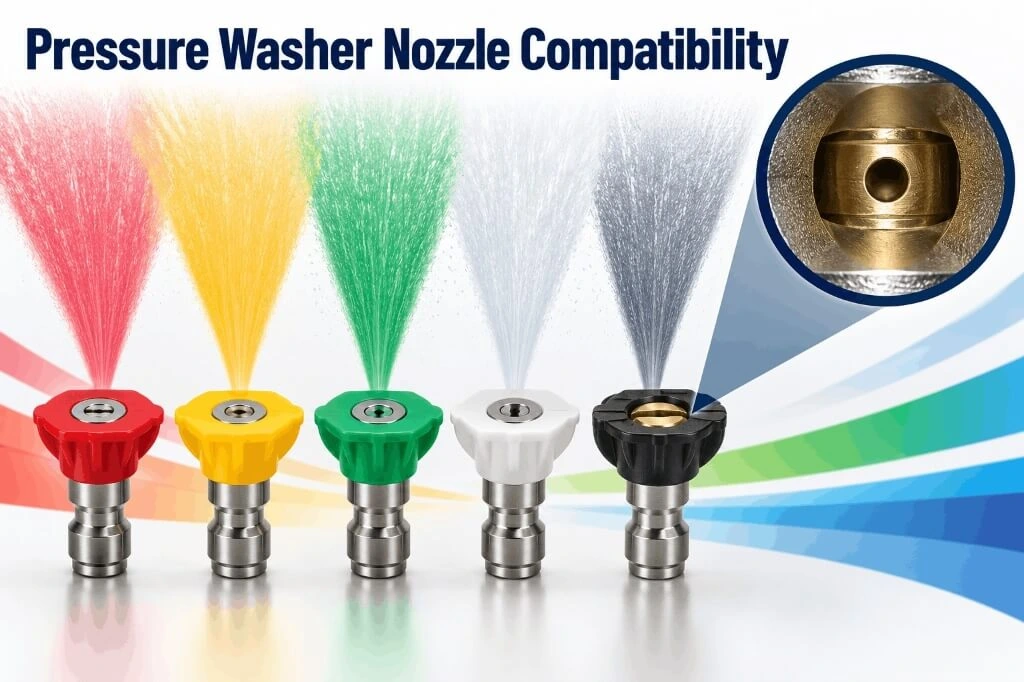
Replacement tips need the correct connection, spray angle, and flow opening. A colorful set that clips into place has passed only one of those checks.
Spray angle is not the same as nozzle size The fan angle controls how widely the jet spreads. The orifice—the small opening inside the tip—affects the relationship between pressure and flow.
Use the nozzle size specified for your machine or a manufacturer-approved sizing chart. An opening that is too small can create excessive restriction; one that is too large can reduce working pressure.
Color codes commonly identify spray patterns, but colors do not establish the correct orifice. A replacement kit should provide specifications, not simply say “fits most washers.”
Start with a surface test
Use the gentlest approved setting at the recommended distance on a hidden area. Inspect the surface before continuing. A wide fan can still lift loose paint or damage weathered wood when used too close.
Turbo nozzles rotate a concentrated jet. Reserve them for compatible durable surfaces; do not treat rotation as protection for car paint, trim, siding, or deck finishes.
Quick Connectors, O-Rings, and Inlet Filters
These smaller parts can be worthwhile purchases when they solve a specific setup or sealing problem.
Garden-hose quick connectors
The 6190 Quick Connect Garden Hose Kit is described as converting one garden-hose end to a snap connection. The listing says two kits are needed to convert both ends.
This is a water-supply accessory. It is not a substitute for a rated high-pressure coupling between the pump and spray gun.
Before installing it, confirm the supply connection and ensure the fitting does not restrict the water flow your washer requires.
O-rings and screens
Inspect seals with the system shut down and depressurized. A flattened or cut O-ring may explain a leak, but damaged connector surfaces or mismatched dimensions need a different solution.
An inlet screen protects the pump from debris. Clean or replace it as instructed; do not remove it permanently to hide a water-supply problem.
Pressure Washer Surface Cleaner: Choose by Operating Range
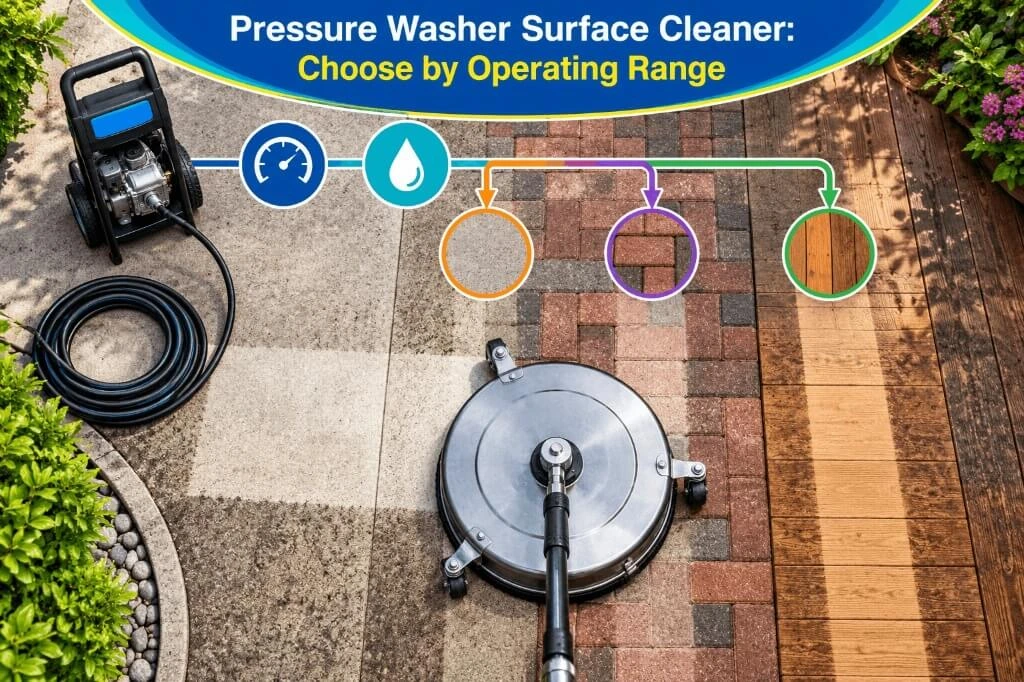
A surface cleaner directs rotating jets downward beneath a housing. It can make suitable flat concrete easier to clean evenly, especially when repeated wand passes become tiring.
Best for broad, durable flat areas
Match the attachment’s required GPM, pressure range, nozzle sizing, and connection to the washer. A large head that needs more flow may move slowly or leave uneven results on a smaller machine.
Do not buy by diameter alone. A compact compatible cleaner can be more useful than a larger attachment the pump cannot support.
For a driveway, also plan how you will rinse away the dirty water. The cleaning head does not automatically remove runoff or absorbed oil stains.
Know the surface limits
Check for weak concrete, coatings, loose paver joints, and damaged edges. Clear loose stones before starting. Keep the cleaner level and moving at a steady pace, with slight overlap between passes.
Do not lift the head with water running to inspect the spray bar. Wood and composite decking require their own surface guidance; a concrete-cleaning attachment is not automatically suitable.
Foam Cannons and Detergent Accessories
A foam cannon can help apply car shampoo evenly, but it should be an optional improvement after the washer’s basic hose, gun, and nozzle setup works correctly.
Check the cannon’s pressure and flow requirements, connector, and recommended orifice. Use detergent suitable for both the application equipment and vehicle finish. Thick foam alone does not show how well dirt is being removed.
For a washer’s built-in detergent pickup, follow the model’s instructions. Many systems draw solution only in a specified low-pressure mode. A high-pressure spray tip may prevent detergent pickup even when the tube is correctly connected.
Use the stated dilution, work on cool surfaces, and do not let detergent dry. Avoid feeding unapproved chemicals through the pump. A garden-hose foam gun and a pressure-washer foam cannon are different products, even when their bottles look similar.
OEM vs Aftermarket Accessories
OEM means original equipment manufacturer. Aftermarket parts come from other suppliers. Neither label eliminates the need for a compatibility check.
Briggs & Stratton’s support and parts information can help owners maintain existing equipment. The limitation is that its name covers different products and generations, so it is not a single connection standard.
Compare warranty terms, return conditions, and replacement-seal availability. Prices and stock can change, particularly for older equipment. Ask about a superseded part number rather than assuming a missing listing means the washer is beyond repair.
Common Mistakes People Make
Ordering from the engine label: Use the complete washer model for water-system accessories; retain engine details for engine parts.
Assuming genuine means compatible: Match the part number and operating limits, even when the packaging carries the correct brand.
Treating a leak as a tightening problem: Inspect the seal and dimensions first. Excess force can damage threads or plastic housings.
Buying accessories to cure pump faults: Check water supply, filters, kinks, and setup before spending. Persistent abnormal operation needs diagnosis.
Using more pressure on every stain: Identify the surface and cleaning method first. A stronger jet can turn staining into permanent damage.
Safe Use and Accessory Maintenance
Follow the washer manual, attachment instructions, surface manufacturer’s guidance, and detergent label. Wear eye protection and sturdy non-slip footwear. Keep people and pets outside the cleaning area.
Never feel for leaks with your fingers or spray anyone. A high-pressure injection wound can look small but needs prompt medical attention. Shut down, isolate the power source, and release trapped pressure before changing components.
Run gas equipment outdoors and direct exhaust away from doors, windows, and vents. Carbon monoxide can build up quickly in enclosed or partly enclosed areas; the CDC has documented poisoning from indoor use of gasoline-powered pressure washers. Keep electric connections dry and use the ground-fault protection specified in the manual. Our electric pressure washer setup guide explains that startup sequence.
After use, flush detergent components, drain and store accessories as directed, and protect them from freezing. Use pump storage treatment only as specified for your machine. Engine oil and pump maintenance are separate matters; do not assume every pump requires an oil change.
Simple Action Plan
Step 1: Record the equipment
Photograph the washer label, current fittings, and damaged component. Find the matching parts diagram and note any modifications.
Step 2: Choose the purchase
Decide whether you are restoring operation or adding a capability. Confirm pressure, flow, temperature, connections, and any approved replacement number before paying.
Step 3: Install and check
Follow the manual with the machine safely isolated. Confirm fittings lock or seat correctly, establish the water supply, and use the approved startup procedure. Stop if leakage or abnormal operation appears.
Step 4: Keep useful records — Save the packaging label, receipt, and confirmed part number with your equipment note. Record what fitted successfully so the next replacement does not require starting again.
Frequently Asked Questions
Will any M22 hose fit my Briggs & Stratton pressure washer?
No. Confirm the sealing dimensions, hose-end arrangement, pressure rating, and model requirements. Matching outer threads alone does not prove that the hose will seal or operate safely.
Can I fit a 3,000 PSI hose to a 3,200 PSI washer?
Do not choose a hose rated below the washer’s specified maximum pressure. Select an appropriately rated assembly instead of relying on distance from the surface or a wider spray tip.
Can I use another brand’s surface cleaner?
Possibly, provided its operating range, fittings, and intended use match your washer. The brand is less important than documented compatibility, correct nozzle sizing, and adequate water flow.
Why does my washer stop drawing soap after a nozzle change?
You may have switched out of the low-pressure detergent mode. Check the manual’s nozzle or wand setting, then inspect the pickup tube and filter with the equipment safely stopped.
What should I do if a part number has changed?
Ask the manufacturer or a knowledgeable supplier to confirm the replacement number against your complete model and revision. Similar appearance is not enough to establish that a newer part replaces yours.
Which accessory should I buy first?
Replace unsafe or failed components first. With a sound basic setup, choose the upgrade for your most frequent job: manageable hose reach, controlled detergent application, or a matched surface cleaner.
Conclusion: Identify First, Upgrade Second
The most useful Briggs and Stratton pressure washer accessories are the ones that match your actual equipment and remove a clear cleaning difficulty.
Start with the washer model and existing connections. Confirm the required ratings, then choose a replacement or attachment with documented suitability. A few well-matched parts are a better investment than a large collection that leaves you searching for another adapter.