
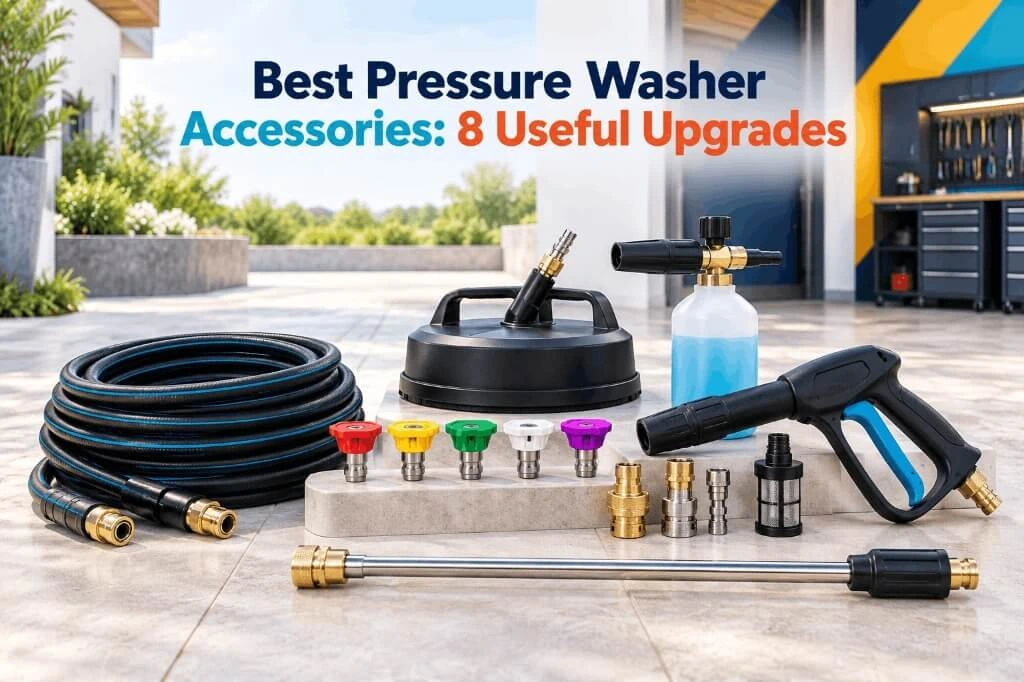
Best Pressure Washer Accessories: 8 Useful Upgrades
If you could improve one part of your pressure-washing routine, what would it be? You might want to reach around a car without moving the machine, clean a driveway with fewer uneven passes, or connect the hose faster. Quick answer: The best pressure washer accessories are the ones that solve a frequent problem and match your machine. A flexible high-pressure hose is a useful general upgrade, a properly matched surface cleaner suits repeated driveway work, and a foam cannon is mainly valuable for regular vehicle washing. Always verify the connection, working PSI, required GPM, temperature rating, and intended surface before buying. This guide compares eight accessory types for homeowners, car owners, DIY cleaners, and small cleaning businesses. It explains who each upgrade suits, when to skip it, and what to check before purchase. The recommendations are based on use cases and documented equipment principles—not unsupported star ratings, hands-on testing claims, or paid product rankings. Best Pressure Washer Accessories at a Glance For an otherwise sound setup, our first upgrade to consider is a more manageable hose if the supplied one restricts movement. For repeated driveway work, a correctly matched surface cleaner may offer more value. If your equipment already meets your needs, buying nothing is a reasonable choice. Accessory type Best for Main benefit Reason to skip or delay Flexible high-pressure hose Awkward reach and frequent repositioning Easier movement around the job Existing hose already reaches comfortably Correctly sized nozzle set Missing or unsuitable spray options More appropriate spray patterns Supplied tips already cover your work Matched surface cleaner Broad, suitable flat paving More consistent coverage Washer cannot meet its operating requirements Compatible foam cannon Regular vehicle washing Controlled shampoo application Vehicle washing is only occasional Quick-connect fittings Frequent setup and pack-down Faster compatible connections Fit or pressure ratings are unclear Comfortable spray gun Long sessions or awkward handling Better grip and control Original gun is comfortable and sound Approved extension wand Limited extra reach from ground level Access without moving closer Recoil or overhead hazards make use unsafe Correct inlet filter or screen Protecting the water-supply path Catches debris before the pump An added filter would restrict flow unnecessarily The order is a practical starting point, not a universal ranking. Replace unsafe or failed components before spending on optional improvements. How We Choose Useful Upgrades A worthwhile accessory should solve a repeated problem, suit the cleaning surface, and remain practical to handle, store, and maintain. We also consider replacement-part support, warranty terms, and the complete installed cost—including required adapters. This guide recommends accessory categories rather than declaring one product the winner for every washer. A compact electric model and a higher-flow gas machine may need very different versions of the same attachment. Detailed compatibility checks are provided in the buyer’s checklist below. If you are choosing the machine too, read our comparison of electric and gas pressure washers before building an accessory setup around it. 1. Pressure Washer Hose Upgrade: Best for Easier Movement A hose that keeps catching under tires or pulling against your wrist can interrupt every stage of a wash. Replacing it with a suitable, more flexible assembly may improve the whole routine. What to look for Choose a hose with the correct working-pressure and temperature ratings, compatible ends, and enough usable length for your cleaning area. Measure the route around obstacles rather than only the distance from the washer. Compare flexibility, abrasion resistance, connector strain relief, and storage requirements. “Heavy duty” does not tell you how comfortably the hose handles. A longer hose can reduce repositioning, but it also adds weight and friction loss. Follow the washer manufacturer’s limits for length and internal diameter. Benefits and limitations The main benefit is convenience across several jobs, from washing a vehicle to moving around patio furniture. The limitation is that a longer or heavier hose can become harder to carry and coil. Keep the assembly away from hot exhaust parts, sharp edges, and vehicle traffic. Buy a handling upgrade when reach is the problem; do not expect it to increase the pump’s rated output. 2. Pressure Washer Nozzle Set: Best for Spray Control A suitable nozzle set gives you options for approved rinsing, washing, and detergent application. It is especially useful when the original tips are missing or worn. Check more than nozzle colors The spray angle determines how widely the stream spreads. The orifice—the small opening inside the tip—must suit the intended pressure and flow. Color coding commonly identifies the spray pattern, but it does not establish the correct opening size. Buy the specified tips or use a manufacturer-approved sizing chart. A wide fan still needs sensible distance and a surface test. It can damage loose paint or weathered timber when used incorrectly. When a turbo nozzle belongs in the kit A turbo nozzle rotates a concentrated stream and may help on compatible durable masonry. It is not a gentle general-purpose attachment. Avoid using it on car paint, delicate trim, or decking unless the relevant surface guidance specifically allows the method. When to skip the upgrade If your supplied nozzle set already covers the approved tasks, another set may duplicate what you own. Spend first on replacing a missing or damaged tip with the correct specification. 3. Surface Cleaner for Driveways: Best for Broad Flat Areas A surface cleaner holds rotating spray jets beneath a housing. On suitable paving, it can make coverage more consistent than repeated narrow passes with a wand. Match operating requirements, not just diameter Check minimum flow, pressure range, nozzle sizing, connection, and surface suitability. A large head will not automatically clean faster on a small washer. If the pump cannot supply enough water, the attachment may require slow movement or leave uneven results. Choose a cleaner explicitly suited to the machine’s output rather than relying on diameter alone. For example, a homeowner cleaning a small concrete parking area may be better served by a compact compatible head than a wide contractor-style unit. What it does not solve You still need