
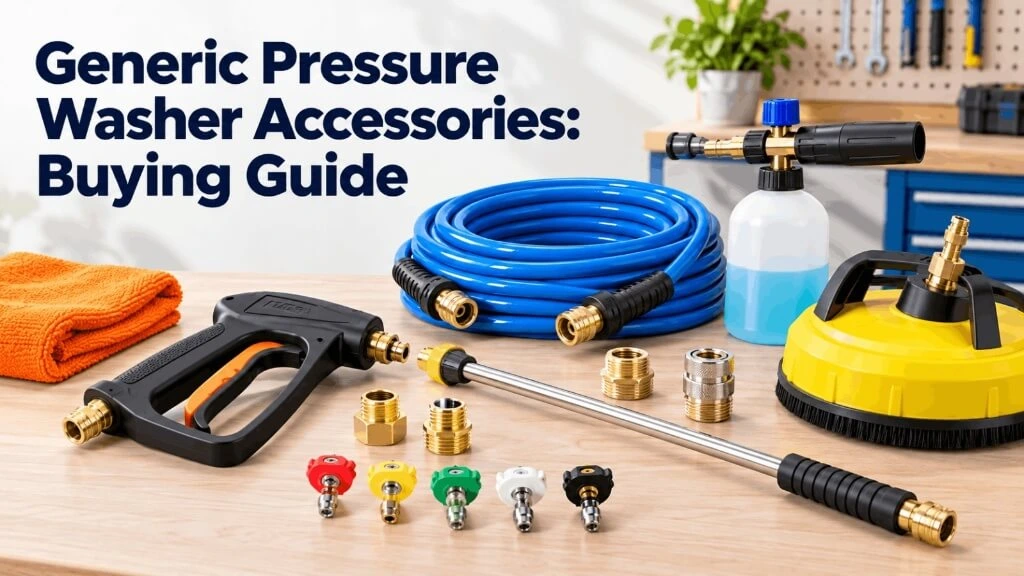
buying guide

Complete collection of generic pressure washer accessories including hose, spray gun, nozzles, and foam cannon.
Guides & Tips

Generic Pressure Washer Accessories: Fit and Buying Guide

Two spray guns appear almost identical in a shopping listing. One names your washer model, while the other says “universal” and costs less. The cheaper option might work well—but a photograph cannot show whether the inlet seals correctly or the gun can handle your machine. Quick answer: Generic pressure washer accessories are worth considering only when the listing documents the complete connection, working PSI, required GPM, temperature limit, intended use, and return or support terms. “Universal” describes a marketing claim, not proof that an accessory fits every pressure washer. This guide explains how to compare aftermarket hoses, fittings, nozzles, foam cannons, and other attachments. It focuses on fit, value, supplier support, and safe use. Here, “generic” means a general or third-party accessory; it is not another name for the Generac brand. What Are Generic Pressure Washer Accessories? The word “generic” is used loosely in product listings. It may describe an unbranded component, an accessory sold under a retailer’s label, or a third-party product intended for several equipment brands. Aftermarket accessories can also come from established specialist manufacturers. They are not automatically low-quality simply because the washer maker did not supply them. Generic, aftermarket, and OEM explained | Term | What it generally means | What it does not prove | |—|—|—| | OEM | Supplied as original equipment or its designated replacement | That every part from the brand fits your model | | Aftermarket | Supplied by another company for replacement or added capability | Poor quality or guaranteed compatibility | | Generic | Broadly described, sometimes unbranded or sold across several brands | A consistent specification or quality level | | Universal | Advertised to fit multiple systems | Compatibility with every pressure washer | Treat these labels as a starting point. Dimensions, operating ratings, instructions, and support are the evidence that matters. This is a selection guide based on equipment requirements and practical buying considerations. It does not claim product testing, verified customer experiences, or measured savings across brands. When Aftermarket Pressure Washer Accessories Make Sense A well-documented third-party accessory can be useful when you need a different hose length, a more comfortable gun, or a cleaning attachment that the original package lacks. It may also provide an alternative when an older accessory is difficult to source. However, an unavailable original part does not make the nearest-looking replacement suitable. Good reasons to consider one Look beyond price to the problem being solved. A flexible hose may make washing around a vehicle easier. A correctly matched foam cannon may suit regular shampoo application. A suitable connector may reduce repeated threading during setup. For a small cleaning business, documented compatible components can simplify spare-parts stock. Confirm each machine’s requirements before standardizing connections. When to choose a model-specific route Use greater caution with proprietary guns, electrical components, internal pump parts, and pressure-control assemblies. These require exact identification and may need professional installation or adjustment. If neither the listing nor the supplier can explain compatibility clearly, choose another product. Buying a documented part is usually a better decision than experimenting with a pressurized connection. Pressure Washer Accessory Compatibility: Five Checks 1. Identify the complete washer Record the machine model and revision from its identification label. A gas engine’s model number helps identify engine parts, but may not identify the hose, gun, or pump installed by the equipment manufacturer. Check whether the current setup has been modified. A replacement gun or pump can change what fits, even when the original manual is correct for the factory assembly. 2. Confirm the working pressure Every high-pressure component must be suitably rated for the washer’s specified maximum pressure. A higher burst-pressure number is not the same as a safe working-pressure rating. Do not buy a lower-rated hose because you plan to stand farther from the surface. Spray distance changes what reaches the surface, not the hose’s required rating. 3. Match water flow GPM means gallons per minute. Accessories such as surface cleaners and foam cannons need an appropriate flow range as well as an acceptable pressure range. A cleaner that requires more water than your pump supplies may work poorly despite connecting correctly. An adapter cannot add pump capacity. 4. Check temperature and detergent suitability Cold-water components are not automatically suitable for hot-water use. Seals, hoses, and bottles must also tolerate the approved cleaning solution. Do not assume a metal-bodied fitting makes the whole assembly suitable for every chemical. The seal material and internal components matter too. 5. Confirm the connection at both ends A hose has two ends, and a gun usually has separate inlet and outlet connections. Verify the entire route rather than just the most visible fitting. Electric and gas labels are too broad to settle this question. Our guide to electric and gas pressure washers explains the machine differences, but individual model specifications still decide accessory fit. Universal Pressure Washer Fittings: Read the Fine Print A listing may describe an adapter set as universal because it includes common connections. That claim does not mean it suits every proprietary system or every sealing dimension. M22 pressure washer adapters M22 refers to a threaded connection. Common pressure washer versions use different sealing insert dimensions, including 14 mm and 15 mm. Those versions should not be treated as interchangeable simply because the outer threads engage. Check the original specifications and the adapter’s dimensions. If measurement is needed, do it only on disconnected, depressurized equipment. A correct adapter bridges a known difference. It does not repair damaged threads or compensate for an unsuitable seal. Quick connectors and garden-hose couplers Quick connectors use mating plugs and sockets. Confirm their size, profile, working rating, and intended position in the setup. A 1/4-inch nozzle connector and a 3/8-inch hose connector are different connection points. Likewise, garden-hose couplers belong on the supply side, not in the high-pressure line from the pump to the gun. Inspect mixed kits piece by piece A single kit may contain water-supply fittings and high-pressure fittings. Do not assume the largest PSI figure on the
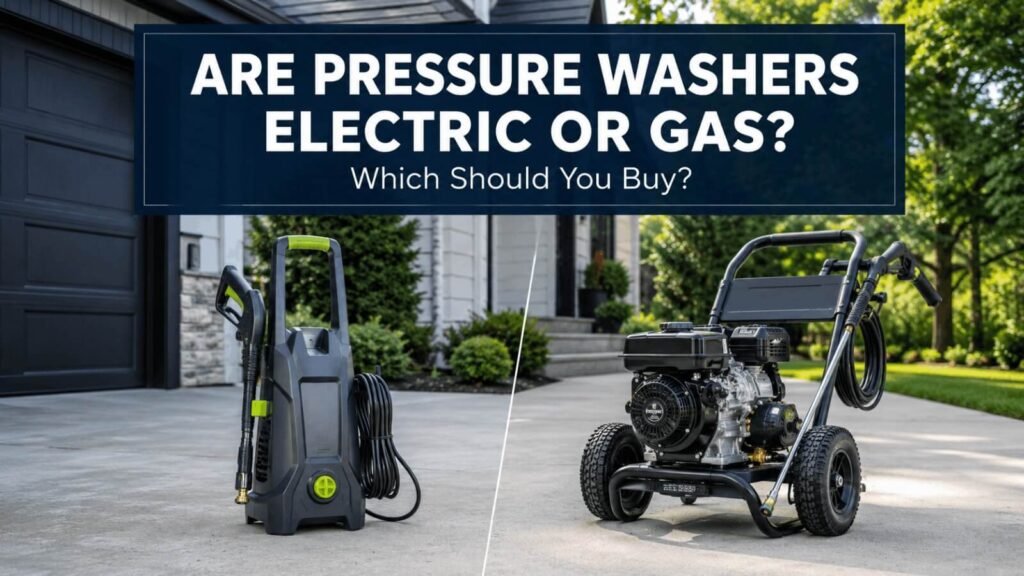
Electric pressure washer and gas pressure washer
Comparisons

Are Pressure Washers Electric or Gas? Which Should You Buy?

Editorial note: This educational comparison explains common differences between electric and gas pressure washers; it is not a hands-on test of specific models. Safety information was checked against current CDC guidance. Always follow the manual for your machine and the care instructions for the surface. Two pressure washers can look almost identical in a product photo yet behave very differently on a driveway. One plugs into an outdoor outlet, starts with a switch, and stores easily in a garage. The other has a gasoline engine, makes more noise, and may clean a large concrete area much faster. Are Pressure Washers Electric or Gas? They can be either. Electric pressure washers use a motor powered by a cord, battery, or dedicated electrical supply. Gas pressure washers use a small combustion engine. Both drive a pump that increases water pressure, but their power, water flow, mobility, maintenance, noise, and best uses are different. Electric is usually simpler for cars, furniture, siding, and small patios. Gas suits large driveways, heavy equipment, big properties, and repeated demanding work. Choose according to the job, not the biggest number on the box. Pressure washers are available in both electric and gas-powered designs. Corded electric machines are common for light and medium home cleaning. Gas models are popular when higher flow, stronger output, and freedom from a power cord are needed. Battery-powered cleaners also exist, but most are designed for portable rinsing and smaller jobs. The power source does not clean the surface directly. It turns the pump. Water enters through a garden hose, the pump raises its pressure, and a high-pressure hose carries it to the spray gun and nozzle. The nozzle then controls the shape and intensity of the spray. Both types can clean effectively. The real question is which provides the right pressure, water flow, reach, control, and durability for your regular jobs. Electric vs Gas Pressure Washer: Quick Comparison Factor Electric Pressure Washer Gas Pressure Washer Power source Corded motor, battery, or dedicated electrical supply Gasoline engine Best for Cars, furniture, small patios, routine siding and light home cleaning Large driveways, long fences, equipment and repeated heavy work Output pattern Usually lower GPM and easier to control Usually higher PSI and GPM for faster heavy cleaning Mobility Limited by cord and outlet on corded models Not tied to an outlet, but still needs a water supply Noise Generally quieter Louder; hearing protection may be needed Maintenance Lower; no fuel, engine oil or spark plug Engine oil, fuel system, air filter and spark plug need attention Weight and storage Usually lighter and more compact Usually heavier and requires fuel-safe storage Exhaust No engine exhaust at the machine Produces carbon monoxide and must remain outdoors Starting Switch or trigger-controlled system Recoil or electric start, depending on model Typical buyer Homeowner or occasional user Large-property owner, contractor or frequent heavy-duty user These are common patterns, not strict rules. Commercial electric and compact gas machines may differ, so compare exact specifications and the manual. How Electric Pressure Washers Work An electric motor drives the pump. Most residential units use a standard household outdoor circuit, while commercial machines may require higher-voltage service. Main Advantages of Electric Models Easy starting: Connect the water, purge air, plug into a suitable protected outlet, and follow the start procedure. Lower maintenance: No gasoline, engine oil, air filter, carburetor, or spark plug is required. Quieter and lighter: Electric machines are generally easier to use, move, and store. No engine exhaust: There are no combustion fumes at the machine. Useful control: Their output often suits cars, furniture, small decks, and other delicate work. Main Limitations of Electric Models The cord limits range and must be managed around hoses and runoff. Use an extension cord only when the manufacturer permits it and specifies the outdoor rating, gauge, and length. Many electric models also move less water than gas machines, so a large driveway may take longer. Budget units may have short hoses, proprietary fittings, or non-serviceable pumps. Who Should Choose Electric? Choose electric for vehicles, furniture, bins, small patios, short fences, and occasional low-pressure siding washing near a suitable outlet. It is also the easier choice when storage space is limited or you want to avoid fuel and engine maintenance. An electric pressure washer may not be the best choice if the farthest cleaning point is beyond safe cord reach or if you regularly clean large, heavily soiled concrete areas. How Gas Pressure Washers Work A gasoline engine turns the pump. It can move around a large property without an outlet, but it still needs an adequate water supply. Main Advantages of Gas Models Higher output: Gas machines commonly combine stronger pressure with more water flow. Faster large-area work: Higher GPM clears loosened dirt from concrete and equipment more quickly. Outlet-free mobility: Useful on farms, jobsites, and large properties. Heavy-duty options: Strong frames, long hoses, and serviceable triplex pumps are available. Accessory support: Higher flow can run larger compatible surface cleaners effectively. Main Limitations of Gas Models Gas units are louder, heavier, and harder to maintain. Fuel can degrade in storage, while engine oil, filters, and spark plugs need service. Exhaust is the most important limitation. A gasoline engine produces carbon monoxide, an invisible and potentially deadly gas. Never run a gas pressure washer inside a home, garage, basement, shed, warehouse, or partly enclosed space. The CDC advises keeping gasoline-powered pressure washers outdoors and at least 20 feet from doors, windows, and vents. Who Should Choose Gas? Choose gas for large driveways, long walkways, equipment, broad hardscapes, properties without suitable outlets, and commercial work that demands higher flow. Before buying, compare pump type, service access, hose length, nozzle set, frame construction, and engine support. . Our gas pressure washer guide explains these factors in more detail. PSI and GPM: Which Type Has More Cleaning Power? Gas pressure washers generally provide higher pressure and water flow in the residential market, but the numbers need context. PSI describes cleaning force, while GPM describes water flow. PSI

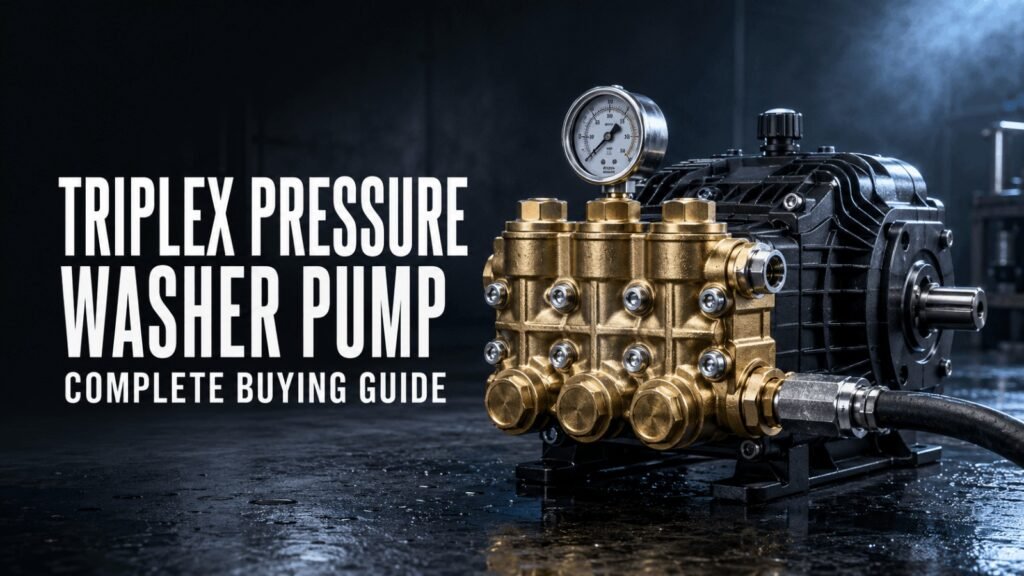
Triplex Pressure Washer Pump Complete Buying Guide Banner
Pressure Washers ➔ Guides & Tips

Triplex Pressure Washer Pump Buying Guide (2026): Types, Specs & Selection

A pressure washer may have a powerful engine, a durable frame, and a professional spray gun, but it cannot clean properly without the right pump. The pump is the core component that converts incoming water into a controlled, high-pressure flow. For demanding cleaning work, a Triplex Pressure Washer Pump is often the preferred choice. It is engineered to deliver steady pressure, handle longer operating sessions, and allow straightforward servicing when seals, valves, or other wear parts need replacement. However, choosing a triplex pump is not as simple as buying the model with the highest PSI. The pump must match your pressure washer’s engine, shaft, mounting pattern, operating speed, water supply, hose, unloader, and intended cleaning work. This comprehensive guide explains how triplex pumps work, how they compare with axial and wobble-plate pumps, what specifications matter most, and how to avoid expensive compatibility mistakes. Pressure Washer Pump: What It Does and Why It Matters A pressure washer pump receives water from a garden hose, tank, or other approved water source. It then moves that water through internal valves and sends it toward the high-pressure hose, spray gun, and nozzle. The pump does not simply “make water powerful.” Its job is to control two critical metrics of pressure washer performance: PSI (Pounds per Square Inch): Represents the force of the water hitting a surface. GPM (Gallons per Minute): Represents the volume of water passing through the system every minute. Both measurements matter. High PSI helps loosen stubborn dirt, while adequate GPM carries the broken dirt away and helps clean a larger area faster. Why the Pump Directly Affects Cleaning Performance A strong engine cannot compensate for a damaged, undersized, or incorrectly matched pump. Common symptoms of a pump-related problem include: Low or inconsistent operating pressure Pulsing flow at the spray gun Water leaking from the pump body Pump oil appearing milky or cloudy Excessive vibration or unusual mechanical noise Pressure dropping significantly after a few minutes of operation Water spraying from the thermal relief valve The engine struggling or stalling when the trigger is pulled Note: Not every pressure problem is caused by the pump. A clogged nozzle, restricted water inlet, leaking hose, dirty filter, trapped air, or incorrectly adjusted unloader can produce similar symptoms. The safer approach is to inspect the complete water path before deciding that the pump must be replaced. Main Pressure Washer Pump Types Compared Most pressure washers use one of three general pump designs depending on their intended application, price point, and serviceability. Pump Type Common Application Serviceability Expected Workload Wobble-Plate Pump Small, affordable electric washers Usually limited / Non-serviceable Occasional light home cleaning Axial-Cam Pump Residential electric and gas washers Varies by model Regular homeowner maintenance Triplex Plunger Pump Prosumer and professional machines Fully serviceable / Rebuildable Frequent or extended heavy cleaning This comparison does not mean every triplex pump will outlast every axial pump. Build quality, maintenance, water conditions, correct installation, and operating temperature all affect overall pump life. A well-built axial pump used correctly may be a better purchase for an occasional homeowner than a poorly matched triplex replacement. High Pressure Washer Pump: Understanding PSI, GPM, and Cleaning Output A High Pressure Washer Pump must deliver the right balance of pressure and water flow for the machine and cleaning job. Choosing only by maximum PSI is one of the most common buying mistakes in the pressure washing industry. PSI Measures Physical Cleaning Force PSI tells you how much pressure the pump can produce under its rated operating conditions. Higher pressure helps with: Cleaning durable concrete and masonry Removing thick, baked-on mud from heavy equipment Stripping loose paint from suitable surfaces Removing heavy environmental buildup from commercial areas However, more PSI is not automatically safer or more useful. Too much pressure can damage vehicle paint, wood fibers, vinyl siding, seals, outdoor furniture, grout, and soft stone. The nozzle angle, distance from the surface, cleaning chemical, water flow, and operator technique are often more important than using maximum pressure. GPM Affects Cleaning Speed and Rinsing Ability GPM measures water volume. A pump with higher GPM can usually rinse loosened debris faster and cover a larger area in less time. For example, two machines may both produce 3,000 PSI. If one delivers 2.3 GPM and the other delivers 4.0 GPM, the 4.0 GPM machine will generally clean large concrete areas twice as fast, provided the engine, nozzle, surface cleaner, and water supply are correctly matched. Higher GPM is especially useful for: Driveway and parking-area cleaning Large patios and building exteriors Commercial surface cleaning & fleet washing Farm and construction equipment Rinsing thick soap or chemical detergents Critical Supply Warning: The property must supply enough water. Installing a 4.0 GPM pump on a water source that only supplies 2.5 GPM can starve the pump. This causes pressure loss, overheating, vibration, and severe cavitation damage. What Are Cleaning Units (CU)? Cleaning units provide a simple way to compare theoretical cleaning output: $$text{Cleaning Units (CU)} = text{PSI} times text{GPM}$$ 3,000 PSI @ 2.5 GPM: $3,000 times 2.5 = 7,500 text{ CU}$ 4,000 PSI @ 4.0 GPM: $4,000 times 4.0 = 16,000 text{ CU}$ Cleaning units are useful for basic comparison, but they do not measure build quality, pump life, nozzle efficiency, chemical effectiveness, or surface safety. Before selecting a commercial setup, always compare the complete machine specifications. If you are looking for a heavy-duty commercial system, check out our detailed guide on the pressure washer honda 4000 psi to see how engine horsepower, pump flow, and structural durability work together. Rated Pressure vs. Maximum Pressure Some product listings emphasize maximum or peak pressure. This figure may only be reached briefly under specific ideal conditions. Rated (working) pressure is far more useful because it represents the continuous pressure the pump is designed to deliver during normal operation. When comparing pumps, always verify: Rated operating pressure & Rated GPM Maximum allowable pressure Maximum RPM Required engine or motor horsepower (HP) Recommended nozzle orifice size Triplex Pressure Washer Pump: How the Design

Scroll to Top