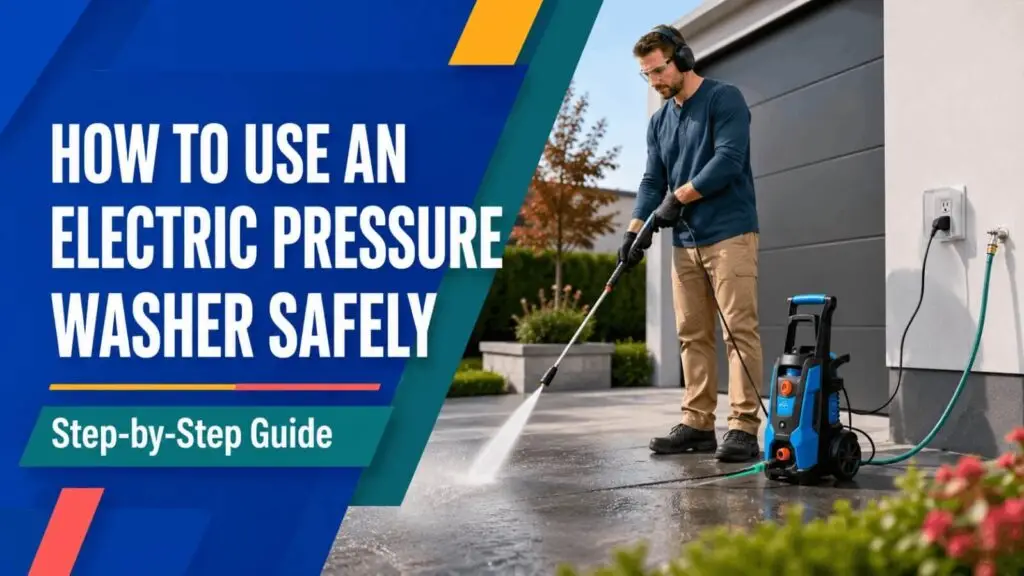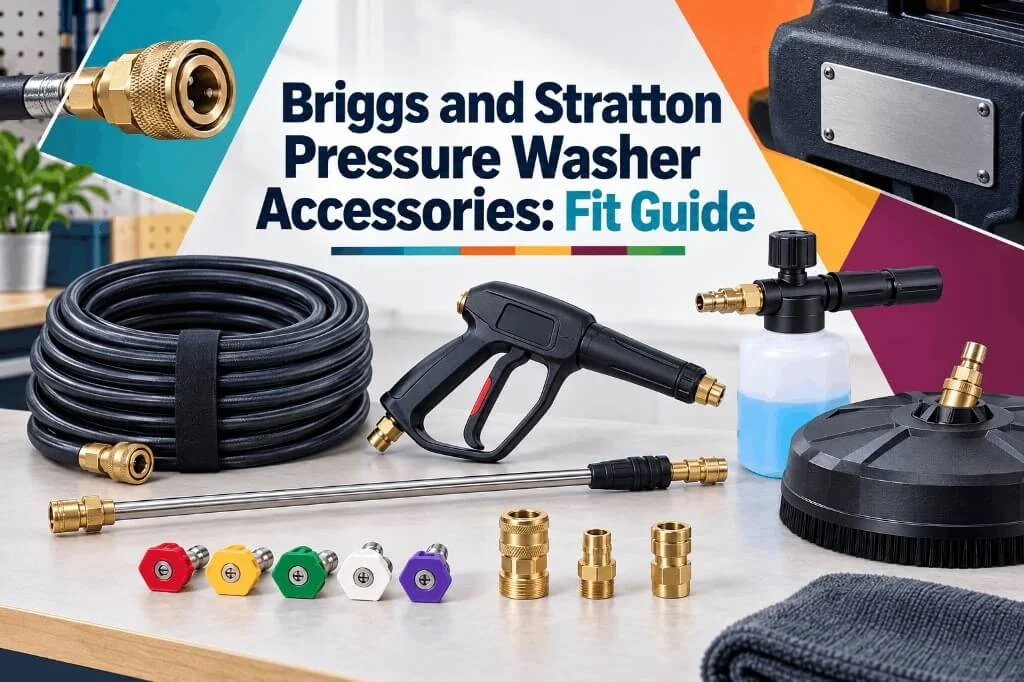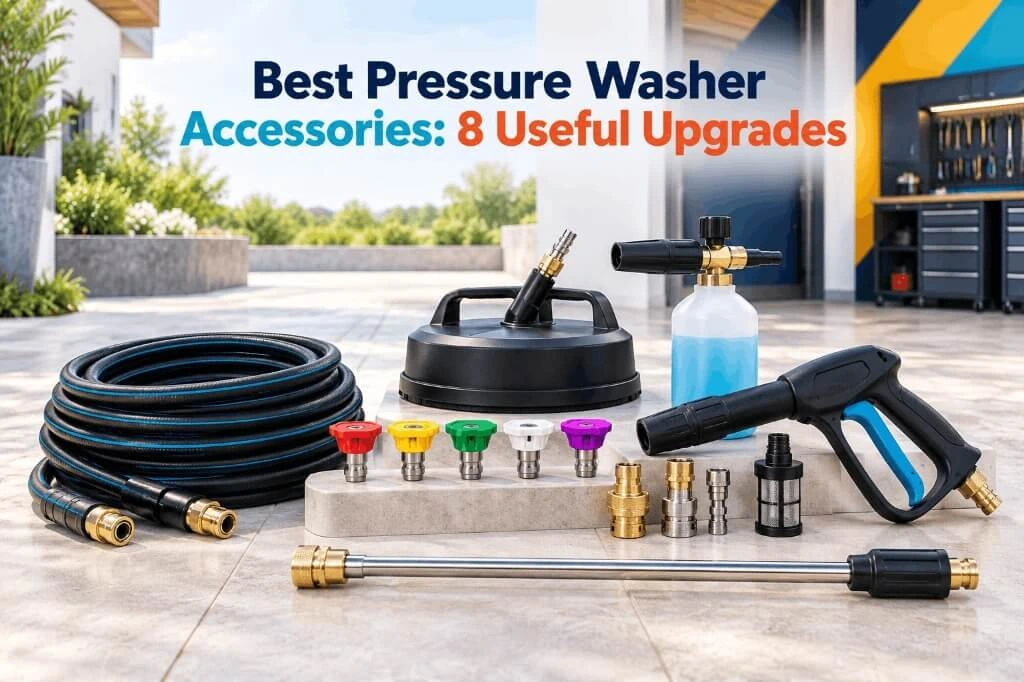
Two spray guns appear almost identical in a shopping listing. One names your washer model, while the other says “universal” and costs less. The cheaper option might work well—but a photograph cannot show whether the inlet seals correctly or the gun can handle your machine.
Quick answer: Generic pressure washer accessories are worth considering only when the listing documents the complete connection, working PSI, required GPM, temperature limit, intended use, and return or support terms. “Universal” describes a marketing claim, not proof that an accessory fits every pressure washer.
This guide explains how to compare aftermarket hoses, fittings, nozzles, foam cannons, and other attachments. It focuses on fit, value, supplier support, and safe use. Here, “generic” means a general or third-party accessory; it is not another name for the Generac brand.
What Are Generic Pressure Washer Accessories?
The word “generic” is used loosely in product listings. It may describe an unbranded component, an accessory sold under a retailer’s label, or a third-party product intended for several equipment brands.
Aftermarket accessories can also come from established specialist manufacturers. They are not automatically low-quality simply because the washer maker did not supply them.
Generic, aftermarket, and OEM explained
| Term | What it generally means | What it does not prove | |—|—|—| | OEM | Supplied as original equipment or its designated replacement | That every part from the brand fits your model | | Aftermarket | Supplied by another company for replacement or added capability | Poor quality or guaranteed compatibility | | Generic | Broadly described, sometimes unbranded or sold across several brands | A consistent specification or quality level | | Universal | Advertised to fit multiple systems | Compatibility with every pressure washer |
Treat these labels as a starting point. Dimensions, operating ratings, instructions, and support are the evidence that matters.
This is a selection guide based on equipment requirements and practical buying considerations. It does not claim product testing, verified customer experiences, or measured savings across brands.
When Aftermarket Pressure Washer Accessories Make Sense
A well-documented third-party accessory can be useful when you need a different hose length, a more comfortable gun, or a cleaning attachment that the original package lacks.
It may also provide an alternative when an older accessory is difficult to source. However, an unavailable original part does not make the nearest-looking replacement suitable.
Good reasons to consider one
Look beyond price to the problem being solved. A flexible hose may make washing around a vehicle easier. A correctly matched foam cannon may suit regular shampoo application. A suitable connector may reduce repeated threading during setup.
For a small cleaning business, documented compatible components can simplify spare-parts stock. Confirm each machine’s requirements before standardizing connections.
When to choose a model-specific route
Use greater caution with proprietary guns, electrical components, internal pump parts, and pressure-control assemblies. These require exact identification and may need professional installation or adjustment.
If neither the listing nor the supplier can explain compatibility clearly, choose another product. Buying a documented part is usually a better decision than experimenting with a pressurized connection.
Pressure Washer Accessory Compatibility: Five Checks
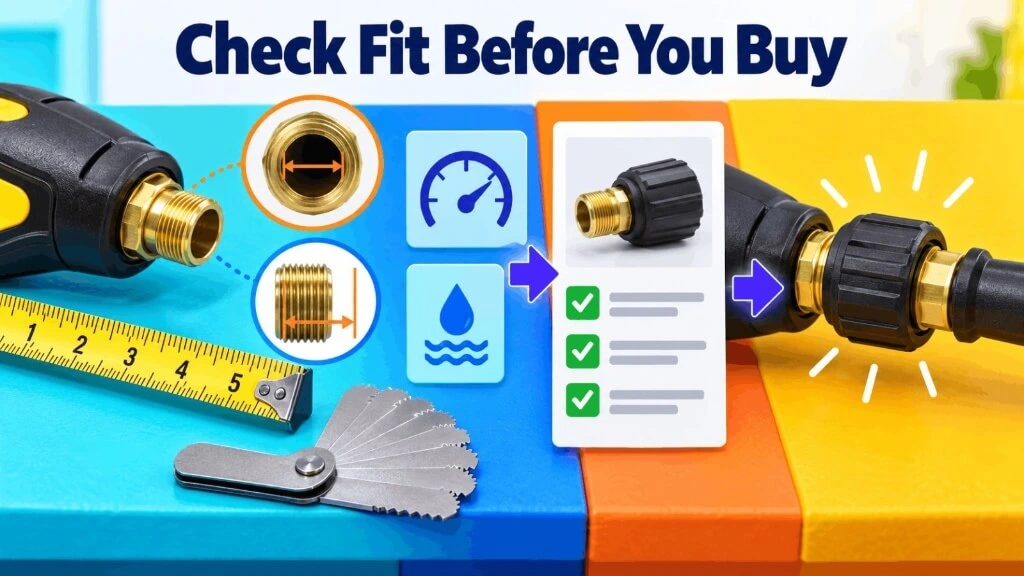
1. Identify the complete washer
Record the machine model and revision from its identification label. A gas engine’s model number helps identify engine parts, but may not identify the hose, gun, or pump installed by the equipment manufacturer.
Check whether the current setup has been modified. A replacement gun or pump can change what fits, even when the original manual is correct for the factory assembly.
2. Confirm the working pressure
Every high-pressure component must be suitably rated for the washer’s specified maximum pressure. A higher burst-pressure number is not the same as a safe working-pressure rating.
Do not buy a lower-rated hose because you plan to stand farther from the surface. Spray distance changes what reaches the surface, not the hose’s required rating.
3. Match water flow
GPM means gallons per minute. Accessories such as surface cleaners and foam cannons need an appropriate flow range as well as an acceptable pressure range.
A cleaner that requires more water than your pump supplies may work poorly despite connecting correctly. An adapter cannot add pump capacity.
4. Check temperature and detergent suitability
Cold-water components are not automatically suitable for hot-water use. Seals, hoses, and bottles must also tolerate the approved cleaning solution.
Do not assume a metal-bodied fitting makes the whole assembly suitable for every chemical. The seal material and internal components matter too.
5. Confirm the connection at both ends
A hose has two ends, and a gun usually has separate inlet and outlet connections. Verify the entire route rather than just the most visible fitting.
Electric and gas labels are too broad to settle this question. Our guide to electric and gas pressure washers explains the machine differences, but individual model specifications still decide accessory fit.
Universal Pressure Washer Fittings: Read the Fine Print
A listing may describe an adapter set as universal because it includes common connections. That claim does not mean it suits every proprietary system or every sealing dimension.
M22 pressure washer adapters
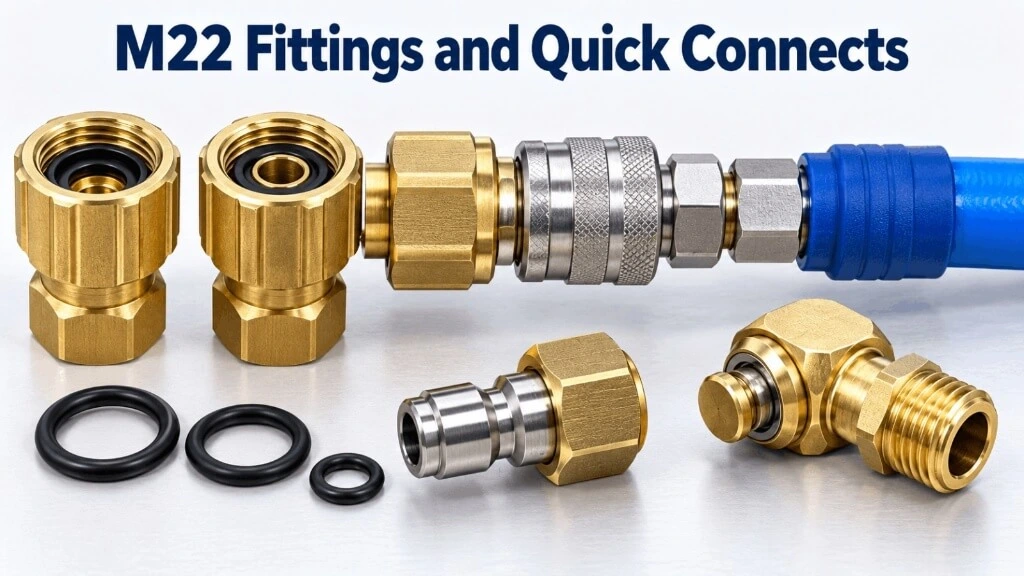
M22 refers to a threaded connection. Common pressure washer versions use different sealing insert dimensions, including 14 mm and 15 mm.
Those versions should not be treated as interchangeable simply because the outer threads engage. Check the original specifications and the adapter’s dimensions. If measurement is needed, do it only on disconnected, depressurized equipment.
A correct adapter bridges a known difference. It does not repair damaged threads or compensate for an unsuitable seal.
Quick connectors and garden-hose couplers
Quick connectors use mating plugs and sockets. Confirm their size, profile, working rating, and intended position in the setup.
A 1/4-inch nozzle connector and a 3/8-inch hose connector are different connection points. Likewise, garden-hose couplers belong on the supply side, not in the high-pressure line from the pump to the gun.
Inspect mixed kits piece by piece
A single kit may contain water-supply fittings and high-pressure fittings. Do not assume the largest PSI figure on the package applies to every item.
Count the pieces you actually need. Several duplicates can make a kit look better value while leaving you without the one adapter required for your machine.
Choosing a Generic Pressure Washer Hose
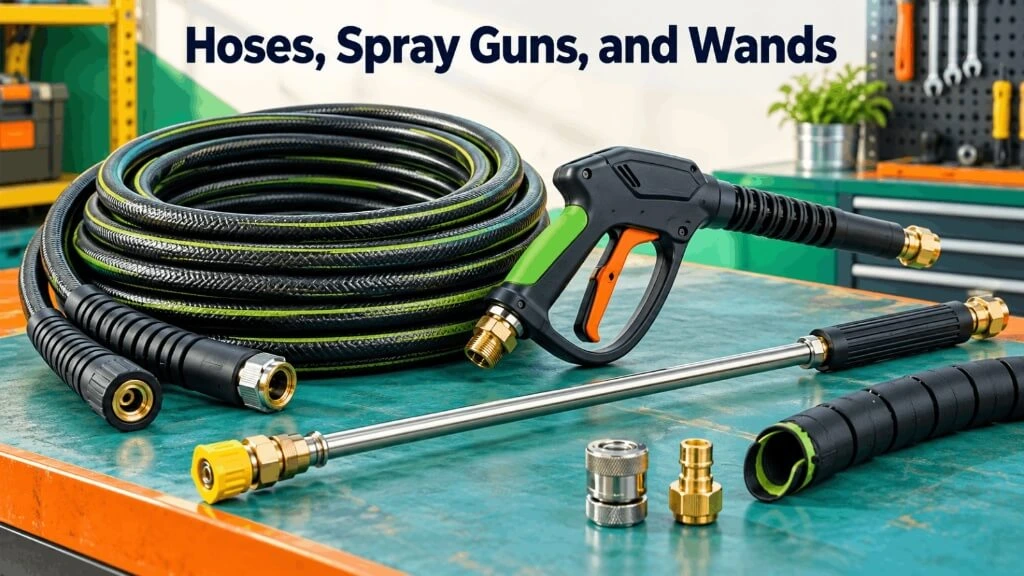
A hose listing should identify length, internal diameter, working pressure, temperature limits, and both end connections. Missing any of those details makes comparison difficult.
Decide what needs improving
For car washing, you may want enough reach to move around the vehicle without pulling the machine. For regular paving work, abrasion resistance and manageable coiling may matter more.
Longer hoses add weight and friction loss. Follow the washer’s approved limits for length and bore instead of joining several extensions to reach farther.
A product photo does not establish flexibility. Look for clear material information, handling details, and a return policy that allows a sensible inspection before use.
Reject unsafe replacements
Do not use a hose with visible reinforcement, bulges, deep cuts, or leaking crimped ends. A new product should also arrive with secure fittings and consistent identification matching the order.
Never patch a high-pressure hose with tape or ordinary hose clamps. If the delivered markings conflict with the seller’s rating, keep it unused and ask for clarification or a replacement.
Generic Nozzles, Spray Guns, and Foam Cannons
These accessories can be practical alternatives, but each has a different compatibility question.
Nozzles: match the opening as well as the pattern
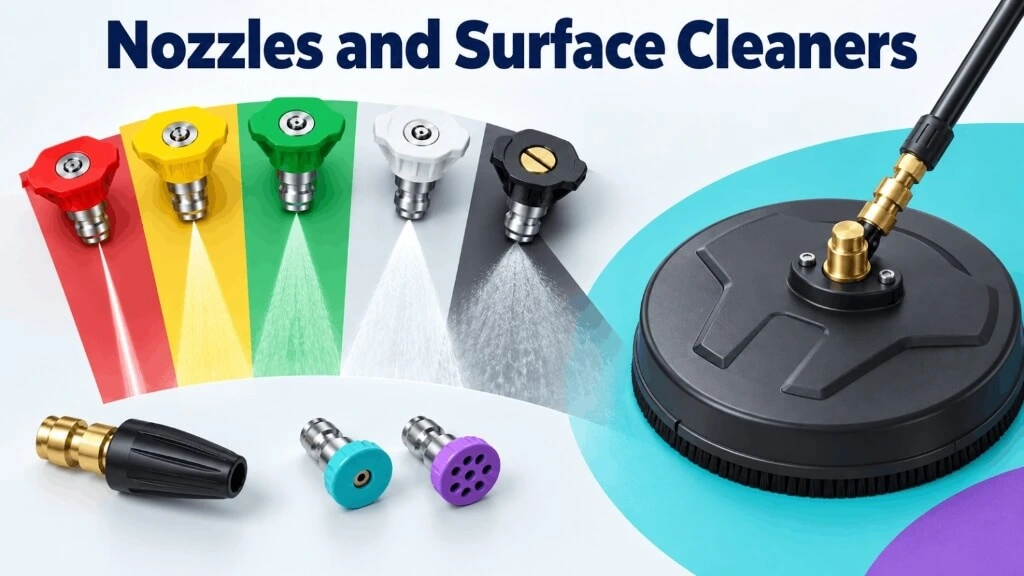
The fan angle controls spray width. The orifice is the opening that must suit the washer’s intended pressure and flow. A tip that clips into the wand has passed only the connection check.
Use the specified nozzle size or an approved sizing chart. Color coding commonly identifies the spray pattern, not the full operating specification.
Avoid buying a turbo nozzle as a supposed gentle upgrade. Its rotating concentrated jet can damage paint, timber, or fragile surfaces.
Spray guns: assess the complete assembly
Check inlet and outlet fit, working ratings, trigger lock, grip, and balance with the wand attached. A swivel or short handle is useful only if the resulting assembly suits the task.
Do not accept a sticking trigger or a gun that fails to shut off. Never tie the trigger open to make prolonged use easier.
Foam cannons: check operating requirements
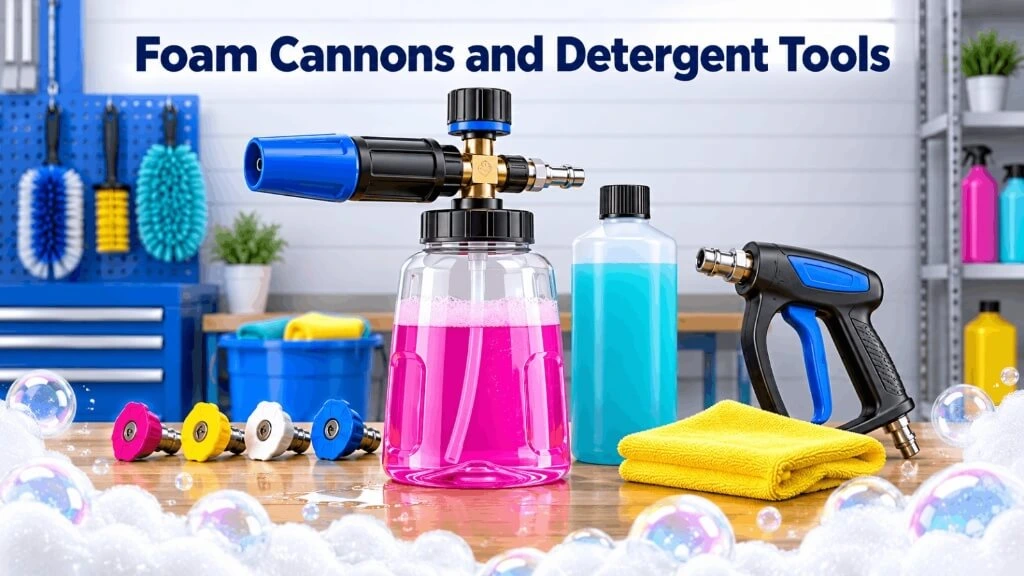
Look for a stated pressure and flow range, compatible connector, recommended orifice, and available replacement seals or pickup tubes.
Thicker foam is not proof of better cleaning. Use suitable shampoo at the recommended dilution, work on cool panels, and prevent detergent from drying. A garden-hose foam gun operates differently from a pressure-washer foam cannon, so check which product is being sold.
Generic Surface Cleaners and Other Larger Attachments
A surface cleaner can help with broad areas of suitable concrete, but its diameter should not lead the buying decision. Confirm minimum flow, pressure range, nozzle sizing, and the connection first.
A wide head on an underpowered setup may need slow passes or produce uneven results. It can also damage weak concrete, coatings, or loose paving joints. A covered spray bar does not remove those risks.
With extension wands, evaluate working length, weight, recoil, and safe access. A fitting that holds securely does not guarantee the operator can control the extended assembly.
Additional inlet filters need suitable flow capacity. A restrictive filter may reduce supply to the pump. A basic sediment filter also does not automatically remove dissolved minerals or prevent vehicle water spots.
How to Judge an Online Listing
A useful product page lets you answer technical questions before payment. Promotional words such as “premium,” “commercial,” and “heavy duty” need supporting details.
Ask these questions when information is missing
- What are the working-pressure and temperature ratings?
- What are the exact connection and sealing dimensions?
- Does this accessory require a minimum flow or a particular nozzle size?
- Are instructions and replacement seals available?
- Is my complete washer model specifically supported?
- What happens if the delivered item differs from the stated specifications?
A written supplier response gives you something concrete to compare with the delivered product. It is still not a reason to ignore conflicting instructions from the washer manufacturer.
Compare the complete cost
Include adapters, shipping, spare parts, and any return charges. Prices and availability can change, and a small saving can disappear if the accessory needs several extra fittings.
Customer reviews may help identify questions about handling or packaging, but confirm the exact variant being discussed. A shared listing can cover different sizes. A star rating cannot establish pressure compatibility.
OEM vs Aftermarket Accessories: A Practical Decision
| Situation | Sensible approach | Why | |—|—|—| | Standard external connection with complete specifications | Compare documented OEM and aftermarket options | Fit and operating limits can be checked | | Proprietary fitting with unclear dimensions | Choose a model-listed option or confirmed adapter | Appearance alone is unreliable | | Older washer with discontinued accessory | Ask for a documented equivalent | Avoids random trial purchases | | Internal pump or electrical repair | Use exact parts information and qualified support | More than external fit is involved | | Very low-priced product without ratings | Keep looking | Missing safety information prevents a sound decision |
There is no need to declare either category the winner. Choose the product that meets the requirements and has adequate support. Check the applicable warranty terms rather than assuming either that all aftermarket use is prohibited or that all related damage would be covered.
Common Mistakes People Make
- Forcing a connection that almost fits: Stop and check dimensions. Extra tightening can damage the fitting or sealing surface.
- Using tape to solve every leak: Some joints seal with O-rings or washers. Follow the connection instructions; tape does not correct a mismatch.
- Buying by material name alone: Brass or stainless steel does not prove machining quality, seal suitability, or pressure capacity.
- Ignoring water supply: Check the hose, tap, and inlet screen before blaming an attachment for poor performance.
- Using the new attachment on a visible surface first: Test an approved hidden area and inspect the result before wider cleaning.
Safe First Use and Maintenance
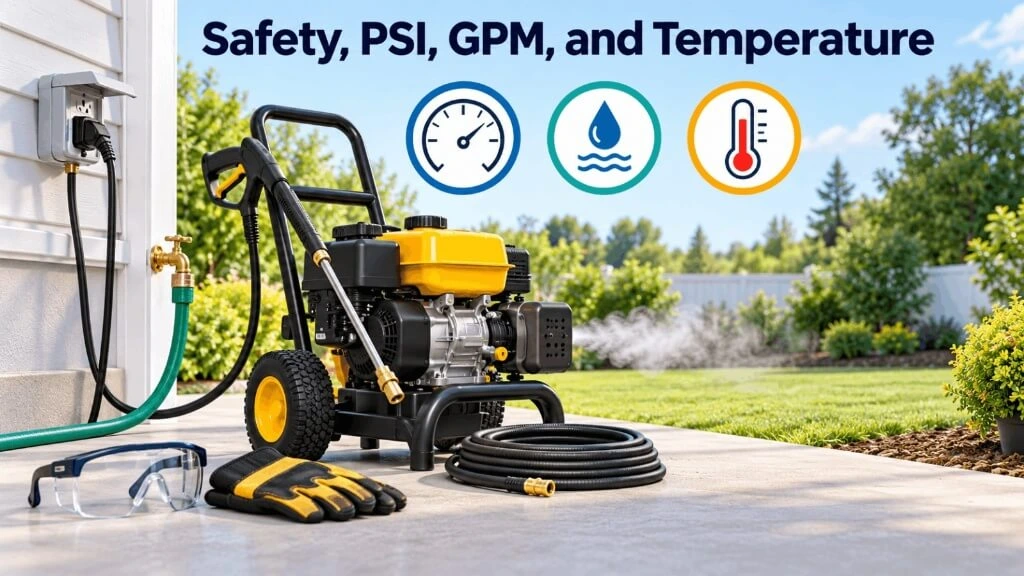
Follow the machine manual, accessory instructions, surface guidance, and detergent label. Isolate the power source and release pressure as instructed before installation or inspection.
Wear eye protection and sturdy non-slip footwear. Keep people and pets clear. Never feel for leaks with your hand. Seek prompt medical care for a high-pressure spray wound, even when it appears minor.
Operate gasoline-powered washers outdoors and keep engine exhaust away from doors, windows, vents, and enclosed or partly enclosed spaces. The CDC has documented carbon monoxide poisoning caused by indoor use of gasoline-powered pressure washers. Keep electric connections dry and use the ground-fault protection required by the manufacturer. Our electric pressure washer setup guide explains the basic connection sequence.
After cleaning, flush detergent equipment and drain components as directed. Keep connector surfaces free of grit, coil hoses without sharp bends, and protect water-containing parts from freezing. Keep a record of confirmed compatible items and the correct replacement seals.
Simple Action Plan
Step 1: Define the purchase
Identify the task or failed component. Record the complete washer model and current connection details, including any previous modifications.
Step 2: Verify the listing
Match the accessory’s pressure, flow, temperature, fittings, and intended use. Ask about missing information before ordering.
Step 3: Inspect the delivery
Check markings, package contents, seals, and fittings against what was advertised. Keep an uncertain item unused while you resolve discrepancies.
Step 4: Use and evaluate
Follow the approved startup and surface-test procedure. Stop for leaks, pulsing, unusual movement, or poor control. Judge value by safe fit and useful performance, not by whether you managed to attach it.
Frequently Asked Questions
Does generic mean the same thing as Generac?
No. Generic describes a general or third-party product category. Generac is a brand name. If you own that brand, search using the exact washer model and the accessory requirements in its manual.
Are generic pressure washer accessories always cheaper?
No. Compare the actual product and full setup cost. Some aftermarket accessories are specialist upgrades, while inexpensive kits may require extra adapters. Price does not tell you whether either option fits.
Can I use one accessory on several washers?
Possibly, when all machines meet its connection and operating requirements. Check each setup separately. A shared brand name or similar advertised PSI is not enough to establish interchangeability.
Will a universal adapter increase pressure?
No. An adapter changes a connection. It cannot increase rated pump capacity or make an under-supplied attachment work properly. Unnecessary restrictions may instead affect performance.
What if the adapter screws on but still leaks?
Stop, depressurize, and check the specified sealing dimensions, seal condition, and mating surfaces. Do not keep tightening or adding sealant without identifying how the connection is designed to seal.
Are generic accessories suitable for professional use?
Some documented aftermarket products may be suitable. Check duty expectations, working ratings, spare-parts availability, and support. A vague “commercial grade” claim is not enough for equipment used repeatedly on paid jobs.
Conclusion: Buy the Specification, Not the Promise
Generic pressure washer accessories can be a sensible choice when their fit, operating limits, and intended use are clear. The value comes from solving a cleaning problem without introducing uncertainty into the setup.
Start with the machine and connection details, compare documented options, and keep poorly specified products out of the basket. If you cannot confirm compatibility, choose a better-supported accessory before putting the system under pressure.