
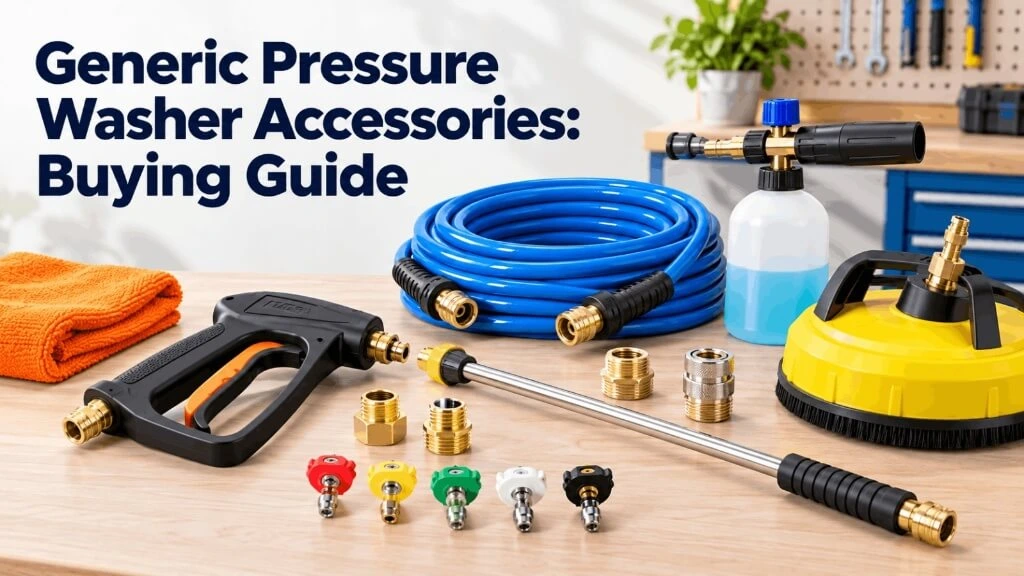
Generic Pressure Washer Accessories: Fit and Buying Guide
Two spray guns appear almost identical in a shopping listing. One names your washer model, while the other says “universal” and costs less. The cheaper option might work well—but a photograph cannot show whether the inlet seals correctly or the gun can handle your machine. Quick answer: Generic pressure washer accessories are worth considering only when the listing documents the complete connection, working PSI, required GPM, temperature limit, intended use, and return or support terms. “Universal” describes a marketing claim, not proof that an accessory fits every pressure washer. This guide explains how to compare aftermarket hoses, fittings, nozzles, foam cannons, and other attachments. It focuses on fit, value, supplier support, and safe use. Here, “generic” means a general or third-party accessory; it is not another name for the Generac brand. What Are Generic Pressure Washer Accessories? The word “generic” is used loosely in product listings. It may describe an unbranded component, an accessory sold under a retailer’s label, or a third-party product intended for several equipment brands. Aftermarket accessories can also come from established specialist manufacturers. They are not automatically low-quality simply because the washer maker did not supply them. Generic, aftermarket, and OEM explained | Term | What it generally means | What it does not prove | |—|—|—| | OEM | Supplied as original equipment or its designated replacement | That every part from the brand fits your model | | Aftermarket | Supplied by another company for replacement or added capability | Poor quality or guaranteed compatibility | | Generic | Broadly described, sometimes unbranded or sold across several brands | A consistent specification or quality level | | Universal | Advertised to fit multiple systems | Compatibility with every pressure washer | Treat these labels as a starting point. Dimensions, operating ratings, instructions, and support are the evidence that matters. This is a selection guide based on equipment requirements and practical buying considerations. It does not claim product testing, verified customer experiences, or measured savings across brands. When Aftermarket Pressure Washer Accessories Make Sense A well-documented third-party accessory can be useful when you need a different hose length, a more comfortable gun, or a cleaning attachment that the original package lacks. It may also provide an alternative when an older accessory is difficult to source. However, an unavailable original part does not make the nearest-looking replacement suitable. Good reasons to consider one Look beyond price to the problem being solved. A flexible hose may make washing around a vehicle easier. A correctly matched foam cannon may suit regular shampoo application. A suitable connector may reduce repeated threading during setup. For a small cleaning business, documented compatible components can simplify spare-parts stock. Confirm each machine’s requirements before standardizing connections. When to choose a model-specific route Use greater caution with proprietary guns, electrical components, internal pump parts, and pressure-control assemblies. These require exact identification and may need professional installation or adjustment. If neither the listing nor the supplier can explain compatibility clearly, choose another product. Buying a documented part is usually a better decision than experimenting with a pressurized connection. Pressure Washer Accessory Compatibility: Five Checks 1. Identify the complete washer Record the machine model and revision from its identification label. A gas engine’s model number helps identify engine parts, but may not identify the hose, gun, or pump installed by the equipment manufacturer. Check whether the current setup has been modified. A replacement gun or pump can change what fits, even when the original manual is correct for the factory assembly. 2. Confirm the working pressure Every high-pressure component must be suitably rated for the washer’s specified maximum pressure. A higher burst-pressure number is not the same as a safe working-pressure rating. Do not buy a lower-rated hose because you plan to stand farther from the surface. Spray distance changes what reaches the surface, not the hose’s required rating. 3. Match water flow GPM means gallons per minute. Accessories such as surface cleaners and foam cannons need an appropriate flow range as well as an acceptable pressure range. A cleaner that requires more water than your pump supplies may work poorly despite connecting correctly. An adapter cannot add pump capacity. 4. Check temperature and detergent suitability Cold-water components are not automatically suitable for hot-water use. Seals, hoses, and bottles must also tolerate the approved cleaning solution. Do not assume a metal-bodied fitting makes the whole assembly suitable for every chemical. The seal material and internal components matter too. 5. Confirm the connection at both ends A hose has two ends, and a gun usually has separate inlet and outlet connections. Verify the entire route rather than just the most visible fitting. Electric and gas labels are too broad to settle this question. Our guide to electric and gas pressure washers explains the machine differences, but individual model specifications still decide accessory fit. Universal Pressure Washer Fittings: Read the Fine Print A listing may describe an adapter set as universal because it includes common connections. That claim does not mean it suits every proprietary system or every sealing dimension. M22 pressure washer adapters M22 refers to a threaded connection. Common pressure washer versions use different sealing insert dimensions, including 14 mm and 15 mm. Those versions should not be treated as interchangeable simply because the outer threads engage. Check the original specifications and the adapter’s dimensions. If measurement is needed, do it only on disconnected, depressurized equipment. A correct adapter bridges a known difference. It does not repair damaged threads or compensate for an unsuitable seal. Quick connectors and garden-hose couplers Quick connectors use mating plugs and sockets. Confirm their size, profile, working rating, and intended position in the setup. A 1/4-inch nozzle connector and a 3/8-inch hose connector are different connection points. Likewise, garden-hose couplers belong on the supply side, not in the high-pressure line from the pump to the gun. Inspect mixed kits piece by piece A single kit may contain water-supply fittings and high-pressure fittings. Do not assume the largest PSI figure on the