
Electric Pressure Washers

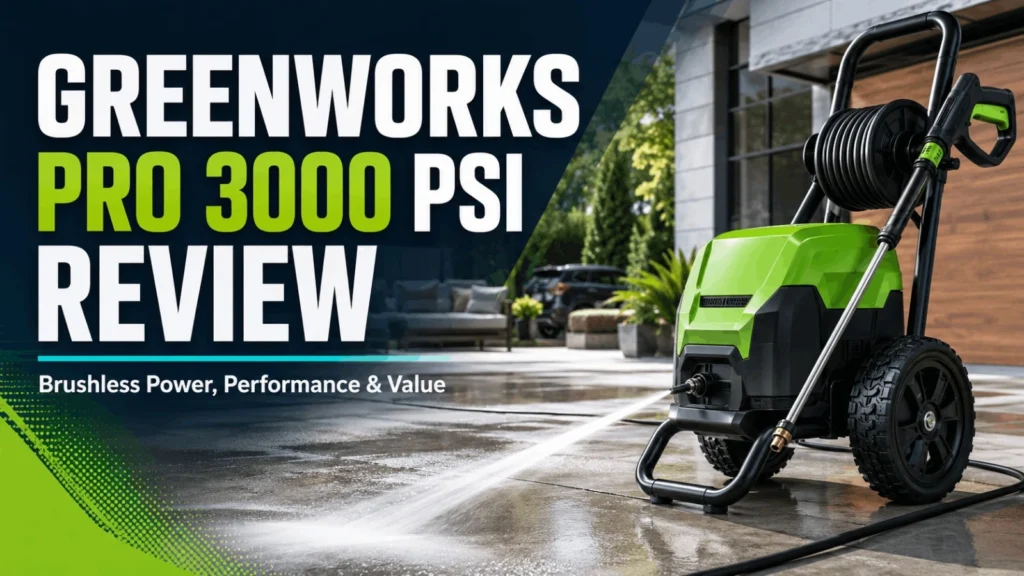
Greenworks Pro 3000 PSI brushless pressure washer review banner showing unit on driveway
Electric Pressure Washers

Greenworks Pro 3000 PSI Brushless Pressure Washer Review: Power and Value

Electric pressure washers are easy to start and maintain, but many compact models feel slow when the job moves from washing a car to cleaning concrete. The Greenworks Pro 3000 PSI brushless pressure washer is designed to offer stronger residential cleaning without gasoline, exhaust, oil changes, or a pull cord. The headline figures require careful explanation. Greenworks lists 3,000 PSI at 1.1 GPM and 2.0 GPM at 100 PSI. These are separate operating points—not 3,000 PSI and 2.0 GPM at the same time. This review covers that important difference, along with the GPW3001 and GPW3002A models, included features, suitable surfaces, common problems, safety, and overall value. How we reviewed it: This is an independent, specification-based review. We checked Greenworks’ current product pages, support information, model details, and public safety guidance. We did not perform instrumented pressure or flow testing, so performance comments are informed suitability judgments rather than laboratory results. Greenworks 3000 PSI Electric Pressure Washer: Quick Verdict The Greenworks Pro 3000 is a capable residential electric washer for concrete, patios, pavers, decks, fencing, siding, vehicles, and outdoor equipment. Its brushless motor, five spray nozzles, 25-foot hose, 35-foot GFCI power cord, onboard soap tank, and 10-inch wheels make it more useful than a basic carry-style machine. Its main limitation is flow at maximum pressure. At 3,000 PSI, the rated flow is 1.1 GPM, so a higher-flow gas washer can rinse a large driveway or heavy mud faster. The Greenworks also needs a suitable 120-volt outlet and dependable water supply. Buying decision Assessment Best for Regular residential cleaning with electric convenience Suitable surfaces Sound concrete, patios, fences, decks, siding, cars and outdoor furniture Main advantage Strong maximum pressure with five nozzles and no gas engine Main limitation 1.1 GPM at maximum pressure limits rinsing speed Portability Steel frame with 10-inch never-flat wheels Overall view Strong choice when its features match frequent home-cleaning jobs Greenworks Pro 3000 PSI Pressure Washer Models: GPW3001 vs GPW3002A Search results can show several Greenworks machines with a 3,000 PSI label. This review covers the corded brushless residential line, mainly the GPW3001, and compares it with the current GPW3002A Gen 2. Model What buyers should know GPW3001 — SKU 5113902 Original corded brushless version. Greenworks lists vertical storage, a one-gallon detergent tank, 25-foot steel-braided hose, 35-foot cord, five nozzles, and 10-inch wheels. GPW3002A — SKU 5128802 Gen 2 corded brushless model with the same rated output, five nozzles, 25-foot hose, 35-foot cord, and open-frame design. 60V/AC and 80V models Different hybrid or battery-powered products. Their batteries, runtime, packages, prices, and warranty terms are outside this review. Always check the complete model and SKU before ordering parts or accessories. Do not assume every “Greenworks 3000 PSI” listing has the same frame, detergent system, package, or warranty. Greenworks Pressure Washer 3000 PSI Specifications The following specifications describe the main GPW3001 configuration. Retail bundles can add accessories, so compare the listing with the supplied manual. Specification Greenworks Pro GPW3001 Power type Corded electric Motor Smart-sensing brushless motor Electrical supply 120V, 60Hz AC Maximum pressure 3,000 PSI Flow at 3,000 PSI 1.1 GPM Maximum flow 2.0 GPM at 100 PSI High-pressure hose 25-foot kink-resistant steel-braided hose Power cord 35 feet with waterproof plug and inline GFCI Included nozzles 15°, 25°, 40°, soap, and turbo Nozzle connection 1/4-inch quick-connect Detergent system One-gallon onboard tank Wheels 10-inch never-flat wheels Certification PWMA-certified performance claims Advertised warranty Three-year tool and ten-year brushless motor warranty for GPW3001 Understanding 3,000 PSI and 2.0 GPM PSI describes water pressure, while GPM describes water flow. Pressure helps loosen dirt; flow helps carry it away. Greenworks lists 3,000 PSI at 1.1 GPM and 2.0 GPM at only 100 PSI. Multiplying 3,000 PSI by 2.0 GPM would therefore create a misleading comparison. This means the washer can apply concentrated pressure to stubborn dirt, but it may rinse wide concrete areas more slowly than a machine delivering higher flow at working pressure. Greenworks Pro 3000: Brushless Motor and Key Features Smart-Sensing Brushless Motor Greenworks says its TRUBRUSHLESS motor adjusts pressure and flow according to the installed nozzle. A brushless electric motor avoids carbon brushes and gas-engine tasks such as fuel storage, oil changes, spark plugs, and pull-cord starting. However, the pump, hoses, fittings, nozzles, screen, detergent tank, and power cord still require inspection and care. Five Quick-Connect Nozzles 15-degree nozzle: Focused high pressure for durable hard surfaces. 25-degree nozzle: Balanced spray for general outdoor cleaning. 40-degree nozzle: Wider, gentler spray for rinsing and more sensitive surfaces. Soap nozzle: Low-pressure detergent application through the tank. Turbo nozzle: Rotating concentrated spray for suitable hard surfaces. The 1/4-inch quick-connect can accept many accessories, but the fitting, pressure rating, flow range, and manufacturer limits must all match. One-Gallon Soap Tank The GPW3001’s large onboard tank reduces refilling during extended jobs. Detergent applies through the black low-pressure soap nozzle. Greenworks recommends designated pressure-washer soap and warns against harsh chemicals such as bleach, ammonia, and strongly alkaline cleaners. Hose, Cord, Wheels, and Vertical Storage The 25-foot steel-braided hose offers better abrasion and kink resistance than many basic hoses, although a large property may still require repositioning. The 35-foot cord adds reach and includes inline GFCI protection. Ten-inch never-flat wheels help on uneven outdoor surfaces, while vertical storage reduces the machine’s garage footprint. Greenworks Pro 3000 Performance on Driveways, Decks, and Cars Driveways, Concrete, and Pavers The 15-degree or turbo nozzle can target dirt on sound concrete. A compatible surface cleaner may produce more even passes, but it is not included in the standard package. Begin with a less aggressive nozzle because damaged joints, loose pavers, weak concrete, and painted surfaces can be marked. Large, stained areas may take time at 1.1 GPM. Decks, Fences, and Siding Use the 25- or 40-degree nozzle, begin farther away, and test an unseen area. Concentrated spray can cut wood fibers or remove coatings. On siding, direct the spray downward where appropriate and keep water away from seams, vents, soffits, outlets, and light fixtures. Cars, RVs, and Boats Use the 40-degree nozzle
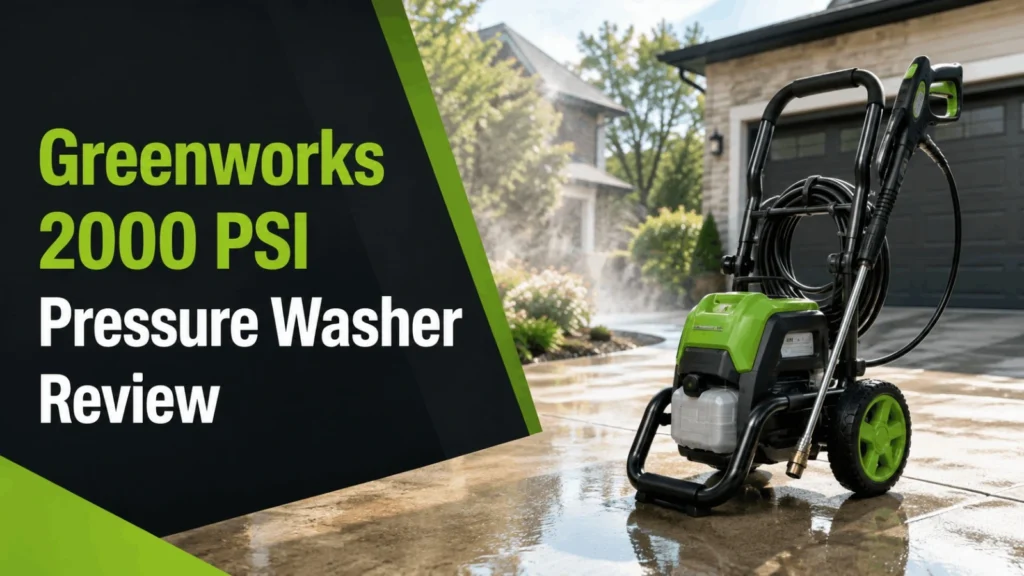
greenworks electric pressure washer 2000 psi
Electric Pressure Washers

Greenworks Electric Pressure Washer 2000 PSI Review: Specs, Uses, and Common Problems

The Greenworks electric pressure washer 2000 PSI is designed for routine residential cleaning without the fuel, exhaust, or engine maintenance of a gas machine. The GPW2003 combines a claimed maximum pressure of 2,000 PSI with an open-frame design, onboard detergent tank, and four spray options. It suits cars, furniture, fences, siding, decks, and modest paved areas better than large or commercial jobs. Review methodology: This is an editorial, specification- and manual-based review of model GPW2003 (SKU 5118202), not a claim of hands-on testing. Product details were checked against Greenworks’ official product information and support guidance on August 27, 2026. Performance comments below are reasoned from the verified specifications and intended applications. Always follow the manual supplied with your machine. Greenworks Electric Pressure Washer 2000 PSI: Quick Verdict The GPW2003 is a useful middle ground between a basic light-duty washer and a high-flow gas model. Its long cord, wheeled frame, soap tank, and varied nozzles suit household cleaning. However, its listed 1.2 GPM maximum means broad or heavily soiled surfaces may take longer. Its universal motor is also a value-oriented design rather than an induction or brushless type. Best for: cars, outdoor furniture, fences, siding, decks, steps, and small patios or driveways. Consider another machine if: you regularly clean extensive concrete, need commercial durability, or lack a suitable grounded outdoor electrical supply. Which Greenworks 2000 PSI Model Is This Review About? Greenworks sells several 2,000 PSI pressure washers with different motors, flow ratings, hoses, and accessories. Confirm the model number rather than relying on color or headline pressure. Product Model / SKU Listed flow Important distinction Main model reviewed GPW2003 / 5118202 1.2 GPM max 14-amp universal motor, 25-foot hose, onboard soap tank Green-frame version GPW2000-1RG / 5117002 1.2 GPM max 13-amp motor, 20-foot hose, siphon detergent tube Black-frame version PWA201 / 5111802 1.1 GPM max Different motor and accessory configuration Check the rating label before buying parts. Retailer bundles can vary, so official model-specific specifications should take priority. Greenworks 2000 PSI Pressure Washer Specifications The following details apply to GPW2003, SKU 5118202: Specification Official listing Maximum pressure 2,000 PSI Maximum water flow 1.2 GPM Motor 14-amp universal motor; not brushless High-pressure hose 25 feet, kink-resistant Power cord 35 feet with inline GFCI Detergent system Onboard soap tank Included spray options Turbo, 25°, 40°, and black soap nozzle Mobility Open steel frame and 10-inch never-flat wheels Connections M22 14 mm hose fittings; 1/4-inch quick-connect nozzles Certification PWMA certified Tool warranty Three-year limited warranty, subject to terms Pressure and flow figures require context. Greenworks lists 2,000 PSI as maximum pressure but describes 1.2 GPM flow at 100 PSI in the product’s key features. Buyers should not assume the machine produces both maximum figures simultaneously. That distinction matters because PSI helps loosen grime, while GPM helps rinse it away and influences how quickly a large area can be completed. Greenworks 2000 PSI Pressure Washer Features 14-Amp Universal Motor The corded motor requires no fuel mixing, oil changes, pull cord, or exhaust. However, the GPW2003 is not an induction- or brushless-motor model; buyers expecting long, frequent duty cycles may prefer another design. 35-Foot GFCI Cord and 25-Foot Pressure Hose The combined reach limits repositioning. Test the inline ground-fault circuit interrupter before use, keep connections dry, and use a grounded receptacle. Open Frame, Wheels, and Onboard Storage The steel frame and 10-inch wheels aid movement, while integrated storage organizes the hose, wand, cord, and nozzles. Onboard Detergent Tank Use only pressure-washer detergent in the built-in tank. Greenworks warns against harsh bleach, alkaline, or ammonia-based cleaners. Soap dispenses at low pressure through the black nozzle. Greenworks 2000 PSI Pressure Washer for Cars, Patios, and Decks Greenworks 2000 PSI Pressure Washer for Cars Begin with the 40° nozzle, keep your distance, and test an inconspicuous area. Never hold the turbo or a narrow stream close to paint, trim, seals, cameras, or damaged clear coat. Rinse loose grit first and follow the vehicle maker’s care guidance. Greenworks 2000 PSI for Patios and Small Driveways The washer can remove ordinary dirt from concrete, pavers, and steps. Its modest flow makes large slabs and embedded stains slower; pretreatment or a higher-flow machine may help. Test pavers and mortar to avoid etching or dislodging joints. Greenworks 2000 PSI for Decks, Siding, and Outdoor Furniture Use the widest effective fan and greater distance on wood, vinyl, paint, and resin furniture. Work with timber grain and avoid forcing water behind siding. Excessive pressure can raise fibers, strip paint, or damage seals. Greenworks 2000 PSI Nozzle and Soap Guide Nozzle Best starting use Main caution Turbo Stubborn grime on durable concrete or masonry Concentrated action can mark softer surfaces 25° General cleaning of many hard outdoor surfaces Test distance before approaching the surface 40° Cars, furniture, siding, and gentle rinsing May clean slowly on embedded grime Black soap Applying approved pressure-washer detergent Low-pressure soap application only Turn the machine off, release trigger pressure, and confirm the quick-connect nozzle is locked before restarting. Never change a nozzle while the spray gun is pressurized. How to Use a Greenworks 2000 PSI Pressure Washer 1. Inspect the Water and Electrical Supply Place the washer on a stable surface. Inspect the cord, GFCI, hoses, gun, wand, O-rings, and inlet filter. Connect cold water; Greenworks specifies a 104°F (40°C) maximum. Never start the motor before water is flowing. 2. Connect the Hose and Purge Trapped Air Connect both hoses and open the tap fully. With the motor off and nozzle removed, hold the trigger until flow is steady. Greenworks recommends purging for about three minutes when air is trapped. 3. Install the Correct Nozzle Choose the widest suitable nozzle. Insert it fully into the quick-connect collar, release the collar, and tug gently to confirm it is secure. Start far from the surface. 4. Start, Test, and Clean in Sections Use a grounded outlet, test the GFCI, and switch on the washer. Keep the wand moving in overlapping passes. Avoid people, animals, windows, vents, electrical equipment, and unstable ladders.

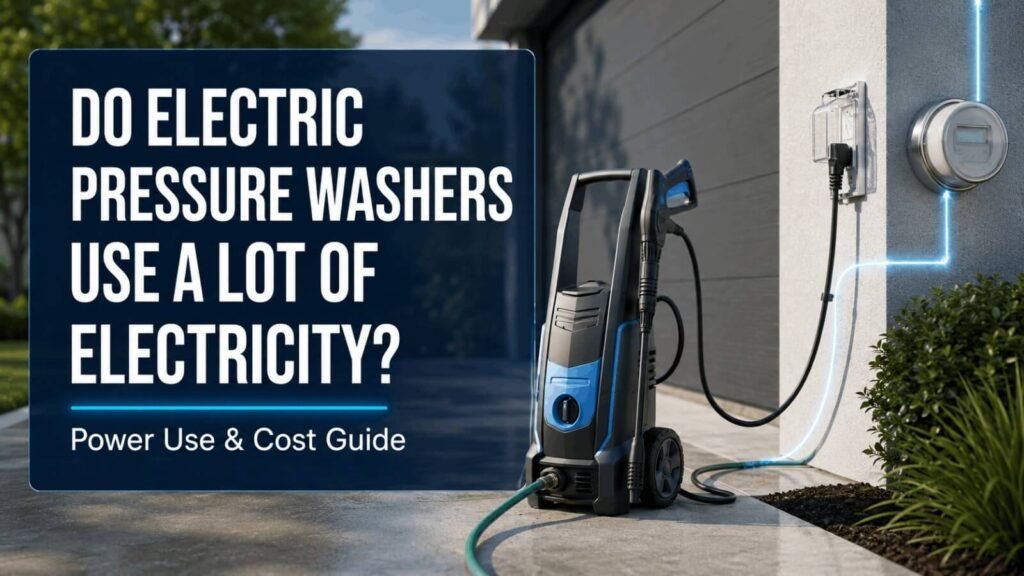
: Electric pressure washer connected safely to an outdoor outlet with electricity-cost graphics
Electric Pressure Washers

Do Electric Pressure Washers Use a Lot of Electricity? Cost Guide

A pressure washer sounds powerful, so it is reasonable to wonder what that motor is doing to your electricity bill. The answer is less alarming than the noise may suggest. Do electric pressure washers use a lot of electricity? They can draw a fairly high amount of power while the motor is running, but most household cleaning jobs last only 30 minutes to a few hours. That usually makes the total electricity cost modest. A machine drawing 1.8 kilowatts continuously for one hour would use 1.8 kilowatt-hours (kWh). At an example rate of $0.15 per kWh, that equals $0.27. Actual use depends on the motor rating, trigger time, total job length, automatic stop system, voltage, water supply, nozzle, and cleaning method. This guide shows how to read the machine label, calculate running cost, compare realistic scenarios, and avoid wasting electricity. How these estimates were prepared: Calculations use manufacturer-listed input power and assume continuous motor operation unless stated otherwise. They are planning estimates, not laboratory measurements. Your machine, trigger time, voltage and electricity tariff will determine the actual cost. Do Electric Pressure Washers Use a Lot of Electricity Per Hour? Corded residential pressure washers vary by market and cleaning class. Current manufacturer examples include 230V models rated from about 1.4 kW to 3.0 kW, while many North American homeowner units use a 120V, 13-amp motor. Always use the rating on your own machine rather than treating these examples as a universal range. Those figures describe power demand while operating, not the amount charged on a monthly bill. Electricity billing is based mainly on energy use in kilowatt-hours: Energy used (kWh) = Power (kW) × Running time (hours) A 1.6 kW machine running for 45 minutes uses up to: 1.6 × 0.75 = 1.2 kWh If electricity costs $0.20 per kWh, the estimated cost is: 1.2 × $0.20 = $0.24 This is a simple full-power estimate. Some electric pressure washers stop the motor when the trigger is released, reducing energy use during pauses. Motor load and power factor can also make measured consumption different from a nameplate calculation. How to Find Your Pressure Washer’s Wattage Check the rating label on the machine, motor, plug tag, or manual. Look for W or kW, together with voltage and amperage. Use Listed Watts When Available If the manufacturer lists rated input power, use that number. Convert watts to kilowatts by dividing by 1,000: 1,400 watts = 1.4 kW 1,800 watts = 1.8 kW 2,000 watts = 2.0 kW Do not calculate electricity use from PSI or GPM. PSI measures water pressure, while GPM measures water flow. Neither tells you the exact electrical input. Estimate From Volts and Amps When only voltage and amperage are shown, multiply them for a basic circuit-demand estimate: Volts × Amps = Volt-amperes (VA) For example, 120V × 13A = 1,560 VA. People often treat that as roughly 1,560 watts for quick planning, but an AC motor’s true watts can differ because of power factor and operating load. A plug-in electricity meter rated for the machine’s current provides a better real-world measurement when the manufacturer allows its use outdoors and the setup remains safely GFCI-protected. Why Voltage Alone Does Not Show Consumption A 230V machine is not automatically twice as expensive to run as a 115V machine. Higher voltage can deliver the same power at lower current. Wattage and operating time—not voltage alone—determine energy use. Electric Pressure Washer Cost Examples The table below uses a 1.8 kW pressure washer and assumes continuous full-power operation. Replace the electricity rate with the amount shown on your utility bill. Cleaning time Energy used At $0.10/kWh At $0.20/kWh At $0.30/kWh 30 minutes 0.9 kWh $0.09 $0.18 $0.27 1 hour 1.8 kWh $0.18 $0.36 $0.54 2 hours 3.6 kWh $0.36 $0.72 $1.08 For a 90-minute job at $0.20 per kWh: 1.8 kW × 1.5 hours × $0.20 = $0.54 This calculation is intentionally conservative if the motor stops whenever the trigger is released. It may underestimate use if the machine includes additional electric heating, a vacuum, or another powered system. Estimate Monthly or Annual Cost Suppose you run a 1.8 kW machine for one hour twice each month: 1.8 kW × 2 hours × 12 months = 43.2 kWh per year At $0.20 per kWh, that equals $8.64 per year. This is only an example; local rates, cleaning frequency, and actual motor-on time will change the result. What Affects Electricity Consumption? Motor Input Rating A larger motor can draw more power, but it may also complete a suitable job faster. Comparing wattage alone does not show which machine will use less total energy. Trigger Time and Automatic Stop Many residential models use a total-stop system that switches off the motor when the spray-gun trigger is released. This reduces unnecessary runtime during repositioning, scrubbing, soap dwell time, or moving furniture. Confirm how your model behaves rather than assuming every machine stops completely. Cleaning Time Job duration often matters more than a small difference in wattage. A 1.8 kW machine used efficiently for 40 minutes can consume less energy than a 1.4 kW unit struggling for two hours. Surface, Dirt, and Nozzle Choice Heavy algae, compacted mud, and old concrete stains take longer than rinsing a car or patio chair. The correct nozzle and detergent can shorten the job, but excessive pressure can damage paint, wood, seals, and vehicle trim. . Our guide to choosing the right PSI for different cleaning jobs helps match cleaning force to the surface. Water Supply A restricted tap, kinked hose, clogged inlet filter, or undersized supply hose can reduce performance. The motor may keep running while the user makes little progress. Confirm that the source can provide the water flow required by the manual. Hot-Water and Commercial Machines Do not apply homeowner cold-water estimates to commercial electric hot-water equipment. A heating element can require much more electricity than the pump motor and may need a dedicated high-voltage circuit. Check motor and heater ratings separately. Is an Electric Pressure Washer Cheaper Than

Scroll to Top