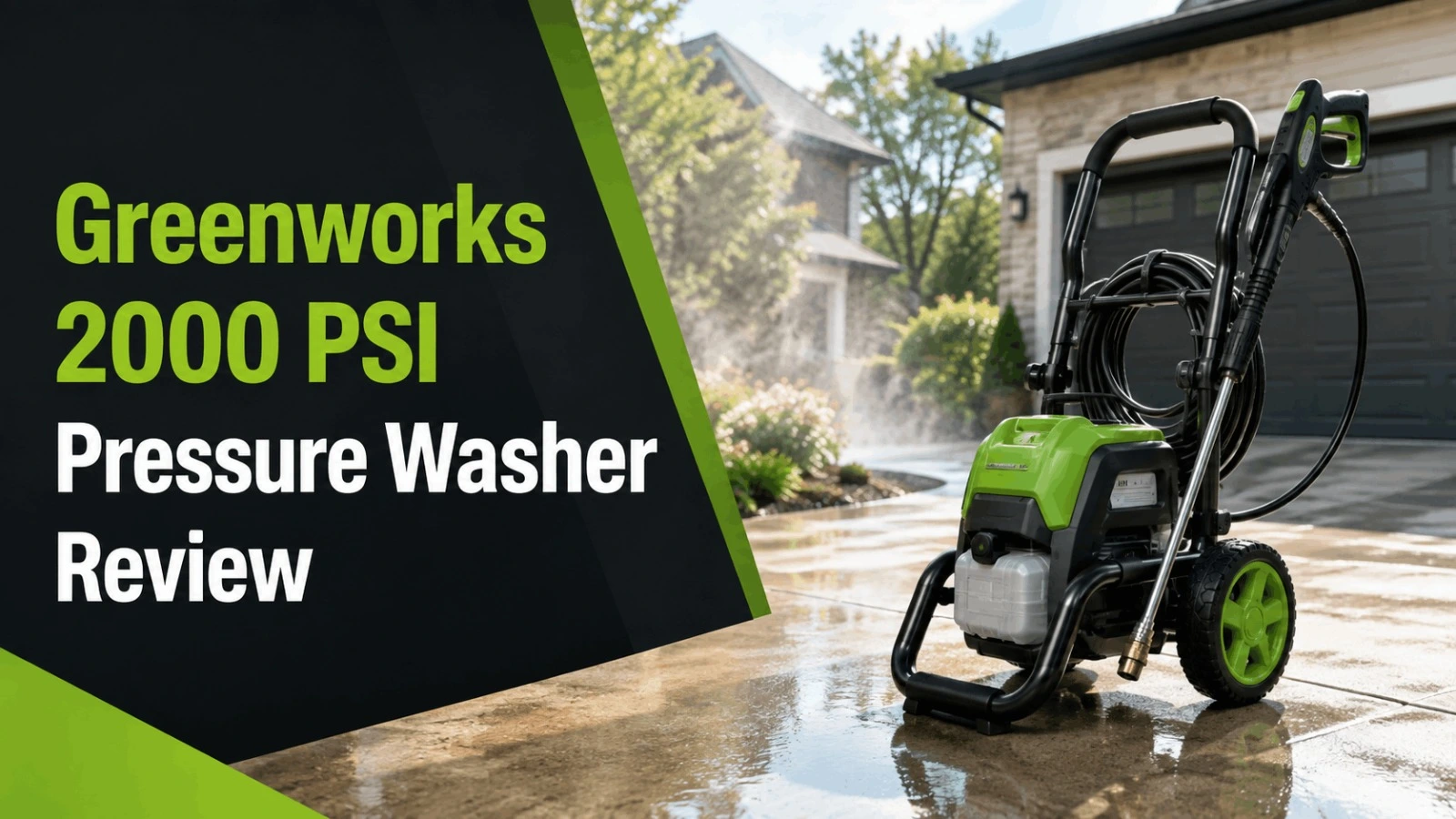
The Greenworks electric pressure washer 2000 PSI is designed for routine residential cleaning without the fuel, exhaust, or engine maintenance of a gas machine. The GPW2003 combines a claimed maximum pressure of 2,000 PSI with an open-frame design, onboard detergent tank, and four spray options. It suits cars, furniture, fences, siding, decks, and modest paved areas better than large or commercial jobs.
Review methodology: This is an editorial, specification- and manual-based review of model GPW2003 (SKU 5118202), not a claim of hands-on testing. Product details were checked against Greenworks’ official product information and support guidance on August 27, 2026. Performance comments below are reasoned from the verified specifications and intended applications. Always follow the manual supplied with your machine.
Greenworks Electric Pressure Washer 2000 PSI: Quick Verdict
The GPW2003 is a useful middle ground between a basic light-duty washer and a high-flow gas model. Its long cord, wheeled frame, soap tank, and varied nozzles suit household cleaning. However, its listed 1.2 GPM maximum means broad or heavily soiled surfaces may take longer. Its universal motor is also a value-oriented design rather than an induction or brushless type.
Best for: cars, outdoor furniture, fences, siding, decks, steps, and small patios or driveways.
Consider another machine if: you regularly clean extensive concrete, need commercial durability, or lack a suitable grounded outdoor electrical supply.
Which Greenworks 2000 PSI Model Is This Review About?
Greenworks sells several 2,000 PSI pressure washers with different motors, flow ratings, hoses, and accessories. Confirm the model number rather than relying on color or headline pressure.
| Product | Model / SKU | Listed flow | Important distinction |
| Main model reviewed | GPW2003 / 5118202 | 1.2 GPM max | 14-amp universal motor, 25-foot hose, onboard soap tank |
| Green-frame version | GPW2000-1RG / 5117002 | 1.2 GPM max | 13-amp motor, 20-foot hose, siphon detergent tube |
| Black-frame version | PWA201 / 5111802 | 1.1 GPM max | Different motor and accessory configuration |
Check the rating label before buying parts. Retailer bundles can vary, so official model-specific specifications should take priority.
Greenworks 2000 PSI Pressure Washer Specifications

The following details apply to GPW2003, SKU 5118202:
| Specification | Official listing |
| Maximum pressure | 2,000 PSI |
| Maximum water flow | 1.2 GPM |
| Motor | 14-amp universal motor; not brushless |
| High-pressure hose | 25 feet, kink-resistant |
| Power cord | 35 feet with inline GFCI |
| Detergent system | Onboard soap tank |
| Included spray options | Turbo, 25°, 40°, and black soap nozzle |
| Mobility | Open steel frame and 10-inch never-flat wheels |
| Connections | M22 14 mm hose fittings; 1/4-inch quick-connect nozzles |
| Certification | PWMA certified |
| Tool warranty | Three-year limited warranty, subject to terms |
Pressure and flow figures require context. Greenworks lists 2,000 PSI as maximum pressure but describes 1.2 GPM flow at 100 PSI in the product’s key features. Buyers should not assume the machine produces both maximum figures simultaneously. That distinction matters because PSI helps loosen grime, while GPM helps rinse it away and influences how quickly a large area can be completed.
Greenworks 2000 PSI Pressure Washer Features
14-Amp Universal Motor
The corded motor requires no fuel mixing, oil changes, pull cord, or exhaust. However, the GPW2003 is not an induction- or brushless-motor model; buyers expecting long, frequent duty cycles may prefer another design.
35-Foot GFCI Cord and 25-Foot Pressure Hose
The combined reach limits repositioning. Test the inline ground-fault circuit interrupter before use, keep connections dry, and use a grounded receptacle.
Open Frame, Wheels, and Onboard Storage
The steel frame and 10-inch wheels aid movement, while integrated storage organizes the hose, wand, cord, and nozzles.
Onboard Detergent Tank
Use only pressure-washer detergent in the built-in tank. Greenworks warns against harsh bleach, alkaline, or ammonia-based cleaners. Soap dispenses at low pressure through the black nozzle.
Greenworks 2000 PSI Pressure Washer for Cars, Patios, and Decks

Greenworks 2000 PSI Pressure Washer for Cars
Begin with the 40° nozzle, keep your distance, and test an inconspicuous area. Never hold the turbo or a narrow stream close to paint, trim, seals, cameras, or damaged clear coat. Rinse loose grit first and follow the vehicle maker’s care guidance.
Greenworks 2000 PSI for Patios and Small Driveways
The washer can remove ordinary dirt from concrete, pavers, and steps. Its modest flow makes large slabs and embedded stains slower; pretreatment or a higher-flow machine may help. Test pavers and mortar to avoid etching or dislodging joints.
Greenworks 2000 PSI for Decks, Siding, and Outdoor Furniture
Use the widest effective fan and greater distance on wood, vinyl, paint, and resin furniture. Work with timber grain and avoid forcing water behind siding. Excessive pressure can raise fibers, strip paint, or damage seals.
Greenworks 2000 PSI Nozzle and Soap Guide
| Nozzle | Best starting use | Main caution |
| Turbo | Stubborn grime on durable concrete or masonry | Concentrated action can mark softer surfaces |
| 25° | General cleaning of many hard outdoor surfaces | Test distance before approaching the surface |
| 40° | Cars, furniture, siding, and gentle rinsing | May clean slowly on embedded grime |
| Black soap | Applying approved pressure-washer detergent | Low-pressure soap application only |
Turn the machine off, release trigger pressure, and confirm the quick-connect nozzle is locked before restarting. Never change a nozzle while the spray gun is pressurized.
How to Use a Greenworks 2000 PSI Pressure Washer

1. Inspect the Water and Electrical Supply
Place the washer on a stable surface. Inspect the cord, GFCI, hoses, gun, wand, O-rings, and inlet filter. Connect cold water; Greenworks specifies a 104°F (40°C) maximum. Never start the motor before water is flowing.
2. Connect the Hose and Purge Trapped Air
Connect both hoses and open the tap fully. With the motor off and nozzle removed, hold the trigger until flow is steady. Greenworks recommends purging for about three minutes when air is trapped.
3. Install the Correct Nozzle
Choose the widest suitable nozzle. Insert it fully into the quick-connect collar, release the collar, and tug gently to confirm it is secure. Start far from the surface.
4. Start, Test, and Clean in Sections
Use a grounded outlet, test the GFCI, and switch on the washer. Keep the wand moving in overlapping passes. Avoid people, animals, windows, vents, electrical equipment, and unstable ladders.
Greenworks Pressure Washer Troubleshooting

Disconnect power and release system pressure before inspecting connections or nozzles. Do not open the pump or attempt electrical repairs unless the manual authorizes the work.
Greenworks Pressure Washer Not Starting
Confirm the outlet works and the plug is fully seated.
Reset and test the inline GFCI.
Check the breaker and inspect the cord for visible damage.
Ensure the trigger is operated as directed during startup.
Connect the water and purge air before switching on the motor.
Stop using the washer if the GFCI repeatedly trips, the cord is damaged, or there is a burning smell. Electrical faults require qualified service.
Greenworks Pressure Washer Pulsating or Cycling
Pulsing often indicates restricted flow, trapped air, or a blocked nozzle. Straighten the hose, open the tap, clean the inlet filter, purge the system, and inspect the tip. A long, narrow, or leaking supply hose can restrict flow.
Greenworks Pressure Washer Low Pressure
Install a high-pressure nozzle rather than the black soap tip. Check for leaks, a clogged or worn tip, a restricted filter, and inadequate water supply. If these checks fail, contact Greenworks instead of dismantling the pump.
Greenworks Pressure Washer Soap Not Working
Install the black nozzle because detergent draws only at low pressure. Use approved soap, follow its dilution directions, clear any blockage, and rinse the detergent system after use.
Leaking Hose or Wand Connection
Depressurize the system, reseat the fitting, and inspect its O-ring. Replace a damaged seal with the correct size. Do not try to stop a pressurized leak with your hand; high-pressure spray can penetrate skin.
Greenworks 2000 PSI Pressure Washer Pros and Cons
Pros
Useful pressure range for common household cleaning
No gasoline, exhaust, pull-starting, or engine oil changes
Long cord and a 25-foot kink-resistant pressure hose
Four included spray options and onboard detergent tank
Wheeled steel frame with integrated accessory storage
PWMA certification and a listed three-year limited tool warranty
Cons
Maximum 1.2 GPM flow can make broad cleaning jobs slower
Universal motor rather than an induction or brushless design
Cord and water hose limit placement and require careful management
Different Greenworks 2,000 PSI models can make accessories and reviews confusing
Not intended as a substitute for a high-flow or commercial pressure washer
Greenworks 2000 PSI vs Smaller Electric and Higher-Flow Washers
| Type | Relative strength | Best fit | Trade-off |
| Smaller electric washer | Lower pressure or flow | Furniture, bicycles, light car washing | Slower on concrete and stubborn grime |
| Greenworks GPW2003 | Midrange 2,000 PSI class | Mixed home and vehicle cleaning | Modest maximum flow |
| Higher-flow electric or gas washer | Faster rinsing and area coverage | Large driveways and frequent heavy cleaning | More cost, weight, noise, or maintenance |
Choose according to the surfaces and area you clean most often, not PSI alone. Hose length, actual operating flow, nozzle selection, duty cycle, service access, and storage space can matter as much as headline pressure.
Buying a New or Used Greenworks 2000 PSI Pressure Washer
For a new machine, confirm the SKU, tips, detergent system, hose, warranty terms, and seller. “Greenworks 2000 PSI” alone is not a specific model description.
For a used washer, inspect the cord, GFCI, hose, gun, fittings, pump, and accessories. Test it with water and power for steady output and leaks. Ask how it was stored because freeze damage can be costly.
Greenworks 2000 PSI Pressure Washer Maintenance and Safety

After each job, flush detergent with clean water, turn off the machine and tap, unplug it, squeeze the trigger to release pressure, and drain the hoses. Clean blocked nozzles only with the supplied tool or the method in the manual.
Before freezing weather, follow the model-specific winterization instructions and use an approved pump protector. Store the washer dry and above freezing with hoses loosely coiled. Greenworks advises keeping the unit away from excessive heat as well.
High-pressure spray can cause serious wounds. Wear eye protection and closed, slip-resistant footwear; never direct the wand at people or animals. The CDC also recommends testing the GFCI and keeping extension-cord connections out of standing water. If an extension cord is unavoidable and permitted by the manual, use an outdoor wet-location-rated, correctly sized cord and keep every connection dry.
Greenworks 2000 PSI Pressure Washer FAQs
Is a Greenworks 2000 PSI pressure washer strong enough for a driveway?
It is suitable for small to moderate areas with ordinary dirt, but its modest flow means a large or heavily stained driveway can take longer than with a higher-GPM washer.
Can I use the Greenworks 2000 PSI pressure washer on a car?
Yes, with a wide fan nozzle, conservative distance, and a test area. Avoid the turbo nozzle on paint and do not spray sensitive seals, electronics, or damaged finishes at close range.
Does the GPW2003 have a brushless motor?
No. Greenworks lists model GPW2003/SKU 5118202 as using a 14-amp universal motor. Other Greenworks 2,000 PSI models may differ.
What fittings does the Greenworks GPW2003 use?
Greenworks lists M22 14 mm threaded hose fittings and 1/4-inch quick-connect spray nozzles. Verify the model before purchasing replacements.
Can I use an extension cord?
“Direct connection to a suitable grounded outlet is preferable. If the manual permits an extension cord, it must be correctly rated for outdoor wet locations. You can also check our guide on electric pressure washer power consumption for more details on electrical safety and usage.”
Final Verdict: Is the Greenworks 2000 PSI Pressure Washer Worth It?
The Greenworks GPW2003 is a sensible residential washer for buyers who value easy electric operation, useful reach, onboard detergent, and enough pressure for varied household jobs. Its 1.2 GPM maximum flow and universal motor make it better suited to periodic home maintenance than rapid, heavy-duty cleaning.
The model is worth considering for cars, fences, furniture, decks, siding, steps, and smaller paved areas—provided you select the right nozzle and follow electrical and surface-safety precautions. Buyers tackling large driveways or frequent demanding work should compare higher-flow options before deciding.