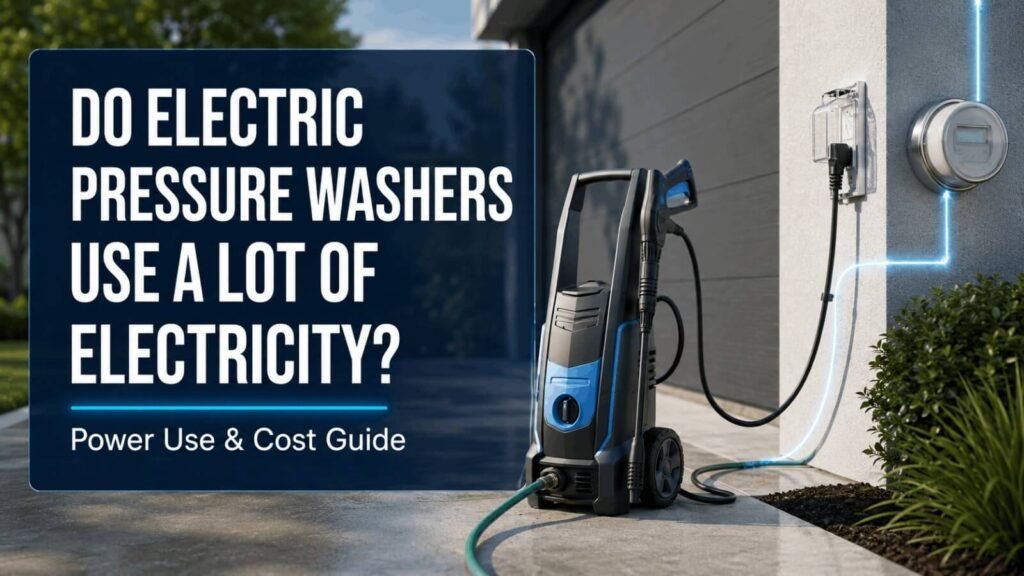
Do Electric Pressure Washers Use a Lot of Electricity? Cost Guide
A pressure washer sounds powerful, so it is reasonable to wonder what that motor is doing to your electricity bill. The answer is less alarming than the noise may suggest. Do electric pressure washers use a lot of electricity? They can draw a fairly high amount of power while the motor is running, but most household cleaning jobs last only 30 minutes to a few hours. That usually makes the total electricity cost modest. A machine drawing 1.8 kilowatts continuously for one hour would use 1.8 kilowatt-hours (kWh). At an example rate of $0.15 per kWh, that equals $0.27. Actual use depends on the motor rating, trigger time, total job length, automatic stop system, voltage, water supply, nozzle, and cleaning method. This guide shows how to read the machine label, calculate running cost, compare realistic scenarios, and avoid wasting electricity. How these estimates were prepared: Calculations use manufacturer-listed input power and assume continuous motor operation unless stated otherwise. They are planning estimates, not laboratory measurements. Your machine, trigger time, voltage and electricity tariff will determine the actual cost. Do Electric Pressure Washers Use a Lot of Electricity Per Hour? Corded residential pressure washers vary by market and cleaning class. Current manufacturer examples include 230V models rated from about 1.4 kW to 3.0 kW, while many North American homeowner units use a 120V, 13-amp motor. Always use the rating on your own machine rather than treating these examples as a universal range. Those figures describe power demand while operating, not the amount charged on a monthly bill. Electricity billing is based mainly on energy use in kilowatt-hours: Energy used (kWh) = Power (kW) × Running time (hours) A 1.6 kW machine running for 45 minutes uses up to: 1.6 × 0.75 = 1.2 kWh If electricity costs $0.20 per kWh, the estimated cost is: 1.2 × $0.20 = $0.24 This is a simple full-power estimate. Some electric pressure washers stop the motor when the trigger is released, reducing energy use during pauses. Motor load and power factor can also make measured consumption different from a nameplate calculation. How to Find Your Pressure Washer’s Wattage Check the rating label on the machine, motor, plug tag, or manual. Look for W or kW, together with voltage and amperage. Use Listed Watts When Available If the manufacturer lists rated input power, use that number. Convert watts to kilowatts by dividing by 1,000: 1,400 watts = 1.4 kW 1,800 watts = 1.8 kW 2,000 watts = 2.0 kW Do not calculate electricity use from PSI or GPM. PSI measures water pressure, while GPM measures water flow. Neither tells you the exact electrical input. Estimate From Volts and Amps When only voltage and amperage are shown, multiply them for a basic circuit-demand estimate: Volts × Amps = Volt-amperes (VA) For example, 120V × 13A = 1,560 VA. People often treat that as roughly 1,560 watts for quick planning, but an AC motor’s true watts can differ because of power factor and operating load. A plug-in electricity meter rated for the machine’s current provides a better real-world measurement when the manufacturer allows its use outdoors and the setup remains safely GFCI-protected. Why Voltage Alone Does Not Show Consumption A 230V machine is not automatically twice as expensive to run as a 115V machine. Higher voltage can deliver the same power at lower current. Wattage and operating time—not voltage alone—determine energy use. Electric Pressure Washer Cost Examples The table below uses a 1.8 kW pressure washer and assumes continuous full-power operation. Replace the electricity rate with the amount shown on your utility bill. Cleaning time Energy used At $0.10/kWh At $0.20/kWh At $0.30/kWh 30 minutes 0.9 kWh $0.09 $0.18 $0.27 1 hour 1.8 kWh $0.18 $0.36 $0.54 2 hours 3.6 kWh $0.36 $0.72 $1.08 For a 90-minute job at $0.20 per kWh: 1.8 kW × 1.5 hours × $0.20 = $0.54 This calculation is intentionally conservative if the motor stops whenever the trigger is released. It may underestimate use if the machine includes additional electric heating, a vacuum, or another powered system. Estimate Monthly or Annual Cost Suppose you run a 1.8 kW machine for one hour twice each month: 1.8 kW × 2 hours × 12 months = 43.2 kWh per year At $0.20 per kWh, that equals $8.64 per year. This is only an example; local rates, cleaning frequency, and actual motor-on time will change the result. What Affects Electricity Consumption? Motor Input Rating A larger motor can draw more power, but it may also complete a suitable job faster. Comparing wattage alone does not show which machine will use less total energy. Trigger Time and Automatic Stop Many residential models use a total-stop system that switches off the motor when the spray-gun trigger is released. This reduces unnecessary runtime during repositioning, scrubbing, soap dwell time, or moving furniture. Confirm how your model behaves rather than assuming every machine stops completely. Cleaning Time Job duration often matters more than a small difference in wattage. A 1.8 kW machine used efficiently for 40 minutes can consume less energy than a 1.4 kW unit struggling for two hours. Surface, Dirt, and Nozzle Choice Heavy algae, compacted mud, and old concrete stains take longer than rinsing a car or patio chair. The correct nozzle and detergent can shorten the job, but excessive pressure can damage paint, wood, seals, and vehicle trim. . Our guide to choosing the right PSI for different cleaning jobs helps match cleaning force to the surface. Water Supply A restricted tap, kinked hose, clogged inlet filter, or undersized supply hose can reduce performance. The motor may keep running while the user makes little progress. Confirm that the source can provide the water flow required by the manual. Hot-Water and Commercial Machines Do not apply homeowner cold-water estimates to commercial electric hot-water equipment. A heating element can require much more electricity than the pump motor and may need a dedicated high-voltage circuit. Check motor and heater ratings separately. Is an Electric Pressure Washer Cheaper Than