Electric Pressure Washer

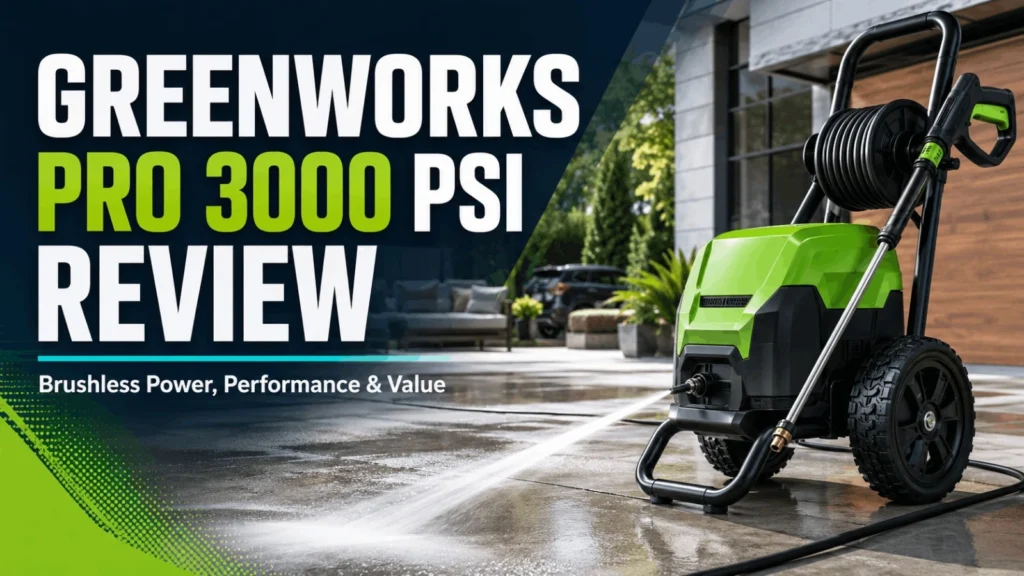
Greenworks Pro 3000 PSI brushless pressure washer review banner showing unit on driveway
Electric Pressure Washers

Greenworks Pro 3000 PSI Brushless Pressure Washer Review: Power and Value

Electric pressure washers are easy to start and maintain, but many compact models feel slow when the job moves from washing a car to cleaning concrete. The Greenworks Pro 3000 PSI brushless pressure washer is designed to offer stronger residential cleaning without gasoline, exhaust, oil changes, or a pull cord. The headline figures require careful explanation. Greenworks lists 3,000 PSI at 1.1 GPM and 2.0 GPM at 100 PSI. These are separate operating points—not 3,000 PSI and 2.0 GPM at the same time. This review covers that important difference, along with the GPW3001 and GPW3002A models, included features, suitable surfaces, common problems, safety, and overall value. How we reviewed it: This is an independent, specification-based review. We checked Greenworks’ current product pages, support information, model details, and public safety guidance. We did not perform instrumented pressure or flow testing, so performance comments are informed suitability judgments rather than laboratory results. Greenworks 3000 PSI Electric Pressure Washer: Quick Verdict The Greenworks Pro 3000 is a capable residential electric washer for concrete, patios, pavers, decks, fencing, siding, vehicles, and outdoor equipment. Its brushless motor, five spray nozzles, 25-foot hose, 35-foot GFCI power cord, onboard soap tank, and 10-inch wheels make it more useful than a basic carry-style machine. Its main limitation is flow at maximum pressure. At 3,000 PSI, the rated flow is 1.1 GPM, so a higher-flow gas washer can rinse a large driveway or heavy mud faster. The Greenworks also needs a suitable 120-volt outlet and dependable water supply. Buying decision Assessment Best for Regular residential cleaning with electric convenience Suitable surfaces Sound concrete, patios, fences, decks, siding, cars and outdoor furniture Main advantage Strong maximum pressure with five nozzles and no gas engine Main limitation 1.1 GPM at maximum pressure limits rinsing speed Portability Steel frame with 10-inch never-flat wheels Overall view Strong choice when its features match frequent home-cleaning jobs Greenworks Pro 3000 PSI Pressure Washer Models: GPW3001 vs GPW3002A Search results can show several Greenworks machines with a 3,000 PSI label. This review covers the corded brushless residential line, mainly the GPW3001, and compares it with the current GPW3002A Gen 2. Model What buyers should know GPW3001 — SKU 5113902 Original corded brushless version. Greenworks lists vertical storage, a one-gallon detergent tank, 25-foot steel-braided hose, 35-foot cord, five nozzles, and 10-inch wheels. GPW3002A — SKU 5128802 Gen 2 corded brushless model with the same rated output, five nozzles, 25-foot hose, 35-foot cord, and open-frame design. 60V/AC and 80V models Different hybrid or battery-powered products. Their batteries, runtime, packages, prices, and warranty terms are outside this review. Always check the complete model and SKU before ordering parts or accessories. Do not assume every “Greenworks 3000 PSI” listing has the same frame, detergent system, package, or warranty. Greenworks Pressure Washer 3000 PSI Specifications The following specifications describe the main GPW3001 configuration. Retail bundles can add accessories, so compare the listing with the supplied manual. Specification Greenworks Pro GPW3001 Power type Corded electric Motor Smart-sensing brushless motor Electrical supply 120V, 60Hz AC Maximum pressure 3,000 PSI Flow at 3,000 PSI 1.1 GPM Maximum flow 2.0 GPM at 100 PSI High-pressure hose 25-foot kink-resistant steel-braided hose Power cord 35 feet with waterproof plug and inline GFCI Included nozzles 15°, 25°, 40°, soap, and turbo Nozzle connection 1/4-inch quick-connect Detergent system One-gallon onboard tank Wheels 10-inch never-flat wheels Certification PWMA-certified performance claims Advertised warranty Three-year tool and ten-year brushless motor warranty for GPW3001 Understanding 3,000 PSI and 2.0 GPM PSI describes water pressure, while GPM describes water flow. Pressure helps loosen dirt; flow helps carry it away. Greenworks lists 3,000 PSI at 1.1 GPM and 2.0 GPM at only 100 PSI. Multiplying 3,000 PSI by 2.0 GPM would therefore create a misleading comparison. This means the washer can apply concentrated pressure to stubborn dirt, but it may rinse wide concrete areas more slowly than a machine delivering higher flow at working pressure. Greenworks Pro 3000: Brushless Motor and Key Features Smart-Sensing Brushless Motor Greenworks says its TRUBRUSHLESS motor adjusts pressure and flow according to the installed nozzle. A brushless electric motor avoids carbon brushes and gas-engine tasks such as fuel storage, oil changes, spark plugs, and pull-cord starting. However, the pump, hoses, fittings, nozzles, screen, detergent tank, and power cord still require inspection and care. Five Quick-Connect Nozzles 15-degree nozzle: Focused high pressure for durable hard surfaces. 25-degree nozzle: Balanced spray for general outdoor cleaning. 40-degree nozzle: Wider, gentler spray for rinsing and more sensitive surfaces. Soap nozzle: Low-pressure detergent application through the tank. Turbo nozzle: Rotating concentrated spray for suitable hard surfaces. The 1/4-inch quick-connect can accept many accessories, but the fitting, pressure rating, flow range, and manufacturer limits must all match. One-Gallon Soap Tank The GPW3001’s large onboard tank reduces refilling during extended jobs. Detergent applies through the black low-pressure soap nozzle. Greenworks recommends designated pressure-washer soap and warns against harsh chemicals such as bleach, ammonia, and strongly alkaline cleaners. Hose, Cord, Wheels, and Vertical Storage The 25-foot steel-braided hose offers better abrasion and kink resistance than many basic hoses, although a large property may still require repositioning. The 35-foot cord adds reach and includes inline GFCI protection. Ten-inch never-flat wheels help on uneven outdoor surfaces, while vertical storage reduces the machine’s garage footprint. Greenworks Pro 3000 Performance on Driveways, Decks, and Cars Driveways, Concrete, and Pavers The 15-degree or turbo nozzle can target dirt on sound concrete. A compatible surface cleaner may produce more even passes, but it is not included in the standard package. Begin with a less aggressive nozzle because damaged joints, loose pavers, weak concrete, and painted surfaces can be marked. Large, stained areas may take time at 1.1 GPM. Decks, Fences, and Siding Use the 25- or 40-degree nozzle, begin farther away, and test an unseen area. Concentrated spray can cut wood fibers or remove coatings. On siding, direct the spray downward where appropriate and keep water away from seams, vents, soffits, outlets, and light fixtures. Cars, RVs, and Boats Use the 40-degree nozzle
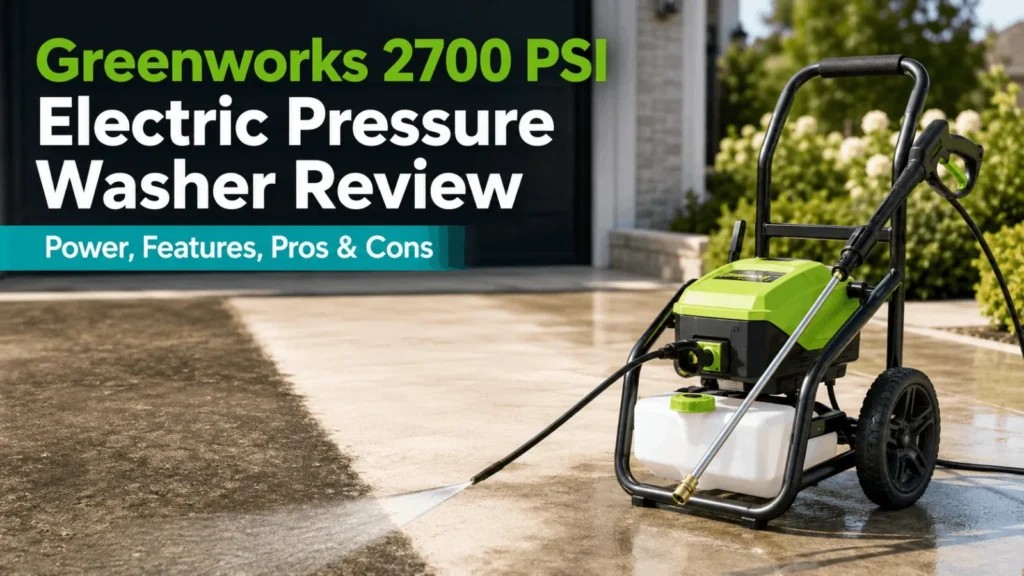
Greenworks 2700 PSI electric pressure washer review banner showing features, pros and cons
Pressure Washers > Reviews

Greenworks 2700 PSI Electric Pressure Washer Review: Is the GPW2702A Worth It?

The Greenworks 2700 PSI electric pressure washer is made for homeowners who want more cleaning force than a small electric unit but do not want the fuel, noise or engine care of a gas model. The GPW2702A combines a brushless motor, five quick-connect nozzles, a one-gallon detergent tank, a 25-foot pressure hose and a 35-foot GFCI power cord. Its headline numbers need a little explanation. The machine provides 2,700 PSI at a rated flow of 1.2 GPM. It can reach 2.3 GPM only in its low-pressure, 100 PSI mode. Those are two different operating points, so buyers should not assume it produces 2,700 PSI and 2.3 GPM at the same time. This research-based review covers the GPW2702A, SKU 5128402. It explains the published specifications, likely performance, useful features, limitations and buying considerations. It is based on the current Greenworks product page, the official operator manual and manufacturer warranty information. We have not claimed hands-on testing or created an unsupported performance score. Quick Verdict The Greenworks GPW2702A is a capable medium-duty residential pressure washer. It should work well for routine cleaning of small and medium driveways, patios, walkways, fences, siding, vehicles and outdoor equipment. Its wide nozzle selection and low-pressure high-flow mode make it more flexible than many entry-level electric models. The main limitation is water flow. At full pressure, 1.2 GPM is enough for home cleaning but may rinse large concrete areas more slowly than a higher-flow gas machine. The open frame is also larger to store than a compact upright washer, and its continuous-run motor should be switched off during long pauses. Best for: Homeowners who want strong electric cleaning for several outdoor jobs near a suitable outlet. Skip it if: You need a machine for daily paid work, very large properties, remote areas without electricity or frequent heavy stain removal. Greenworks GPW2702A Specifications Confirm the model number before buying because Greenworks has sold more than one 2,700 PSI pressure washer. This review covers GPW2702A, SKU 5128402, not the older GWP2700 or a retailer-specific package. Specification GPW2702A Published Information Maximum pressure 2,700 PSI Rated flow at maximum pressure 1.2 GPM at 2,700 PSI Maximum low-pressure flow 2.3 GPM at 100 PSI Motor Smart-sensing brushless motor with JETTFlow technology Power source 120-volt corded electric Power cord 35 feet with inline GFCI High-pressure hose 25 feet, kink-resistant Spray nozzles 15°, 25°, 40°, soap and turbo Detergent tank One gallon, onboard Wheels 10-inch never-flat wheels Nozzle connection 1/4-inch quick connect Certification PWMA certified Published warranty Three years for the tool and ten years for the motor, subject to current terms There is one specification conflict worth noting. The current Greenworks page describes the motor as 14 amps in one section and 15 amps in another. Check the rating label on the machine and the manual supplied with your exact unit before choosing a circuit or extension cord. How Powerful Is This 2700 PSI Electric Pressure Washer? Pressure and water flow perform different jobs. PSI helps loosen bonded dirt, while GPM carries the loosened material away. The GPW2702A delivers its highest pressure with 1.2 GPM and its highest flow with only 100 PSI. That split rating is not automatically a weakness. High pressure helps with marks on durable surfaces, while the higher-flow low-pressure mode is useful for rinsing and detergent work. However, it is misleading to multiply 2,700 PSI by 2.3 GPM because the machine does not reach both figures together. When comparing high-pressure performance, use the rated 2,700 PSI at 1.2 GPM. The pressure is strong for a corded residential unit, but cleaning speed depends on more than the largest PSI number. Surface condition, nozzle choice, detergent, water supply and technique all affect the result. Old oil, paint, rust and stains absorbed deep into concrete may still need special treatment. Performance by Cleaning Job Driveways, Patios and Walkways The machine has enough rated pressure for routine residential concrete cleaning. The 25° nozzle is the safest general starting point. The 15° or turbo nozzle can help on stubborn areas, but both should be tested first and kept moving to avoid visible lines or surface damage. A compatible 15-inch surface cleaner may produce a more even finish and reduce splash. Still, the 1.2 GPM high-pressure flow means a long driveway will take more time than it would with a higher-flow gas washer. Decks, Fences and House Siding Begin with the 40° nozzle from a generous distance. Too much pressure can raise wood grain, remove stain, mark soft material or push water behind siding. Test a hidden area before cleaning the full surface. Do not use a pressure-washer gun while standing on a ladder. A jet can create sudden kickback. Use approved ground-level extensions for high work and follow the surface manufacturer’s cleaning instructions. Cars, Boats and Outdoor Furniture The 40° nozzle or low-pressure rinse mode is the sensible choice for vehicle washing. Keep a safe distance and avoid direct close spray on damaged paint, seals, tires, cameras, electrical connectors, bearings and decals. Apply only detergent approved for pressure washers. Test painted or delicate furniture underneath before washing the visible area. Soft brushes and a garden hose may be safer for fragile materials. Lawn and Outdoor Equipment The washer can remove mud from mowers, carts and garden tools. Allow hot engines to cool first, and avoid air intakes, bearings, electrical parts, seals and warning labels. More pressure is not always better around moving components. Key Greenworks GPW2702A Features Brushless Motor and JETTFlow Technology Greenworks says its smart-sensing motor recognizes the selected nozzle and adjusts water flow for the task. A brushless design removes motor-brush wear and can support efficient operation. It does not make the whole machine maintenance-free; hoses, filters, nozzles, seals and the pump still need inspection and proper storage. Continuous-Run Motor Unlike some compact electric washers that stop the motor when the trigger is released, the GPW2702A uses a continuous-run design. This provides immediate pressure when you pull the trigger. During a long break, turn off the washer instead of leaving water

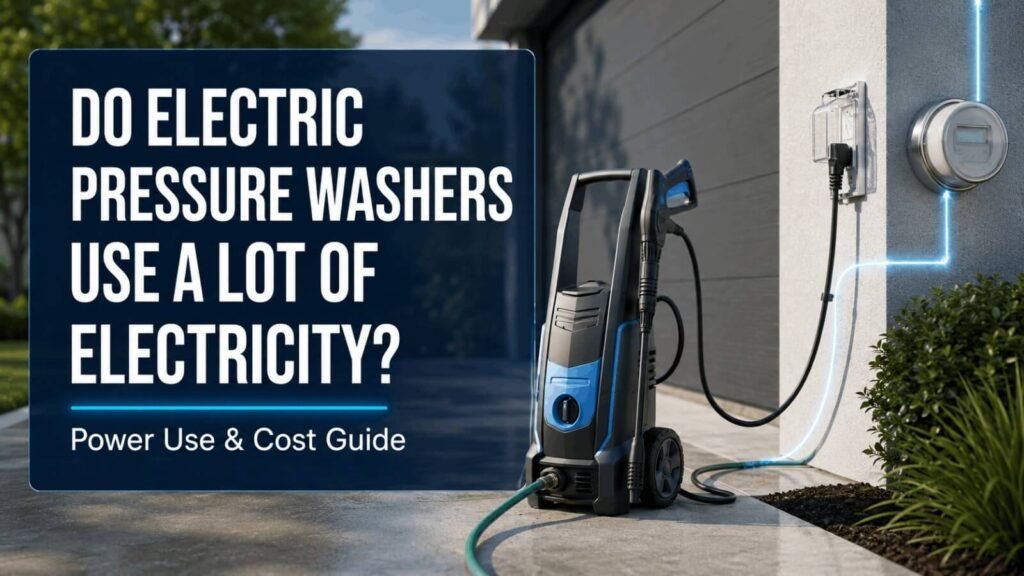
: Electric pressure washer connected safely to an outdoor outlet with electricity-cost graphics
Electric Pressure Washers

Do Electric Pressure Washers Use a Lot of Electricity? Cost Guide

A pressure washer sounds powerful, so it is reasonable to wonder what that motor is doing to your electricity bill. The answer is less alarming than the noise may suggest. Do electric pressure washers use a lot of electricity? They can draw a fairly high amount of power while the motor is running, but most household cleaning jobs last only 30 minutes to a few hours. That usually makes the total electricity cost modest. A machine drawing 1.8 kilowatts continuously for one hour would use 1.8 kilowatt-hours (kWh). At an example rate of $0.15 per kWh, that equals $0.27. Actual use depends on the motor rating, trigger time, total job length, automatic stop system, voltage, water supply, nozzle, and cleaning method. This guide shows how to read the machine label, calculate running cost, compare realistic scenarios, and avoid wasting electricity. How these estimates were prepared: Calculations use manufacturer-listed input power and assume continuous motor operation unless stated otherwise. They are planning estimates, not laboratory measurements. Your machine, trigger time, voltage and electricity tariff will determine the actual cost. Do Electric Pressure Washers Use a Lot of Electricity Per Hour? Corded residential pressure washers vary by market and cleaning class. Current manufacturer examples include 230V models rated from about 1.4 kW to 3.0 kW, while many North American homeowner units use a 120V, 13-amp motor. Always use the rating on your own machine rather than treating these examples as a universal range. Those figures describe power demand while operating, not the amount charged on a monthly bill. Electricity billing is based mainly on energy use in kilowatt-hours: Energy used (kWh) = Power (kW) × Running time (hours) A 1.6 kW machine running for 45 minutes uses up to: 1.6 × 0.75 = 1.2 kWh If electricity costs $0.20 per kWh, the estimated cost is: 1.2 × $0.20 = $0.24 This is a simple full-power estimate. Some electric pressure washers stop the motor when the trigger is released, reducing energy use during pauses. Motor load and power factor can also make measured consumption different from a nameplate calculation. How to Find Your Pressure Washer’s Wattage Check the rating label on the machine, motor, plug tag, or manual. Look for W or kW, together with voltage and amperage. Use Listed Watts When Available If the manufacturer lists rated input power, use that number. Convert watts to kilowatts by dividing by 1,000: 1,400 watts = 1.4 kW 1,800 watts = 1.8 kW 2,000 watts = 2.0 kW Do not calculate electricity use from PSI or GPM. PSI measures water pressure, while GPM measures water flow. Neither tells you the exact electrical input. Estimate From Volts and Amps When only voltage and amperage are shown, multiply them for a basic circuit-demand estimate: Volts × Amps = Volt-amperes (VA) For example, 120V × 13A = 1,560 VA. People often treat that as roughly 1,560 watts for quick planning, but an AC motor’s true watts can differ because of power factor and operating load. A plug-in electricity meter rated for the machine’s current provides a better real-world measurement when the manufacturer allows its use outdoors and the setup remains safely GFCI-protected. Why Voltage Alone Does Not Show Consumption A 230V machine is not automatically twice as expensive to run as a 115V machine. Higher voltage can deliver the same power at lower current. Wattage and operating time—not voltage alone—determine energy use. Electric Pressure Washer Cost Examples The table below uses a 1.8 kW pressure washer and assumes continuous full-power operation. Replace the electricity rate with the amount shown on your utility bill. Cleaning time Energy used At $0.10/kWh At $0.20/kWh At $0.30/kWh 30 minutes 0.9 kWh $0.09 $0.18 $0.27 1 hour 1.8 kWh $0.18 $0.36 $0.54 2 hours 3.6 kWh $0.36 $0.72 $1.08 For a 90-minute job at $0.20 per kWh: 1.8 kW × 1.5 hours × $0.20 = $0.54 This calculation is intentionally conservative if the motor stops whenever the trigger is released. It may underestimate use if the machine includes additional electric heating, a vacuum, or another powered system. Estimate Monthly or Annual Cost Suppose you run a 1.8 kW machine for one hour twice each month: 1.8 kW × 2 hours × 12 months = 43.2 kWh per year At $0.20 per kWh, that equals $8.64 per year. This is only an example; local rates, cleaning frequency, and actual motor-on time will change the result. What Affects Electricity Consumption? Motor Input Rating A larger motor can draw more power, but it may also complete a suitable job faster. Comparing wattage alone does not show which machine will use less total energy. Trigger Time and Automatic Stop Many residential models use a total-stop system that switches off the motor when the spray-gun trigger is released. This reduces unnecessary runtime during repositioning, scrubbing, soap dwell time, or moving furniture. Confirm how your model behaves rather than assuming every machine stops completely. Cleaning Time Job duration often matters more than a small difference in wattage. A 1.8 kW machine used efficiently for 40 minutes can consume less energy than a 1.4 kW unit struggling for two hours. Surface, Dirt, and Nozzle Choice Heavy algae, compacted mud, and old concrete stains take longer than rinsing a car or patio chair. The correct nozzle and detergent can shorten the job, but excessive pressure can damage paint, wood, seals, and vehicle trim. . Our guide to choosing the right PSI for different cleaning jobs helps match cleaning force to the surface. Water Supply A restricted tap, kinked hose, clogged inlet filter, or undersized supply hose can reduce performance. The motor may keep running while the user makes little progress. Confirm that the source can provide the water flow required by the manual. Hot-Water and Commercial Machines Do not apply homeowner cold-water estimates to commercial electric hot-water equipment. A heating element can require much more electricity than the pump motor and may need a dedicated high-voltage circuit. Check motor and heater ratings separately. Is an Electric Pressure Washer Cheaper Than

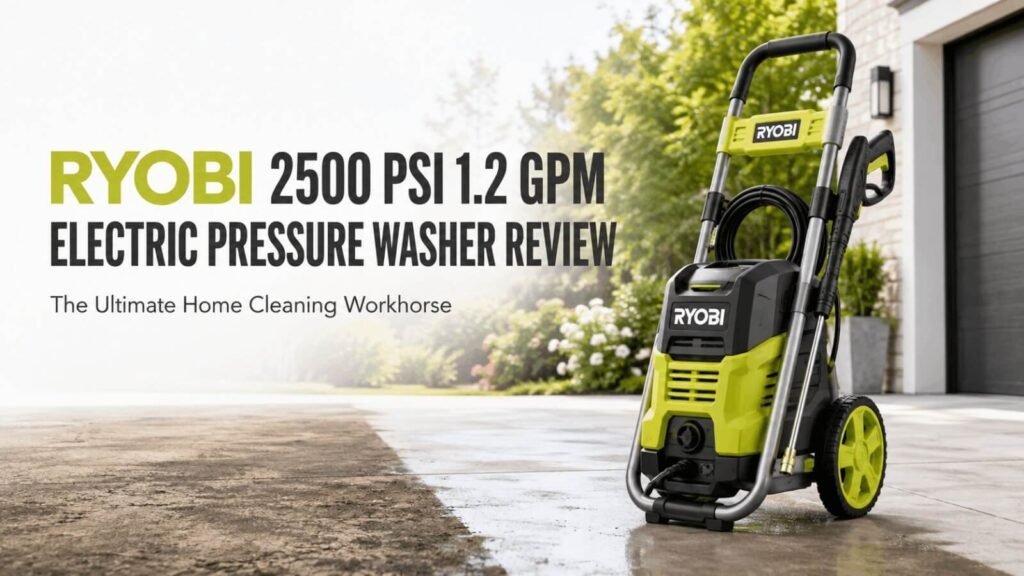
RYOBI 2500 PSI 1.2 GPM electric pressure washer review cover image on outdoor driveway
Buying Guides, Safety Tips

RYOBI 2500 PSI 1.2 GPM Electric Pressure Washer Review: The Ultimate Home Cleaning Workhorse

Maintaining a clean, spotless home exterior often feels like an endless battle against stubborn dirt, grime, mildew, oil leaks, and seasonal weathering. While residential garden hoses lack the force needed to dislodge deeply set contaminants, commercial gas pressure washers can be overly loud, cumbersome, fume-heavy, and aggressive enough to damage delicate finishes. Enter the RYOBI 2500 PSI 1.2 GPM Electric Pressure Washer. Engineered to bridge the gap between lightweight domestic sprayers and heavy industrial machines, this high-performance unit promises professional-grade electric cleaning power without the maintenance headaches of gas engines. In this comprehensive review, we will break down its technical specifications, core features, practical real-world applications, maintenance needs, and how it stacks up against top competitors. Technical Specifications Overview Feature / Specification Details Brand & Model RYOBI 2500 PSI Electric Pressure Washer Max Pressure Output 2500 PSI (Pounds per Square Inch) Water Flow Rate 1.2 GPM (Gallons per Minute) Cleaning Power Index 3,000 Cleaning Units (PSI × GPM) Onboard Soap Tank Volume 1 Gallon High-Pressure Hose 25 ft. Reach Hose Power Source Corded Electric Standards Met EPA Compliant Item Weight 40 lbs Included Accessories 15° Nozzle, Soap Nozzle, Turbo Nozzle Why Choose the RYOBI 2500 PSI Electric Pressure Washer? The electric pressure washer segment is crowded with entry-level machines delivering lower pressure. The RYOBI 2500 PSI 1.2 GPM model stands out by offering genuine medium-to-heavy residential cleaning capability powered purely by electricity. It eliminates common pain points associated with gas equipment: Instant Push-Button Start: No pull cords, chokes, or stubborn cold-weather engine starts. Zero Emissions & Quiet Operation: Ideal for enclosed patios, townhomes, and garages without exhaust fumes or excessive noise. Minimal Maintenance: No oil changes, spark plug replacements, fuel stabilizers, or carburetor rebuilds required. Key Features & Product Performance 1. 2500 PSI Output with 1.2 GPM Flow Rate Cleaning effectiveness relies on the combination of pressure (PSI) and water volume (GPM). Generating 3,000 Total Cleaning Units, this machine delivers ample impact force to dislodge compacted grime while remaining far more water-efficient than a standard outdoor spigot. 2. Integrated 1-Gallon Soap Tank The built-in 1-gallon detergent tank lets you quickly apply foam cleaners, vehicle soaps, and surface degreasers without hauling external buckets around the yard. 3. Quick-Connect Pro-Grade Nozzles The included quick-connect nozzle set covers a variety of cleaning tasks: Turbo Nozzle: Employs an oscillating pinpoint stream for maximum circular cleaning impact—ideal for deep concrete stains and weathered brick. 15° Fan Nozzle: Provides a balanced spray pattern ideal for general surface stripping and house siding cleanup. Soap Applicator Nozzle: Siphons detergent directly from the onboard 1-gallon tank at low pressure. Practical Applications: What Can You Clean? Automotive Care & Car Detailing Electric pressure washers offer smooth, consistent pressure delivery. Paired with the low-pressure soap nozzle or an optional 40° wide-angle nozzle (sold separately), it applies cleaning foam evenly across paintwork. Safety Tip: Maintain a distance of at least 2 to 3 feet from painted automotive panels and avoid targeting delicate trim pieces with narrow spray angles. Concrete Driveways, Sidewalks, & Slabs Porous concrete easily absorbs motor fluids, dirt, and algae. Utilizing the included Turbo Nozzle allows you to lift deep-seated grime and restore discolored walkways quickly. Wood Decks, Fences, & Composite Surfaces Softwoods can splinter easily under direct pressure. Always test an inconspicuous area first, starting at a conservative distance and moving closer only as needed to clean without damaging delicate wood grain. House Siding & Soffits With its combined cord-and-hose reach, this unit lets you easily maneuver around the property perimeter to strip pollen, bug nests, and mildew from vinyl siding and brick foundations. RYOBI 2500 PSI vs. Market Competitors Feature RYOBI 2500 PSI Greenworks Pro 2300–2500 Typical Gas 2500 PSI Power Source Electric Electric Gas Engine (4-Stroke) Max Pressure 2500 PSI 2300–2500 PSI 2500 PSI Flow Rate 1.2 GPM 1.2 GPM 2.3 GPM Maintenance Minimal Minimal Oil, Filters, Fuel Prep Total Weight 40 lbs ~45 lbs 65–75 lbs Best Used For Home & Auto Care Residential DIY Heavy Commercial Work Operating Instructions & Winterization Guide 1.Connect Water Source:Check for leak-free connections. Attach a standard 5/8-inch garden hose securely to the water inlet on the unit and turn on the water spigot fully. 2.Purge Trapped Air:Prevents pump cavitation. Before connecting to electrical power, squeeze the spray gun trigger for 30–45 seconds until a steady, continuous stream of water flows out of the wand. 3.Power On:Direct wall outlet recommended. Plug the power cord directly into a grounded outdoor receptacle and turn the power dial to the ON position. 4.Winterization & Storage:Protect internal seals from freezing. Flush the detergent system with fresh water for 60 seconds after using soap. Disconnect hoses, squeeze the trigger to drain remaining internal water, and apply an aerosol pump protector before cold-weather storage. Pros and Cons Pros: Zero Gas Maintenance: No fuel mixing, oil checks, or spark plug replacements. Lightweight Frame: At only 40 lbs, it is easy to transport around yards and up deck stairs. Versatile Soap System: Integrated 1-gallon onboard tank streamlines foam application. Included Turbo Tip: Accelerates deep cleaning on hard concrete surfaces. Cons: 1.2 GPM Flow Rate: Slower rinsing speed compared to high-volume commercial gas models. Electrical Outlet Bound: Requires proximity to a functional outdoor power source. Frequently Asked Questions (FAQs) Q1. Can I use an extension cord with the RYOBI 2500 PSI pressure washer? The official manual recommends plugging the power cord directly into a wall outlet. If an extension cord is strictly unavoidable, use only a heavy-duty 12-AWG outdoor-rated cord no longer than 25 feet. Extension cords measuring 50 feet or longer are not permitted due to severe risk of voltage drop and motor damage. Q2. Is 2500 PSI safe for washing cars? Yes, when used with the low-pressure soap nozzle or an optional compatible 40° wide fan nozzle at a safe distance (2–3 feet). Never use the 0° red tip or Turbo Nozzle on vehicle paint or glass. Q3. Can I feed hot water into this unit? No. The RYOBI 2500 PSI pressure washer is designed strictly for

Scroll to Top