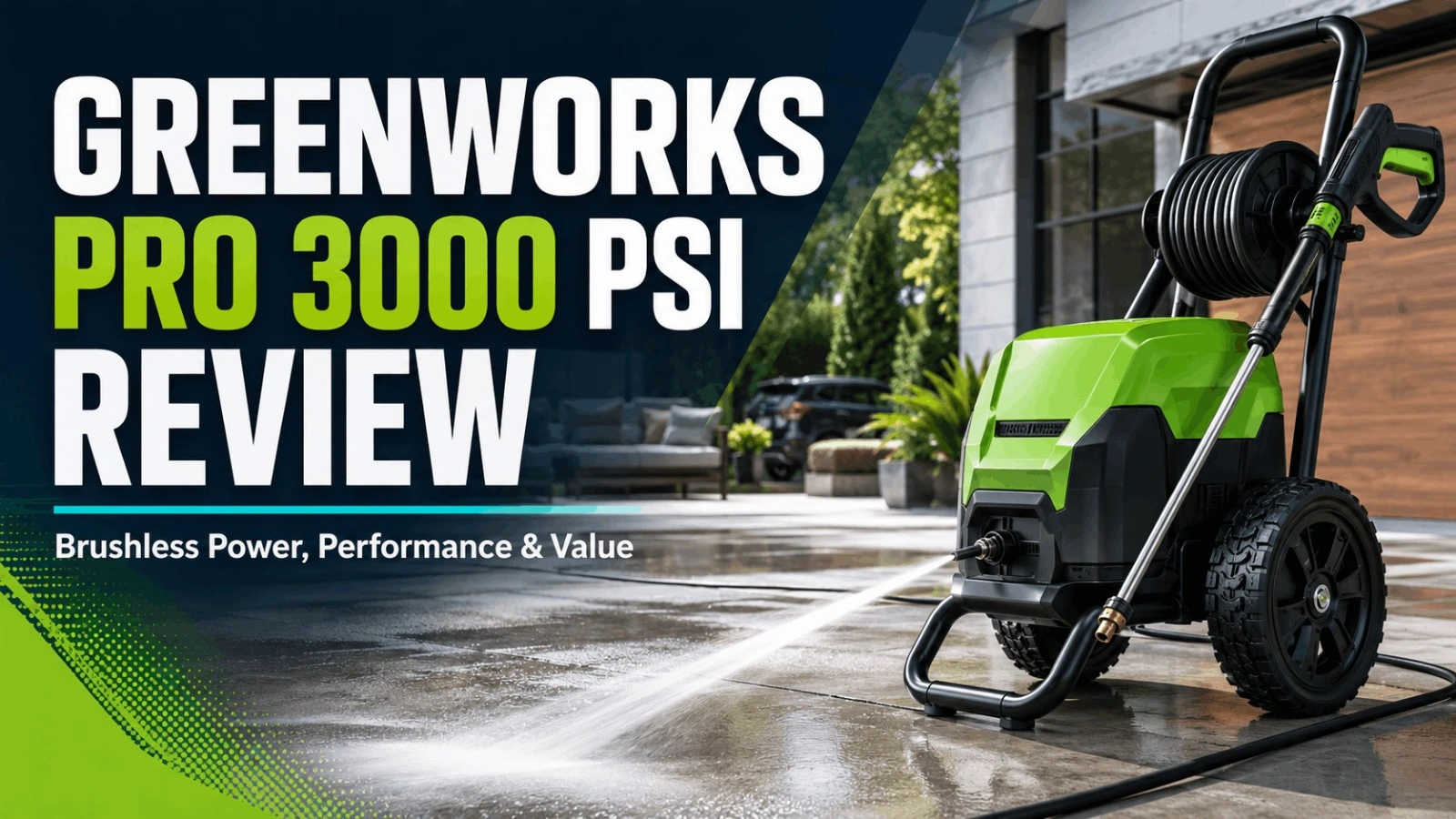
Electric pressure washers are easy to start and maintain, but many compact models feel slow when the job moves from washing a car to cleaning concrete. The Greenworks Pro 3000 PSI brushless pressure washer is designed to offer stronger residential cleaning without gasoline, exhaust, oil changes, or a pull cord.
The headline figures require careful explanation. Greenworks lists 3,000 PSI at 1.1 GPM and 2.0 GPM at 100 PSI. These are separate operating points—not 3,000 PSI and 2.0 GPM at the same time. This review covers that important difference, along with the GPW3001 and GPW3002A models, included features, suitable surfaces, common problems, safety, and overall value.
How we reviewed it: This is an independent, specification-based review. We checked Greenworks’ current product pages, support information, model details, and public safety guidance. We did not perform instrumented pressure or flow testing, so performance comments are informed suitability judgments rather than laboratory results.
Greenworks 3000 PSI Electric Pressure Washer: Quick Verdict
The Greenworks Pro 3000 is a capable residential electric washer for concrete, patios, pavers, decks, fencing, siding, vehicles, and outdoor equipment. Its brushless motor, five spray nozzles, 25-foot hose, 35-foot GFCI power cord, onboard soap tank, and 10-inch wheels make it more useful than a basic carry-style machine.
Its main limitation is flow at maximum pressure. At 3,000 PSI, the rated flow is 1.1 GPM, so a higher-flow gas washer can rinse a large driveway or heavy mud faster. The Greenworks also needs a suitable 120-volt outlet and dependable water supply.
| Buying decision | Assessment |
| Best for | Regular residential cleaning with electric convenience |
| Suitable surfaces | Sound concrete, patios, fences, decks, siding, cars and outdoor furniture |
| Main advantage | Strong maximum pressure with five nozzles and no gas engine |
| Main limitation | 1.1 GPM at maximum pressure limits rinsing speed |
| Portability | Steel frame with 10-inch never-flat wheels |
| Overall view | Strong choice when its features match frequent home-cleaning jobs |
Greenworks Pro 3000 PSI Pressure Washer Models: GPW3001 vs GPW3002A

Search results can show several Greenworks machines with a 3,000 PSI label. This review covers the corded brushless residential line, mainly the GPW3001, and compares it with the current GPW3002A Gen 2.
| Model | What buyers should know |
| GPW3001 — SKU 5113902 | Original corded brushless version. Greenworks lists vertical storage, a one-gallon detergent tank, 25-foot steel-braided hose, 35-foot cord, five nozzles, and 10-inch wheels. |
| GPW3002A — SKU 5128802 | Gen 2 corded brushless model with the same rated output, five nozzles, 25-foot hose, 35-foot cord, and open-frame design. |
| 60V/AC and 80V models | Different hybrid or battery-powered products. Their batteries, runtime, packages, prices, and warranty terms are outside this review. |
Always check the complete model and SKU before ordering parts or accessories. Do not assume every “Greenworks 3000 PSI” listing has the same frame, detergent system, package, or warranty.
Greenworks Pressure Washer 3000 PSI Specifications
The following specifications describe the main GPW3001 configuration. Retail bundles can add accessories, so compare the listing with the supplied manual.
| Specification | Greenworks Pro GPW3001 |
| Power type | Corded electric |
| Motor | Smart-sensing brushless motor |
| Electrical supply | 120V, 60Hz AC |
| Maximum pressure | 3,000 PSI |
| Flow at 3,000 PSI | 1.1 GPM |
| Maximum flow | 2.0 GPM at 100 PSI |
| High-pressure hose | 25-foot kink-resistant steel-braided hose |
| Power cord | 35 feet with waterproof plug and inline GFCI |
| Included nozzles | 15°, 25°, 40°, soap, and turbo |
| Nozzle connection | 1/4-inch quick-connect |
| Detergent system | One-gallon onboard tank |
| Wheels | 10-inch never-flat wheels |
| Certification | PWMA-certified performance claims |
| Advertised warranty | Three-year tool and ten-year brushless motor warranty for GPW3001 |
Understanding 3,000 PSI and 2.0 GPM
PSI describes water pressure, while GPM describes water flow. Pressure helps loosen dirt; flow helps carry it away. Greenworks lists 3,000 PSI at 1.1 GPM and 2.0 GPM at only 100 PSI. Multiplying 3,000 PSI by 2.0 GPM would therefore create a misleading comparison.
This means the washer can apply concentrated pressure to stubborn dirt, but it may rinse wide concrete areas more slowly than a machine delivering higher flow at working pressure.
Greenworks Pro 3000: Brushless Motor and Key Features
Smart-Sensing Brushless Motor
Greenworks says its TRUBRUSHLESS motor adjusts pressure and flow according to the installed nozzle. A brushless electric motor avoids carbon brushes and gas-engine tasks such as fuel storage, oil changes, spark plugs, and pull-cord starting. However, the pump, hoses, fittings, nozzles, screen, detergent tank, and power cord still require inspection and care.
Five Quick-Connect Nozzles
15-degree nozzle: Focused high pressure for durable hard surfaces.
25-degree nozzle: Balanced spray for general outdoor cleaning.
40-degree nozzle: Wider, gentler spray for rinsing and more sensitive surfaces.
Soap nozzle: Low-pressure detergent application through the tank.
Turbo nozzle: Rotating concentrated spray for suitable hard surfaces.
The 1/4-inch quick-connect can accept many accessories, but the fitting, pressure rating, flow range, and manufacturer limits must all match.
One-Gallon Soap Tank
The GPW3001’s large onboard tank reduces refilling during extended jobs. Detergent applies through the black low-pressure soap nozzle. Greenworks recommends designated pressure-washer soap and warns against harsh chemicals such as bleach, ammonia, and strongly alkaline cleaners.
Hose, Cord, Wheels, and Vertical Storage
The 25-foot steel-braided hose offers better abrasion and kink resistance than many basic hoses, although a large property may still require repositioning. The 35-foot cord adds reach and includes inline GFCI protection. Ten-inch never-flat wheels help on uneven outdoor surfaces, while vertical storage reduces the machine’s garage footprint.
Greenworks Pro 3000 Performance on Driveways, Decks, and Cars

Driveways, Concrete, and Pavers
The 15-degree or turbo nozzle can target dirt on sound concrete. A compatible surface cleaner may produce more even passes, but it is not included in the standard package. Begin with a less aggressive nozzle because damaged joints, loose pavers, weak concrete, and painted surfaces can be marked. Large, stained areas may take time at 1.1 GPM.
Decks, Fences, and Siding
Use the 25- or 40-degree nozzle, begin farther away, and test an unseen area. Concentrated spray can cut wood fibers or remove coatings. On siding, direct the spray downward where appropriate and keep water away from seams, vents, soffits, outlets, and light fixtures.
Cars, RVs, and Boats
Use the 40-degree nozzle and controlled distance. Avoid close pressure on damaged paint, decals, badges, sensors, cameras, tires, seals, and electrical parts. Follow the vehicle manufacturer’s care instructions. A compatible foam cannon may improve detergent coverage, but it does not replace careful rinsing or contact washing when road film remains.
Outdoor Furniture and Equipment
Choose the widest effective spray for bins, suitable furniture, tools, and garden equipment. Let hot items cool and disconnect powered equipment. Protect bearings, labels, intakes, switches, and electrical openings.
Greenworks Pro 3000 PSI Brushless Pressure Washer Pros and Cons

Pros
Strong maximum pressure for a residential corded electric washer.
Smart-sensing brushless motor and push-button starting.
Five included nozzles cover gentle rinsing through hard-surface cleaning.
One-gallon onboard detergent tank on the GPW3001.
Steel-braided 25-foot pressure hose and long GFCI-equipped cord.
Ten-inch wheels and vertical storage improve movement and storage.
No gasoline, exhaust, or routine gas-engine maintenance.
Cons
Maximum pressure is delivered at 1.1 GPM, not 2.0 GPM.
Large or heavily soiled surfaces may rinse more slowly than with a higher-flow gas washer.
The 25-foot pressure hose may feel short on a large property.
The 14-amp motor needs a suitable electrical supply.
It is bulkier than a compact carry-style washer.
Similar Greenworks model names can create parts and bundle confusion.
“Pro” branding does not make it a daily commercial-duty machine.
Common Greenworks Pro 3000 PSI Pressure Washer Problems

Motor Will Not Start or Keeps Shutting Off
Check the switch, outlet, inline GFCI, household breaker, cord, water supply, and installed nozzle. Release stored pressure before restarting. Greenworks also recommends purging trapped air with the machine off and the water running. Stop using the washer if electrical parts are damaged.
Pressure Pulses or Feels Weak
A kinked garden hose, restricted supply, trapped air, blocked nozzle, dirty inlet screen, or leaking connection can reduce pressure. Fully open the tap, straighten hoses, inspect the screen, and purge air before starting. Greenworks recommends at least 10 feet of unrestricted garden hose between the tap and machine.
Detergent Does Not Draw
Install the black soap nozzle and check the tank, detergent consistency, and feed path. Soap applies at low pressure. Use a compatible watery detergent and clean out dried residue as directed.
Nozzle Keeps Clogging
Switch off, unplug, close the water, and release pressure before removing a nozzle. Clean it according to the manual. Repeated blockages may indicate debris or mineral buildup in the water supply or inlet screen.
How to Use the Greenworks 3000 PSI Electric Pressure Washer Safely
The CDC’s pressure-washer safety guidance warns that high-pressure spray can cause serious wounds that initially appear minor. Never point the wand at people or animals. Wear eye protection and closed footwear, keep others clear, and seek prompt medical attention for any pressure-washer injury.
Before Cleaning
Inspect the hose, gun, wand, fittings, cord, GFCI, nozzles, and inlet screen.
Place the washer on stable ground and keep plugs dry, raised, and away from spray.
Connect a cold household water supply and fully open the tap.
With the motor off, hold the trigger until water flows steadily and trapped air is removed.
Install the gentlest suitable nozzle and test a hidden area from a safe distance.
After Cleaning and Storage
Switch off, unplug, close the tap, and release stored pressure. Drain the hose, gun, wand, pump, and detergent system. Coil the hose and cord without sharp bends. Replace a damaged pressure hose rather than repairing it. Use pump protector and store above freezing when required by the manual.
Is the Greenworks Pro 3000 Worth It?

The GPW3001 or GPW3002A makes sense for homeowners who regularly clean concrete, patios, fencing, siding, vehicles, and outdoor equipment but want electric starting and less engine maintenance. Its five nozzles, wheeled frame, hose, cord, and detergent system add real value when those features will be used.
It is harder to justify for occasional car washing or a few chairs; a smaller electric washer costs less and stores more easily. A higher-flow gas washer or a best commercial electric pressure washer is more suitable for frequent large driveways, heavy mud, remote work, or daily paid cleaning. Before buying, confirm the exact model, standard accessories, current written warranty, parts support, return policy, and price. Greenworks sells separate corded, battery, and hybrid 3,000 PSI products, so model verification matters more than the headline pressure alone.
Frequently Asked Questions
Is the Greenworks Pro 3000 PSI pressure washer really 3,000 PSI?
Greenworks lists a maximum of 3,000 PSI at 1.1 GPM. The advertised 2.0 GPM occurs at 100 PSI, not at maximum pressure.
Is the Greenworks Pro 3000 good for driveways?
It can clean sound concrete with the correct nozzle and technique. Large areas and deep staining may take longer because flow at maximum pressure is 1.1 GPM.
Can the Greenworks Pro 3000 safely wash a car?
It can be used carefully with the 40-degree nozzle, adequate distance, and compatible detergent. Avoid vulnerable paint, tires, seals, sensors, trim, and electrical components.
Does it include a surface cleaner?
The standard manufacturer package lists five nozzles, a hose, wand, and manual, but not a surface cleaner. Retail bundles can differ, so verify the listing.
What is the difference between GPW3001 and GPW3002A?
Both are corded brushless residential models with the same advertised pressure and flow. GPW3002A is the Gen 2 version. Compare the exact frame, storage, detergent system, bundle, and written warranty before choosing.
Is it suitable for a cleaning business?
It is primarily positioned as a residential washer. Commercial users should consider duty cycle, flow, hose reach, service support, and warranty terms before relying on it for paid daily work.
Final Verdict
The Greenworks Pro 3000 PSI brushless pressure washer combines electric convenience with useful residential cleaning power. Its brushless motor, five nozzles, soap system, reinforced hose, long power cord, wheels, and storage design suit a wide range of outdoor jobs.
Its 3,000 PSI rating is delivered at 1.1 GPM, while 2.0 GPM applies only at low pressure. That makes it powerful but not automatically faster than every gas washer on large surfaces.
Buy it when the included equipment and corded operation fit your routine. Choose a smaller washer for occasional light work or a higher-flow professional machine for frequent demanding jobs.