
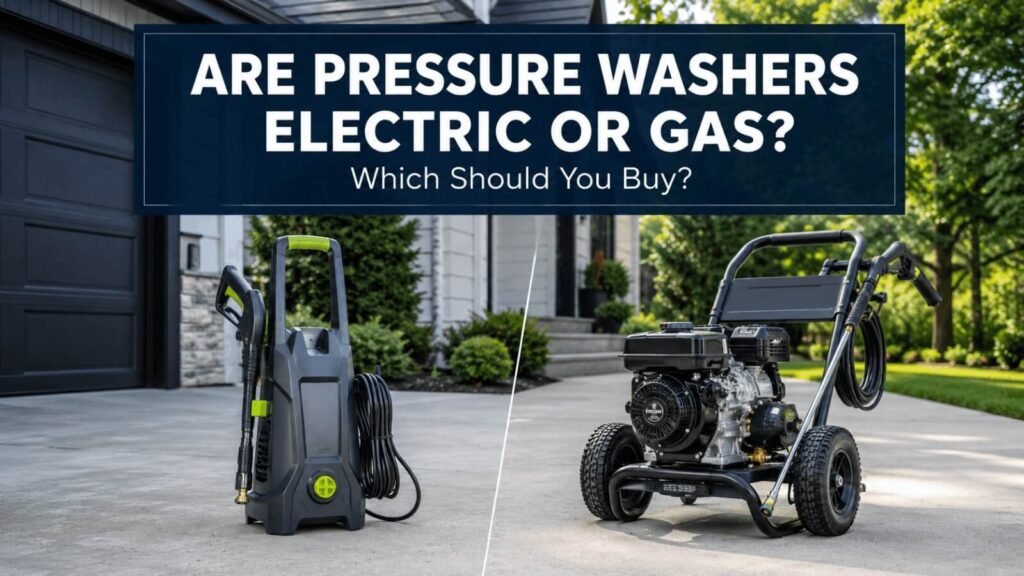
Are Pressure Washers Electric or Gas? Which Should You Buy?
Pressure washers come in both electric and gas versions, and the choice changes how much cleaning power you get. Gas washers deliver far more flow and pressure. Electric washers are lighter, quieter and need almost no upkeep. This guide compares the two using real model numbers from maker pages, so you can see the gap in numbers. It also covers power needs, running care, safety and the jobs each type suits best. We did not test these machines. Every figure comes from a maker spec or a named listing. Are Pressure Washers Electric or Gas? The Short Answer Both. The right one depends on what you clean and how often. If you only clean a few times a year and your jobs are small, an electric model is usually the better value. If you have a lot of concrete to do, gas saves hours. Electric vs Gas Pressure Washer: Quick Comparison The table uses figures from the maker models we have covered. Electric examples are the Greenworks GPW2003. Gas examples are the Generac 2900 PSI, Simpson MS61039 and Westinghouse WPX3400. Factor Electric Gas Typical pressure About 2,000 PSI max (Greenworks GPW2003) 2,900 to 3,400 PSI (Generac, Simpson, Westinghouse) Typical flow 1.2 GPM max (Greenworks GPW2003) 2.4 to 2.6 GPM Power source Outlet, 14-amp motor on the GPW2003 Gas engine, 196cc to 212cc Mobility Limited by a 35 ft cord Go anywhere you can roll it Weight Lighter, check the box label 52.1 lb (Simpson), 57 lb (Generac) Upkeep Cord and pump care, no fuel Oil, fuel, spark plug, carburetor Safety extras GFCI in the plug Carbon monoxide risk, outdoors only Sources: Greenworks, Generac, Simpson and Westinghouse listings as cited in our model reviews. Always check your own model’s label, since many models vary by number. How Electric Pressure Washers Work An electric washer uses a motor to drive a pump. You plug it into a wall outlet and turn it on. There is no engine, so it starts at once and runs quietly compared with gas. The Greenworks GPW2003 is a good example. It has a 14-amp universal motor, a 25 ft hose and a 35 ft power cord with an inline GFCI plug. The GFCI cuts power quickly if it detects a fault, which matters when water and electricity share a work area. Extension cords are the usual weak point. A thin or long cord drops voltage, makes the motor hot and can trip its thermal protector. Karcher’s manuals list 25 ft of 12/2 cord or 50 ft of 10/2 cord for one model, and other makers give different limits, so follow your manual. Our guide on why a pressure washer won’t start covers cord and GFCI checks. How Gas Pressure Washers Work A gas washer uses a small engine to drive the pump. The engine runs on gasoline and needs oil, just like a lawn mower. Because it makes its own power, it can run strong pumps and high flow. The Generac 2900 PSI uses a 196cc OHV engine and delivers 2.4 GPM. The Westinghouse WPX3400 uses a 212cc engine for 3400 PSI and 2.6 GPM. These machines are heavier, louder and need regular care, but they clean much faster. Check the oil before each use, use fresh fuel and run water before you start. Some models, like the Generac we reviewed, have no low-oil shutoff, so you have to watch the dipstick yourself. See our Generac 2900 PSI review for details. PSI and GPM: Which Type Has More Cleaning Power? PSI is force and GPM is volume. Multiply them for cleaning units, a simple way to compare machines. The table shows models we have already checked against maker pages. Model Type PSI x GPM Cleaning units Greenworks GPW2003 Electric 2,000 x 1.2 2,400 Westinghouse WPX3400e Electric 3,000 x 1.1 (rated) 3,300 Generac 2900 PSI Gas 2,900 x 2.4 6,960 Simpson MS61039 Gas 3,000 x 2.4 7,200 Westinghouse WPX3400 Gas 3,400 x 2.6 8,840 The pattern is clear. The gas examples deliver roughly three times the cleaning units of the Greenworks electric. The Westinghouse electric WPX3400e shows that some electric units are closer, but it still falls well below the gas models. Note that the Greenworks listing gives 1.2 GPM measured at 100 PSI, so you should not assume the maximum PSI and flow occur together. Treat these as comparison figures, not guaranteed results on the surface. Which Type Is Better for Common Cleaning Jobs? Whichever you choose, test a hidden spot first, and keep the wand moving. For a pick of models by use, see our home-use buying guide. Power and Space Needs Electric washers need an outlet within reach. A 14-amp motor draws most of a standard 15-amp household circuit, so avoid sharing the circuit with other heavy tools. Common electrical guidance is to keep continuous loads below about 80% of a circuit’s rating, which leaves roughly 12 amps on a 15-amp circuit. Read your manual for the exact requirement. Gas washers need open air. You have to run them outdoors, away from windows, doors and vents. They also need a place to store fuel safely. See our power requirements guide for fuel and electrical details. Running Care and Upkeep Electric washers are simpler. Inspect the cord, GFCI and hose, rinse the inlet screen, and drain the pump before freezing weather. Gas washers need more. Our maintenance checklist and winterizing guide cover both types. What About Cordless Pressure Washers? A third option sits below electric in power. Cordless washers run on batteries, so there is no cord and no fuel. They are handy for quick jobs like bikes, patio furniture and cars, but their runtime and pressure are limited. If you are weighing that route, our guides on portable cordless pressure washers and cordless vs electric pressure washers go through the trade-offs. For heavy concrete work, gas is still the faster tool. Safety Differences Between Electric and Gas A Worked Example: Amps and Outlets Here is the math behind the 14-amp figure. A 14-amp motor