
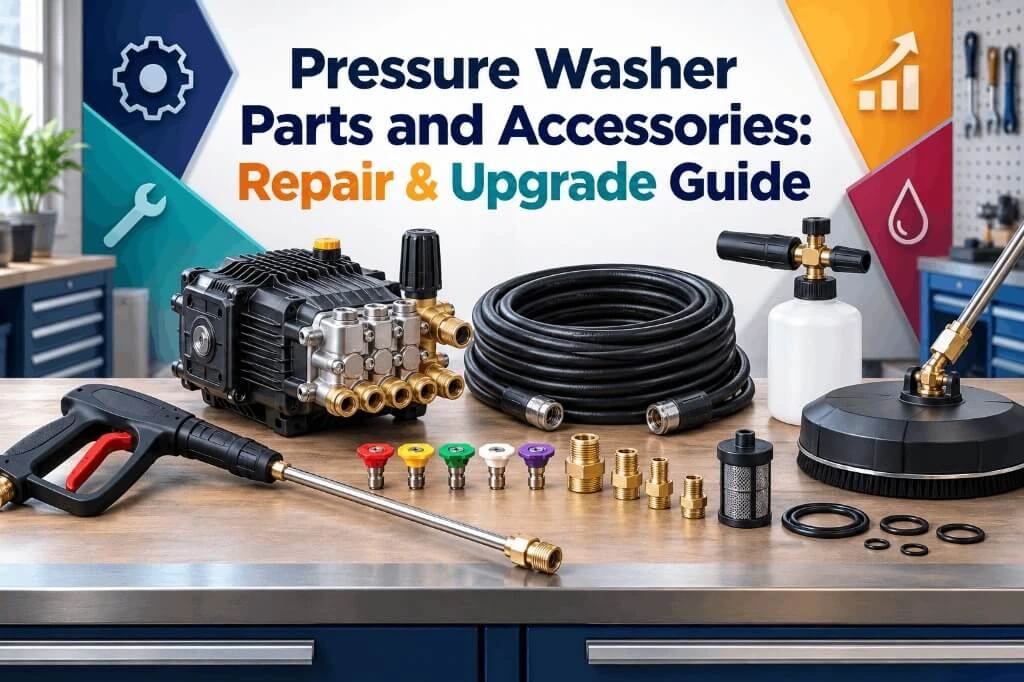
A weak spray can send you shopping for a new pump when the real problem is a worn nozzle. A dripping connection can lead to a replacement hose when only the correct seal is needed. Buying before identifying the fault makes pressure washer ownership more expensive than necessary.
Quick answer: Buy pressure washer parts and accessories only after identifying the complete machine model and the job the component must perform. For replacement parts, confirm the part number and revision. For external accessories, check the working PSI, GPM requirement, temperature limit, connector dimensions, and intended surface.
This guide covers safe first checks, compatibility requirements, common replacement components, and useful upgrades. It is designed for homeowners maintaining an occasional-use washer and small businesses keeping equipment ready for work. The guidance is based on manufacturer information and recognized safety sources; it does not claim hands-on product testing.
Pressure Washer Parts and Accessories: What Is the Difference?
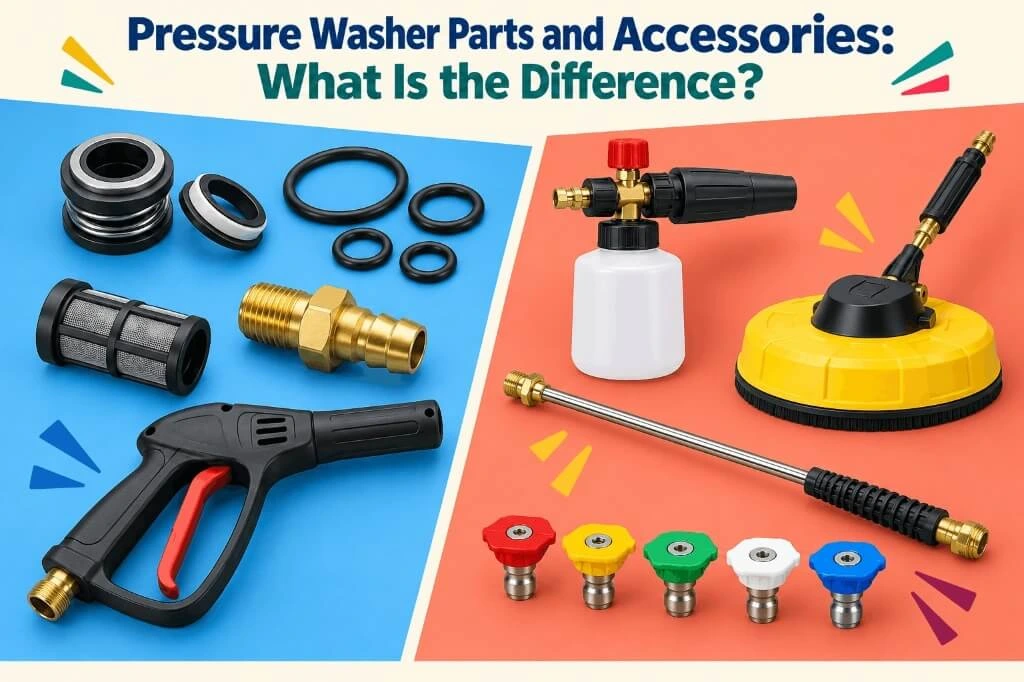
A replacement part restores an existing function. An accessory changes how you use the machine or expands the jobs it can handle.
The distinction is not always strict. A hose replaces a failed component, while a more manageable approved hose can also improve reach and handling. What matters is knowing your reason for buying.
| Component or accessory | Main purpose | Typical buying reason |
| Inlet screen and supply fittings | Bring clean water into the machine | Missing screen, damaged fitting, or supply connection problem |
| Pump and internal seals | Produce and contain pressurized flow | Confirmed mechanical fault |
| High-pressure hose | Carry pressurized water to the gun | Damage, leakage, or unsuitable reach |
| Spray gun and wand | Control and direct water | Trigger fault, damaged connection, or handling need |
| Nozzle tips | Shape the spray and provide the specified outlet opening | Wear, blockage damage, or another approved spray pattern |
| Detergent pickup components | Draw and deliver cleaning solution | Split tube, blocked filter, or confirmed injector fault |
| Surface cleaner or foam cannon | Adapt the washer to a specific cleaning task | More suitable coverage or detergent application |
Compatibility Checklist Before You Buy
Use this checklist for every purchase instead of relying on appearance or a “universal fit” claim:
-
Complete pressure washer model, revision, and serial range
-
Exact current or superseded part number
-
Maximum working pressure—not merely burst pressure
-
Required water flow in GPM or L/min
-
Cold-water or hot-water temperature rating
-
Connector type, thread, insert, plug, socket, and sealing method
-
Package contents, required adapters, and replacement seals
-
Intended surface, detergent, and duty level
Start with the original equipment in safe working order. Optional attachments should come after damaged hoses, faulty triggers, and unreliable water connections are addressed.
Pressure Washer Replacement Parts: Identify Before Ordering
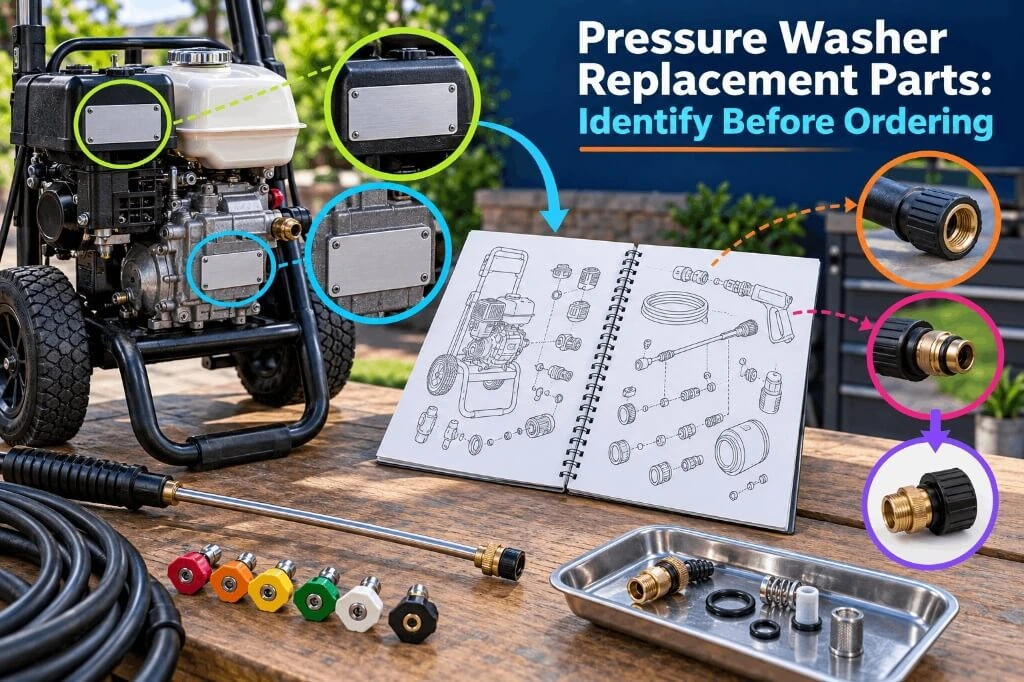
Record the complete machine model
-
Find the washer’s identification label and record the model, revision, and serial number where available. Take a photograph so you can check the information while shopping.
-
A gas engine may have a separate model identification. That helps with engine parts, but it does not automatically identify the pump, gun, or hose supplied by the equipment maker.
-
Use the illustrated parts list for the complete machine. It shows how assemblies relate and helps distinguish a small seal from a complete fitting or manifold.
Match the diagram number to the orderable part
-
A number beside an item in a diagram may be only its position in the drawing. Find the corresponding entry in the parts table to obtain the actual part number.
-
Check any serial-number or revision restrictions. If an old part has been replaced by a newer number, ask the supplier to confirm the change against your model.
-
Before ordering, also check what the package includes. A bare assembly may exclude seals, bolts, adapters, or other components shown nearby in the illustration.
Inspect previous modifications
-
Used equipment may have a replacement pump or aftermarket gun. Compare the actual assembly with the original diagram before relying on factory specifications alone.
-
Keep photographs of both ends of a hose or fitting. A clear view of the sealing surface is often more useful to a supplier than a distant photograph of the whole washer.
Diagnose the Symptom Before Buying a Part
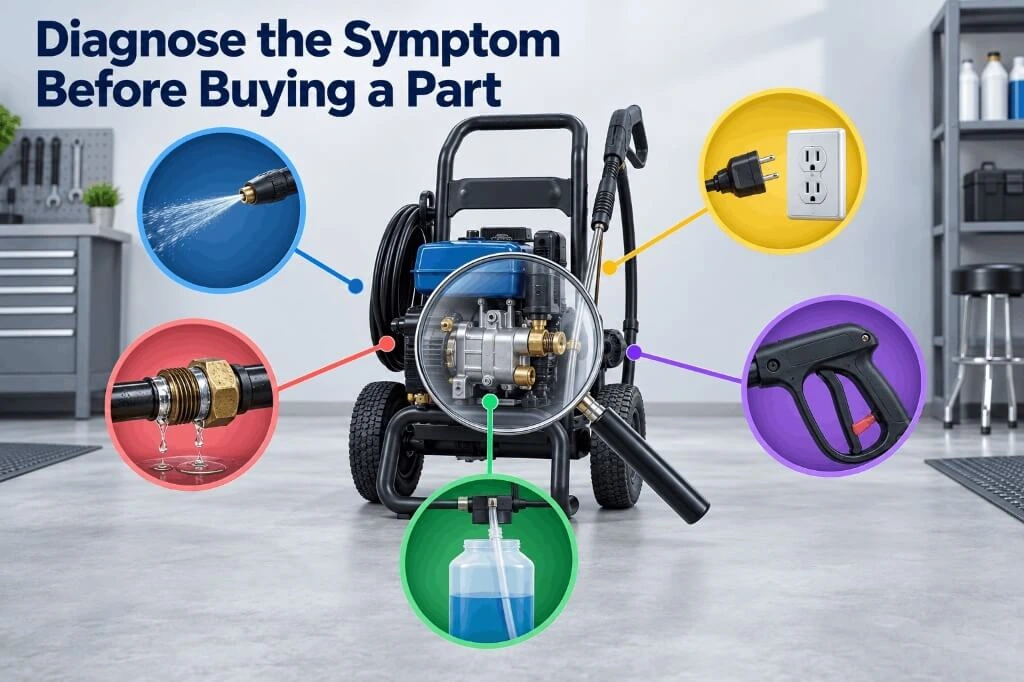
A symptom points to possible causes; it does not establish which component has failed. Begin with checks allowed by the operator’s manual, with the machine safely stopped whenever you inspect or disconnect anything.
| Symptom | Beginner-safe first check | When to seek help |
| Weak or uneven spray | Supply flow, hose kinks, inlet screen, and correct nozzle | Problem remains after approved basic checks |
| Leak at an external joint | Correct connection and accessible seal condition | Cracked housing, damaged threads, or uncertain sealing dimensions |
| Detergent will not draw | Required soap mode, pickup tube, and detergent filter | Suspected internal injector fault |
| Electric washer will not start | Approved outlet and startup/reset checks in the manual | Repeated tripping, damaged wiring, or burning smell |
| Gun does not stop water correctly | Stop using it | Suspected trigger or valve fault |
Do not keep operating a pulsing or leaking machine while trying unrelated accessories. Write down when the fault occurs: only with one nozzle, only during detergent use, or with every approved attachment. That detail helps narrow the next check.
Avoid adjusting a pressure regulator to disguise poor output. A worn tip or water-supply issue needs its own correction; turning a control without the proper procedure can create another problem.
Pressure Washer Hose and Fittings
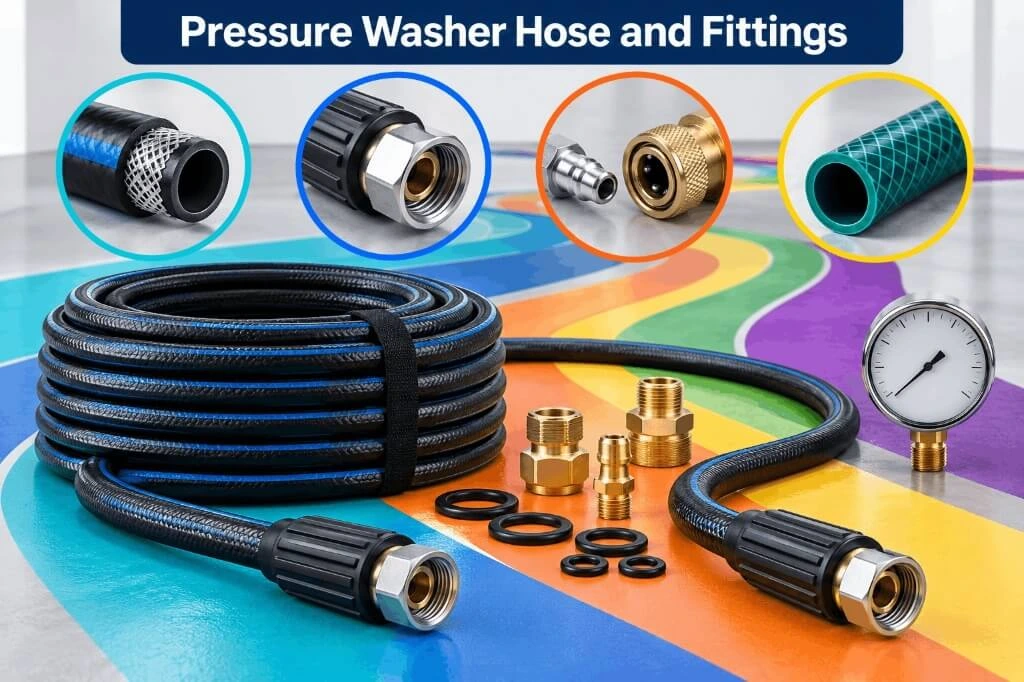
The supply hose and high-pressure hose work on opposite sides of the pump. Their fittings are not interchangeable merely because an adapter can join them.
Check pressure, temperature, and hose ends
-
A replacement high-pressure hose must be rated for the washer’s specified maximum pressure and water temperature. Use the working-pressure rating, not a higher burst-pressure claim.
-
For threaded connections, confirm the thread and sealing dimensions. M22 fittings can use different internal insert sizes even when the outer threads look similar. For quick connections, match the plug, socket, nominal size, profile, and intended location. Measure carefully or ask the manufacturer or supplier to verify the connection.
-
A 3/4-inch garden-hose fitting belongs on the supply side. Do not place ordinary garden-hose couplers in the pressurized line between the pump and gun.
Choose manageable reach
-
Measure the route around the cleaning area rather than the straight-line distance from the tap. Corners, wheels, and furniture change how much usable hose you need.
-
Longer hoses reduce repositioning but add weight and friction loss. Internal diameter and flow affect that loss, so stay within the manufacturer’s hose guidance.
-
Never patch a damaged high-pressure hose with tape or household clamps. Replace an assembly with bulges, exposed reinforcement, significant cuts, or high-pressure leaks.
Replacement Spray Gun and Wand
A spray gun controls flow with its trigger. A wand creates reach and holds the nozzle or attachment. A replacement must match both the hose inlet and the wand outlet.
Check pressure, flow, temperature, trigger lock, and overall handling. A short gun can be convenient around a vehicle but may put your hands closer to splash and grime. A long wand gives reach but increases leverage and fatigue.
For frequent cleaning, consider whether the trigger remains comfortable and whether approved seals or swivels are available. A complete gun replacement may be more practical than an internal repair when the unit is not designed for user servicing.
Do not tie the trigger open or remove a safety feature. If it sticks or fails to shut off properly, stop using the assembly.
Nozzle Tips: Small Parts That Affect the Whole Setup
A nozzle has two important characteristics: its spray pattern and its opening size. Matching only the connector is not enough.
Fan angle and orifice size
-
The angle determines how widely the stream spreads. The orifice is the opening through which water leaves. It needs to suit the machine’s intended pressure and flow.
-
A wider fan spreads force over a larger area, but it does not guarantee safety on a delicate finish. A narrow jet concentrates force and increases the risk of surface damage.
-
Choose the specified nozzle size or use an approved sizing chart. Do not select tips solely by color, because color usually identifies the pattern rather than the complete operating specification.
Distinguish blockage from wear
-
A blocked tip and a worn opening require different responses. Follow the manual’s cleaning method for debris; do not drill or enlarge the opening. Replace a worn nozzle with the correct size rather than compensating elsewhere in the system.
-
Turbo nozzles use a rotating concentrated jet. They are task-specific tools for suitable durable surfaces, not general replacements for a car-washing or deck-rinsing tip.
Pressure Washer Pump Replacement: When Fit Gets More Complicated
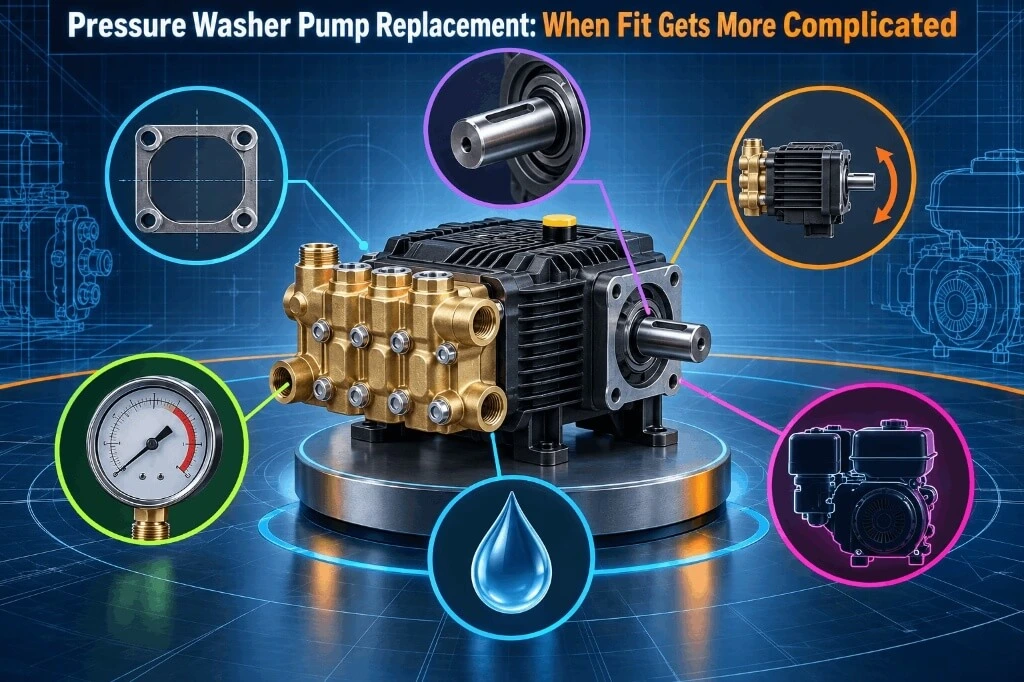
A replacement pump is a mechanical matching decision, not an accessory chosen by appearance.
More than PSI and GPM
-
A supplier or service technician must confirm mounting arrangement, shaft dimensions, drive orientation, operating speed, power requirements, and the required pressure and flow. Water inlet conditions and control-system compatibility also matter.
-
A pump that physically bolts into place may still be unsuitable for the engine, motor, or existing controls. Higher advertised output does not make it a sensible upgrade.
-
Internal valves, seals, unloaders, and electrical controls require model-specific procedures. Leave uncertain diagnosis, pressure adjustment, and major pump work to qualified service support.
Repair or replace the machine?
-
Compare the total repair cost: diagnosis, parts, labor, shipping, and other worn components. Then consider the condition of the power source, frame, hose, and gun.
-
There is no universal percentage at which replacement becomes better. A sound machine with available parts may justify repair. Several major faults on an unsupported model may make a replacement more practical.
-
If that decision changes the type of equipment you need,
our guide to electric and gas pressure washers explains the broader ownership differences.
Pressure Washer Attachments Worth Considering
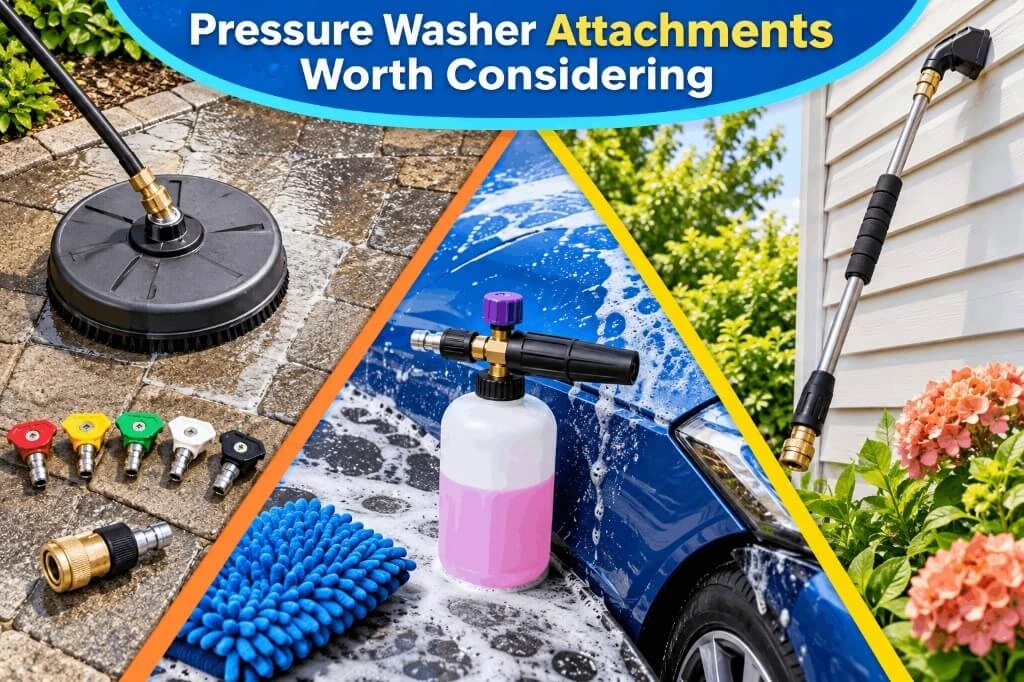
Choose an attachment for a repeat job, after confirming the machine can operate it properly.
Surface cleaner: best for suitable flat paving
-
A rotating spray bar beneath a housing can give more consistent coverage on compatible flat concrete. Check the attachment’s minimum flow, pressure range, nozzle requirements, and connection.
-
A larger head may clean poorly when the pump cannot supply enough water. Keep the head level, move steadily, and plan a separate rinse to carry dirty water away.
-
Avoid assuming it is suitable for wood, coatings, or weak paving joints. The housing limits splash; it does not eliminate damage risk.
Foam cannon: best for controlled shampoo application
-
A compatible foam cannon can distribute car shampoo, but thick foam is not a measure of cleaning power. Confirm operating requirements and use the recommended detergent dilution.
-
Work on cool panels and prevent the solution from drying. Remaining road film may require a suitable contact wash. A foam cannon is optional, especially if your regular jobs do not involve vehicle care.
Extension wand: best where reach remains controllable
-
An approved extension can help reach an area from stable ground, but length increases handling demands. Stay away from electrical lines and avoid driving water into vents, roof edges, or siding gaps.
-
Do not use a ladder to compensate for insufficient reach while handling a pressure washer. Choose another method or professional help when access is unsafe.
OEM or Aftermarket: Compare Documentation and Support
OEM parts come from the original equipment manufacturer. Aftermarket options come from other suppliers and may offer different lengths, materials, or handling features.
An OEM part listed for your exact model provides a clear replacement route. An aftermarket part can also be suitable when its dimensions, ratings, and application are documented.
Be cautious with listings that show only a photograph and “universal fit.” Ask for the missing specifications, available replacement seals, warranty terms, and return conditions.
For a small cleaning business, standardizing compatible connections across equipment can simplify spares. Do not force that standard onto a machine through unsuitable adapters or unapproved changes.
Prices and availability can change. Compare the complete installed cost, including any required fittings, rather than the headline price alone.
Common Buying and Repair Mistakes
-
Ordering a whole assembly too early: Check whether an approved accessible seal or small component solves the confirmed problem before replacing more parts.
-
Using thread tape on every joint: Some connections seal with an O-ring or washer. Follow the fitting instructions; tape cannot correct damaged sealing surfaces or wrong dimensions.
-
Buying by appearance or PSI alone: Flow, temperature, connection type, and intended duty remain important. A high-pressure rating is only one requirement.
-
Adding chemicals the system cannot handle: Use detergent approved for the equipment and surface. Never mix cleaners or send an unapproved solution through the pump.
-
Treating accessories as repairs: A new foam cannon or nozzle set will not solve every mechanical or supply problem. Diagnose the issue first.
Safety Before Inspection or Installation
Follow the operator’s manual, attachment instructions, surface guidance, and detergent label. Shut down and isolate the power source, then release trapped pressure as instructed before disconnecting components. Let hot equipment cool.
Wear eye protection and sturdy non-slip footwear. Keep people and pets away, and never feel for a pressure leak with your hand. A high-pressure spray wound needs prompt medical attention even when it appears small.
Operate gasoline-powered pressure washers outdoors and keep exhaust away from doors, windows, vents, and enclosed or partly enclosed spaces. . The CDC has documented carbon monoxide poisoning linked to indoor use of gasoline-powered pressure washers. Keep electrical connections dry and use the ground-fault protection required by the manufacturer. Do not cut or splice a damaged power cord.
For connection order and startup checks, follow our electric pressure washer setup guide, alongside your model’s instructions.
Simple Action Plan
Before you start
-
Record the machine identification and describe the fault or desired improvement. Locate the relevant manual and diagram. Confirm part numbers, ratings, connection details, and package contents before ordering.
During installation and use
-
Work only within the manual’s user-service procedures. Confirm fittings seat or lock correctly, establish the water supply, and follow the approved startup sequence. Test an attachment on a small suitable area. Stop for leakage, unusual vibration, or abnormal operation.
After cleaning: pressure washer maintenance checklist
-
Flush detergent equipment, shut down, relieve pressure, and drain components as directed. Clean screens and tips using approved tools. Coil hoses without sharp bends and store fittings away from grit.
-
Follow separate engine and pump maintenance schedules where applicable. Some pumps are sealed and do not require routine user oil changes. Use the specified storage procedure and protect water-containing parts from freezing.
-
Save confirmed part numbers and receipts. This turns a successful repair into useful information for the next service.
Frequently Asked Questions
Are pressure washer parts interchangeable between brands?
Some external components can be shared when all specifications match. Internal parts and proprietary connections often need exact model compatibility. Never assume that two machines with the same advertised PSI use the same parts.
What does a part-number suffix mean?
It may identify a revision or a different version, depending on the manufacturer. Do not remove it when searching. Ask the supplier to confirm whether a different suffix is an approved replacement.
Can a new hose improve cleaning pressure?
Replacing a damaged, restricted, or unsuitable hose may restore intended performance. It does not increase pump capacity. A longer or narrower hose can also create additional losses, so follow the approved specification.
Should I keep spare O-rings?
A small set of correctly identified seals can be useful, especially for frequent work. Match dimensions and material to each application. A random assortment is less helpful if you cannot confirm which seal belongs where.
Is a pressure washer repair kit enough to fix low pressure?
Not without diagnosis. Low output can come from supply restrictions, nozzle issues, or internal faults. A kit only helps when its contents match both the machine and the established cause.
Can I use a car accessory on a driveway?
A broad rinse tip may serve more than one job when approved, but a foam cannon or vehicle shampoo is not automatically the right choice for paving stains. Match the detergent and attachment to the surface and soil.
Conclusion: Fix the Problem, Then Improve the Setup
The smartest way to buy pressure washer parts and accessories is to start with a clear purpose. Identify the failed function or the cleaning task you want to improve, then confirm the specifications before spending.
Keep the basic machine safe and reliable first. Add useful reach, coverage, or detergent control afterward. A documented, well-matched setup is easier to maintain and more useful than a box of uncertain replacements.