
A pressure washer can lose pressure, leak water, run unevenly, or refuse to start even when its Honda engine is still in excellent condition. The difficult part is knowing whether you need Honda pressure washer parts, pump components, or a completely new pump.
This distinction matters because Honda usually supplies the engine—not the complete pressure washer pump. A machine advertised as a “Honda GX390 pressure washer” may use a pump made by CAT Pumps, General Pump, AR, Comet, AAA, or another manufacturer.
This guide explains how to identify the correct GX390 engine parts, diagnose pump problems, compare repair with replacement, and choose a compatible pump without relying on PSI alone. It is written for homeowners, DIY users, equipment owners, and cleaning professionals who want to avoid ordering the wrong component.
Honda Pressure Washer Parts: Know Which System You Are Repairing
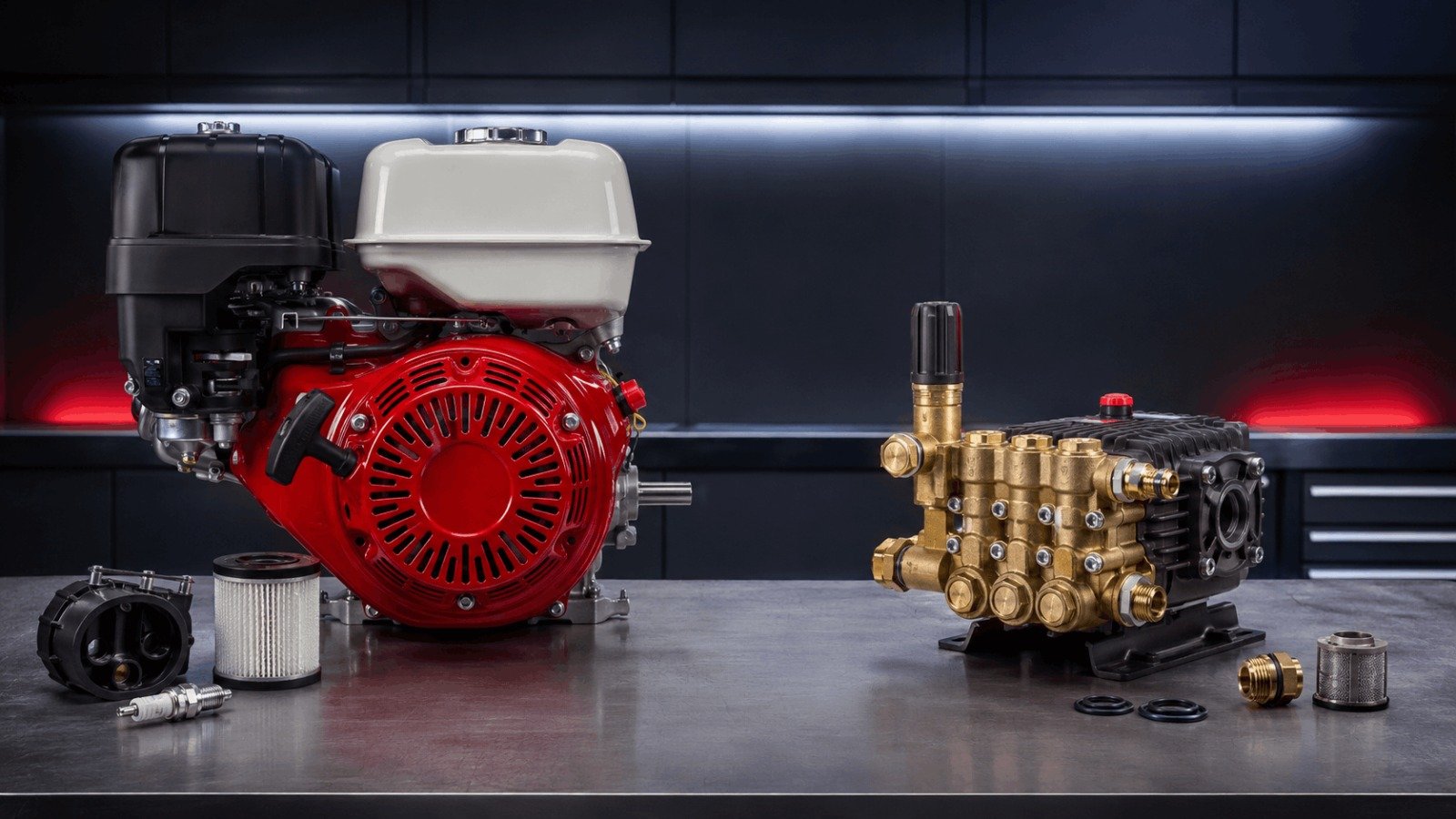
A gas pressure washer has two major mechanical systems: the engine and the pump. They work together, but their parts normally come from different manufacturers.
The Honda engine turns fuel into mechanical power. The pump uses that power to pressurize the incoming water. A problem in either system can make the machine appear weak or unusable.
System | Main function | Common parts |
Honda engine | Produces rotational power | Air filter, spark plug, carburettor, fuel valve, recoil starter, ignition coil, gaskets and crankshaft |
Pressure washer pump | Creates water pressure and flow | Seals, check valves, plungers, unloader valve, manifold, thermal relief valve and oil seals |
Water delivery system | Carries water to and from the pump | Inlet filter, hose, spray gun, fittings, O-rings and nozzle |
Detergent system | Draws and applies cleaning solution | Chemical injector, siphon tube, filter and soap nozzle |
If the engine starts and runs smoothly but the spray is weak, the problem is more likely connected to water flow, the nozzle, unloader, valves, seals, or pump. If the engine will not start, surges without a water load, smokes, or stalls, begin with the Honda engine system.
Before buying anything, find both identification labels:
- The engine model, type code, and serial number.
- The pump manufacturer and exact pump model.
- The pressure washer’s complete model and serial number.
A photograph of each label is more useful than relying on the words “GX390 pressure washer.”
Honda GX390 Pressure Washer Parts
The Honda GX390 is a 389cc, air-cooled, four-stroke OHV engine. Current published specifications list net power at approximately 11.7 horsepower at 3,600 rpm. Older listings and advertisements may describe it as a 13-horsepower engine, but net output is the more useful figure when matching a pump.
GX390-powered pressure washers are commonly used for concrete cleaning, equipment washing, fleet work, paint preparation, agricultural cleaning, and other demanding jobs. They are larger and more powerful than typical residential machines.
Common GX390 Engine Replacement Parts
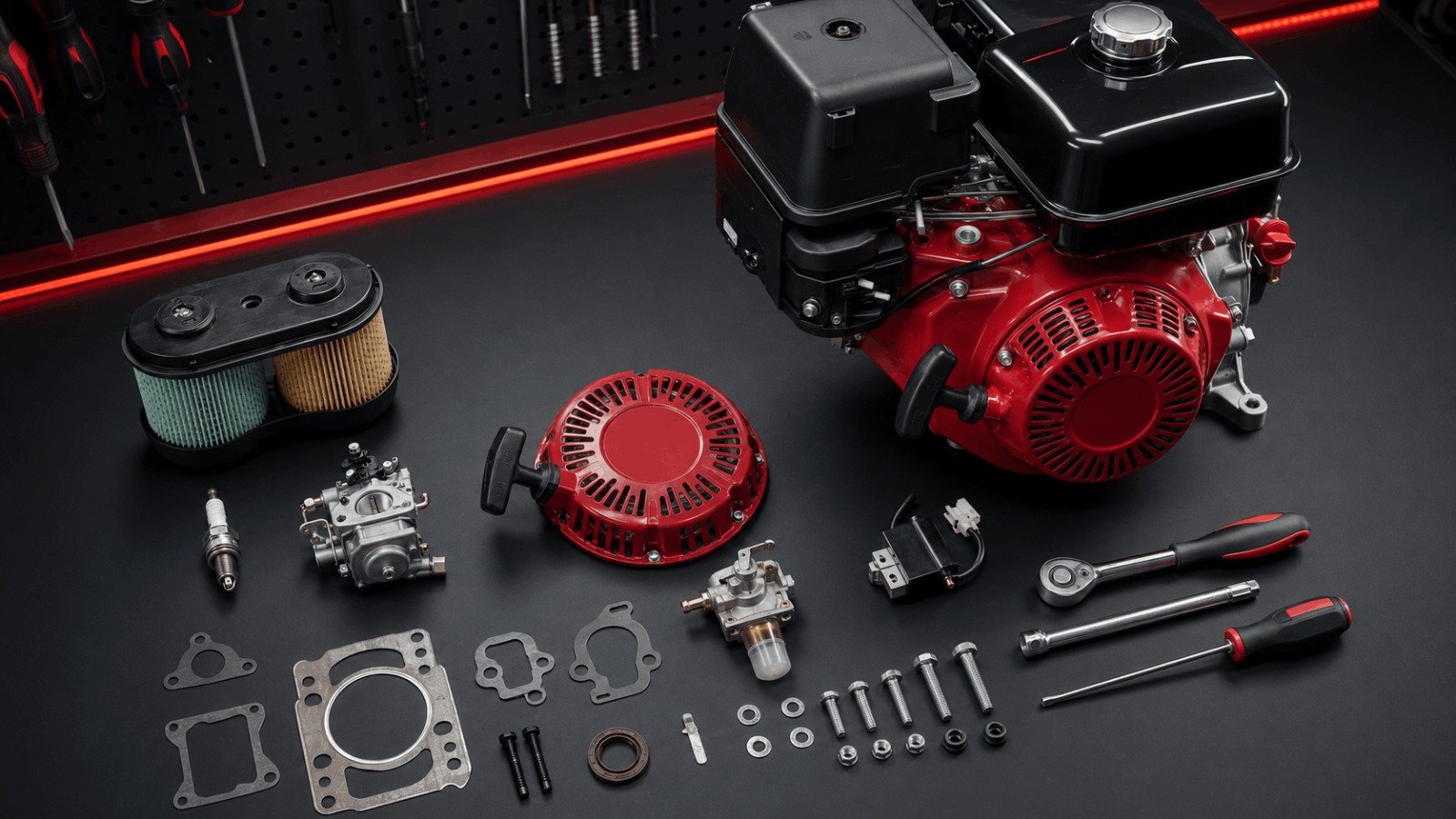
Part | Common signs of trouble | What to check first |
Air filter | Power loss, rich running or black exhaust | Dirt, oil saturation and incorrect installation |
Spark plug | Hard starting, misfiring or rough running | Electrode wear, deposits and correct gap |
Carburetor | Surging, fuel leaks or poor starting | Old fuel, blocked jet, dirty bowl or damaged gasket |
Fuel valve and line | Fuel starvation or leakage | Cracks, blockage, loose clamps and valve operation |
Recoil starter | Rope does not retract or engage | Rope, spring, starter pawls and housing |
Ignition coil | No spark or intermittent shutdown | Wiring, stop-switch circuit and spark-plug condition |
Oil Alert system | Engine stops or will not start | Correct oil level and level ground |
Muffler and guard | Excessive noise or damaged protection | Loose fasteners, corrosion and cracks |
Engine gaskets and seals | Oil or fuel leakage | Source of leak before ordering a gasket |
Crankshaft or key | Vibration or pump-coupling problems | Shaft damage, worn keyway and incorrect pump fit |
Routine parts such as the air filter and spark plug are usually straightforward to replace. Internal engine repairs involving valve timing, crankshaft damage, low compression, or major oil leakage require more experience and may be better handled by a qualified small-engine technician.
Why the GX390 Type Code Matters
“GX390” identifies the engine family, but it does not describe every detail of your engine.
GX390 versions may differ in:
- PTO shaft diameter, length, and design
- Keyway dimensions
- Recoil or electric starting system
- Charging coil and wiring
- Air-cleaner configuration
- Fuel tank arrangement
- Control-box design
- Emissions equipment
- Regional specifications
Two engines can both carry the GX390 name while using different shafts, starter assemblies, carburetors, or electrical parts. Ordering from the full model and type code is safer than choosing a component because a marketplace listing says “fits GX390.”
Genuine, OEM-Specification, or Aftermarket Parts?
Genuine Honda parts are normally the safest choice when fit, calibration, and long-term reliability matter. They are particularly valuable for carburetors, ignition components, internal engine parts, and parts connected to the Oil Alert system.
Good-quality aftermarket filters, starter ropes, gaskets, and routine service items can be practical when their measurements and specifications match. However, very cheap carburetors and ignition coils can produce difficult-to-diagnose problems, including surging, poor fuel control, or inconsistent spark.
For commercial machines, saving a small amount on an uncertain part may not be worthwhile if it creates downtime during paid work.
Honda GX390 Pressure Washer Pump: What You Need to Know
The phrase “Honda GX390 pressure washer pump” can be misleading. It usually means a pump powered by a Honda GX390 engine, not a pump manufactured by Honda.
The pump has its own brand, model, specifications, service requirements, and repair kits. A seal kit for one 4,000 PSI triplex pump will not necessarily fit another 4,000 PSI triplex pump.
Main Parts Inside a Triplex Pump
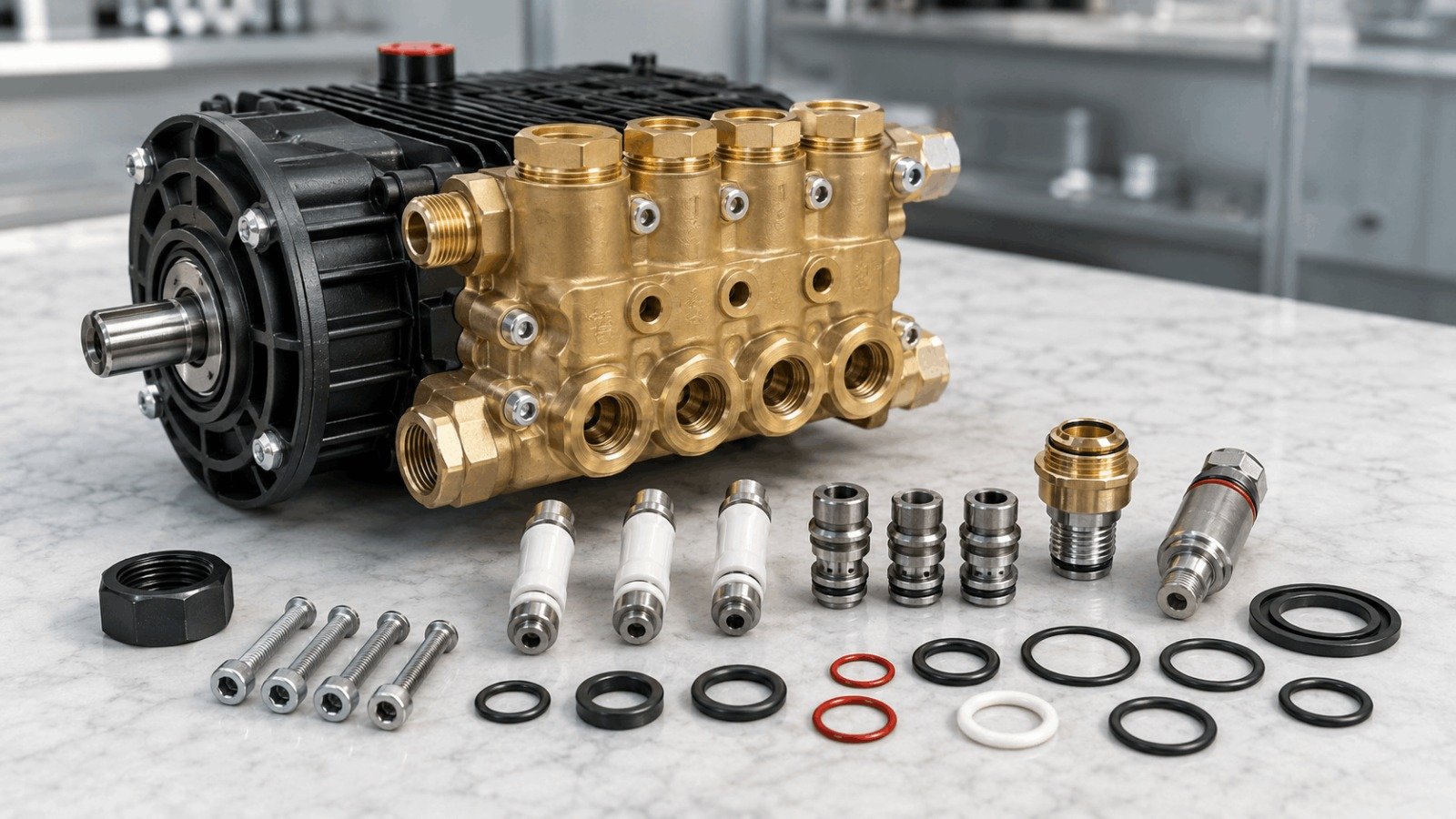
Commercial GX390 machines commonly use triplex plunger pumps. These pumps use three plungers moving in sequence to create consistent water flow.
Important components include:
- Plungers: Move back and forth to pressurize water.
- Water seals or packings: Prevent high-pressure water from escaping around the plungers.
- Oil seals: Keep pump oil separate from the water section.
- Check valves: Control the direction of water through the pump.
- Manifold: Contains the high-pressure water passages, valves, and seals.
- Unloader valve: Redirects water when the spray-gun trigger is released.
- Thermal relief valve: Releases overheated bypass water on equipped pumps.
- Connecting rods and crankshaft: Convert rotary engine power into plunger movement.
- Bearings: Support the pump crankshaft under load.
Pump repair kits are normally sold by the pump model. Do not buy “GX390 pump seals” without identifying the pump itself.
Signs the Pump May Need Repair
A pump problem may show up as:
- Pulsing pressure after the water supply has been checked
- Water leaking from the pump manifold
- Milky pump oil
- Pump oil leaking near the crankcase
- Pressure that falls as the pump becomes warm
- Rough mechanical noise
- Pressure failing to build even with the correct nozzle
- Water entering the pump-oil chamber
- Repeated thermal-relief discharge
- An unloader that sticks or does not return smoothly
Not every low-pressure problem requires pump repair. A blocked inlet filter, undersized garden hose, air leak, worn nozzle, incorrect nozzle size, kinked hose, weak water supply, or trapped air can create similar symptoms.
For a broader view of how these engines are paired with commercial machines, see the Honda GX390 pressure washer guide.
Beginner-Safe Checks Before Opening the Pump
Complete these checks in order:
- Confirm that the water source delivers more flow than the pump requires.
- Use a short, unrestricted garden hose with a clean inlet screen.
- Remove kinks and inspect connections for air leaks.
- Turn on the water and purge air before starting the engine.
- Check the high-pressure hose, gun, lance, and fittings.
- Inspect the nozzle for debris, wear, and correct sizing.
- Test with another known-compatible nozzle.
- Look for visible water or pump-oil leakage.
- Check whether the engine holds its normal operating speed under load.
Only move to internal pump diagnosis after these basic causes have been ruled out.
Honda 4000 PSI Pressure Washer Pump Compatibility
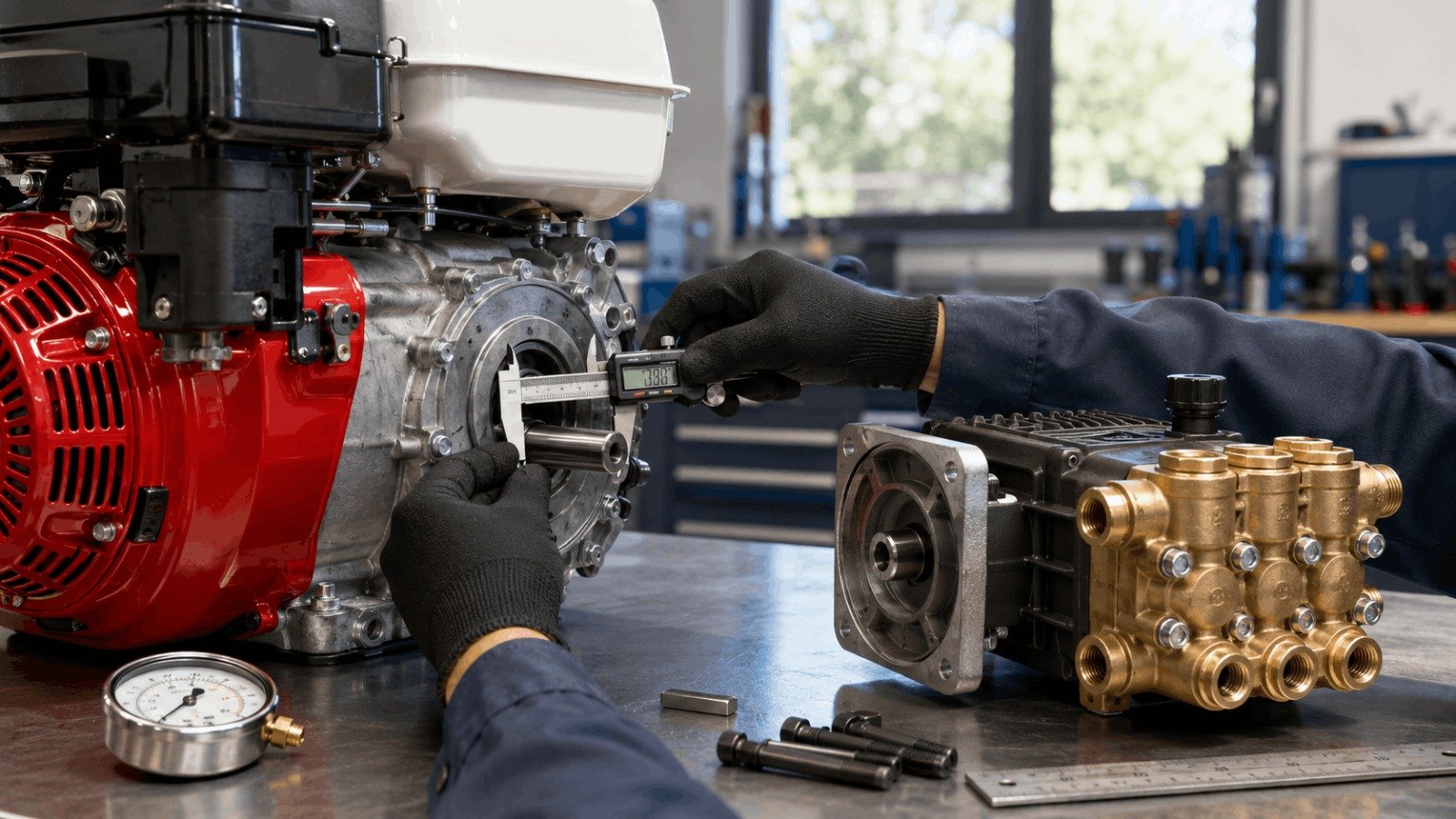
A Honda GX390 can power many pumps in the 4,000 PSI class, especially around 4.0 GPM. However, a pump should never be selected on the 4,000 PSI label alone.
A 4,000 PSI, 4.0 GPM pump produces approximately 9.3 hydraulic horsepower before efficiency losses are considered:\text{Hydraulic HP}=\frac{\text{PSI}\times\text{GPM}}{1714}
\frac{4000\times4}{1714}\approx9.3\text{ HP}
The engine must provide more than this because no pump is perfectly efficient. At an estimated 85% pump efficiency, the shaft requirement is close to 11 horsepower. That makes a properly matched 4 GPM, 4,000 PSI pump a sensible upper-working combination for many GX390 installations.
A pump rated for 4,000 PSI at 5 GPM would require considerably more power. Connecting it to a GX390 does not guarantee that the machine will achieve both figures at the same time.
Compatibility Checklist for a 4000 PSI Pump
Factor | What must match |
Working pressure | The intended operating PSI, not only the advertised maximum |
Flow rate | GPM must be realistic for the engine’s available power |
Input speed | Direct-drive and belt-drive pumps use different input speeds |
Shaft diameter | Must match the exact engine or drive system |
Shaft length | Enough engagement without interference |
Keyway | Correct width and depth |
Mounting flange | Correct bolt pattern and alignment |
Rotation | Pump must turn in the required direction |
Pump orientation | Inlet, outlet, drain plug, and oil sight glass must remain accessible |
Drive method | Direct drive, gearbox, or belt drive |
Water inlet | Must support the required GPM without restriction |
Outlet connection | Must match the hose and unloader arrangement |
Unloader system | Built-in or external, with correct pressure and flow rating |
Hose and gun rating | Working rating must safely cover the system’s maximum pressure |
Nozzle size | Must match the intended PSI and GPM |
The safest approach is to compare the old pump’s data plate and installation measurements with the replacement pump’s technical drawing.
Maximum PSI Is Not Normal Operating Pressure
Some pumps advertise a maximum pressure that should not be treated as their ideal continuous setting. Commercial cleaning is usually more reliable when a pump operates within its rated working range instead of staying at its absolute limit.
A pressure gauge installed at the pump outlet helps with correct setup. The system should also use the proper nozzle size. Do not use the unloader valve as the main method of reducing pressure for every cleaning job. A mismatched nozzle can force the unloader to bypass too much water, increase heat, and create unstable operation.
For delicate surfaces, pressure should be controlled through the correct nozzle, distance, technique, and—where supported—a proper pressure-adjustment system.
GX390 Pressure Washer Pump: Direct Drive vs. Belt Drive
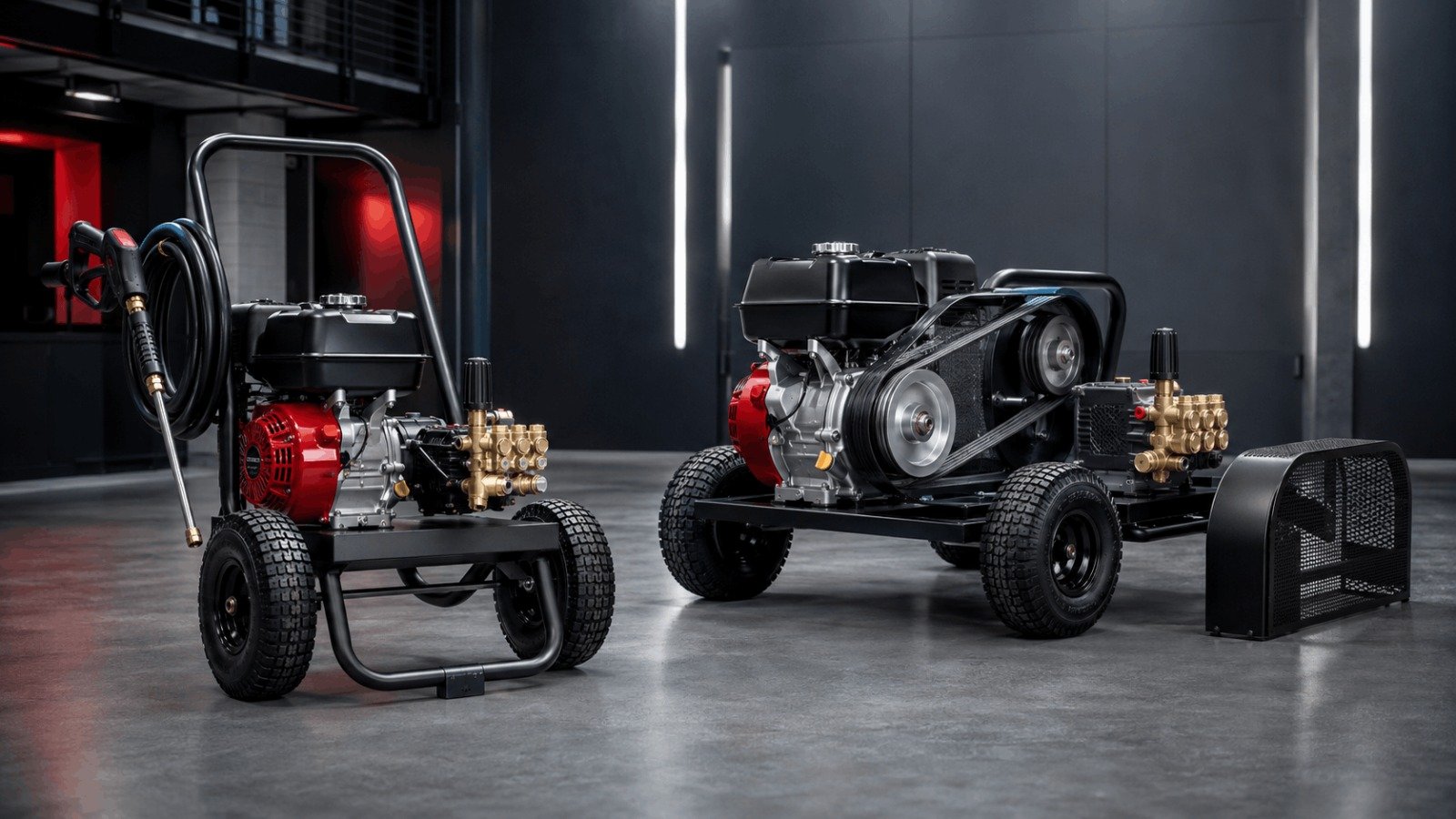
The correct replacement also depends on how the existing pump connects to the GX390.
Direct-Drive Pump
A direct-drive pump mounts directly to the engine’s PTO shaft.
Advantages:
- Compact design
- Lower purchase cost
- Fewer drive components
- Easier to transport
- Common on mobile pressure washer carts
Limitations:
- Pump operates at or near engine speed
- More engine heat and vibration reach the pump
- Pump location can make servicing difficult
- Not always ideal for long, continuous commercial shifts
Direct drive usually makes sense for homeowners, mobile contractors, and businesses using the machine for moderate periods with regular breaks.
Belt-Drive Pump
A belt-drive system uses pulleys and belts to transfer power from the engine to the pump.
Advantages:
- Pump can operate at a lower speed
- Less direct heat transfer from the engine
- Reduced vibration at the pump
- Easier pump positioning and maintenance
- Well suited to extended commercial use
Limitations:
- Higher cost
- Larger frame
- More parts to inspect
- Belts require alignment and tension checks
A belt-drive pump cannot normally replace a direct-drive pump without changing the mounting system, pulleys, belts, guards, and frame layout.
Honda GX340 Pressure Washer Pump Parts
The Honda GX340 and GX390 belong to the same general engine series, but they are not identical. The GX340 has a smaller displacement and lower net power output than the GX390.
Some pressure washer pumps may be offered for both engines because a particular GX340 and GX390 version can share a compatible shaft and mounting pattern. That does not mean every engine part or pump installation is interchangeable.
What May Be Compatible
Depending on the exact engine and pump models, compatibility may exist for:
- Certain external service components
- Some mounting arrangements
- Pumps requiring power within the GX340’s range
- Standard fittings, hoses, guns, and nozzles
- Some frames or pump mounting plates
What Should Never Be Assumed
Do not assume compatibility for:
- Carburetors
- Pistons and cylinder components
- Connecting rods
- Crankshafts
- Ignition or charging components
- Recoil assemblies
- Flywheels
- Internal gaskets
- Pump shaft adapters
- Pump repair kits
Honda GX340 pressure washer pump parts are still selected according to the pump model. If the same pump model is installed on both a GX340 and GX390 machine, its seals and valves may be identical. That compatibility comes from the pump—not from the Honda engine name.
Should You Repair or Replace the Pump?
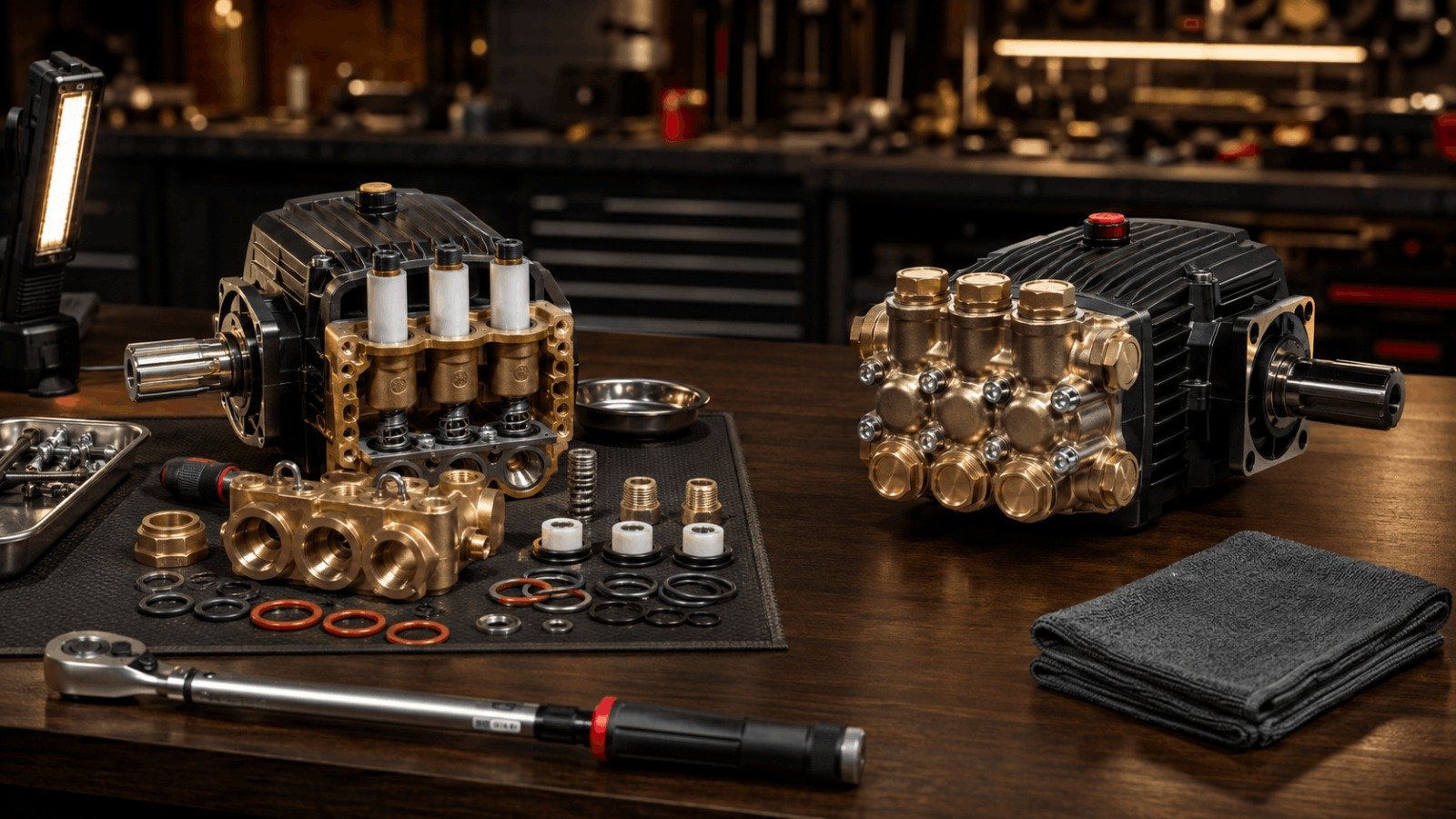
Triplex pumps are often designed to be serviced. However, rebuilding is not automatically the most economical answer.
Condition | Repair may make sense | Replacement may make sense |
Worn water seals | Yes, if plungers and manifold are healthy | If corrosion or cracks are also present |
Failed check valves | Yes, with the correct valve kit | If several internal systems are damaged |
Minor oil-seal leak | Yes, if caught early | If water has damaged bearings or crankcase |
Sticking unloader | Yes, if service parts are available | If the bore is damaged or parts are unavailable |
Cracked manifold | Sometimes, with a replacement manifold | If manifold cost approaches pump cost |
Broken ceramic plunger | Possible on a valuable commercial pump | Often better on a low-cost or heavily worn pump |
Damaged crankcase | Rarely economical | Usually replace the pump |
Unknown low-cost axial pump | Limited repair value | Replacement is often more practical |
Before deciding, compare:
- Cost of the correct repair kit
- Condition of the plungers and manifold
- Availability of technical instructions
- Cost of professional labor
- Age and service history of the pump
- Cost and warranty of a compatible replacement
- Downtime caused by repeated repairs
A commercial-grade triplex pump with a sound crankcase is often worth rebuilding. A badly corroded or cracked pump may continue causing problems even after new seals are installed.
How to Diagnose Low Pressure Before Ordering Parts
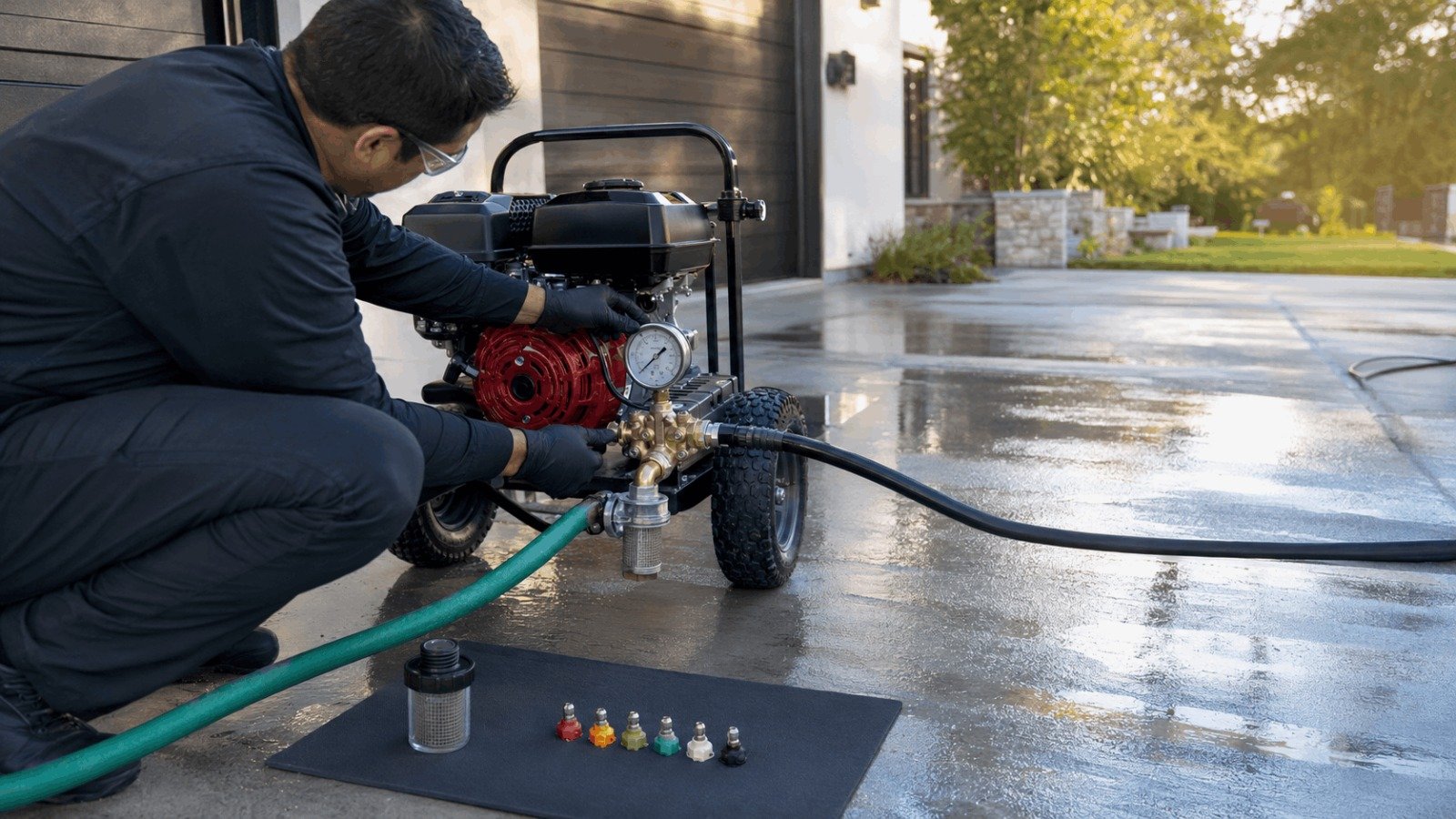
Low pressure is one of the most common reasons people begin searching for replacement pumps. Use this order of diagnosis:
Measure the Water Supply
Disconnect the garden hose from the pressure washer and time how long it takes to fill a measured container. The supply should comfortably exceed the pump’s required GPM.
A 4 GPM pump should not be fed by a water source that only produces 4 GPM under ideal conditions. Hose length, fittings, filters, elevation, and other restrictions can reduce the flow reaching the pump.
Inspect the Inlet Side
Check the inlet screen, garden hose, quick-connects, tank plumbing, and supply valves. A pump can draw air through a loose inlet fitting without producing a large visible water leak.
Purge Trapped Air
With the engine off, turn on the water and hold the spray-gun trigger until a steady stream flows. Starting a high-pressure pump while it contains air can cause pulsing and poor lubrication of water-side components.
- Check the Nozzle
A worn nozzle has a larger opening and can reduce pressure. A nozzle that is too small can overload the pump, create excessive pressure, and force the unloader to bypass.
Use a nozzle chart that matches the machine’s true GPM and intended pressure.
- Observe Engine Behavior
If the engine slows heavily when the trigger is pulled, the pump may be overloaded, the nozzle may be too small, or the engine may not be producing full power.
If the engine holds speed but pressure remains low, inspect the nozzle, unloader, valves, seals, and pump condition.
- Inspect for Leakage and Contaminated Oil
Water leaking from the manifold usually points to worn packings, damaged O-rings, or a cracked component. Milky pump oil suggests that water may be entering the oil chamber.
For additional symptom-based checks, use this pressure washer troubleshooting checklist.
Leave Advanced Testing to a Qualified Technician
Internal unloader adjustment, pressure calibration, manifold removal, and pump rebuilding require the correct tools and procedures. Incorrect adjustment can create dangerously high system pressure or damage the pump.
What to Check Before Buying Replacement Parts
Create a simple record before visiting a dealer or ordering online:
- Pressure washer brand and complete model
- Pressure washer serial number
- Honda engine family, model, type code, and serial number
- Pump brand and exact model
- Pump PSI, GPM, and input RPM
- Direct-drive or belt-drive configuration
- PTO shaft diameter, length, and keyway
- Pump bolt pattern
- Unloader type
- Inlet and outlet connection sizes
- Photographs of labels, fittings, and mounting points
- Original part number, if available
When buying used equipment, do not accept “GX390 pump” as a complete description. Ask for clear photographs of the pump plate and engine code.
Pressure Washer Parts Safety
A 4,000 PSI system can cause severe injection injuries and property damage. Basic precautions are essential.
- Turn off the engine before inspection or repair.
- Allow the engine, exhaust, and pump to cool.
- Close the fuel valve when appropriate.
- Disconnect the spark-plug cap before working near moving parts.
- Shut off the water supply.
- Squeeze the spray-gun trigger to release trapped pressure.
- Never check a high-pressure leak with your hand.
- Replace damaged pressure hoses instead of using tape or temporary patches.
- Confirm that the gun, hose, fittings, and accessories are rated for the system.
- Never operate a gasoline engine indoors or in a partly enclosed space.
- Keep fuel away from sparks, flames, and hot engine parts.
- Install all belt and rotating-part guards before operation.
- Do not adjust the unloader without a pressure gauge and the correct procedure.
- Follow the engine manual, pump manual, detergent directions, and surface manufacturer’s guidance.
If high-pressure fluid penetrates the skin, treat it as an emergency even if the injury looks small.
Maintenance Tips That Reduce Parts Failure
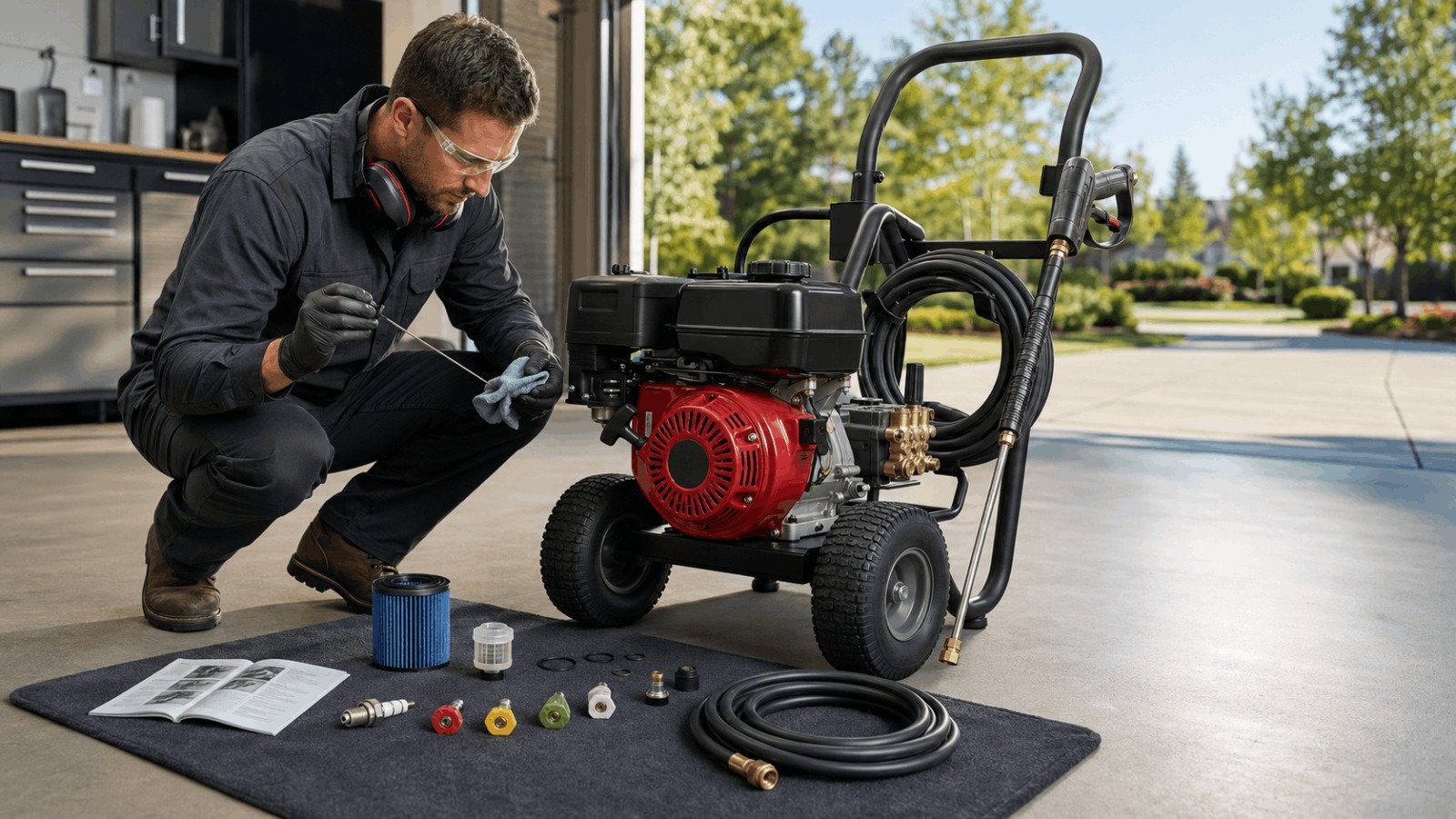
Before Each Use
- Check engine-oil level on level ground.
- Inspect the pump for water or oil leaks.
- Clean the inlet filter.
- Check the garden hose and water flow.
- Inspect the high-pressure hose for cuts, bubbles, or exposed reinforcement.
- Confirm the nozzle is clean and correctly sized.
- Tighten loose frame and mounting hardware.
During Operation
- Turn on the water before starting the engine.
- Purge air from the system.
- Avoid running the pump without water.
- Do not leave the pump in bypass with the trigger released for extended periods.
- Watch for pressure changes, unusual noise, or leaks.
- Keep the engine outdoors with clear ventilation.
After Use
- Flush detergent from the pump and chemical line.
- Release system pressure.
- Drain water where required.
- Inspect quick-connect O-rings.
- Clean the equipment without spraying sensitive engine components.
- Store the machine dry and protected from freezing.
- Follow the engine and pump manuals for oil-service intervals.
Pump-oil type and change intervals vary by manufacturer. Do not automatically use engine oil or a generic oil recommendation in every pump.
Common Mistakes People Make
Buying by Engine Name Alone
A listing that says “fits Honda GX390” may not match your pump mount, shaft, unloader, or plumbing.
Correction: Use the engine type code and pump model, then verify measurements against the technical drawing.
Choosing PSI and Ignoring GPM
Two pumps can both advertise 4,000 PSI while requiring very different horsepower.
Correction: Match pressure, flow, input speed, efficiency, and available engine power together.
Ordering a Pump Kit Without Finding the Pump Model
Pump seals and valves are not selected by engine model.
Correction: Read the pump identification plate and order the kit for that exact pump.
Assuming GX340 and GX390 Parts Are Identical
Their similar appearance does not guarantee internal or external compatibility.
Correction: Compare exact part numbers using the full engine model and type code.
Adjusting the Unloader to Restore Lost Pressure
Turning the unloader without diagnosing water flow, the nozzle, seals, or valves can create unsafe pressure.
Correction: Test the simple causes first and use a gauge for any approved adjustment.
Starting Before Turning On the Water
A pump depends on water for cooling and lubrication.
Correction: Connect the supply, open the valve, and purge air before starting the engine.
Letting the Machine Idle in Bypass
Water circulating inside the pump becomes hot when the trigger remains closed.
Correction: If you will not spray shortly, shut the machine down according to its manual.
Repairing a High-Pressure Hose With Tape
Tape cannot safely contain thousands of pounds of pressure.
Correction: Replace the hose or use a professionally approved repair method for that exact hose construction.
Ignoring Nozzle Wear
A worn nozzle may look normal but can cause a noticeable pressure drop.
Correction: Compare it with a new nozzle of the correct size before condemning the pump.
Simple Action Plan
Step 1: Identify Everything
Record the pressure washer model, Honda engine type code, pump model, PSI, GPM, input speed, and drive type.
Step 2: Complete the Basic Checks
Test the water supply, purge air, clean the inlet screen, inspect the nozzle, and check all hoses and fittings.
Step 3: Separate Engine and Pump Symptoms
Determine whether the engine is failing to produce power or the water system is failing to build pressure.
Step 4: Confirm the Exact Part
Use the manufacturer’s parts diagram and match the original part number. For a complete pump, confirm the shaft, flange, rotation, horsepower, RPM, fittings, and unloader arrangement.
Step 5: Decide Between Repair and Replacement
Repair a serviceable triplex pump when the crankcase, manifold, and plungers remain healthy. Replace a heavily damaged, cracked, corroded, or uneconomical pump.
Step 6: Install and Test Safely
Follow the service manual, restore all safety guards, supply water before starting, and test with a pressure gauge where calibration is required.
Frequently Asked Questions
Does Honda manufacture the pump on a Honda GX390 pressure washer?
Usually, Honda manufactures the engine. The pump is commonly produced by a separate pump company. Check the pump plate before buying seals, valves, an unloader, or a replacement pump.
Can I install any 1-inch shaft pump on a GX390?
No. Shaft diameter is only one requirement. Shaft length, keyway, flange, bolt pattern, rotation, input speed, horsepower, pump orientation, and plumbing must also match.
Can a Honda GX390 run a 4000 PSI pressure washer pump?
Yes, a correctly matched GX390 can commonly power a pump around 4,000 PSI and 4 GPM. A higher-flow 4,000 PSI pump may require more horsepower than the engine can provide.
How do I know if the pump or engine is faulty?
If the engine runs smoothly at normal speed but the spray remains weak after checking the water supply and nozzle, the pump or unloader may be responsible. If the engine stalls, surges, smokes, or cannot maintain speed, diagnose the engine first.
Are Honda GX340 and GX390 pressure washer pumps interchangeable?
Sometimes, but only when the shaft, mount, input speed, rotation, and power requirements match. Never assume compatibility from the engine family name alone.
Is it cheaper to rebuild or replace a GX390 pressure washer pump?
A high-quality triplex pump is often worth rebuilding when it only needs seals or valves. Replacement may be more economical when the manifold, crankcase, plungers, and bearings have extensive damage.
Why does my pressure washer lose pressure after several minutes?
Possible causes include an inadequate water supply, clogged inlet filter, air leak, worn nozzle, overheating in bypass, sticking unloader, worn seals, damaged valves, or an engine that loses power when hot.
Where can I find the correct Honda part number?
Use the engine model, type code, and serial number with an official parts catalogue or authorized Honda engine dealer. “GX390” alone may not identify the correct version.
Conclusion
Finding the correct Honda pressure washer parts begins with identifying which half of the machine has failed. The Honda GX390 provides the power, while a separately manufactured pump creates the pressure and water flow.
For engine components, use the complete Honda model and type code. For pump seals, valves, unloaders, and repair kits, use the exact pump manufacturer and model. If replacing the complete pump, confirm PSI, GPM, horsepower, input speed, shaft dimensions, mounting pattern, rotation, and fittings before ordering.
A few minutes spent checking labels and measurements can prevent an expensive compatibility mistake. Start with simple water-supply and nozzle checks, follow the relevant manuals, and leave pressure calibration or major internal repairs to a qualified technician when necessary.
Helpful Resources
- Honda GX240, GX270, GX340 and GX390 Owner’s Manual —
- official operating, safety, identification, and engine-maintenance guidance, for more information, pressure washer honda 4000 psi