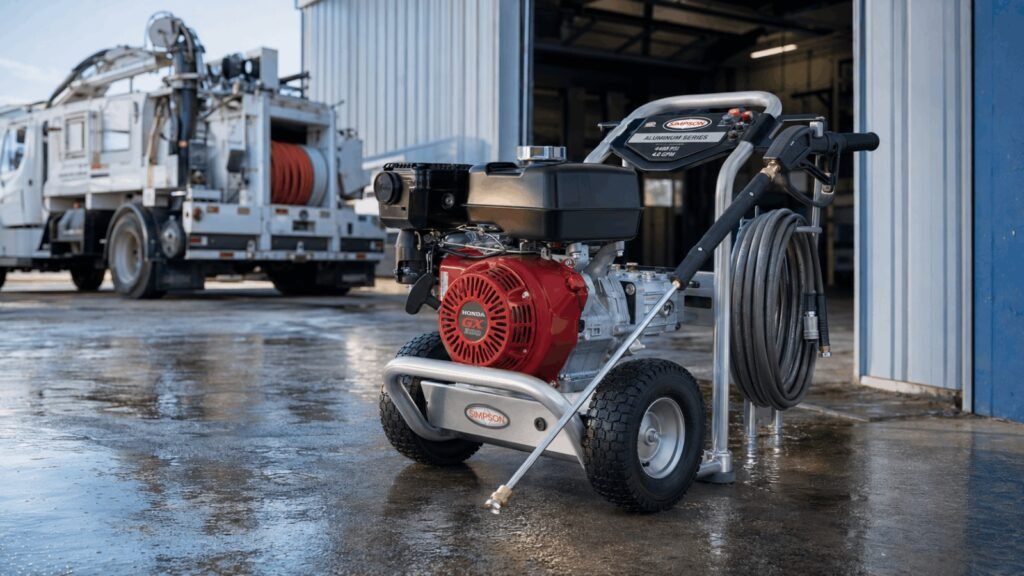
A Honda GX390 pressure washer is a gas washer built around one of the most common commercial engines in the business: a 389 cc, single-cylinder, air-cooled, four-stroke motor. Honda rates it at about 11.7 horsepower, and that is enough to drive a pump making 4,000 PSI at 4.0 GPM. This guide explains what the engine does, which washers use it, and what to check before you buy one.
It is not a list of every machine with a Honda badge. Some well-known 4,000-plus PSI washers use other engines, and we say which ones. We also did not test any machine here. Specs come from maker sheets and dealer listings, and we flag every place where sources disagree.
Why you can trust this guide
- Source order. We used maker spec sheets first, then dealer and parts listings. Each section says which one it relied on.
- Corrections. An earlier version of this page listed a Simpson “Aluminum Series 4,400 PSI” washer. We could not find that model. Simpson’s own sheet for the Aluminum Series ALH4240 shows 4,200 PSI, so this page now uses that number.
- Gaps we could not close. We could not open Honda’s own GX390 manual, so we do not quote exact service intervals. Where the engine data differs between sources, we show the range.
- Last checked: October 24, 2026. Model codes and prices change, so confirm them with the seller.
Honda GX390 specs at a glance
Several dealer and distributor pages agree on the core numbers. Honda itself uses these ratings, and the small differences below come from how each seller rounds them.
| Spec | Honda GX390 |
|---|---|
| Engine type | Single-cylinder, air-cooled, four-stroke, overhead valve |
| Displacement | 389 cc (88 mm bore x 64 mm stroke) |
| Power | About 8.7 kW (11.7 hp) at 3,600 rpm; some listings show 8.2 kW (11.0 hp) |
| Torque | About 26.5 N·m (19.5 lb-ft) at 2,500 rpm |
| Compression ratio | 8.0:1 or 8.2:1, depending on the source |
| Oil capacity | About 1.1 L (1.16 US qt) |
| Fuel tank | About 6.1 L (6.4 US qt) |
| Dry weight | About 31.5 kg (69 lb) |
Why a 4,000 PSI washer needs an engine this size
You can check the match with a simple formula. The power water carries is PSI times GPM divided by 1,714, and the answer is in horsepower. A washer making 4,000 PSI at 4.0 GPM needs about 9.3 hp of water power. At 4,200 PSI it needs 9.8 hp. At 4,400 PSI, 17,600 cleaning units, it needs about 10.3 hp.
No pump is perfectly efficient, so the real engine load is higher. That is why makers use an engine rated near 11 to 12 hp for this class. A smaller engine would be overloaded, and a much larger one would add weight and cost for no gain.
The GX390 also has a long record in rental yards and fleets, which means parts and service are easy to find in most US towns. That matters more to a working crew than any single number on the spec sheet.
What that power means in real work
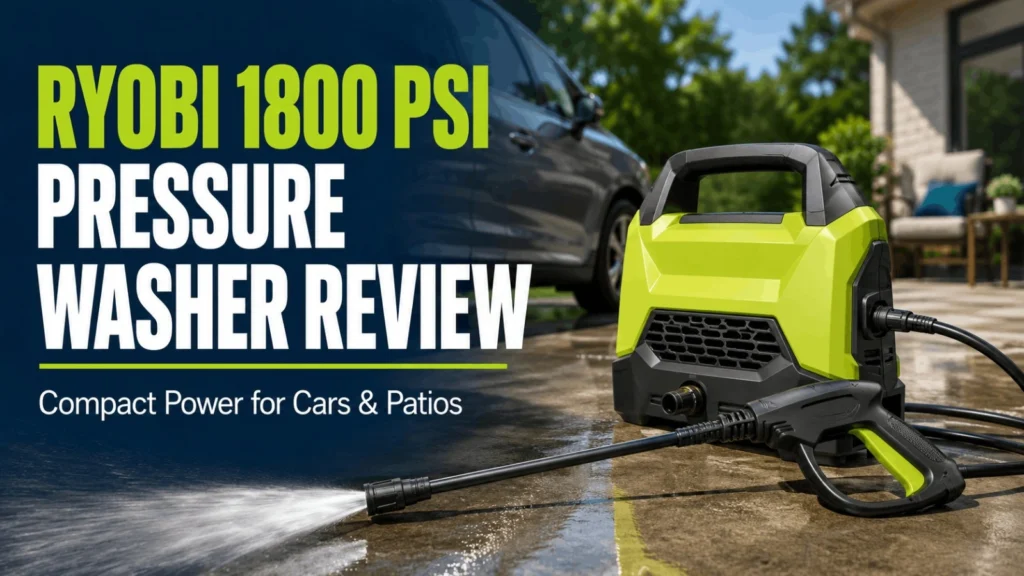
Compare it with a home machine. The RYOBI RY142500 is rated at 2,500 PSI and 1.2 GPM, which is 3,000 cleaning units. A 4,200 PSI washer at 4.0 GPM is 16,800 units, about 5.6 times as much. In practice that shows up as speed. A GX390 machine can clear wide concrete, truck beds, equipment and storefronts in far less time, and the 4 GPM flow carries loosened dirt away instead of just pushing it around. You can read how the smaller class performs in our RYOBI 2500 PSI review.

Cleaning units are only a yardstick, calculated from maximum ratings. Nozzle size, hose length and how close you hold the wand all change the spray you actually get.
Pressure washers that use the Honda GX390
These four machines pair the engine with a triplex pump. All figures come from maker or dealer listings.
1. Simpson Aluminum Series ALH4240
Simpson’s sheet for part 60688 lists 4,200 PSI at 4.0 GPM, a Honda GX390 and a CAT triplex pump on an aircraft-grade aluminum frame. Sources give the weight as 124 to 133 pounds, which is light for the class. It suits crews that load the washer in and out of a truck every day.

2. DEWALT DXPW60605
A parts listing gives 4,200 PSI, 4 GPM, a Honda 389 cc engine, a CAT industrial triplex pump and direct drive. The weight is 139 pounds. The same listing says there is no detergent injection, so plan on a separate soap method. Do not mix it up with the DXPW60606, which has different specs.

3. Pressure-Pro EB4040HC
Dealers list 4,000 PSI at 4 GPM, a Honda GX390, a CAT 5PP3140 triplex pump, a 50-foot hose and a chemical injector. Prices run from about $2,177 to $2,212. The model name appears as E4040HC and EB4040HC, and some dealers sell both belt-drive and direct-drive versions, so confirm the drive type.

4. BE B4013 series
BE sells several 4,000 PSI, 4.0 GPM models under this name, all with a GX390. The pump depends on the model: one sheet lists a General EZ4040G with a 50-foot hose and a 163-pound shipping weight, and another lists a CAT 66DX40GG1 with a 25-foot hose at 162 pounds. Read the full model code before you buy.

Side-by-side comparison
| Model | PSI | GPM | Pump | Weight |
|---|---|---|---|---|
| Simpson ALH4240 | 4,200 | 4.0 | CAT triplex | 124 to 133 lb |
| DEWALT DXPW60605 | 4,200 | 4.0 | CAT triplex, direct drive | 139 lb |
| Pressure-Pro EB4040HC | 4,000 | 4.0 | CAT 5PP3140 triplex | Not listed |
| BE B4013 series | 4,000 | 4.0 | General EZ4040G or CAT 66DX40GG1 | 162 to 163 lb (shipping) |
Not every big washer has a Honda GX390
Do not assume the engine from the PSI rating. The Simpson PowerShot PS60843 makes 4,400 PSI at 4.0 GPM, but it uses a 420 cc Simpson CRX420 engine. Kärcher’s HD 3.0/27 runs a Honda GX200, a smaller engine, and makes 2,700 PSI at 3.0 GPM.
You will also see “GX390-compatible” or “13 hp” engines on very cheap washers. These are copies, not Honda engines. The label on the engine should say Honda and show the model code. If the listing does not name the engine, ask the seller before you pay.
Direct drive or belt drive with a GX390
The engine does not decide how the pump is driven. In a direct-drive washer the pump bolts to the engine shaft, so it spins at engine speed. In a belt-drive washer, belts turn the pump more slowly. Belt-drive machines usually weigh more and cost more, but they tend to run cooler on long days. If you spray many hours a week, ask for belt drive. For a few hours a week, direct drive is fine. We compare drive types in more detail in our guide to the best commercial pressure washer.

Check your water supply first
A 4.0 GPM pump drinks four gallons every minute. If your tap cannot supply that, the pump starves. The result is pulsing spray, extra heat and faster wear. The quick test takes two minutes. Turn the tap on fully with only a garden hose attached, and time how long it takes to fill a 5-gallon bucket. Five gallons in 75 seconds or less means you are delivering 4 GPM. Anything slower means you need a bigger hose, a second tap or a water tank.
Run the hose clear for a few seconds before you connect it, so that grit does not reach the inlet screen. Never run the pump without water, even for a few seconds.
A basic first-start routine
These are general steps for a gas pressure washer with a recoil starter. Your manual has the exact order for your model, so treat this as a memory aid.
- Place the washer on level ground outdoors, with room around the engine for air.
- Check the engine oil level and the fuel level with the engine cool.
- Connect the garden hose and the high-pressure hose, then turn the water on fully.
- Squeeze the trigger until water flows steadily and the air is out of the line.
- Open the fuel valve and set the choke as the manual directs.
- Pull the starter cord with a firm, steady stroke, then adjust the choke as the engine warms up.
- Keep the trigger gun pointed at a safe spot, and do not leave the engine running with the trigger released for long.
The last step matters because water recirculates inside the pump while the trigger is released, and it heats up. A thermal relief valve protects the pump, but long idle periods still add stress.
Weight, moving and storing
These machines are not light. The DEWALT DXPW60605 weighs about 139 pounds, and the BE models ship at 162 to 163 pounds. Two people, or a loading ramp, make moving one into a truck safer than lifting it. Strap it down upright so that oil and fuel do not leak.
The fuel tank holds about 6.1 liters, which is roughly 1.6 US gallons. For long storage, run the machine through its manual’s storage steps, protect the pump against freezing, and keep the unit in a dry place away from heaters and open flames.
Fuel, oil and starting
A few facts are worth knowing. The engine holds about 1.1 liters of oil and about 6.1 liters of fuel. Retailer listings recommend regular unleaded gasoline rated 86 octane or higher. Use fresh fuel, and add a stabilizer before long storage. The GX390 has a recoil starter on most pressure washers, and some machines offer an electric start.
Never run a gas engine indoors or in a closed garage, because the exhaust contains carbon monoxide. Let the engine cool before you refuel. For storage steps, see our guide to winterizing a pressure washer.
Honda GX390 maintenance: what to expect
We could not open Honda’s own manual, so we do not quote exact intervals. What we could confirm is the shape of the schedule. Honda’s maintenance sheet for the GX120 to GX390 family has columns for before each use, the first month or 20 hours, and then every 50 hours and every 100 hours. It lists engine oil, the air cleaner, the spark plug and valve clearance. Owners also quote the manual as calling for a first oil change after about 20 hours. Read the rows for your engine in the manual that came with it.
The routine matters because oil and air filters are cheap, and the engine is not. Check the oil level before each start, clean the air filter more often in dust, and keep a written log. Our pressure washer maintenance checklist is a good template, and our pump maintenance guide covers the other half of the machine.
What to check before you buy
- Engine label. It should read Honda GX390, with a model code and serial number.
- Pump brand and type. CAT, General and AR pumps have wide parts support.
- Drive type. Direct or belt, and the weight that goes with it.
- Hose and gun. A 50-foot hose and a rear-load gun are common on the machines above.
- Warranty. Ask who covers the engine and who covers the pump.
- Local rules. Some models are not sold in California.
Questions people ask
Is the Honda GX390 good for a pressure washer?
Yes, for 4,000 PSI machines at about 4 GPM. The engine’s power rating, about 11.7 hp, matches the roughly 9 to 10 hp of water power those washers need, and parts are easy to find.
How much horsepower does a GX390 have?
Honda rates it near 8.7 kW, or about 11.7 horsepower, at 3,600 rpm. Some listings round it to 8.2 kW (11.0 hp).
Does a GX390 washer need special oil?
The engine holds about 1.1 liters. We could not confirm the oil grade from a Honda document, so check the manual before you fill it.
Is a GX390 better than a cheaper clone engine?
A Honda GX engine is easier to service and has stronger parts support. A copy can cost less, but you carry more risk if it fails. Check the label on any machine you buy.
Sources used
Machine specs come from the Simpson ALH4240 sheet, BE’s spec sheet, and dealer and parts listings for the DEWALT and Pressure-Pro models. Engine figures come from several Honda distributor and dealer pages. Water power uses the standard formula PSI times GPM divided by 1,714. We could not open Honda’s owner’s manual and say so above. Last checked October 24, 2026.