A pressure washer maintenance checklist comes down to two short routines: a few checks before every use, and a few steps after every use. Gas models add engine checks on top. Do those consistently and most pump, hose and no-start problems never happen.
This guide follows Briggs and Stratton’s published preventative maintenance page and adds figures from other makers where they differ. We did not test these steps ourselves. Where a maker gives no interval, we say so and point you to your manual instead of guessing.
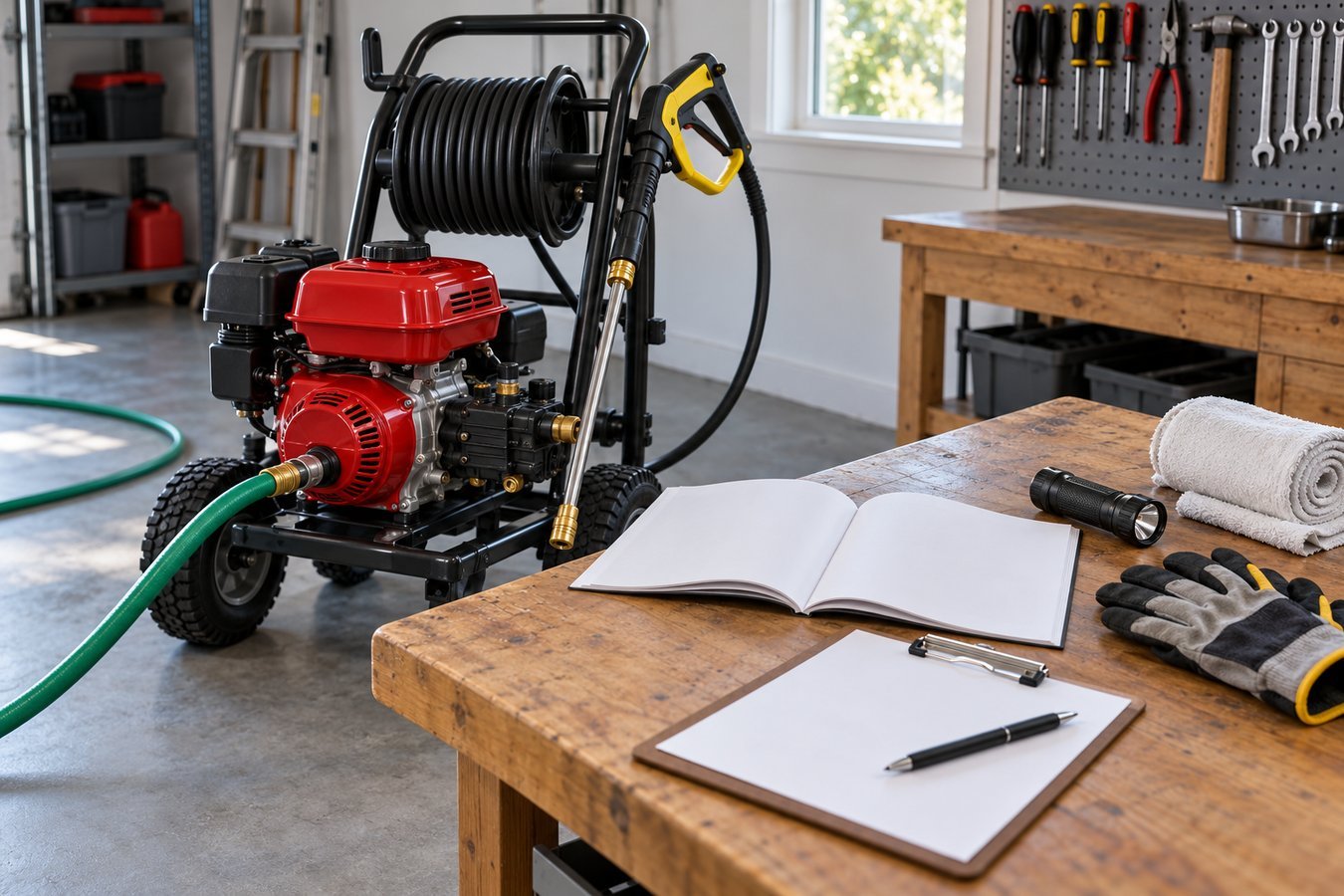
Pressure Washer Maintenance Checklist at a Glance
| When | Task | Applies to |
|---|---|---|
| Before each use | Check engine oil and fuel level | Gas |
| Before each use | Check tire pressure, 15 to 25 PSI | Wheeled gas models |
| Before each use | Flush and inspect the water inlet screen and in-line screens | Gas and electric |
| Before each use | Inspect hoses, couplings and the spray gun for wear | Gas and electric |
| After each use | Flush the detergent system for 2 minutes before stopping the engine | Gas and electric |
| After each use | Release pressure, disconnect hoses, drain the pump | Gas and electric |
| After each use | Pull the recoil handle about 6 times to push water out of the pump | Gas |
| By the manual’s schedule | Engine oil, air filter, spark plug, pump oil | Gas, some electric |
The before and after items come from Briggs and Stratton. Service intervals vary by engine and pump, so they are left to your manual.
Find Your Model Number and Manuals First
Similar-looking washers can have different oil capacities, filters and drain procedures. A pressure rating alone does not tell you how a machine should be serviced. Before you build a schedule, write down three things and keep them with the machine.
- The washer’s model and serial number, usually on a label on the frame.
- The engine model, if it is a gas unit. The engine often has its own manual and its own label.
- The pump model. On some machines the pump is a separate branded part with its own instructions.
Photograph those labels with your phone. A label that has faded or been pressure-washed clean is a common reason owners cannot order the right part later.
Before Every Use: The Quick Safety Pass
This takes about five minutes. Do it on level ground with the machine off.
- Check the engine oil level and the fuel level on gas models.
- Check tire pressure on wheeled units. Briggs and Stratton gives 15 to 25 PSI.
- Look over the high-pressure hose, the garden hose, the couplings and the spray gun for cracks, bulges, leaks or kinks.
- Make sure every connection is tight and the trigger lock works.
- Check the nozzle is clear and seated correctly.
A damaged high-pressure hose is a safety problem, not just a nuisance. If you replace one, buy a hose whose pressure rating is higher than the maximum rating of your washer, as Briggs and Stratton advises.
Check Water Flow and the Inlet Screen
The pump depends on clean water at the right volume. Debris in the supply starves it and scores the seals.
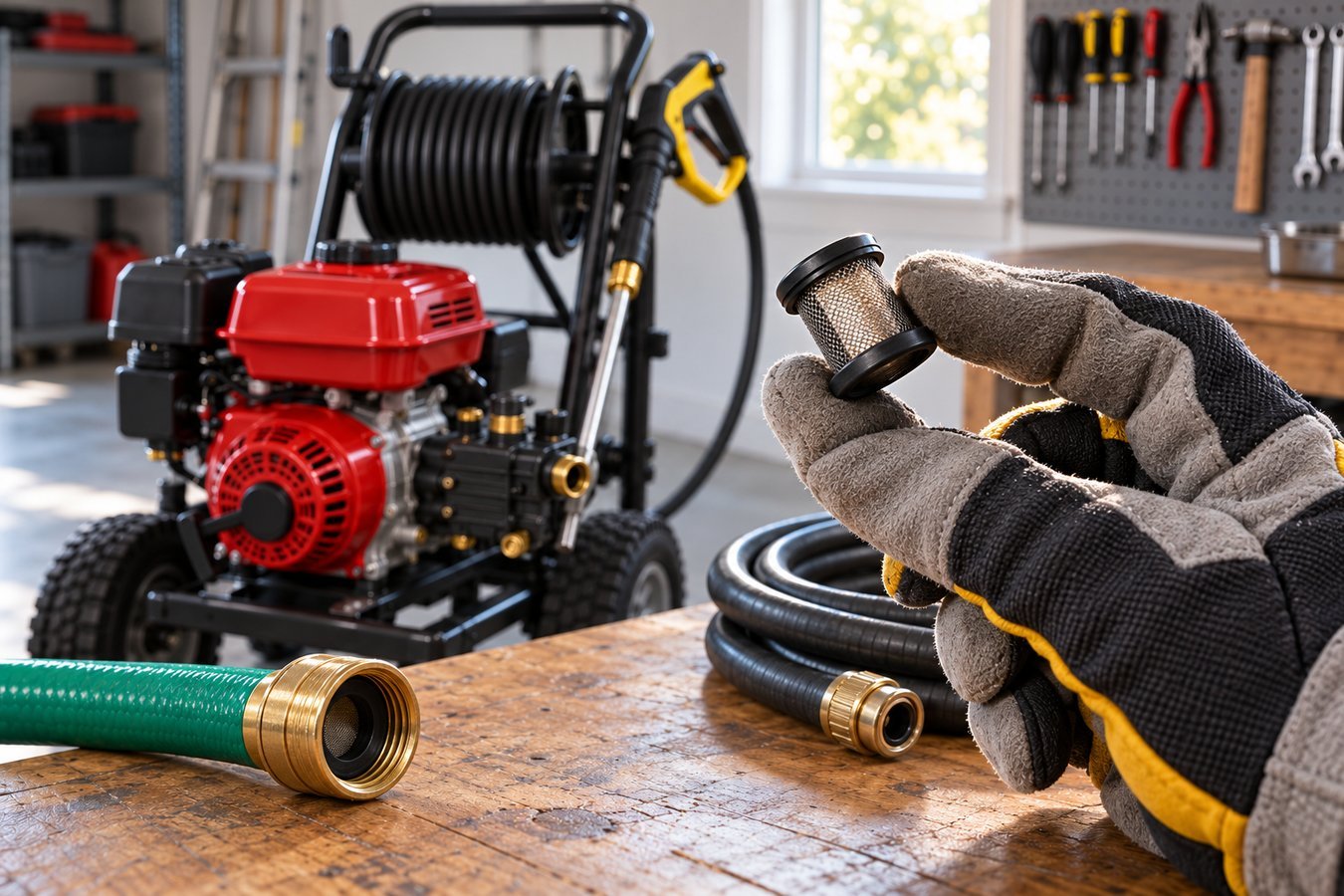
Flush the water inlet screen and any in-line screens before use, and look at them for grit or mineral build-up. Run the garden hose for a few seconds first so loose dirt leaves the line before it reaches the machine.
Connect the water and squeeze the gun trigger until water flows steadily, then start the machine. This purges air from the pump. Running a pump with no water supply for long overheats the seals, which is one of the most common ways owners damage one.
Inspect Hoses and Spray Components
Hoses fail at the ends first. Check the area around each coupling, where the hose flexes most.
High-pressure hose
Run your hand along the length. A soft spot, a bulge or visible braid means replacement. Do not tape or patch it.
Couplings and O-rings
Quick-connect fittings use small rubber O-rings. Dry or flattened ones leak and cost pressure. They are cheap to replace.
Spray gun, wand and nozzle
If the spray pattern looks uneven or the pressure pulses, a partly blocked nozzle is the usual cause. A straightened paperclip is the standard tool for clearing a nozzle orifice. Turn the machine off and release pressure first.

After Every Use: Flush, Release, Drain
This is the routine most owners skip, and it matters more than the others.
- If you used detergent, put the siphon tube in clean water and run the machine for 2 minutes before stopping the engine. This flushes soap out of the pump and injector.
- Turn the machine off and shut the water supply.
- Squeeze the trigger to release trapped pressure, then lock it.
- Disconnect the high-pressure hose and the garden hose and drain both.
- On a gas washer, pull the recoil handle about 6 times to push the water remaining in the pump out.
Detergent left in the system dries into a film that sticks seals and clogs the injector. Water left in the pump is what freezes and cracks it in cold weather. Our winterizing guide covers the extra steps for storage.
Gas Engine Care
Briggs and Stratton’s preventative maintenance page lists the before-use and after-use checks above but does not give oil type or service intervals. Those are in your engine manual, so use it.
Some secondary guides suggest changing the engine oil about every 50 hours of use or once a year. Treat that as a rough rule only. Sources vary, and the figure in your engine manual wins.
| Part | Why it matters | Source for the interval |
|---|---|---|
| Engine oil | Low or dirty oil wears the engine fast | Engine manual |
| Air filter | A clogged filter causes hard starting and rough running | Engine manual |
| Spark plug | Fouled plugs cause misfires and no-starts | Engine manual |
| Fuel | Stale fuel gums the carburetor | Add stabilizer for storage |
If the engine will not start, see our no-start troubleshooting guide before replacing parts.

Electric Washer Care
Electric models skip the engine items but have their own. Inspect the power cord for cuts and crushed sections. Check the plug and any built-in ground fault protection, and test it as the manual says. Keep the motor vents free of dust and debris, since blocked vents cause overheating.
Never run an electric washer with a damaged cord, and keep the plug and extension cord connections out of standing water.
Pump Maintenance
Pump types differ, and this is where owners get confused. Some pumps are sealed and need no routine oil changes. Others have a sight glass and a drain plug, and want fresh oil on a schedule.
Find your pump model in the manual and check which kind you have. If it takes oil, use only the type the maker names. Milky oil means water has got in, and the pump needs service. Whatever the pump type, clean water and proper storage protect it.
A Simple Seasonal Rhythm
Most owners do not use a washer weekly, so a calendar is easier to follow than hour counts.
Start of season
Check the oil, replace fuel that is more than about a month old, inspect every hose and O-ring, and connect water and squeeze the trigger to purge air before you start the engine.
During the season
Run the before-use and after-use routines above each time. They take a few minutes and catch most problems early.
End of season
Complete the flush and drain, then follow the storage steps in our winterizing guide. If the machine will sit unused for weeks, treat the fuel before you put it away, because gasoline goes stale in about 30 days according to Briggs and Stratton.
What Your Machine Is Telling You
When something changes, the symptom usually points to the cheapest check first.
- Pressure pulses or surges. Check for a clogged inlet screen, a kinked garden hose, a partly blocked nozzle or air in the pump.
- Low pressure. Look for a worn nozzle, leaking couplings or a restricted water supply.
- Detergent will not draw. The siphon tube or injector is probably clogged with dried soap.
- Water leaks at the pump. Worn seals or a cracked housing. Stop using the machine and have it serviced.
- Engine runs rough or will not start. Old fuel, a dirty air filter or a fouled spark plug are the usual causes.
If a check does not fix it, stop and read the manual’s troubleshooting page rather than guessing at internal parts.
Safety Habits That Belong on Every Checklist
- Wear eye protection and closed shoes. Spray and debris can cause injury.
- Never point the wand at people, pets or your own feet.
- Always release pressure by squeezing the trigger before you disconnect anything.
- Run a gas engine only outdoors or somewhere with plenty of fresh air, since exhaust contains carbon monoxide.
- Let the engine cool before you refuel.
Water Supply and Hose Habits That Protect the Pump
Most pump damage starts upstream of the pump. The garden hose, the tap and the inlet filter decide how clean and how plentiful the water is when it arrives.
Use a garden hose of the diameter your manual calls for, and keep it as straight as you can. A kinked or very long, thin hose limits flow, and the pump then runs short of water even though the tap is fully open. If you draw from a rain barrel or a tank, filter the water first, because sand and leaf matter wear seals quickly.
Coil the high-pressure hose in loose loops when you finish, never in tight turns. Tight coils and sharp bends are where the inner liner cracks. Store it off the ground, away from sunlight and out of reach of anything that could cut it, such as sharp tools and mower blades.
Finally, store nozzles and the foam cannon in a small bin. A lost nozzle often leads to someone using the wrong one, and the wrong nozzle can raise pump pressure or damage a surface.
Keep a Simple Maintenance Log
A notebook kept with the machine is enough. Write down the date and hours of use, oil changes, plug or filter replacements, and anything unusual. When the machine acts up, the log shows what changed.
Common Maintenance Mistakes
- Skipping the detergent flush. Soap dries and sticks seals.
- Running the pump with no water. Seals overheat within a short time.
- Storing the hose under pressure. Release it and drain it every time.
- Ignoring a worn hose. A burst hose at working pressure can injure you.
- Leaving old fuel in the tank. It causes most spring no-starts.
- Using a lower-rated replacement hose. It must exceed the washer’s maximum rating.
Why you can trust this guide
How we built it. We did not test these steps. The before-use and after-use items come from Briggs and Stratton’s preventative maintenance page. Other figures are labeled as general guidance from secondary guides.
Corrections. An earlier version of this page gave no maker-confirmed numbers. We added the tire pressure range, the 2-minute detergent flush and the recoil pull count, and removed vague advice.
Limits. Oil type and service intervals were not on the maker page, so follow your manual. Last checked: November 2026.
Questions people ask
How often should I maintain a pressure washer?
Do a quick check before each use and a flush and drain after each use. Engine and pump servicing follows the schedule in your manual.
How long should I flush the detergent system?
Briggs and Stratton says to run clean water through it for 2 minutes before you stop the engine.
What tire pressure does a wheeled pressure washer need?
Briggs and Stratton lists 15 to 25 PSI. Check the number on the tire sidewall too.
Why pull the recoil handle after use?
Pulling it about 6 times pushes the remaining water out of the pump, which helps prevent freeze damage and corrosion.
Can I use any replacement hose?
No. The replacement high-pressure hose must be rated above your washer’s maximum pressure.