Common causes of a pressure washer that won’t start fall into four groups: no power, old fuel, low oil, or a safety switch that never closed. On an electric washer, the usual culprit is a tripped GFCI plug or an undersized extension cord. On a gas washer, it is stale fuel or the low-oil shutoff.
This guide works in the order that saves time. You start with the free checks, move to the common faults, and only then touch the spark plug or carburetor. If your question is “why won’t my pressure washer start,” pick your engine type below and follow the steps.
Common causes by symptom: find yours first
Use this table to jump to the likely cause. Every row is explained in detail further down.
| What you see | Likely cause | First thing to try |
|---|---|---|
| Electric: nothing happens, no sound | Tripped GFCI, dead outlet, tripped breaker | Press RESET on the plug, test the outlet with a lamp |
| Electric: hums but the motor won’t spin | Pressure trapped in the pump, weak power, bad capacitor | Squeeze the trigger to release pressure, plug in without an extension cord |
| Electric: runs a minute, then dies | Thermal overload from heat or a thin cord | Unplug, let it cool 20 to 30 minutes, use a heavier cord |
| Gas: pulls fine, no sign of firing | Stale fuel, choke or fuel valve in the wrong spot | Check the fuel valve, choke and fuel age |
| Gas: cranks, never catches | Low oil sensor, fouled spark plug | Check the dipstick, then pull the plug |
| Gas: pull cord is stiff or locked | Water or pressure locked in the pump | Shut off water, squeeze the trigger, try again |
| Gas: starts, then stalls | Clogged fuel cap vent, dirty carburetor, choke left on | Loosen the fuel cap, open the choke slowly |
None of these fixes needs special tools. The spark plug socket is the only item most people have to buy.
Safety checks before you touch anything
Do three things before you open or test the machine. They take two minutes and prevent most injuries.
- Unplug an electric washer, or pull the spark plug wire off a gas washer, before you inspect parts.
- Never run a gas engine in a garage or shed. It makes carbon monoxide, which you cannot smell. Test and start it outdoors, well away from windows.
- Keep the GFCI in the circuit. Do not bypass or tape over it. It is there because water and electricity share the same work area.
Also let a hot engine cool before you touch the muffler or open the fuel cap. A warm engine can spray fuel when you remove the cap.
Check the basics that fool everyone
Before blaming the engine, run through the small stuff. Maker troubleshooting guides all list these first, because they fix a surprising number of “dead” machines.
- Connect the water and turn it on. Many electric models have a flow or pressure switch, and the pump should never run dry.
- Check the power switch or key. Some units have a pedal or a separate on/off switch that sits in the OFF position after storage.
- Squeeze the trigger once. Karcher’s support page notes that a machine can still be under pressure from the last use, and squeezing the trigger lets the motor start.
- Look at the spray gun. Make sure the trigger lock is off and the wand is fully clicked into the gun.
- Check the hose. A kinked garden hose or a closed tap starves the pump.
If none of these helps, split into the electric or gas section below.

Electric pressure washer won’t start
Electric washers have fewer moving parts, so the fault is usually in the power path. Work from the wall outlet toward the motor.
1. Tripped GFCI
Most electric washers have a GFCI built into the plug. Press the RESET button firmly. If it clicks and the washer starts, you are done.
If the GFCI won’t reset, plug the washer into a different outlet. If it still won’t reset, the plug or the power cord is damaged. A damaged cord can trip the GFCI instantly, so inspect the whole length for nicks and crushed spots.
2. Dead outlet or tripped breaker
Plug a lamp or phone charger into the same outlet. If that is dead too, check the breaker panel and the GFCI outlet in the garage or bathroom, since outdoor outlets are often fed from there. Reset it and try again.
3. The extension cord problem
A thin or long cord causes a voltage drop. The motor then pulls more current, gets hot, and cuts out. Maker manuals warn against extension cords for this reason, and the numbers they give differ by brand.
| Source | Cord advice |
|---|---|
| Karcher K 280 M manual | 25 ft of 12/2 cord, or 50 ft of 10/2 cord |
| Simpson-style guidance | 25 ft or shorter, 14/3 or thicker, outdoor rated |
| Other dealer guides | 14 gauge, no longer than 50 ft |
These figures disagree, and a lower gauge number means a thicker wire. The manual for your model should be the tiebreaker. The safest test is to plug the washer straight into a known-good outlet with no extension cord at all.
4. Thermal overload
Electric motors have a thermal protector that cuts power when the motor overheats. It can trip after a long job, in a hot garage, or when a thin cord forces the motor to work harder.
Unplug the washer and wait 20 to 30 minutes. Some units reset by themselves once they cool, and others have a small reset button on the motor housing. If it trips again within minutes, suspect the cord or a worn pump.
5. Total Stop System, trigger and pressure switch
Many electric washers only run while you hold the trigger. When you release it, a pressure switch or Total Stop System shuts the motor off. If the system sticks or air is trapped in the lines, the motor may not respond.
- Turn the water on and squeeze the trigger for 30 seconds with the wand pointed at the ground to push out air.
- Check that the gun trigger moves freely and springs back.
- Disconnect and reconnect the high-pressure hose, which releases trapped pressure.
6. Hum, but no spin
A hum with no movement points to a locked pump or a weak start capacitor. Release the trigger pressure first, then try again on a short cord. If the motor still only hums, stop. Running it can burn out the windings, and the repair is a job for a service center.
Gas pressure washer won’t start
A gas engine needs three things at the same moment: fuel, spark and air, plus enough oil to pass the low-oil sensor. Check them in the order below, because the first two cause most no-starts.
1. Oil level and the low-oil sensor
Many engines have a low-oil shutdown that blocks the ignition. Honda’s manuals describe this as an oil alert system. The engine cranks, but no spark reaches the plug.
Put the machine on level ground. Wipe the dipstick, push it in without screwing it, and read the level. Top up if it is low. An overfilled crankcase is also a problem, so drain it back to the full mark if you overshoot.
2. Fuel: the most common cause
Old gasoline is the top reason outdoor equipment won’t start, according to Briggs and Stratton’s own troubleshooting page. Ethanol blends age fast. Untreated E10 is usually quoted as fresh for about 30 days, with real trouble after 60 to 90 days, and these numbers come from small engine mechanics rather than a lab standard.
A fuel stabilizer extends the life of fresh fuel, but it does not repair gas that has already gone bad. Briggs says its engines can run on fuel with up to 10% ethanol, so E10 from the pump is fine when it is fresh.
If the fuel is older than a couple of months, drain it into an approved can and refill with fresh gas. Dispose of the old fuel at a hazardous waste site, and do not pour it on the ground.

3. Fuel valve, choke and switch
Honda’s checklists list these as frequent causes. Run through them slowly.
- Fuel valve in the ON position.
- Engine switch in the ON position.
- Choke closed for a cold start, then opened as the engine warms.
- Throttle set to the start position your manual shows.
- Fuel cap vent open. A blocked vent makes the engine starve and stall after a minute.
If the engine is flooded, the plug will smell of gas and look wet. Open the choke, set the throttle to maximum and pull the cord several times. That clears the extra fuel in most cases.
4. Spark plug
A fouled plug is the next thing to check, and it takes five minutes. Pull the plug wire, unscrew the plug and look at it.
- Black, oily or sooty tip: the plug is fouled. Clean it with a wire brush or replace it.
- Wet with fuel: the engine flooded. Dry it and retry.
- Cracked white porcelain or a burnt electrode: replace it.
To test for spark, Honda’s manuals say to refit the plug in its cap, rest the metal body on the engine, switch the engine on, and pull the cord while you watch the gap. A bright blue spark means the ignition is fine. No spark means a new plug first, then the ignition coil. Check the gap against your manual, because the spec differs by engine.
5. Air filter
A clogged filter chokes the engine. Remove it and try to start the engine briefly without it. If the engine starts, clean or replace the filter. Foam filters can be washed in soapy water and dried completely. Paper filters get replaced.
6. Carburetor
Old fuel leaves varnish in the carburetor jets. Symptoms are cranking with no fire, or starting only with the choke on. A carb cleaner spray can clear light gum. If the jets are blocked, the carburetor needs to come off for a proper clean, and that is where many owners hand it to a small engine shop.
7. A stiff or locked pull cord
If the cord barely moves, the pump may be hydro-locked. Turn off the water, disconnect the hose and squeeze the trigger to release pressure. Try the cord again. If it stays locked, do not force it, since you can break the recoil or bend a pump part.
Check your water supply the right way
A weak water supply starves the pump and can stop a unit from starting or running. The test is simple, and you only need a bucket and a watch.
- Find the washer’s flow rate in gallons per minute (GPM) on the label.
- Run the garden hose into a 5 gallon bucket.
- Time how long it takes to fill.
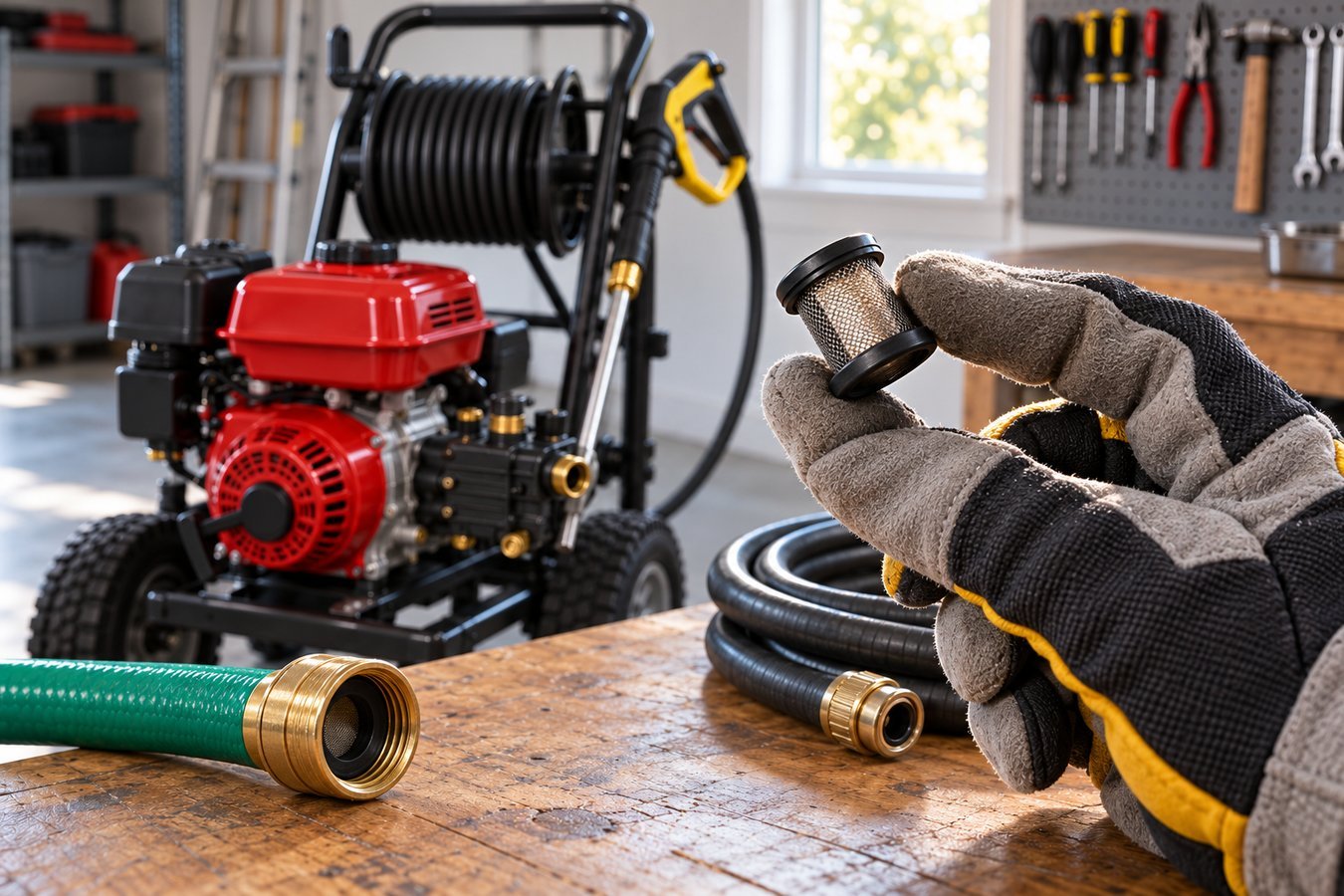
A washer rated at 2.5 GPM needs the bucket full in 2 minutes or less, because 5 gallons divided by 2.5 GPM is 2 minutes. If the bucket takes longer, the hose, tap or inlet screen is restricting the flow. Also check the small screen where the hose connects. Debris there causes weak flow.
A 10 minute checklist for gas models
- Move the washer outside onto level ground.
- Connect the water and turn it on.
- Check the oil on the dipstick.
- Check the fuel age and refill with fresh gas if in doubt.
- Open the fuel valve, switch the engine on, close the choke.
- Pull the cord five times with the trigger off the wand.
- If it does not fire, pull and inspect the spark plug.
- Test for spark. Replace the plug if the spark is weak.
- Check the air filter.
- If it still fails, move to the carburetor or a service shop.
When to stop and call a pro
Some faults are cheaper to fix by a shop than by trial and error. Stop if you see any of these:
- A new spark plug still shows no spark.
- Fuel is leaking from the carburetor or tank.
- The oil looks milky or smells of gasoline.
- The pull cord locks solid with the water off and the trigger released.
- An electric motor hums, smells burnt, or trips the GFCI on every try.
If the washer is under warranty, contact the maker first. A DIY repair can void the cover.
How to stop it happening next season
Most no-starts come from storage mistakes, so prevention is cheap.
- Add stabilizer to fresh fuel before storage, then run the engine for a few minutes so it reaches the carburetor.
- Check the oil before every use.
- Replace the spark plug once a year, or follow the interval in your manual.
- Drain the pump and hoses before freezing weather.
- Store the unit dry, with the cord coiled loosely and no kinks.
Briggs and Stratton’s storage pages also suggest running some engines dry if they use alcohol-blended fuel. That advice conflicts with the stabilizer method, so follow your own manual on which one to use.
Why you can trust this guide
How we built it. We did not test these machines ourselves, and we do not claim hands-on repair experience. The steps come from maker manuals and support pages, including Honda engine checklists, Karcher support, Briggs and Stratton troubleshooting pages and dealer guides.
Where sources disagree. Extension cord limits and fuel shelf life vary by source. We show the numbers side by side and tell you to follow your model’s manual.
Limits. Spark plug gaps and oil capacities differ by engine, so we did not give one number for all. Last checked: November 2026.
Questions people ask
Why won’t my pressure washer start after sitting all winter?
Old fuel is the most likely cause. Fuel that sat for months can gum up the carburetor. Replace the fuel, check the oil and spark plug, and try again.
Why does my electric pressure washer click but not run?
A click often means the pressure switch or relay is engaging but the motor cannot turn. Check for trapped pressure, a weak extension cord or a seized pump.
Can I start a pressure washer without water?
You should not. Running the pump dry damages the seals within a short time. Always connect and turn on the water first.
How do I know if the spark plug is bad?
Pull it and look for black soot, wet fuel or cracked porcelain. Then test for spark against the engine block. No spark with a clean, correct plug points to the ignition coil.
Why does my pressure washer start and then stall?
The common causes are a blocked fuel cap vent, a dirty carburetor, the choke left closed, or a starved water supply. Try the fuel cap and water bucket test first.
Related guides
- Pressure Washer Power Requirements: Fuel, Electricity, and Safety Guide
- Pressure Washer Maintenance Checklist for Gas and Electric Models
- How to Winterize a Pressure Washer for Cold Weather Storage
- Do Power Washers Take Regular Gas? Complete Fuel Guide
- Pressure Washer Pump Maintenance Guide for Routine Care and Storage