A high-powered pressure washer is only as effective as the nozzle attached to the end of its wand. Whether you need a commercial pressure washer nozzle or a standard home tip, the pressure washer nozzle dictates the spray angle, velocity, surface impact, and overall cleaning speed.
Using the wrong spray tip can strip paint off surfaces, destroy vehicle clear coats, etch concrete, or drastically slow down your workflow. Conversely, selecting the best pressure washer nozzles allows contractors and homeowners alike to cut cleaning times in half while protecting delicate surfaces.
In this ultimate guide, we break down color-coded nozzle systems, review top-rated pressure washer spray tips, explain how to calculate correct orifice sizes, and reveal how to choose the right nozzle for any cleaning job.
Quick Reference: Pressure Washer Nozzle Color Code Guide
Nozzle Color | Spray Angle | Pressure / Impact | Ideal Application & Use Case |
Red | 0° (Pencil Jet) | Extreme Impact | Spot cleaning concrete, stain removal, high-reach blasting |
Yellow | 15° (Narrow Fan) | High Impact | Heavy grease, rust removal, masonry cleaning, brick stripping |
Green | 25° (Medium Fan) | Moderate Impact | Fleet washing, driveways, wood decks, walkways, sidings |
White | 40° (Wide Fan) | Light Impact | Auto detailing, windows, delicate sidings, patio furniture |
Black | 65° (Low-Pressure) | Chemical Flow | Applying soaps, detergents, degreasers, and sanitizers |
1. Why Upgrading Your Pressure Washer Nozzle Matters
Many pressure washer owners overlook spray tips, assuming all quick-connect nozzles deliver identical performance. However, premium aftermarket spray nozzles differ significantly from cheap stock tips included in basic box kits.
Precision Orifice Machining
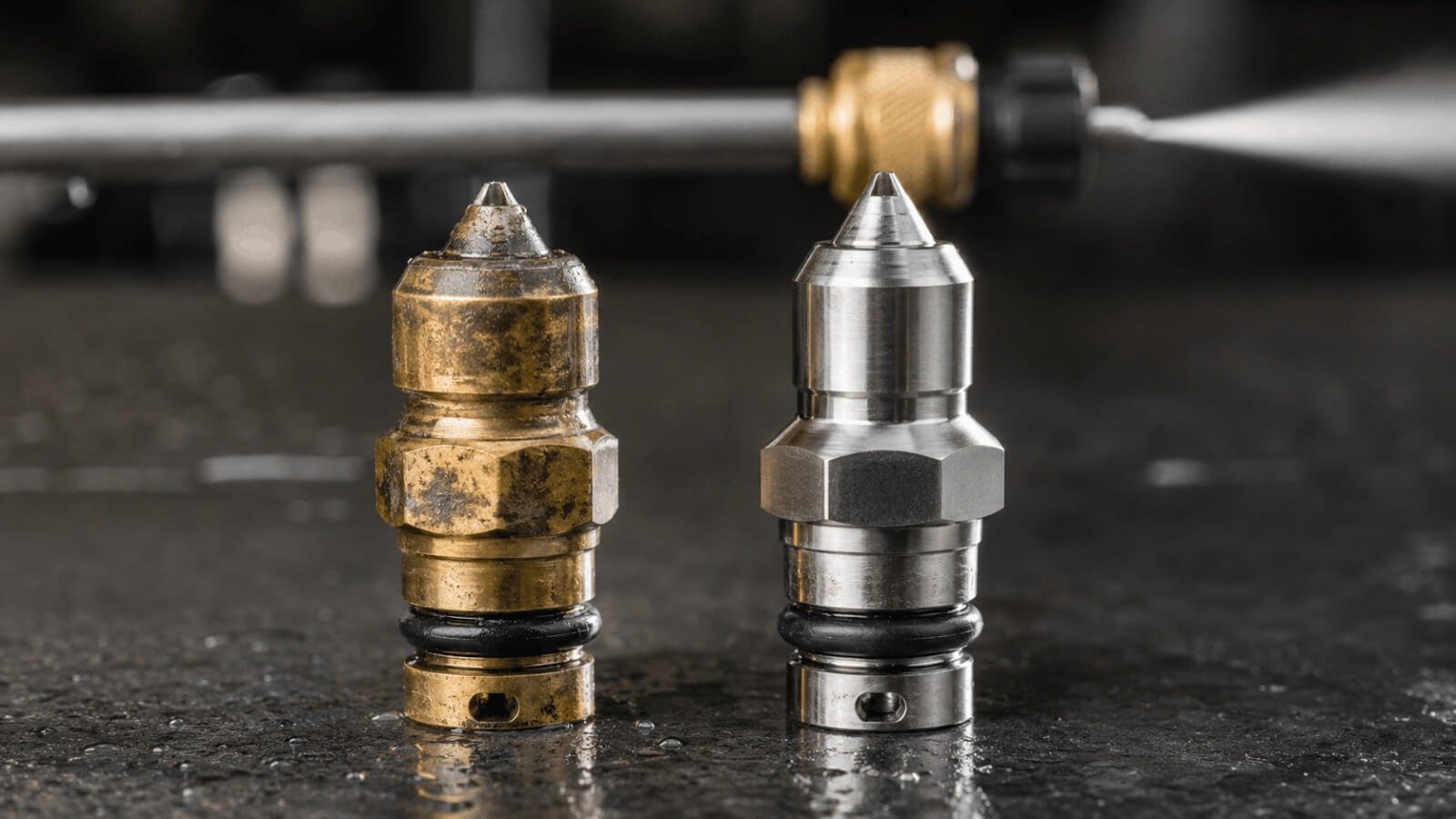
Standard consumer nozzles feature soft brass or lower-grade stainless steel internal orifices that wear out under continuous hydraulic friction. As the orifice widens over time, water velocity drops, severely reducing cleaning pressure. The best pressure washer nozzles are engineered using hardened 304 stainless steel or industrial ceramic cores that hold exact pressure tolerances over hundreds of hours of operation.
Safety & Surface Damage Prevention
Selecting the correct spray tip angle protects valuable surfaces from destruction. A 0° red tip concentrates stream force into a single spot capable of cutting wood or etching concrete, while a 25° green or 40° white tip distributes mechanical force evenly across broad surfaces.
Maximizing Cleaning Units (CU)
A pressure washer’s cleaning capability is measured in Cleaning Units (CU), calculated as:
$$\text{Cleaning Units (CU)} = \text{PSI} \times \text{GPM}$$
A high-quality pressure washer spray tip preserves maximum water stream velocity, ensuring that all available cleaning energy hits the target surface without pressure loss.
2. Reviews: The Best Pressure Washer Nozzles on the Market
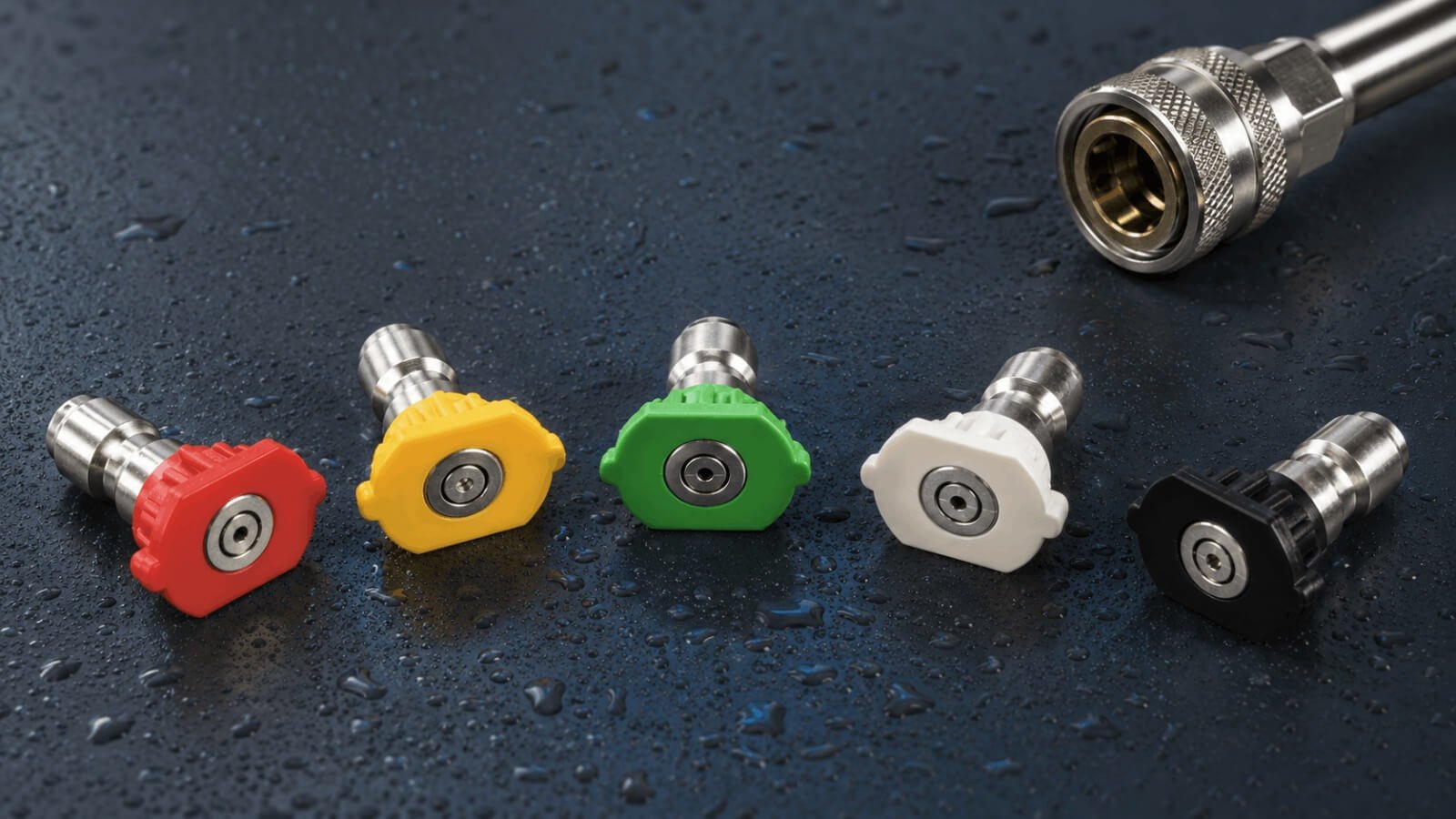
1. Velocity Pro Stainless Steel Quick Connect Set – Best Overall Pressure Washer Nozzle Set
For complete versatility across residential and commercial cleaning projects, a 5-piece stainless steel pressure washer nozzle set is an absolute necessity.
- Key Specifications:
- Connect Type: Standard 1/4-inch Quick-Connect Plug
- Material: 304 Hardened Stainless Steel Body & Core
- Max Pressure: Rated up to 5,000 PSI
- Set Includes: 5 Color-Coded Spray Tips (0°, 15°, 25°, 40°, Soap)
Why It Stands Out
Unlike cheap brass tips that corrode when exposed to harsh soaps and degreasers, the Velocity Pro set features full stainless steel construction. Each tip has laser-etched spray degree markings for quick identification on the job site, delivering smooth, line-free fan spray patterns.
- Pros:
- Ultra-durable stainless steel construction resists high-PSI internal erosion.
- Compatible with virtually all gas and electric pressure washers featuring 1/4-inch quick-connect wands.
- Resists rusting from aggressive cleaning detergents.
- Cons:
- Must be matched correctly to your machine’s overall GPM output.
2. Suttner ST-357 Heavy-Duty Turbo Nozzle – Best Rotary Pressure Washer Nozzle
When cleaning expansive concrete driveways, brick pavers, or rusted metal equipment, standard fan nozzles can be slow. A rotary pressure washer nozzle (often called a Turbo Nozzle) dramatically speeds up surface stripping.
- Key Specifications:
- Max Pressure: 4,350 PSI
- Max Temperature: 195°F (Hot Water Compatible)
- Internal Core: Precision Ground Ceramic Seat
- Covering: Shock-Resistant Rubber Housing
Why It Stands Out
A turbo nozzle combines the cutting strength of a 0° pencil jet with the broad coverage of a 25° fan tip. It rotates a concentrated 0° stream in a rapid circular motion thousands of times per minute. The Suttner ST-357 uses a solid ceramic internal core that resists sand and hard water abrasion, making it one of the best pressure washer nozzles for concrete restoration.
- Pros:
- Cleans concrete and masonry up to 200% faster than standard spray tips.
- Hot water rated up to 195°F for severe grease removal.
- Thick rubber outer cover prevents accidental scuffing on walls or vehicles.
- Cons:
- Far too aggressive for delicate painted wood, vinyl siding, or car clear coats.
3. Tool Daily 6-in-1 Adjustable Multi-Spray Tip – Best Quick-Change Pressure Washer Tip
For auto detailers and homeowners tired of losing individual spray tips or changing nozzles constantly, an adjustable pressure washer nozzle assembly simplifies your entire wash setup.
- Key Specifications:
- Spray Options: 6 Settings (0°, 15°, 25°, 40°, Soap Rinse, Soap Jet)
- Max Pressure: Rated up to 4,000 PSI
- Connection: 1/4-inch Quick-Connect Plug
- Design: Rotatable Multi-Angle Head
Why It Stands Out
Instead of swapping individual color-coded nozzles out of your pocket, this single unit allows you to rotate the outer collar to switch from an intense 15° stream to a low-pressure soap setting instantly.
- Pros:
- Eliminates the risk of dropping or losing small individual nozzle tips.
- Speeds up multi-stage washing processes (soap application, washing, and gentle rinsing).
- Smooth internal detents lock each spray pattern securely into place.
- Cons:
- Slightly heavier at the tip of the spray wand compared to individual tips.
4. MTM Hydro High-Reach Stainless Steel Nozzle Kit – Best for High Distances
Cleaning second-story home sidings, roof soffits, or high commercial machinery without ladders requires a dedicated high pressure washer nozzle kit designed for long-distance throw.
- Key Specifications:
- Includes: 1 High-Reach Chemical Tip + 1 High-Reach Flush Tip
- Max Pressure: Rated up to 5,000 PSI
- Throw Range: Up to 30 Feet Vertical Reach
- Material: Italian Stainless Steel Engineering
Why It Stands Out
Standard chemical spray tips mist water immediately, losing vertical reach. MTM Hydro’s high-reach nozzles utilize narrow-bore fluid dynamics to keep the water stream tightly grouped, allowing you to apply soap and rinse surfaces up to 30 feet off the ground while staying safely on solid footing.
- Pros:
- Enables ladder-free cleaning of high walls, gutters, and second-story sidings.
- Reduces job site fall hazards significantly.
- Premium Italian engineering ensures zero internal stream friction.
- Cons:
- Requires a machine with at least 3.0 GPM output for maximum distance throw.
3. Understanding Pressure Washer Nozzle Color Codes
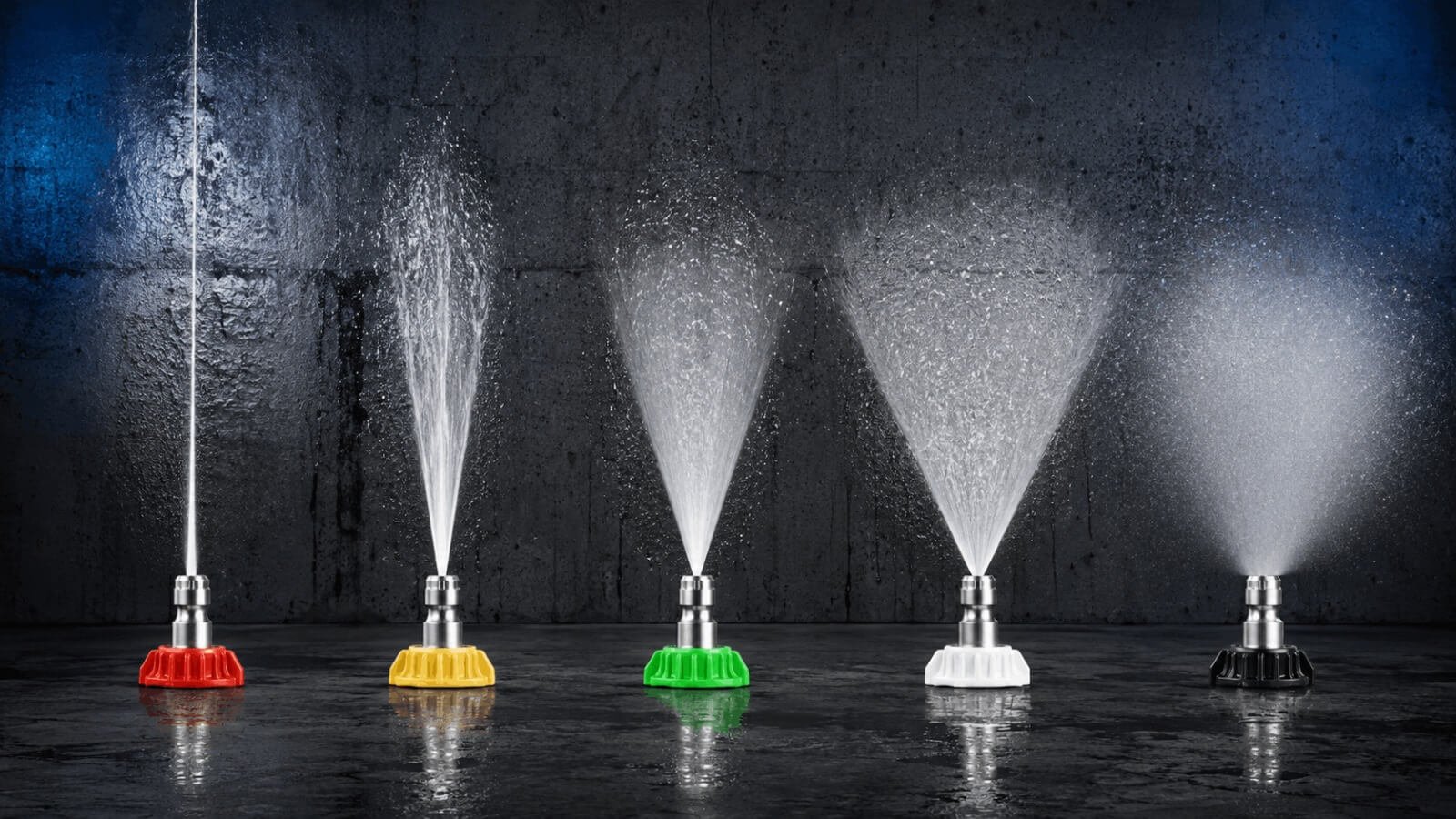
Understanding how each color-coded pressure washer nozzle functions prevents accidental damage and optimizes cleaning efficiency:
Plaintext
0° Red Tip 15° Yellow Tip 25° Green Tip 40° White Tip 65° Black Tip
┌─────────────┐ ┌─────────────┐ ┌─────────────┐ ┌─────────────┐ ┌─────────────┐
│ Pencil Jet │ │ Narrow Fan │ │ Medium Fan │ │ Wide Fan │ │ Low Pressure│
│ Pinpoint │ │ Heavy Strip │ │ General Wash│ │ Gentle Wash │ │ Soap / Chem │
└─────────────┘ └─────────────┘ └─────────────┘ └─────────────┘ └─────────────┘
Red Tip (0° Pencil Jet)
- Stream Geometry: A paper-thin concentrated water stream.
- Best Uses: Spot cleaning tough concrete stains, stripping paint off steel, or removing tree sap deposits on hard masonry.
- Safety Warning: Never point a 0° tip at skin, wood, or vehicles. It can instantly slice soft materials and cause severe injury.
Yellow Tip (15° Chisel Stream)
- Stream Geometry: A narrow, forceful 15-degree fan blade.
- Best Uses: Heavy stripping, removing rust, peeling loose paint, cleaning brick mortar, and stripping oil off garage floors.
Green Tip (25° General Cleaning Fan)
- Stream Geometry: A balanced 25-degree medium fan spray.
- Best Uses: This is the most popular pressure washer spray tip. Perfect for washing concrete driveways, brick patios, wooden decks, home sidings, and aluminum trailers.
White Tip (40° Gentle Rinse Fan)
- Stream Geometry: A broad, low-impact 40-degree fan spray.
- Best Uses: Auto detailing, washing windows, rinsing patio furniture, cleaning outdoor screens, and washing delicate painted surfaces.
Black Tip (65° Low-Pressure Soap Tip)
- Stream Geometry: Wide low-velocity spray.
- Best Uses: The black tip features a large internal orifice that lowers line pressure. This pressure drop triggers your machine’s downstream chemical injector to siphon soaps, detergents, and degreasers into the stream.
4. How to Choose the Right Pressure Washer Nozzle for Your Machine
Buying the best pressure washer nozzles won’t help if you select the wrong orifice size. The orifice is the physical hole through which water exits the tip.
Nozzle sizing depends directly on your machine’s GPM (Gallons Per Minute) and PSI (Pounds Per Square Inch):
- If Orifice Size is Too Small: The nozzle restricts water flow excessively. Your pressure washer’s unloader valve will bypass repeatedly, overheating the pump and potentially causing engine stalling or pump failure.
- If Orifice Size is Too Large: Water flows out without adequate resistance, causing your working pressure (PSI) to drop significantly below rated capacity.
Nozzle Sizing Chart Reference
Machine GPM | 2,000 PSI | 3,000 PSI | 4,000 PSI |
2.0 GPM | Size 3.0 | Size 2.5 | Size 2.5 |
3.0 GPM | Size 4.5 | Size 3.5 | Size 3.0 |
4.0 GPM | Size 6.0 | Size 4.5 | Size 4.0 |
5.0 GPM | Size 7.5 | Size 5.5 | Size 5.0 |
Pro Tip: Check your machine’s manual for its rated PSI and GPM, then cross-reference a nozzle chart before purchasing aftermarket tips.
5. Maintenance Tips to Prevent Nozzle Clogging & Wear
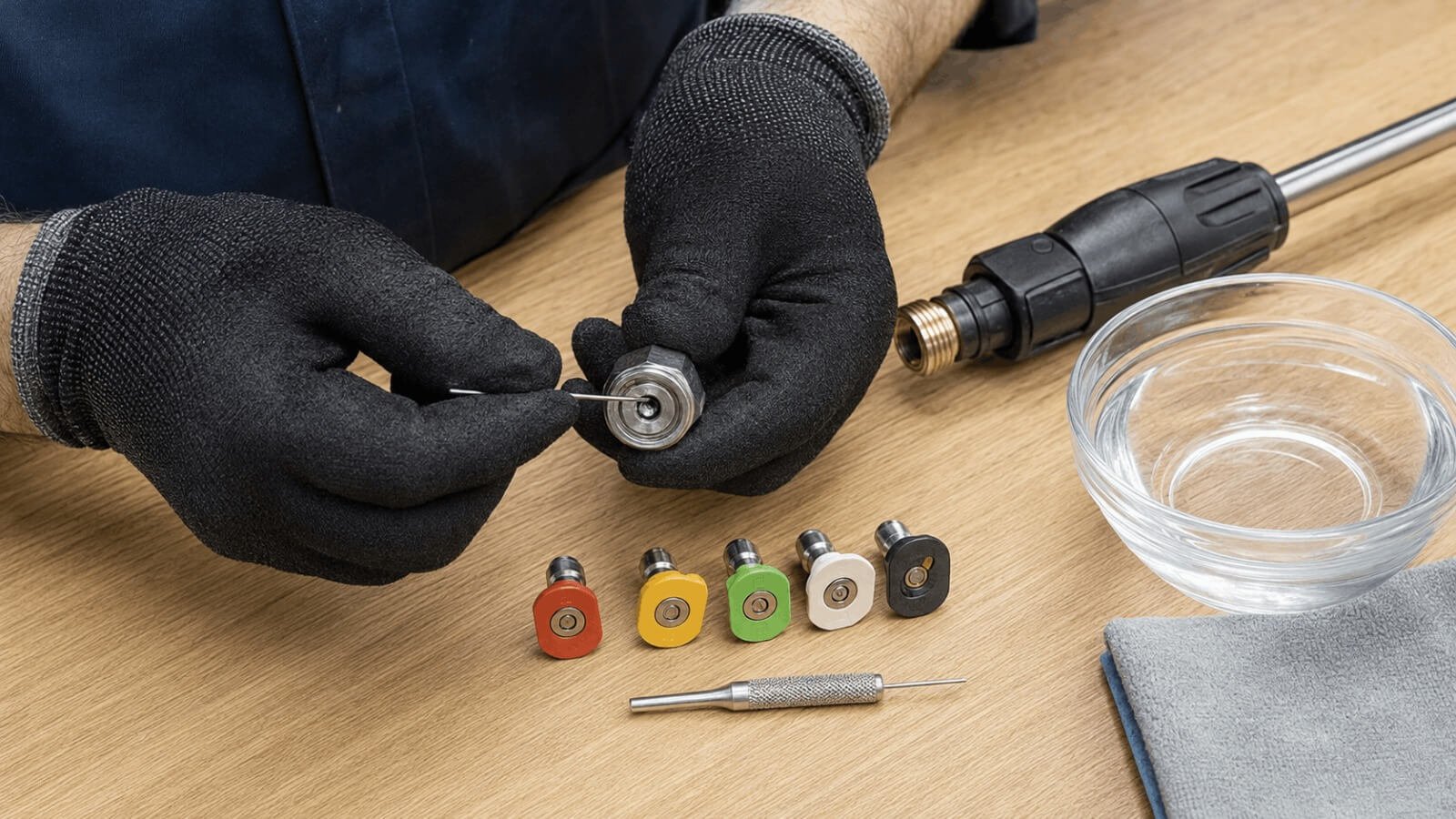
To maximize the life of your pressure washer spray nozzles and prevent sudden pressure drops, follow these maintenance best practices:
Cleaning Clogged Nozzle Tips
Grit, mineral scale, or debris inside water lines can easily lodge in tiny nozzle orifices, causing fan patterns to distort or flutter:
- Shut down the pressure washer and engage the trigger gun safety latch.
- Disconnect the spray tip from the quick-connect wand coupler.
- Insert a thin metal nozzle cleaning pin (or small paperclip) into the front orifice to clear trapped grit.
- Flush water backward through the nozzle from the quick-connect plug to wash out remaining debris.
Chemical Rinsing
After spraying soaps, bleach, or degreasers using black chemical tips, run clean fresh water through the wand for 30 seconds. This prevents chemical crystallization and internal corrosion inside the nozzle body.
Conclusion: Which Pressure Washer Nozzle Set Should You Buy?
Finding the best pressure washer nozzles depends on the specific washing tasks you perform most often:
- For general home maintenance, patio washing, and vehicle care, a complete 5-piece stainless steel kit like the Velocity Pro Quick Connect Set offers all necessary angles.
- For restoring driveways, cleaning brick, or stripping rusted machinery, the rotating action of the Suttner ST-357 Turbo Nozzle will cut cleaning times in half.
- For rapid car detailing or ladder-free house washing, convenience options like the Tool Daily 6-in-1 Multi-Spray Tip or MTM Hydro High-Reach Kit deliver ultimate speed and safety.
By matching the correct nozzle angle and orifice size to your specific pressure washer model, you unlock maximum cleaning power while keeping your surfaces completely safe.
Helpful External Resources
For additional guidance about pressure washer nozzle selection, spray angles, sizing, maintenance, and safe operation, explore these trusted resources:
- Choosing the Proper Pressure Washer Nozzle – SIMPSON — Explains the red, yellow, green, white, and black nozzle color codes and their recommended uses.
- Pressure Washer Nozzles and Tips Guide – SIMPSON — Covers standard spray tips, soap nozzles, and rotary turbo nozzles.
- Quick-Connect Nozzle Sizes and Spray Angles – Mi-T-M — Provides available nozzle orifice sizes and common spray-angle options.
- Rotating Pressure Washer Nozzles – Mi-T-M — Explains how turbo nozzles combine the impact of a 0-degree stream with wider cleaning coverage.
- Pressure Washer Safety Guidelines – CDC — Important safety information about high-pressure spray injuries and when medical treatment is necessary.
- Personal Protective Equipment for High-Pressure Cleaning – OSHA — Guidance on protecting the eyes and skin while using high-pressure water-cleaning equipment.
- DeWalt Pressure Washer Instruction Manual — Includes instructions for safely installing, changing, and checking quick-connect pressure washer nozzles.
Safety reminder: Always consult your pressure washer’s instruction manual before installing an aftermarket nozzle. Match the nozzle’s orifice size, maximum PSI, connection type, and temperature rating to your machine.