pressure washer buying guide

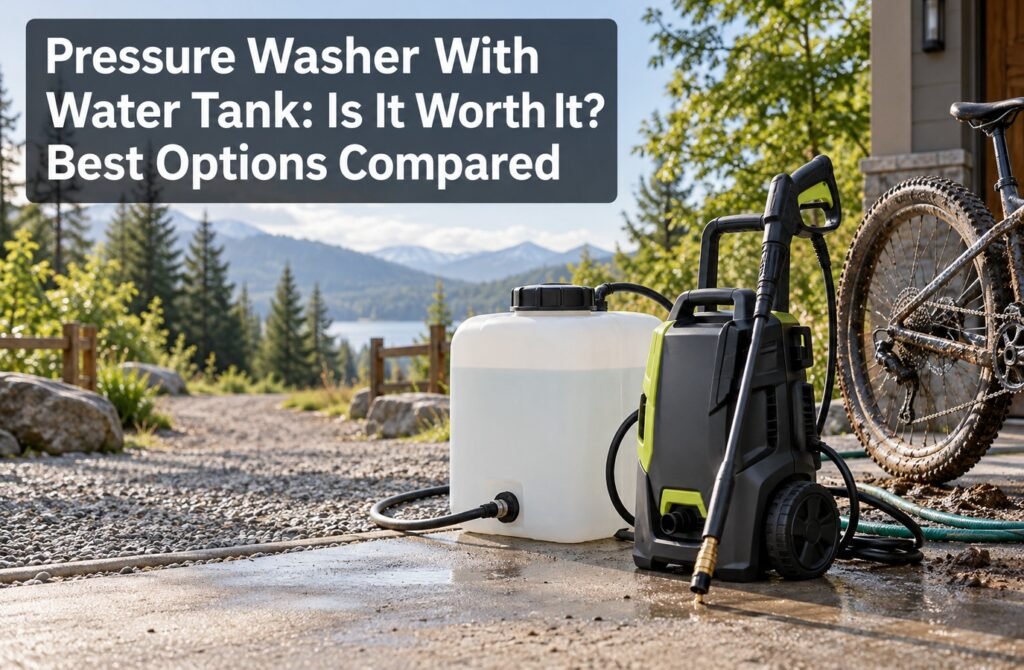
Pressure washer with water tank: portable washer and water tank set up away from a garden tap
Comparisons, Product Comparisons

Pressure Washer With Water Tank: Is It Worth It? Best Options Compared

A Pressure Washer With Water Tank sounds like the easiest way to wash anywhere. Fill the tank, load the washer, and skip the garden hose. That can work well for a muddy bike, outdoor gear, or a small job away from a water connection. For a driveway or regular home cleaning, however, a small tank may run out much sooner than expected. The phrase also covers different products. Some have a built-in reservoir, some connect to a separate container through a suction hose, and others are full trailer systems for commercial crews. These options do not deliver the same pressure, flow, or cleaning time. This guide compares five representative setups, explains what a water tank does and does not change, and helps match the tank to the job. The comparison uses manufacturer-published specifications and product information; these models were not hands-on tested for this article. Availability and specifications can vary by region, so confirm the exact model and manual before buying. What Does a Pressure Washer With Water Tank Mean? A water tank supplies water to the pump. It is different from a detergent reservoir, which holds soap. Check the product description: “built-in tank” can refer to either one. Common setups include: A tank does not increase PSI or GPM. PSI is spray pressure; GPM is water flow. A larger tank only supplies water longer. Full-size washers can clean more aggressively, but may empty a small tank quickly. That is the key point when comparing any pressure washer with water tank. Built-in reservoirs, separate feed tanks, and trailer systems solve different water-supply problems. Is a Pressure Washer With Water Tank Worth It? A tank is useful when a tap is unavailable, the work area is far from the house, or you need a portable rinse for bikes, tools, boots, or outdoor equipment. A built-in reservoir saves repeated trips with a bucket. A trailer tank supports longer jobs away from a water connection. Keep this in mind while you shop for a pressure washer with water tank. It is less useful when a garden tap is nearby. A hose gives a continuous supply without tank weight, refills, or extra storage. Large flat surfaces also use much more water than a quick spot rinse, so a compact battery unit may be too slow for a long driveway. It is one more reason to check the manual for any pressure washer with water tank. Plan what happens after the first tank empties. You may need a refill point, a larger supply, or a washer that can also connect to a pressurized source. If your main concern is choosing a machine for routine house and yard jobs, our home pressure washer buying guide covers the wider choices. This matters whenever you plan to use a pressure washer with water tank. A portable tank suits short rinses away from home, but does not replace an unlimited water supply. Best Pressure Washer With Water Tank Options Compared These products are not direct substitutes. The comparison shows what each setup is designed to do and where it may fall short. Option Water supply Published details Best fit Muc-Off Mobile Pressure Washer Explorer Bundle 20 L built-in tank; extra 20 L tank available in selected bundles 40 V battery, 500 W motor; up to 942 PSI maximum, 652 PSI Boost / 507 PSI Eco; runtime up to 15 / 24 minutes Bike and motorcycle cleaning away from a tap Kärcher OC 3 Plus 7 L built-in tank Low-pressure outdoor cleaner with battery power Shoes, bikes, pets, and small items Kärcher K5 with approved suction hose Separate tank or standing source; tank not included 2,000 PSI pressure rating; use a filtered suction hose and follow the exact manual Homeowners wanting a full-size electric washer Simpson Mobile Trailer 95001 49-State 150-gallon trailer tank 3,800 PSI at 3.5 GPM; 100 ft high-pressure hose; 900 lb unit weight Mobile professional cold-water cleaning Mi-T-M PWR Series trailer package 200-gallon tank Hot-water configuration listed at 3,500 PSI and 4.2 GPM; water recovery equipment Commercial sites needing a large supply and water recovery Muc-Off Mobile Pressure Washer Explorer Bundle Best for: Riders washing bikes or motorcycles away from a tap. The 40-volt, 500-watt unit has a 20-liter reservoir. The manufacturer lists up to 15 minutes in Boost mode or 24 minutes in Eco mode; an extra 20-liter tank is available separately or in selected bundles. Muc-Off lists up to 942 PSI maximum and mode figures of 652 PSI in Boost and 507 PSI in Eco; it does not publish a GPM figure on the product page. It is not a direct substitute for a driveway washer. Pros: Portable, self-contained, and supplied with lances intended for bike and motorcycle cleaning. Cons: Its tank is small for large surfaces, battery time is limited, and published PSI/GPM data is absent. It is a specialty mobile washer, not a full-size home replacement. Kärcher OC 3 Plus Mobile Outdoor Cleaner Best for: Light rinsing of shoes, bikes, pets, and small outdoor items. The OC 3 Plus has a 7-liter tank and integrated battery. It is a low-pressure mobile cleaner, not a conventional washer for stripping dirt from concrete. Pros: Self-contained, easy to move, and suited to gentle on-the-go rinsing. Cons: Low pressure and limited water capacity rule out patios, siding, and heavy grime. Check the product type before expecting full-size washer performance. Kärcher K5 With a Separate Tank and Suction Hose Best for: Homeowners who need an alternate water source for occasional full-size cleaning. The corded K5 family lists a 2,000 PSI pressure rating; it does not include a large supply tank. The manufacturer says K4 and K5 models can draw from standing water with a filtered suction hose, subject to the exact model manual. Pros: Use the washer for home jobs, then connect an approved hose and separate tank when needed. Cons: The tank and suction kit are separate, and not every washer can self-prime. For cordless models, our cordless pressure washer accessories guide explains why hoses, filters,
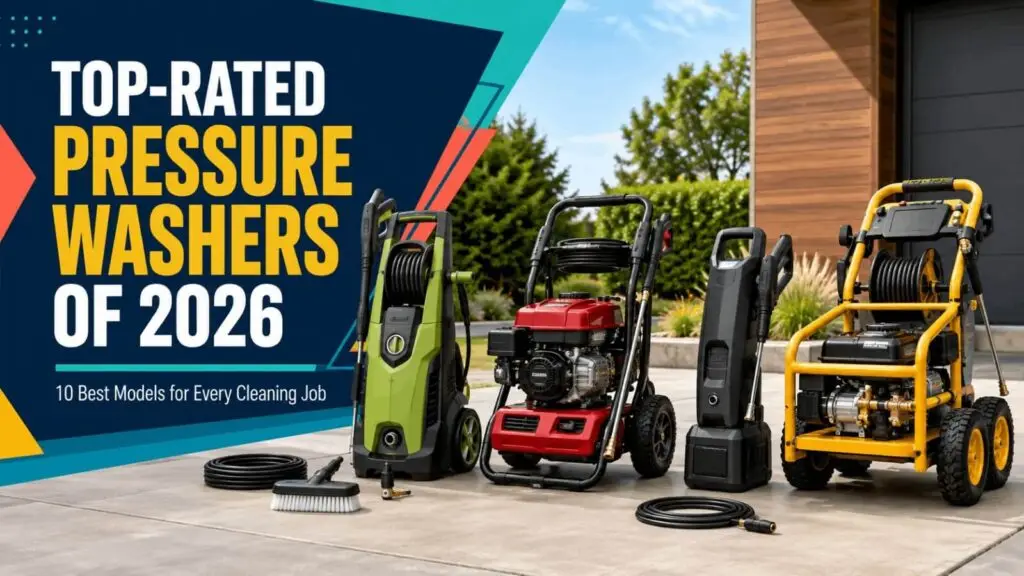
Top-rated pressure washers of 2026 graphic showing 10 best gas, electric, and cordless models.
PSI & GPM Guides

Top Rated Pressure Washers of 2026: 10 Models Compared

The top-rated pressure washers are not simply the machines with the highest PSI. A powerful gas washer may be ideal for a long concrete driveway but inconvenient for washing one car. A compact electric model is easier to start and store, while a cordless washer offers freedom from a power outlet at a higher purchase price. This guide compares ten pressure washers for different buyers and cleaning jobs. Our selections include corded electric, battery-powered and gas machines, from entry-level homeowner units to professional models with triplex pumps. Quick recommendation: Based on published specifications and task suitability, the Greenworks Pro GPW3002A is our best overall choice for most homeowners. Choose the Westinghouse WPX3400 when you need residential gas power, or the SIMPSON PowerShot PS3228 for frequent professional work. Top Rated Pressure Washers briefly Category Model Power source Published output Best use Best overall Greenworks Pro GPW3002A Corded electric 3,000 max PSI at 1.1 GPM Regular home cleaning Best residential gas Westinghouse WPX3400 Gas 3,400 PSI, 2.6 GPM Driveways and heavy dirt Best professional SIMPSON PowerShot PS3228 Gas 3,300 PSI, 2.5 GPM Contractors and frequent use Best cordless EGO HPW3204-2 Dual-battery 3,200 PSI at 1.2 GPM Portable cleaning Best easy-to-use electric RYOBI RY142500 Corded electric 2,500 PSI, 1.2 GPM General residential work Best high-flow electric Kärcher K5 FC Corded electric 2,000 max PSI; up to 2.0 GPM Large home-cleaning areas Best compact DEWALT DWPW2100 Corded electric 2,100 PSI, 1.2 GPM Small homes and storage spaces Best entry-level Sun Joe SPX3000 Corded electric 2,030 rated PSI, 1.2 rated GPM Cars, furniture and patios Best accessory system Generac Speed Wash 3200 Gas 3,200 PSI, 2.7 GPM Versatile outdoor cleaning Best heavy-duty Generac G0088730 Gas 4,200 PSI, 4.0 GPM Large and commercial jobs Published output figures come from the manufacturers. “Maximum” PSI and GPM may be measured under different operating conditions and may not occur together. How We Selected the Top-Rated Pressure Washers This is a research-based buying guide; we did not perform hands-on testing. We compared manufacturer specifications, pressure and flow, pump and motor design, hose length, nozzle selection, detergent delivery, portability, maintenance needs, warranty coverage and suitability for common cleaning jobs. Manufacturer product pages were verified on August 20, 2026. Category winners are editorial recommendations based on their intended use, not laboratory rankings. Prices, stock, specifications and included accessories can change, so confirm the exact model, package and warranty before ordering. 1. Greenworks Pro GPW3002A — Best Overall Pressure Washer The Greenworks Pro GPW3002A is our best overall choice for homeowners who want strong cleaning without gasoline maintenance. Its brushless motor supplies up to 3,000 PSI at 1.1 GPM, while its high-flow mode reaches 2.0 GPM at 100 PSI. Those figures should not be combined as one operating point. The package includes a 25-foot kink-resistant hose, 35-foot GFCI power cord and five nozzles: 15°, 25°, 40°, soap and turbo. Ten-inch wheels make the open-frame machine easier to move, and vertical storage reduces its garage footprint. Pros Strong performance for a residential electric washer Brushless motor with automatic pressure and flow adjustment Five useful nozzles and long power cord Ten-year motor and three-year tool warranty stated by Greenworks Cons Bulkier than compact electric machines Maximum PSI and maximum flow do not occur together 2. Westinghouse WPX3400 — Best Residential Gas Pressure Washer The Westinghouse WPX3400 delivers 3,400 PSI and 2.6 GPM from a 212cc four-stroke engine. That output is well suited to concrete, brick, fences, siding and other demanding residential jobs. It includes a 25-foot hose, five quick-connect tips and a 0.5-gallon detergent tank. The steel frame and 12-inch never-flat wheels are practical for uneven outdoor surfaces. Its axial-cam pump needs less attention than a serviceable triplex design, although it is aimed more at homeowner use than daily contracting. Pros High cleaning output at a competitive gas-machine level Five nozzle tips and large onboard soap tank Strong wheels and steel frame Cons Recoil starting and normal gas-engine maintenance Manufacturer lists this version as not CARB compliant 3. SIMPSON PowerShot PS3228 — Best for Professionals The SIMPSON PowerShot PS3228 is designed for contractors and serious users. Its Honda GX200 engine powers an AAA triplex pump at 3,300 PSI and 2.5 GPM. Unlike a basic residential axial pump, the triplex design is intended for more demanding and frequent work. The package provides a 25-foot MorFlex hose, five nozzles, welded steel frame and 10-inch pneumatic tires. At 77 pounds, it is not lightweight, but its build is better matched to deck restoration, paint preparation and repeated property cleaning. Pros Honda GX200 engine and serviceable triplex pump Flexible, abrasion-resistant MorFlex hose Commercial warranty coverage on engine, pump and frame Cons Heavy and more expensive than homeowner models This PS3228 version is not sold in California 4. EGO HPW3204-2 — Best Cordless Pressure Washer The EGO POWER+ HPW3204-2 removes the need for both fuel and a wall outlet. Two included 56V 6.0Ah batteries provide up to 3,200 PSI at 1.2 GPM, with a maximum-flow mode of up to 2.0 GPM. EGO states a runtime of up to 60 minutes, although actual runtime depends on the selected mode and workload. The washer can use a garden hose or draw clean water through its included siphon hose. ECO, High and Turbo modes are selected through the wand display. A foam cannon, five nozzles and 25-foot hose are included. Pros True cordless operation with strong peak pressure Can draw from a clean portable water source Good accessory package and five-year tool warranty Cons Much more expensive than most corded machines Runtime and maximum output depend on battery charge 5. RYOBI RY142500 — Best Easy-to-Use Electric Model The RYOBI RY142500 is a sensible middle-ground choice for decks, fences, siding, sidewalks and small driveways. Its brushless electric motor produces 2,500 PSI at 1.2 GPM without the starting, fuel and oil requirements of a gas engine. It has a 25-foot hose, metal wand, onboard soap tank and 12-inch flat-free wheels. The machine stores its hose, wand, cord and nozzles onboard, which helps reduce setup

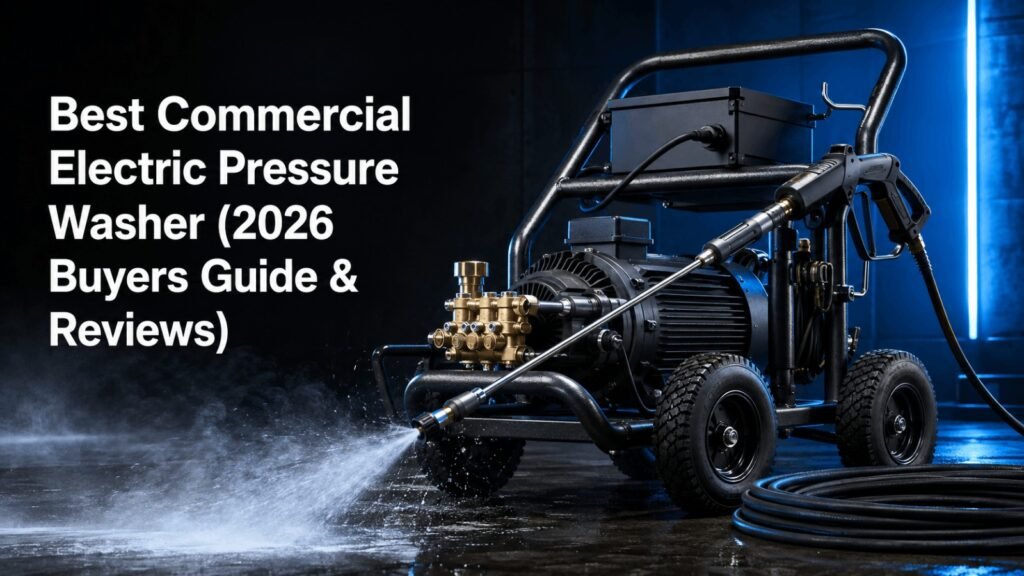
Best commercial electric pressure washer heavy duty unit spraying water outdoors
Buying Guides

Best Commercial Electric Pressure Washer (2026 Buyers Guide & Reviews)

The best commercial electric pressure washer depends first on your power supply, not the brand. A 120 volt machine suits detailing and light shop work at about 1,900 PSI and 2 GPM. A 230 volt machine reaches 3,000 PSI and 3.5 to 4 GPM, which is what most true commercial jobs need. Hot water is a separate choice for grease. I did not test any washer in this guide. The specs come from dealer listings and one maker page, and I show where they disagree. The old version of this page also listed three products I could not verify at all: a Canpump unit, an Epps unit and a Kärcher HD 3.0/20-4 M Cage. I removed them rather than repeat numbers I could not check. Best commercial electric pressure washer: quick picks by job Comparison: models I could check from dealer listings These figures come from dealer listings, not from my own tests. Where numbers differ between sellers, the last column says so. Model Power Pressure and flow Water Where sources disagree AR Blue Clean AR630TSS 120 V, 60 Hz (one dealer lists 20 A) About 1,900 PSI, 2.1 GPM Cold A Gen 2 AR630 is listed at 1,600 PSI and 2.3 GPM. Old page said 2,030 PSI, which I could not confirm AR Blue Clean AR630HW 120 V 1,600 PSI, 2.3 GPM Hot Another hot variant lists 1,500 PSI at 2.1 GPM and 19 A Pressure Pro EE3015G wall mount 230 V, 3 HP 1,500 PSI, 3 GPM Cold Dealer listing only Pressure Pro EE3530G 230 V single phase, 35 A 3,000 PSI, 3.5 GPM Cold Direct-drive General pump per one dealer DEWALT 60783 230 V single phase 3,000 PSI, 4 GPM Cold Check amperage on the nameplate Mi-T-M CW Premium 3000 230 V, 8 to 10 HP depending on model 3,000 PSI, 3.5 to 3.9 GPM Cold Single and three phase versions exist, amps vary DEWALT also lists a DXPW3000E 3,000 PSI, 4.0 GPM electric pressure washer on its own site, so check the exact model number before you buy. Why pick the best commercial electric pressure washer over a gas one The trade-off with any commercial electric pressure washer is power supply and portability. A gas engine works anywhere. An electric unit needs the right outlet or circuit and a cord. If you move between job sites, gas or a generator-powered setup may still make more sense. See our Honda GX390 guide for the gas side. Power: the biggest factor in choosing a commercial electric washer 120 volt units Ordinary outlets in the U.S. are 120 volts, and consumer-style electric washers usually draw 13 to 15 amps. One forum discussion notes that a 15 amp, 120 volt circuit limits output to roughly 2.4 electric horsepower, which is why higher-pressure work moves to 230 volts. That is anecdotal, but it matches what the specs show: 120 volt machines top out around 2,000 PSI and about 2 GPM. 230 volt units Commercial machines at 3,000 PSI are normally 230 volt. A 3,000 PSI, 3.5 GPM unit like the Pressure Pro EE3530G is listed at 35 amps. That is a dedicated circuit, not a wall outlet. Have a licensed electrician check your panel, breaker size and wiring before you buy, and follow the nameplate and local code. Extension cords and GFCI One cord calculator suggests 12 AWG outdoor-rated cord for a typical pressure washer, with thicker wire for long runs, for example 10 AWG at 100 feet. Keep plugs dry and use GFCI protection. Never run a 230 volt commercial unit through a household extension cord. The best commercial electric pressure washer is useless if the circuit trips every five minutes. PSI and GPM for commercial electric work Pressure loosens dirt. Flow rinses it and sets your speed. Multiply them for a rough cleaning-power number. A 1,900 PSI, 2.1 GPM unit is about 3,990. A 3,000 PSI, 4 GPM unit is 12,000, which is three times faster on flat concrete. Our guide on how much PSI you need shows safe ranges by surface. If you will clean big slabs, pair a 4 GPM machine with a surface cleaner. Our guide to the best commercial pressure washer surface cleaner explains how to match size to flow. Cold water or hot water? Cold water is enough for dirt, mud, algae and most vehicle washing. Hot water helps with grease, oil and sticky residue. Electric hot water models exist, but they add cost, and heating needs power or fuel. Check the temperature rating on any hose, gun and accessory before you run hot water. One 120 volt manufacturer model lists a maximum inlet temperature of 122 degrees Fahrenheit, so inlet limits are real. Triplex pump or axial pump? Commercial washers use a triplex plunger pump, which has three pistons and is built for long hours. Cheaper residential machines use an axial cam pump, which wears faster. Dealer pages often name the pump brand, like General Pump on some Pressure Pro models, so look for that. Direct drive pumps are compact. Belt drive models run slower and are often marketed as longer lasting. Commercial versus residential electric pressure washers A commercial machine is built for daily use, and the best commercial electric pressure washer for a busy shop is the one sized for that workload. It has a stronger motor, a metal pump head, a better warranty and parts you can replace. A residential machine is built for a few hours a month. If you use a washer on most workdays, buy commercial. If you wash a car and a patio, you do not need it. What to check before you buy the best commercial electric pressure washer Maintenance that protects a commercial electric washer Our pump maintenance guide and winterizing guide cover the routine. For nozzles, read our nozzle guide. Match the best commercial electric pressure washer to the job Most buying mistakes come from sizing for the hardest job you do once a year. Size for the job you do every

Scroll to Top