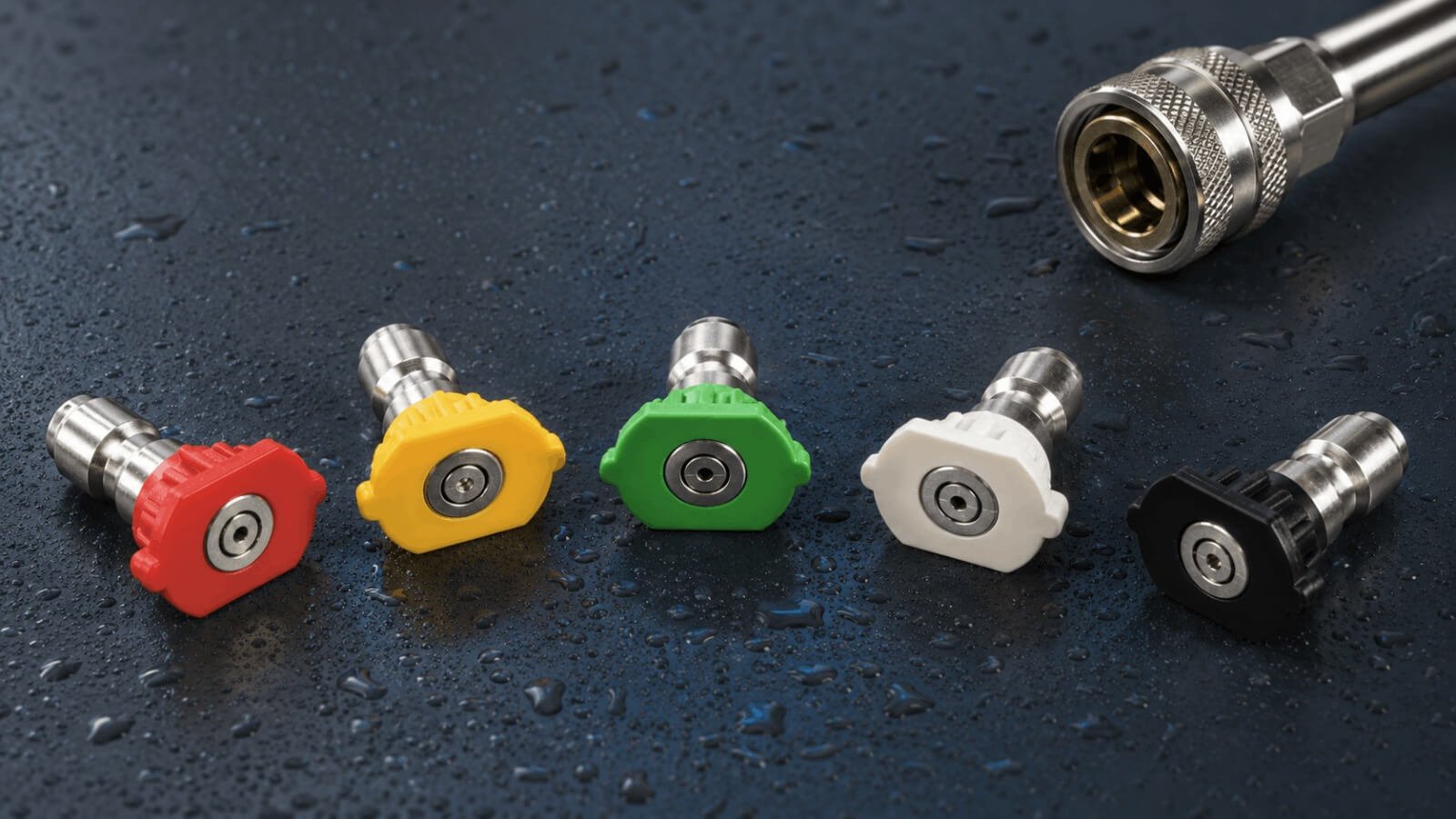
The best pressure washer nozzles are the ones that match your job and your machine. For most people that means a set of five color-coded tips: red (0 degrees), yellow (15), green (25), white (40) and a black soap tip. Start with white or green, and only go narrower when the surface can take it.
The second half of the answer is the size of the hole. A tip that is too small strains the pump, and one that is too large drops your pressure. This guide shows how to read the colors, how to size a nozzle with a simple calculation, and which tip to use on a driveway, deck, car or siding.
Why you can trust this guide
- What this is: a buying and selection guide. We did not bench test individual nozzle brands for this article, so we do not rank brands.
- Sources: manufacturer and parts-supplier nozzle charts for the color and size conventions, and a published medical case report for the injury warning.
- Where sources disagree: the angle of the black soap tip is listed as 50 degrees on some kits and 65 degrees on others. We show both. Read the label on your own tip.
- Last checked: 7 November 2026.
The 7 Best Pressure Washer Nozzles by Type
When people say “best nozzle” they usually mean “best nozzle for this job.” Here are the seven tip types worth knowing, from sharpest to softest.
| Tip | Spray angle | Best for | Avoid on |
|---|---|---|---|
| Red | 0 degrees | Rust spots, tough stains on concrete | Wood, siding, cars, skin |
| Yellow | 15 degrees | Heavy dirt on concrete and brick | Wood, painted surfaces |
| Green | 25 degrees | General cleaning, decks, fences | Soft wood at close range |
| White | 40 degrees | Cars, siding, windows, rinsing | Very stubborn stains |
| Black (soap) | 50 to 65 degrees | Applying detergent | Rinsing |
| Turbo (rotary) | Spinning 0 degree jet | Fast cleaning on flat concrete | Wood, soft stone, vehicles |
| Surface cleaner tip | Built into a disc | Large flat areas | Walls, steps |
Colors follow a common code across most brands, but a few sellers use their own scheme. The number printed on the tip is the one to trust.
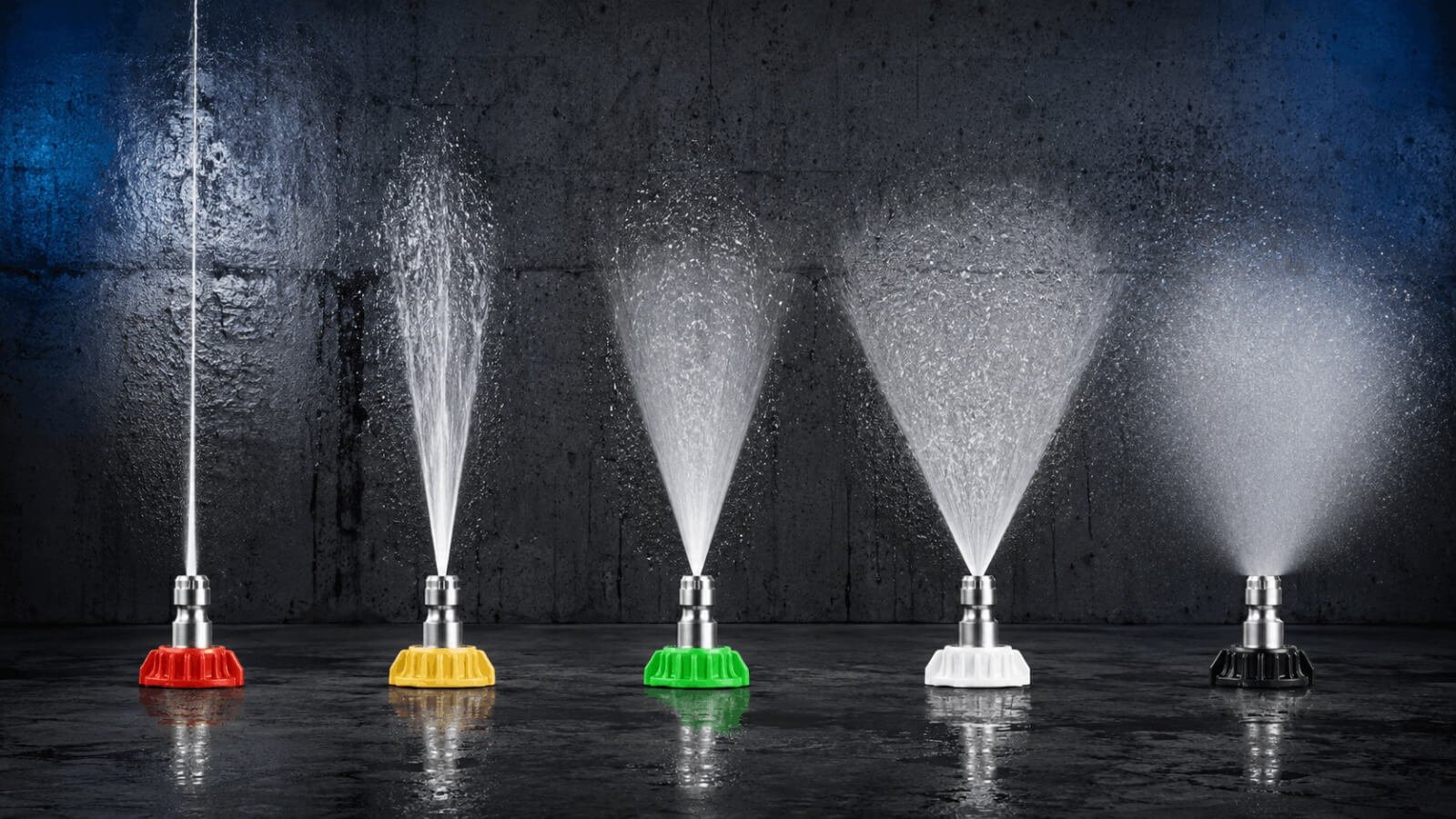
Pressure Washer Nozzle Colors Explained
The spray angle is simple geometry. A small angle puts the same water on a small spot, so it hits hard. A wide angle spreads the water out, so it hits softly.
Red, 0 degrees
This tip fires a pencil thin jet. It is the one that cuts. It can chip concrete, gouge wood and slice skin.
Most home owners rarely need it. If you do use it, keep it for a stubborn spot, hold it far back and keep it moving.
Yellow, 15 degrees
The yellow tip is the heavy cleaner. It makes a narrow fan that shifts caked-on dirt from concrete and brick.
Use it on hard, sealed surfaces. Test on a hidden corner first, because it can still leave marks.
Green, 25 degrees
Green is the all-rounder. It is strong enough to lift grime from a deck or fence, and wide enough to avoid deep damage when you hold it at a sensible distance.
If you only want to learn one tip first, learn this one.
White, 40 degrees
White is the gentle one. Use it to rinse cars, clean siding and wash windows. It is also the best tip to start with when you are unsure.
Black soap tip
This tip has a larger opening, so the pressure drops. That drop is what lets the machine pull detergent through the injector. It is only for applying soap, not for cleaning.
If you spray with it and nothing comes out of the detergent tube, check that you have the black tip on and not the white one.
Color Is Not Size: How Nozzle Sizing Works
Here is the part most guides skip. The color tells you the angle. It does not tell you the size of the hole.
Every nozzle also has a number stamped on it, such as 2.5 or 3.0. That number is the orifice size. Parts suppliers explain it this way: the size is the flow in gallons per minute that the hole passes at 4,000 PSI. So a size 4.0 tip passes 4.0 GPM at 4,000 PSI.
Your machine probably does not run at 4,000 PSI. So you scale the number to your own pressure. Water flow through a hole rises with the square root of the pressure. That gives a simple formula:
Nozzle size = your GPM divided by the square root of (your PSI divided by 4,000)
This is our own working based on the 4,000 PSI rule, not a figure printed by a maker. Check it against your machine’s chart, and use the chart if they differ.
| Machine rating | The math | Closest size |
|---|---|---|
| 2,000 PSI, 1.4 GPM | 1.4 divided by 0.707 | About 2.0 |
| 2,800 PSI, 2.3 GPM | 2.3 divided by 0.837 | About 2.75, so 2.5 or 3.0 |
| 3,000 PSI, 2.5 GPM | 2.5 divided by 0.866 | About 2.9, so 3.0 |
| 4,000 PSI, 4.0 GPM | 4.0 divided by 1.0 | 4.0 |
The first row uses the ratings of an electric home unit such as the Karcher K5 listing (2,000 PSI, 1.4 GPM). Retail listings for this model also show a variant at 1.55 GPM, which would change the answer.
What happens when the size is wrong
- Hole too small: pressure climbs above the rating. The pump works harder and can overheat or wear out sooner.
- Hole too large: pressure falls and cleaning feels weak, even though the pump is fine.
- Between sizes: parts suppliers commonly suggest the slightly larger one, because it eases the load on the pump at a small cost in force.
Many consumer machines come with tips that have no number at all. If yours do, use the manual to find the right replacement size.
Best Nozzle for the Job You Are Doing
Use this list as a starting point. Always begin with a wider tip than you think you need.
- Concrete driveway: green or yellow for dirt, a turbo tip or surface cleaner for large flat areas.
- Brick and pavers: green at a distance. Narrow tips can blast sand out of the joints.
- Wood deck and fence: white or green, held back, moving with the grain.
- Vinyl siding: white tip, spraying slightly downward so water does not get behind the panels.
- Car or boat: white tip, plenty of distance, and the black soap tip for foam.
- Gutters and windows: white tip with a short, careful burst.
- Rust or paint stripping on metal: yellow, or red only when nothing else works.
For the PSI side of each job, see our guide on how much PSI you need for different cleaning jobs.
Turbo (Rotary) Nozzles: Worth It?
A turbo nozzle spins a 0 degree jet in a cone. You get the cutting power of the red tip across a wider circle.
That makes it popular for large concrete areas. It can finish a driveway faster than a fixed 15 degree tip.
The downsides are real. A spinning jet can leave swirl marks on soft surfaces. It also costs more, and cheap ones wear out faster. Keep it away from wood, vehicles and soft stone.
If you have a lot of flat concrete, a surface cleaner attachment gives a more even result than any nozzle. Our guide to the best commercial pressure washer surface cleaner covers that option.
Brass, Stainless Steel and Ceramic Nozzles
The hole in a nozzle wears with use. The material around it decides how fast.
- Plastic: cheap and fine for occasional jobs. It wears fastest.
- Brass: soft metal that wears over time. It is common and affordable.
- Stainless steel: harder and holds its shape longer under heavy use.
- Ceramic or carbide insert: the hardest option, which makers claim lasts longest. It costs the most.
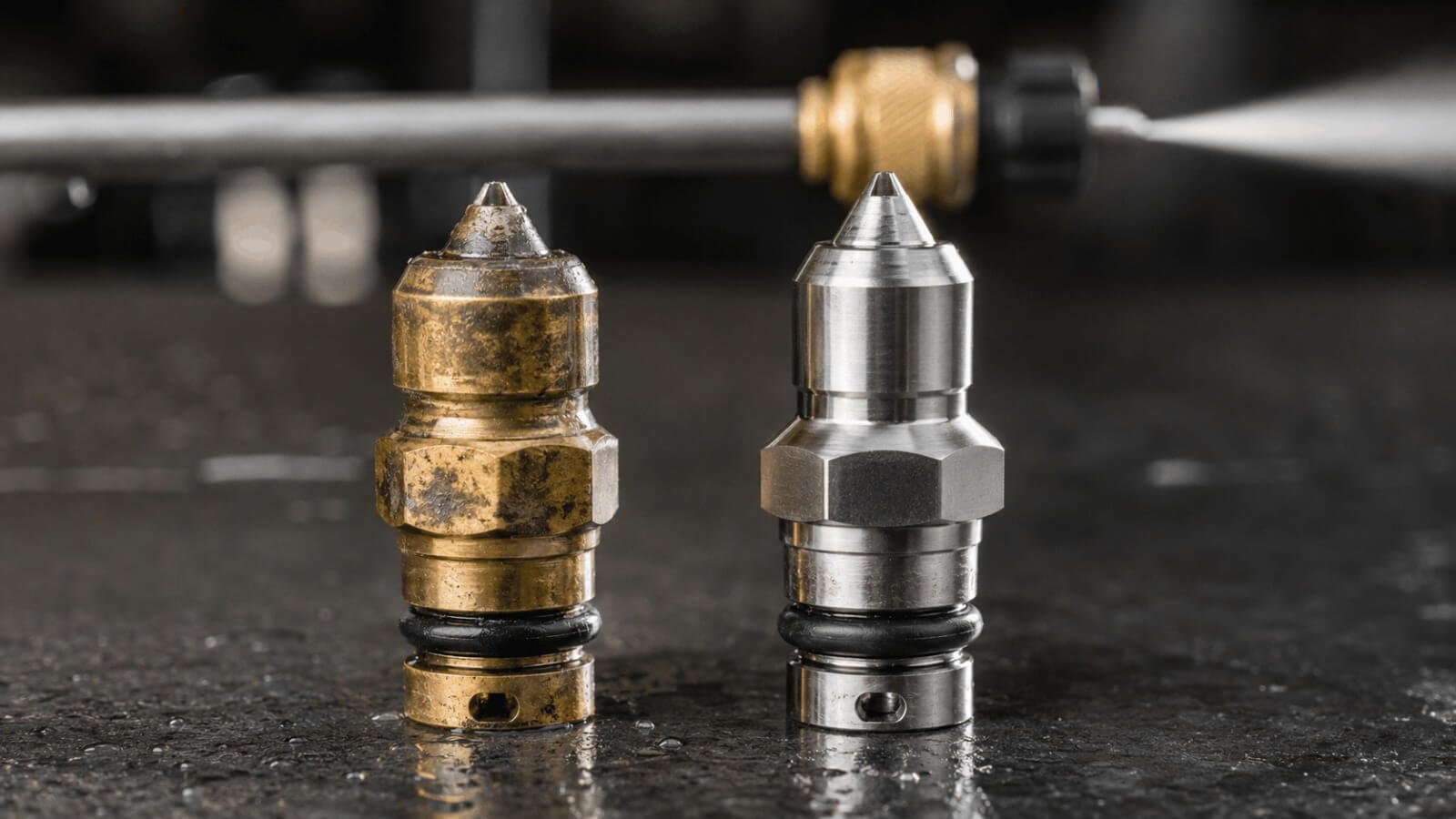
For a home owner who washes a few times a year, stainless steel is a sensible middle ground. Pay more only if you work at a high volume.
Quick Connect or Threaded?
Most consumer pressure washers use quick connect nozzles. You pull back a collar, push the tip in, and release. It takes two seconds.
Many commercial machines use threaded or larger quick connect fittings. Check the size on your wand before you buy. A common home size is 1/4 inch, while larger machines often use 3/8 inch. Our list of the best pressure washer accessories has other parts that need the same check.
How to Tell a Nozzle Is Worn Out
Nozzles fail quietly. These are the signs.
- Cleaning feels weaker than it used to, with the same machine and settings.
- The spray pattern is uneven, with streaks or a pulsing edge.
- The pump pressure gauge, if you have one, reads lower than the rating.
- The hole looks bigger or no longer round when you hold the tip up to the light.
A wear gauge or a set of drill bits can show whether the hole has grown. If it has, replace the tip before the pump takes the blame. Also check the pressure washer pump maintenance guide if pressure stays low with a new nozzle.
How to Build a Starter Nozzle Kit
You do not need a huge set. Here is a simple way to spend your money in order of value.
- The set that came with the machine. Most include red, yellow, green, white and black. Learn these first.
- A correctly sized replacement for your most used tip. Usually that is the green or the white. Spares matter because tips get lost in the grass.
- A surface cleaner or a turbo tip, but only if you have a lot of flat concrete.
- An extension wand or a pivoting coupler, if you need to reach gutters, wheel wells or the underside of a deck.
A cheap set of eight or ten random tips is rarely a bargain. Many are the wrong size for your machine and give you a false sense of choice.
How to Change a Nozzle the Right Way
- Turn off the machine and squeeze the trigger to release trapped pressure.
- Lock the trigger.
- Pull back the quick connect collar and take out the old tip.
- Push in the new tip until it clicks, then release the collar.
- Tug the tip lightly to confirm that it is locked.
- Unlock the trigger, point the wand at the ground and start again.
This takes under a minute. It also prevents the most common accident, which is a tip shooting out of the wand under pressure.
How to Clear a Clogged Nozzle
A clogged tip gives a split or sputtering spray, and pressure may spike. Do not keep spraying through it.
- Shut the machine off and release the pressure.
- Remove the nozzle and look through the hole toward a light.
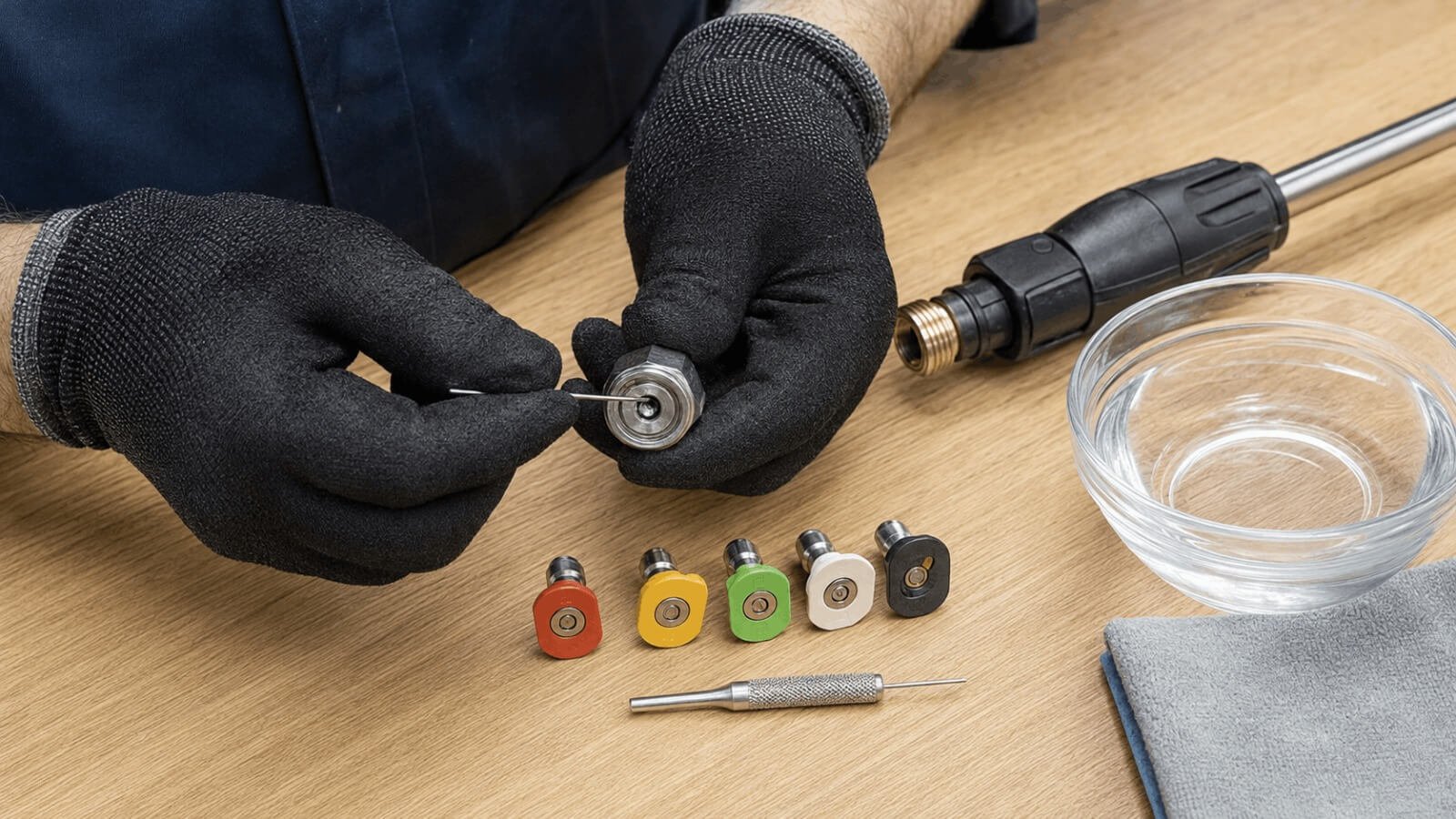
- Use the small cleaning needle that comes with many kits. A straightened paper clip also works. Do not use a drill bit, which can enlarge the hole.
- Flush water backward through the nozzle from the front with a garden hose.
Hard water leaves scale in the tip. If you see white crust, soak the tip in a mild descaler according to the product label.
Nozzle Safety
A pressure washer jet can injure skin without leaving much of a mark. Medical case reports describe tiny puncture wounds from high pressure water that hid deeper damage. A 2008 report in the International Journal of Emergency Medicine describes an injury from a 2,500 PSI washer.
If a jet ever hits your skin, get checked in an emergency room even if the wound looks small.
- Never point the wand at a person, a pet or your own foot.
- Do not change nozzles while the trigger can be squeezed. Release the pressure first.
- Wear eye protection. Debris and spray travel farther than you expect.
- Lock the trigger when you set the wand down.
Mistakes People Make With Nozzles
- Grabbing the red tip first because it looks the most powerful.
- Using the soap tip and wondering why nothing gets clean.
- Replacing a lost tip with the wrong size.
- Holding any tip too close to wood.
- Never replacing a worn tip.
Questions People Ask
What is the best all-purpose pressure washer nozzle?
The green 25 degree tip. It gives enough force to clean decks, fences and concrete without the damage risk of the narrow tips.
Which color nozzle is safest on a car?
White, the 40 degree tip, held at a distance and kept moving. Never use red or yellow on paint.
Does nozzle size matter more than color?
They do different jobs. Color sets the angle, and size sets how the machine’s flow and pressure balance. Wrong size can strain the pump, so check both.
Do all nozzles fit all pressure washers?
No. The quick connect size has to match your wand, and the orifice size should match your machine’s rating.
How often should I replace a nozzle?
There is no fixed schedule. Replace it when the spray looks uneven, pressure drops or the hole looks worn. Heavy users may need a new tip each season.