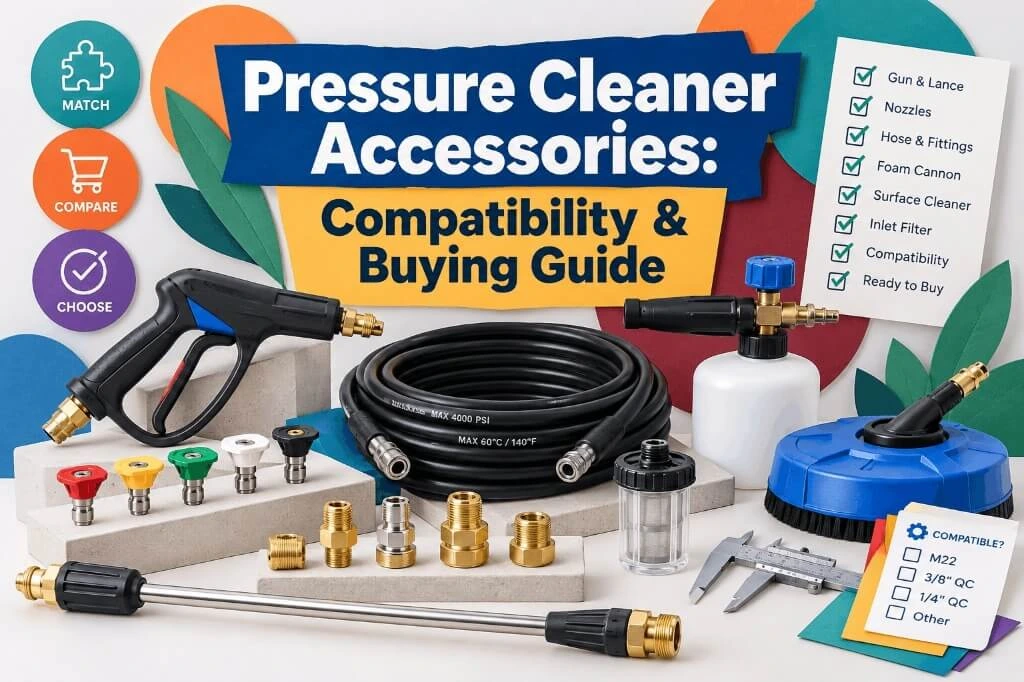
The right pressure cleaner accessories can make car washing, patio rinsing, and driveway cleaning faster and easier. The wrong ones can cause leaks, poor performance, awkward handling, wasted money, or surface damage.
This guide explains which attachments are useful, how to confirm compatibility, and what to buy first. It is for homeowners, DIY users, and small cleaning businesses. Recommendations are based on equipment requirements and practical use cases—not claimed hands-on testing.
Quick answer: Choose an accessory for a specific job, then match its connector, working-pressure rating, water-flow requirement, temperature limit, and nozzle size to your exact pressure washer. A high PSI number or “universal” label does not prove compatibility.
Which Pressure Cleaner Accessories Do You Actually Need?
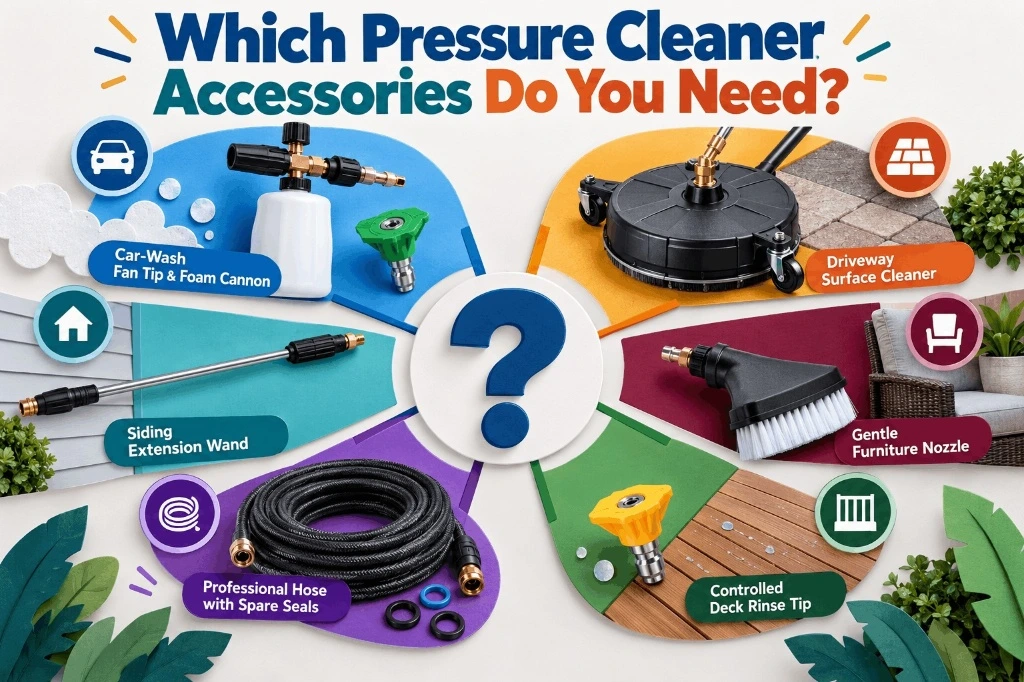
Accessories change how water reaches the surface, how detergent is applied, or how comfortably you work. They do not increase the pump’s rated capacity.
Start with the problem you want to solve. A stiff hose needs a handling upgrade. A large concrete area may benefit from a suitable surface cleaner. A car wash setup needs controlled rinsing and compatible detergent more than an aggressive nozzle.
A small set that you use regularly is better value than a large kit containing several unsuitable attachments.
Pressure Washer Attachments: Check Compatibility First
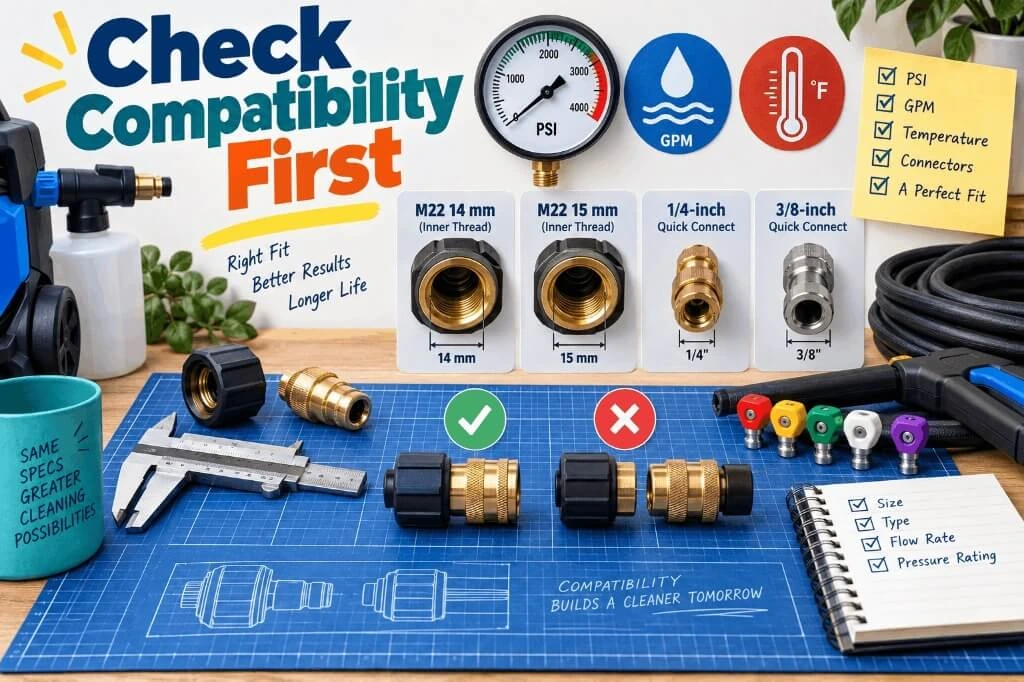
PSI, GPM, and working ratings
When shopping for pressure cleaner accessories, checking compatibility is your most important step.
PSI means pounds per square inch and describes pressure. GPM means gallons per minute and describes water flow. Attachments need the right combination. A surface cleaner can tolerate the pressure yet require more flow than the pump delivers; a foam cannon can fit but work poorly outside its operating range.
Every high-pressure component must have a suitable working-pressure rating for the machine. A burst-pressure figure is not a working rating. A 5,000 PSI fitting does not turn a 2,000 PSI washer into a more powerful machine.
Check temperature limits too. Cold-water accessories are not automatically suitable for hot-water equipment.
“Cleaning units,” calculated as PSI multiplied by GPM, provide only a rough comparison. They do not confirm fit or cleaning quality, especially when separate maximum PSI and GPM figures do not occur together.
Electric, gas, and cordless compatibility
Power type alone does not determine whether an attachment works. Connections, operating output, and manufacturer approval matter more. Electric and gas models may use proprietary fittings, while small cordless cleaners may lack the flow for conventional surface cleaners.
If you are choosing the machine as well, our guide to electric and gas pressure washers explains the broader buying decision.
Read the connector description carefully
“Universal” should prompt a closer check, not replace one. Record the machine model, gun inlet, hose ends, and wand outlet before ordering.
An M22 threaded connection may use a 14 mm or 15 mm sealing insert. Those versions are not interchangeable simply because the outer threads engage. Likewise, a 1/4-inch nozzle connector and a 3/8-inch hose connector serve different positions in a setup.
For proprietary twist-lock fittings, use an adapter specifically listed for that connection. Avoid building a long stack of adapters that makes the gun bulky and strains its inlet.
Pressure Washer Nozzle Tips: Control the Spray
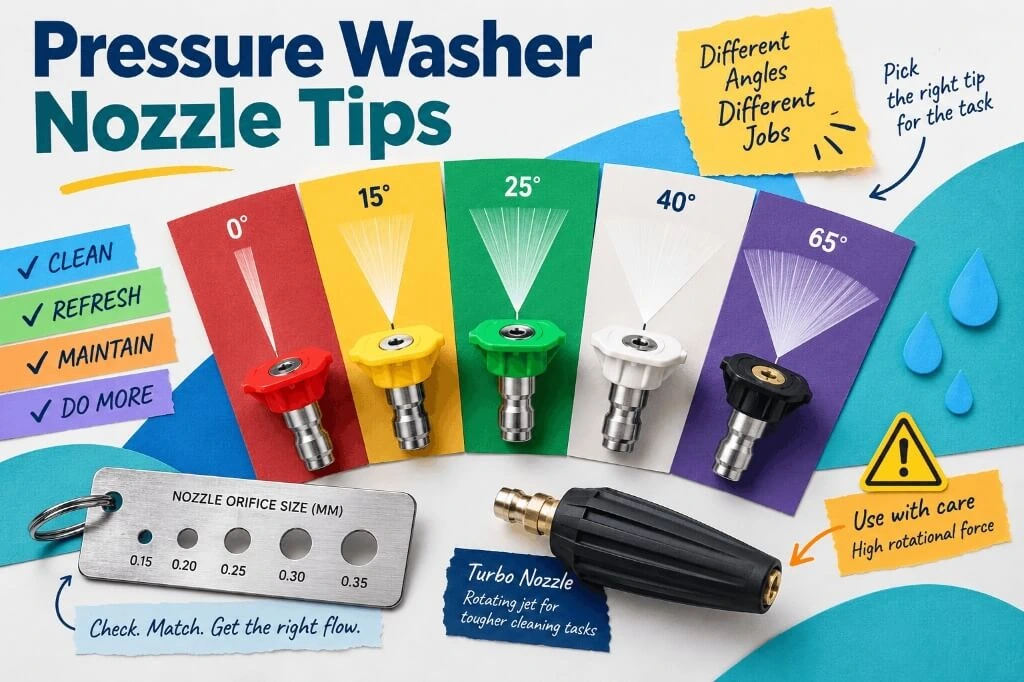
A nozzle sets the spray pattern and contains an opening sized for water flow. Both features matter when replacing the original tip.
Fan angle and nozzle opening are different
A wider fan spreads the stream; a narrower fan concentrates it. A wide fan is still not automatically safe on peeling paint, soft wood, damaged seals, or delicate trim.
The opening, often called the orifice, must match the intended pressure and flow. An undersized opening can cause excessive restriction or unstable operation; an oversized one can reduce working pressure. Use the machine’s specified tip size or an approved nozzle-sizing chart.
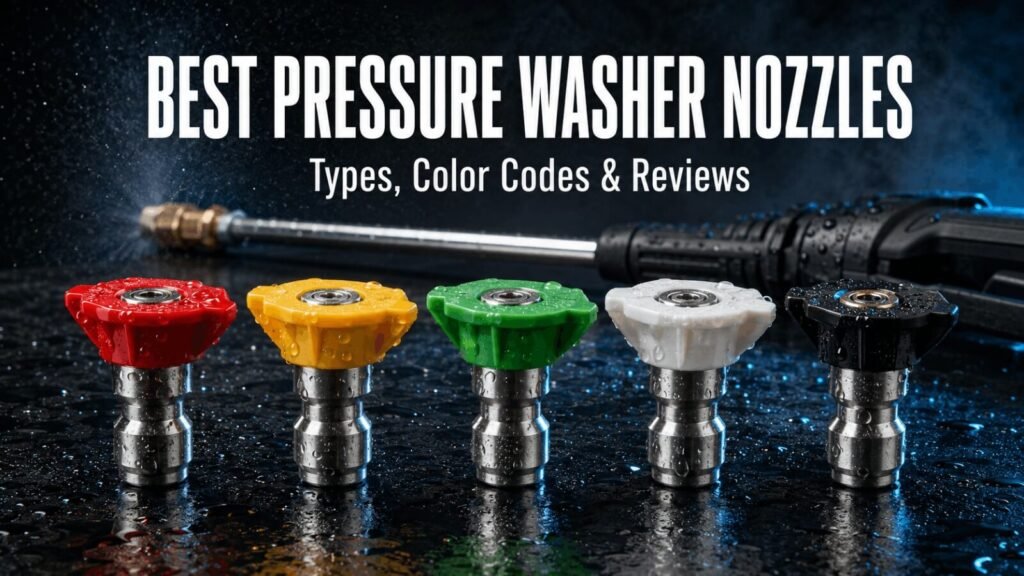
Color coding commonly identifies spray angle, but check the markings and manual. Color alone does not establish flow size or surface suitability.
A practical first spray
Choose the gentlest approved setting, begin at the manual’s recommended distance, and test a hidden area. Inspect it before moving closer. Wet wood and concrete can temporarily hide marks.
Where a turbo nozzle makes sense
A turbo nozzle rotates a concentrated stream to cover more area. It can help on suitable durable masonry, but its movement does not make the jet gentle.
Avoid treating it as a general-purpose car, siding, or deck attachment. It can damage finishes, dislodge weak mortar, and mark surfaces. Even on concrete, check condition and surface guidance first.
Pressure Washer Hose and Fittings: Improve Handling
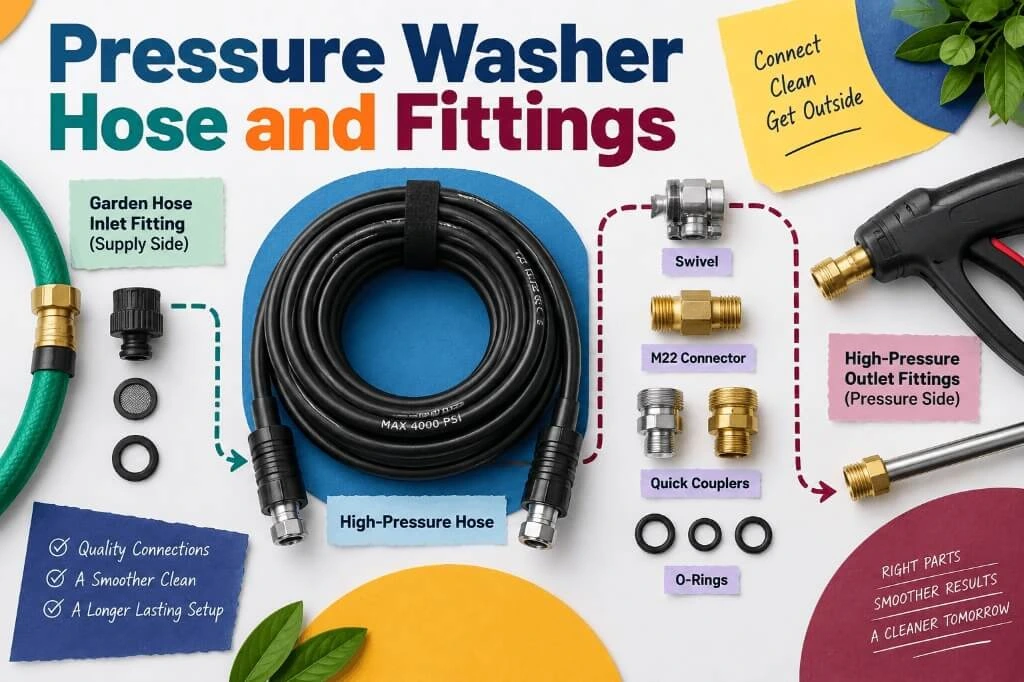
Upgrading your hose is one of the most effective pressure cleaner accessories to improve overall handling and reach.
A hose that catches around every wheel can make a simple wash frustrating. Length, flexibility, and routing may matter more to daily use than another spray attachment.
Choose useful length, not maximum length
Measure the route around your cleaning area. Include corners and the distance needed to keep the washer in a safe position.
A longer hose reduces repositioning but adds weight, storage needs, and friction loss. Follow approved hose length and diameter specifications instead of joining several narrow extensions. Professionals should also compare abrasion resistance, flexibility, temperature rating, and replacement availability.
Separate garden-hose fittings from high-pressure fittings
Garden-hose couplers belong on the water-supply side. They must not be used as substitutes between the pump outlet and spray gun.
Some mixed adapter kits include both types. Read the rating and intended position of each piece; do not assume a pressure claim on the package applies to every garden-hose coupler inside.
Quick connectors can simplify setup, but they introduce seals that need inspection. With the system depressurized, check that the connector locks fully and give it a gentle tug before use.
Foam Cannon for Car Washing: Helpful, but Optional
A foam cannon mixes detergent solution with pressurized water and air at the gun. A garden-hose foam gun is a different accessory and operates from the water supply without a pressure washer.
What to check before buying
Check pressure and flow range, connector, replacement parts, and bottle handling. Follow the cannon maker’s orifice guidance rather than assuming a smaller opening is always better.
Thick foam is not proof of stronger cleaning. Detergent choice, dilution, dirt type, and dwell time all affect the result.
Use shampoo approved for the vehicle surface and application equipment. Work on cool panels out of strong sun, and never let detergent dry. Foaming can help loosen dirt, but it does not guarantee a touch-free wash; remaining road film may need a suitable gentle contact wash.
When to skip it
If your main jobs are muddy paving and garden furniture, a foam cannon may offer little benefit. A compatible low-pressure detergent system may already meet your needs. Spend first on the accessory that solves your most frequent problem.
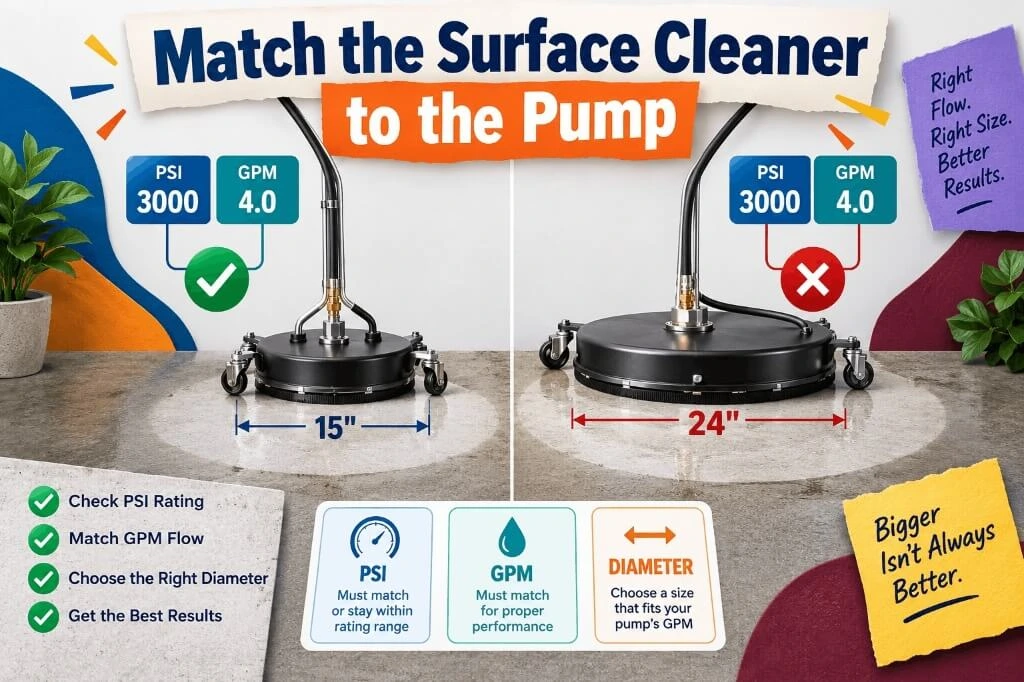
Pressure Washer Surface Cleaner: Match It to the Pump
Among all pressure cleaner accessories, a surface cleaner saves the most time on large driveways.
A surface cleaner usually contains rotating spray arms beneath a housing. On suitable flat surfaces, it can produce more consistent coverage than sweeping a wand back and forth.
Diameter is only part of the decision
Check the cleaner’s minimum and maximum pressure, required flow, nozzle sizing, and connection. A larger cleaning head is not automatically faster on a small washer.
An oversized attachment may require slow passes or leave uneven results. Choose within the maker’s operating range instead of relying on a universal inches-per-GPM rule. Compact electric units usually need smaller matched heads; higher-flow machines may support wider models.
Technique and limitations
Clear loose stones first. Keep the head level and move in steady, slightly overlapping passes. Avoid pausing over one spot with the jets running, and never lift an operating cleaner to inspect underneath.
Expect a separate rinse to move dirty water away. Oil staining may need approved pretreatment, and weak concrete, coatings, or paver joints can still be damaged. A covered spray bar controls splash; it does not guarantee surface safety.
Spray Guns, Extension Wands, and Water Filters
Spray guns: comfort and control
Choosing high-quality pressure cleaner accessories like ergonomic spray guns and inlet filters ensures long-term pump protection.
Choose a rated gun with compatible inlet and outlet connections, a comfortable trigger, and a working safety lock. A short gun may help around a vehicle but is not the right reach solution for every task.
Check whether seals and swivels are replaceable. Never secure the trigger open to reduce hand effort. If holding it becomes painful, stop and review the equipment and workload.
Extension wands: reach has a handling cost
Longer wands increase leverage and make recoil harder to control. Added reach does not make ladder-based pressure washing safe.
Use only an approved extension you can control from stable ground. Avoid overhead electrical lines and spraying into siding gaps, vents, or roof edges. Where safe access is not possible, use a suitable alternative method or professional service.
Water filters: protect flow as well as the pump
An inlet screen catches debris before it enters the washer. An additional filter must be suitable for the supply pressure and required flow; a restrictive or dirty filter can starve the pump.
A sediment filter does not automatically remove dissolved minerals. If reducing water spots is the goal, that is a separate water-treatment decision with its own capacity and maintenance requirements.
Common Buying and Setup Mistakes
Avoid buying pressure cleaner accessories based only on bundle size or visual appearance.
Buying by piece count: Eight fittings may include duplicates or supply-side couplers you do not need. Compare the contents with your actual connection points.
Using thread tape on every leak: O-ring and washer-sealed connections need the correct intact seal. Tape is not a repair for mismatched dimensions or damaged parts.
Chasing a stain with more pressure: Old coatings or absorbed oil may not respond safely. Identify the surface and stain before changing the method.
Adding unsuitable chemicals: Household cleaners may harm seals, surfaces, or the detergent system. Use approved products and never mix chemicals.
Blaming the accessory for weak output: First check supply flow, hose kinks, blocked screens, and setup. Stop if the machine pulses or behaves abnormally.
Safety Before You Connect Anything
Follow the washer manual, accessory instructions, surface guidance, and detergent label together. When their requirements conflict, stop and confirm compatibility.
Wear eye protection and sturdy non-slip footwear, and keep bystanders and pets away. Never check leaks with your hand or direct the spray at anyone. Seek prompt medical care for a high-pressure spray wound, even if it looks small.
Switch off, isolate power, and release trapped pressure as instructed before disconnecting parts. Replace a damaged high-pressure hose; do not patch it with tape.
Keep electrical connections dry and use the specified ground-fault protection. Some machines prohibit extension cords. Run gas equipment outdoors, at least 20 feet from windows, doors, and vents.
Our electric pressure washer setup guide covers the connection and startup sequence in more detail.
Three-Step Accessory Plan
1. Before buying
Record the model, working PSI and GPM, connector dimensions, temperature limit, and two most common jobs. Choose one accessory that solves a clear problem; confirm ratings, parts, warranty, and returns.
2. Before and during cleaning
Inspect the equipment and surface, prepare the water supply, follow the approved startup procedure, and test a small area. Stop for leaks, pulsing, unusual vibration, or visible damage.
3. After cleaning
Flush detergent equipment, shut down, release pressure, and drain parts as instructed. Clean screens and tips with approved tools, protect parts from freezing, keep connectors away from grit, and coil hoses without sharp bends.
Frequently Asked Questions
Are pressure cleaner accessories universal?
No. Matching threads or a similar-looking connector are not enough. Check sealing dimensions, pressure, flow, temperature, and model compatibility before buying an attachment or adapter.
Can accessories increase my washer’s PSI?
They cannot upgrade its rated pump capacity. A correct replacement can restore intended performance, while a different spray pattern changes how force reaches the surface. Neither creates a more powerful pump.
Why does my new foam cannon produce watery foam?
Check detergent dilution, pickup-tube fit, adjustment, flow requirements, and the recommended orifice. Also inspect for blockages according to the instructions. Do not compensate by adding an unapproved chemical mixture.
Can a surface cleaner clean a wooden deck?
Do not assume so. Rotating jets can mark wood or damage finishes. Use it only when both the attachment instructions and deck manufacturer permit the method and operating settings.
Should I buy an accessory bundle or individual parts?
A bundle makes sense when every major piece suits your machine and planned work. Individual parts are usually the clearer choice when you need one specific improvement or have proprietary connections.
Conclusion: Buy for the Job and the Connection
Useful pressure cleaner accessories make a task easier without creating a new compatibility problem. For one owner, that means a flexible hose; for another, a matched surface cleaner or controlled detergent setup.
Start by checking your washer’s specifications and identifying the job that causes the most difficulty. Buy one suitable upgrade, use it correctly, and judge its value by control, convenience, and cleaning results—not by the number of parts in the box.
Helpful Resources
Editorial and Testing Disclosure
Prepared by Pressure Washer Wise using manufacturer specifications, equipment manuals, and government safety guidance. This article provides general buying and safety information; it does not claim that every accessory described was personally tested. Verify all measurements and ratings against your exact washer and accessory manuals before purchase or use. Clearly disclose affiliate relationships on any page containing compensated links, and recheck product specifications, recalls, and safety guidance during updates.