The Ryobi 1900 PSI electric pressure washer offers an easy alternative to a gas machine for routine jobs around the home. There is no fuel, oil change, choke, or pull cord. Connect the water and power correctly, purge the air, and it starts with a switch.
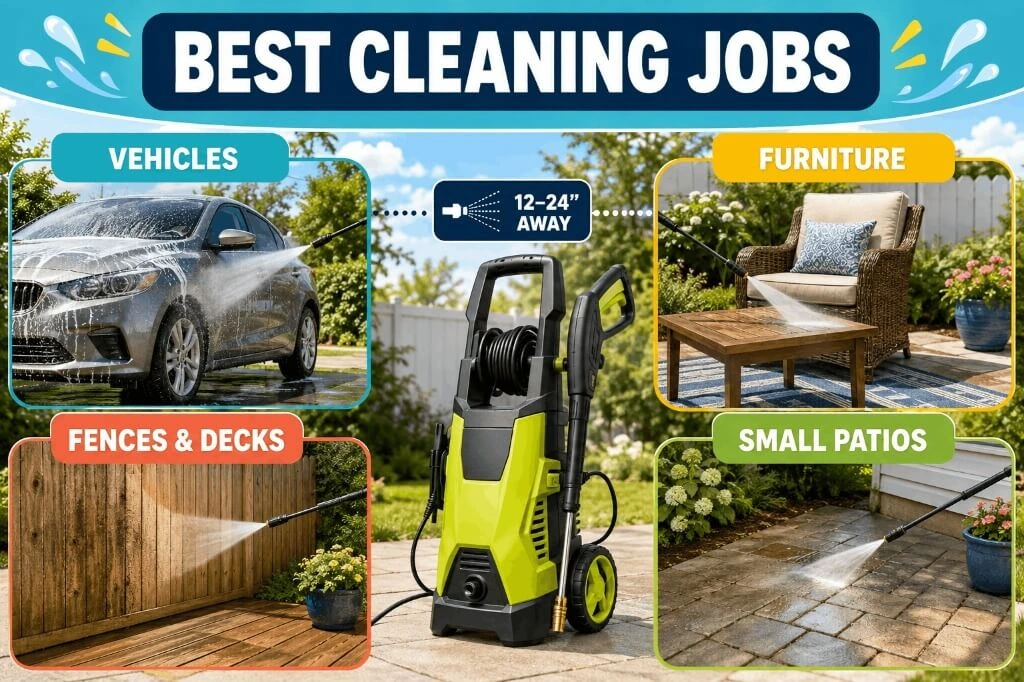
Its 1.2 GPM water flow also sets a clear limit. It can clean furniture, vehicles, boats, fences, garden tools, and small patios, but it will take longer on large driveways or deeply stained concrete.
This review covers model RY1419MT and the RY1419MTVNM designation shown in its operator manual. It explains the specifications, realistic cleaning ability, setup, common problems, and who should—or should not—buy it.
How this review was prepared: This is a specification- and manual-based evaluation, not a claim of long-term hands-on testing. Product details were checked against the official Ryobi RY1419MT page and the RY1419MTVNM operator’s manual. Performance conclusions are based on the verified 1,900 PSI and 1.2 GPM ratings and the machine’s included equipment.
Ryobi 1900 PSI Pressure Washer: Quick Verdict
The Ryobi 1900 PSI pressure washer is best viewed as a light-duty home cleaner. Its main advantages are push-button starting, a wheeled frame, telescoping handle, onboard storage, built-in soap tank, 25-foot hose, and three useful nozzles.
Its main drawback is rinsing speed. A 1.2 GPM machine can remove normal dirt, but it moves less water than a larger electric or gas washer. The turbo nozzle improves cleaning on small areas of sound concrete, yet it does not turn this model into a fast driveway machine.
Practical Assessment Summary
| Review Area | Practical Assessment |
| Best for | Furniture, vehicles, boats, RVs, tools, fences and small patios |
| Suitable with care | Siding, decks and small areas of sound concrete |
| Less suitable for | Large driveways, deep oil stains and frequent commercial work |
| Main advantage | Simple electric operation and compact storage |
| Main limitation | Modest 1.2 GPM flow |
Ryobi Pressure Washer 1900 PSI Specifications
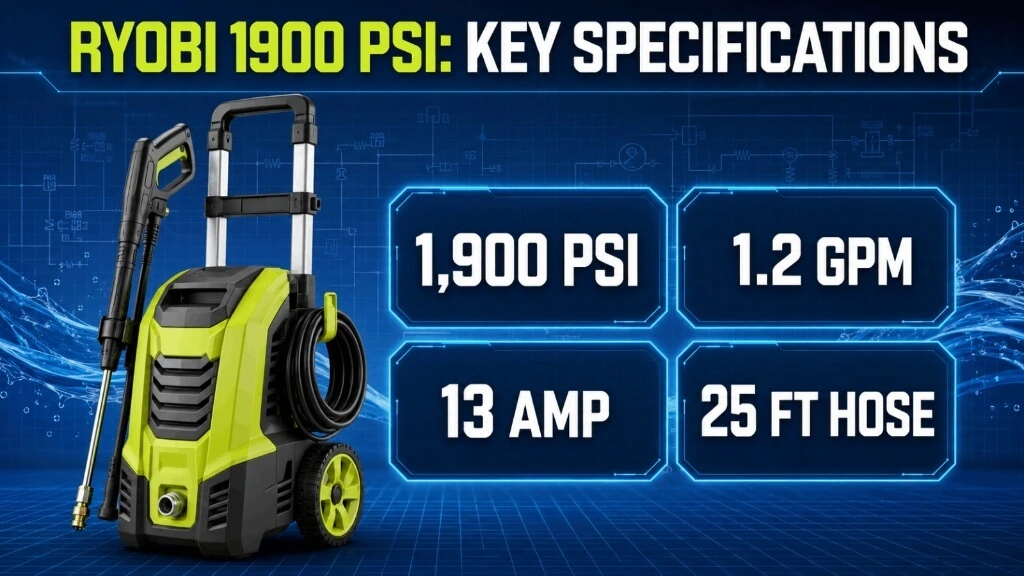
The retail model is RY1419MT, while the manual uses RY1419MTVNM. Check the data plate before ordering parts because the model, manufacturing, and serial numbers are more reliable than a shortened online title.
| Specification | Verified Detail |
| Maximum pressure | 1,900 PSI |
| Maximum water flow | 1.2 GPM |
| Motor | 13-amp corded electric |
| Electrical supply | 120V AC, 60 Hz |
| High-pressure hose | 25 feet |
| Nozzle connection | 1/4-inch quick connect |
| Included nozzles | 15-degree, turbo and soap |
| Detergent system | Integrated tank with downstream injection |
| Machine soap setting | 20:1; also follow detergent instructions |
| Mobility | Wheels and telescoping handle |
| Storage | Onboard hose, cord, wand and nozzle storage |
| Household warranty | Three years stated in the manual |
| Commercial-use warranty | 90 days stated in the manual |
Multiplying 1,900 PSI by 1.2 GPM gives 2,280 cleaning units. This is useful for rough comparison, but it does not predict every result. Water supply, voltage, nozzle choice, surface condition, hose restrictions, and working distance also matter.
What Comes With the Ryobi 1900 PSI Electric Pressure Washer?
The standard listed package contains the washer, trigger handle, spray wand, 25-foot non-marring hose, soap tank, 15-degree nozzle, turbo nozzle, soap nozzle, and manual. Retailer bundles may add accessories, so check the exact package before buying.
A foam cannon, wider vehicle nozzle, longer hose, or surface cleaner may require a separate purchase. Confirm the connector and pressure-flow requirements before ordering an accessory.
Ryobi 1900 PSI Electric Pressure Washer Performance
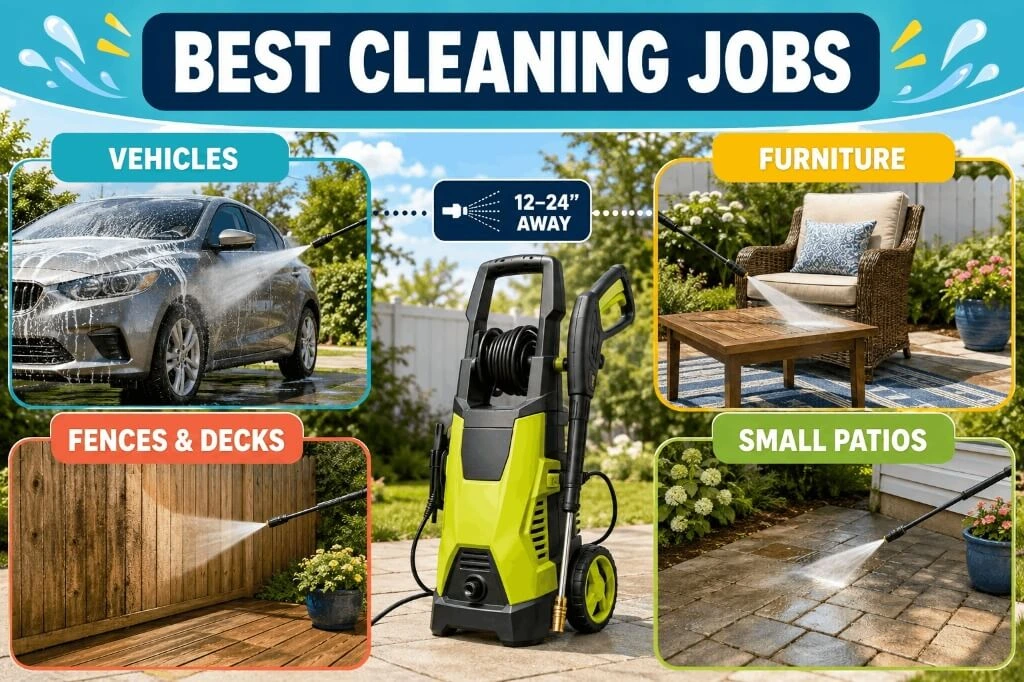
Cars, Boats, Campers, and RVs
This Ryobi can wash vehicles when used with careful nozzle control. Apply suitable cleaner at low pressure, keep the wand moving, and begin from a generous distance. The supplied 15-degree nozzle is concentrated, so a compatible wider nozzle may provide a gentler rinse.
Do not spray closely at damaged paint, badges, soft trim, tires, window seals, vents, electrical connectors, or decals. A foam cannon can improve soap coverage, but it must work with a 1/4-inch quick-connect wand and the machine’s 1.2 GPM flow.
Patio Furniture and Garden Equipment
Furniture, planters, wheelbarrows, bicycles, and garden tools are a good match for this machine. Begin at a safe distance and move closer only when the material tolerates the pressure.
Avoid spraying directly into bearings, switches, engine air intakes, seals, or fragile joints. High-pressure water can enter areas that would remain dry during normal garden-hose rinsing.
Siding, Fences, and Decks
The 1,900 PSI rating can damage soft wood, lift loose paint, or drive water behind siding. Start 1–2 feet away, use the least aggressive effective nozzle, and test a hidden area. Spray siding across or downward rather than upward into laps, vents, and openings.
Detergent and dwell time are often safer than moving the nozzle very close. Follow the surface or coating manufacturer’s cleaning instructions.
Patios, Walkways, and Driveways
The turbo nozzle can help with small patches of sound concrete, brick, or masonry. Test first because its rotating concentrated stream may mark weak mortar, old concrete, coatings, or decorative finishes.
The machine is practical for small areas. A long driveway exposes the 1.2 GPM limitation because rinsing takes time. A small compatible surface cleaner may improve consistency, while an oversized attachment may spin poorly or leave stripes.
Ryobi 1900 PSI Features That Matter
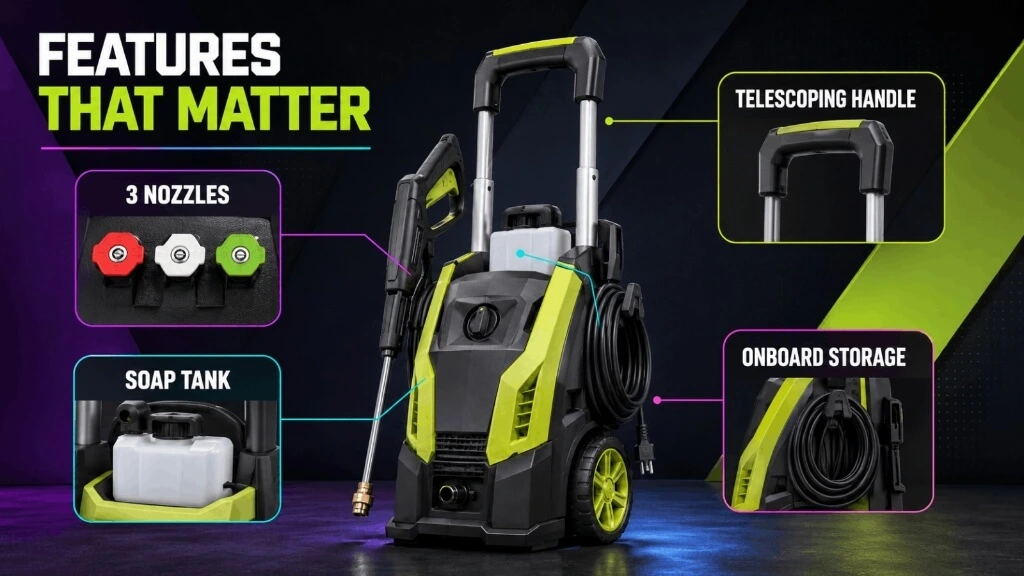
Three Quick-Connect Nozzles
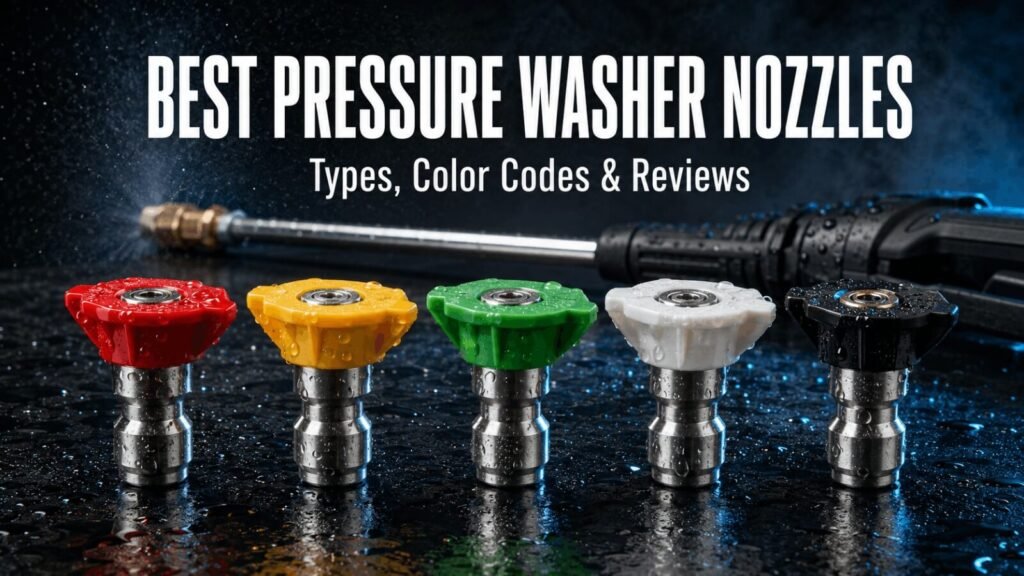
The 15-degree tip produces a focused fan for controlled cleaning. The turbo nozzle creates a rotating concentrated spray for suitable hard surfaces. The low-pressure soap nozzle activates detergent draw. The built-in system normally will not apply soap through the high-pressure nozzles.
Integrated Detergent Tank
The tank removes the need for a loose suction hose. Use only detergent designed for pressure washers and prepare it according to the product label. The manual states that the machine setting is 20:1.
Do not add bleach, acids, alkaline chemicals, solvents, flammable liquids, household detergents, or industrial solutions. Flush the soap system with clean water after use.
Wheels, Telescoping Handle, and Storage
The vertical wheeled frame is easier to move than a carry-only washer. The retractable handle reduces storage height, while dedicated spaces keep the cord, hose, wand, and nozzles together. Coil the high-pressure hose loosely; sharp bends and tight wrapping can damage its outer covering.
How to Set Up the Ryobi 1900 PSI Pressure Washer
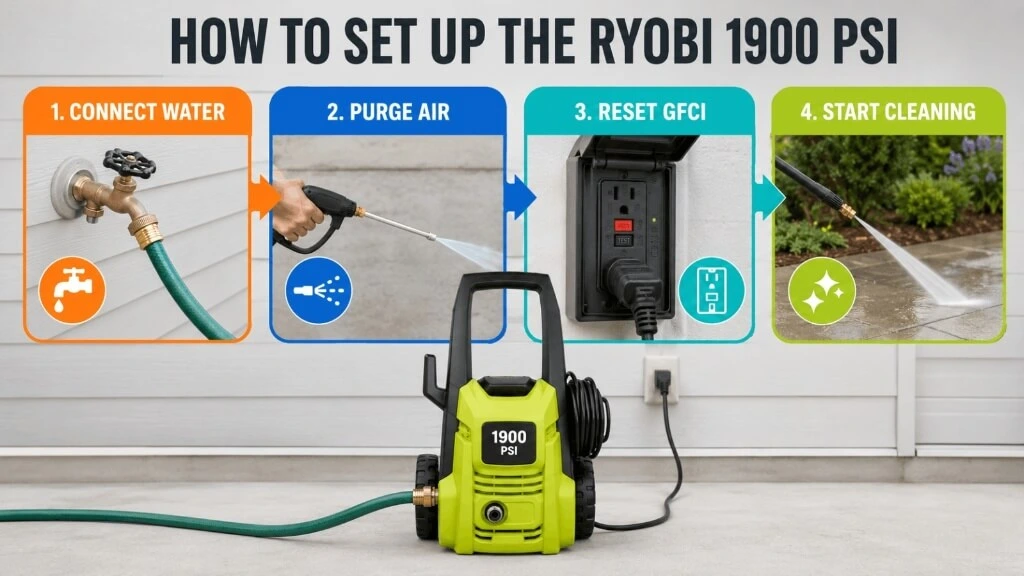
Correct setup helps prevent weak pressure, pulsing, and pump damage:
Assemble Frame: Assemble the frame and handle according to the manual.
Connect Fittings: Connect the wand, trigger handle, and high-pressure hose. Start threaded fittings by hand to prevent cross-threading.
Inspect Inlet: Inspect and clean the water-inlet screen.
Uncoil Garden Hose: Fully uncoil the garden hose. The manual calls for at least 10 feet of unrestricted hose between the tap and washer.
Water Supply: Connect a cold-water supply and open the tap fully.
Purge Air: With the motor off, hold the trigger until the water stream is steady and free of air.
Attach Nozzle: Fit the correct nozzle while the machine is off and depressurized.
Check Electricals: Keep the plug and connection dry and off the ground. Reset and test the GFCI plug.
Start Washer: Switch on the washer, hold the gun with both hands, and begin 1–2 feet from a test area.
Caution: Never run the pump without water. Dry running can damage internal seals.
Common Ryobi 1900 PSI Pressure Washer Problems
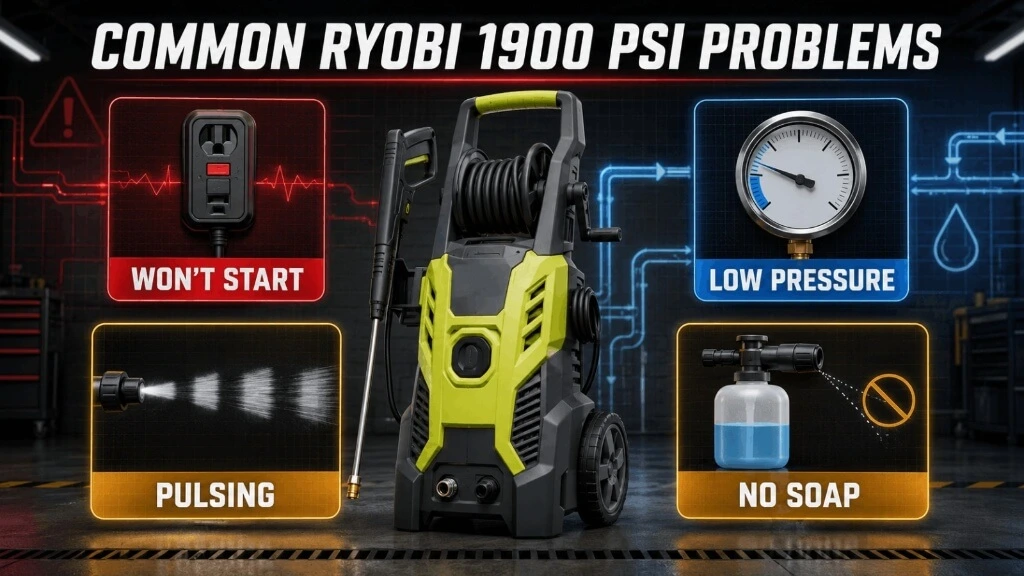
Ryobi 1900 PSI Pressure Washer Will Not Start
Check the switch, outlet, breaker, and GFCI reset. Switch off, unplug the unit, release hose pressure, and inspect the cord and plug. A wet connection, overloaded circuit, damaged cord, or unsuitable extension cord can prevent safe operation.
The manual does not recommend an extension cord. If one is unavoidable, it specifies an outdoor-rated cord of at least 14 AWG for 25 feet or 12 AWG for 50 feet. A 100-foot extension cord is not allowed. Arrange a drip loop and keep every connection dry and raised from the ground.
Pressure Is Weak or Pulsing
Open the tap fully, remove hose kinks, clean the inlet screen, purge air, straighten the high-pressure hose, and inspect the nozzle. The manual recommends a 3/4-inch garden hose if the machine cannot reach pressure. A blocked nozzle can also cause pulsing.
If these checks do not help, a leaking gun, damaged hose, or internal pump fault may require an authorized service centre.
Detergent Does Not Draw
Install the soap nozzle and check the detergent level, mixture, and water supply. Allow time for the solution to move through the system. The 15-degree and turbo nozzles operate at high pressure and do not activate normal soap draw.
Hose, Wand, or Connection Leaks
Turn off power and water, then squeeze the trigger to release stored pressure. Inspect the fitting and O-ring. Replace the correct seal instead of overtightening plastic parts. Never patch a high-pressure hose that has cuts, bubbles, exposed reinforcement, or leaking couplings.
Ryobi 1900 PSI Pros and Cons
| Pros | Cons |
| No fuel, oil changes, choke, or pull cord | 1.2 GPM is slow for large areas |
| Includes 15-degree, turbo, and soap nozzles | No wide fan nozzle in the basic package |
| Built-in soap tank and quick-connect wand | 25-foot hose may require moving the unit |
| Wheeled frame and telescoping handle | Extension-cord limits reduce reach |
| Compact vertical and onboard storage | Not designed for demanding commercial use |
Who Should Buy the Ryobi 1900 PSI Pressure Washer?
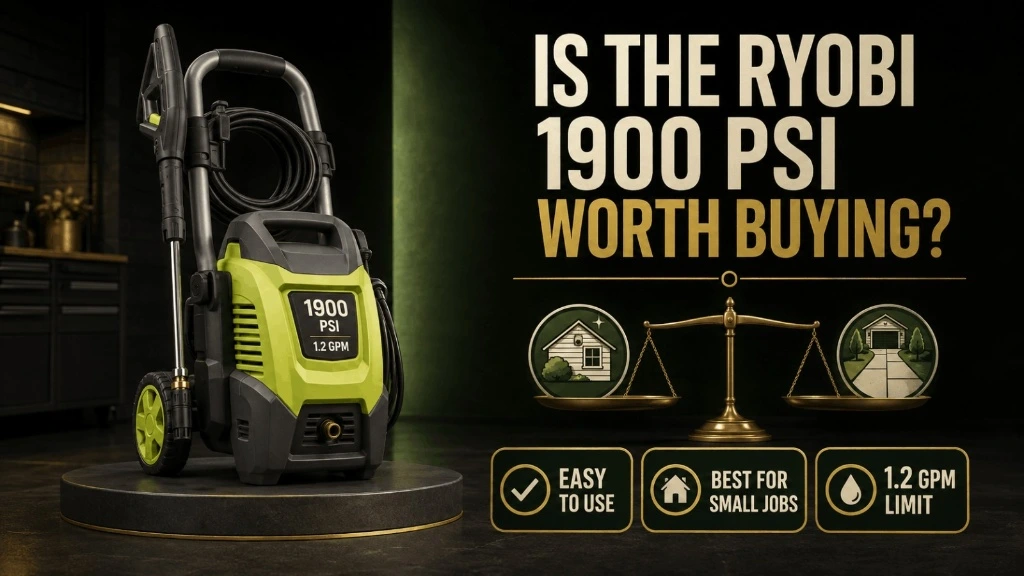
Buy it for occasional household cleaning when you have suitable outdoor power and value easy starting and compact storage. It makes the most sense for modest cleaning areas where convenience matters more than speed.
Choose a higher-flow electric or gas model if you regularly clean long driveways, large commercial areas, deep concrete stains, or several properties. Business users should also consider the manual’s shorter commercial-use warranty and the labour time created by 1.2 GPM flow.
Ryobi 1900 PSI Electric Pressure Washer FAQs
Is the Ryobi 1900 PSI pressure washer good for cars?
Yes, with suitable vehicle detergent, a safe working distance, and careful nozzle control. A compatible wider nozzle may be gentler than the included 15-degree tip.
Can the Ryobi 1900 PSI clean a driveway?
It can clean small sections and normal surface dirt, especially with the turbo nozzle on sound concrete. Large or heavily stained driveways will be slow because the machine delivers 1.2 GPM.
Can I use an extension cord?
Ryobi does not recommend one. If unavoidable, the manual specifies an outdoor-rated 14 AWG cord up to 25 feet or 12 AWG up to 50 feet. A 100-foot cord is not permitted.
Why does my Ryobi 1900 PSI pressure washer pulse?
Common causes include trapped air, inadequate water flow, a kinked hose, dirty inlet screen, or clogged nozzle. Correct these before assuming the pump has failed.
Related Article: Check out our top pressure washer buying guides
Final Verdict
The Ryobi 1900 PSI electric pressure washer is a practical choice for homeowners who want simple operation, compact storage, and enough pressure for routine outdoor cleaning. Its three nozzles, built-in detergent tank, wheels, and telescoping handle make it more useful than a very basic portable washer.
Its 1.2 GPM flow is the deciding limitation. Choose it for furniture, vehicles, boats, RVs, fences, siding, garden equipment, and modest patio work—not as a fast solution for large driveways or commercial cleaning.