portable pressure washer

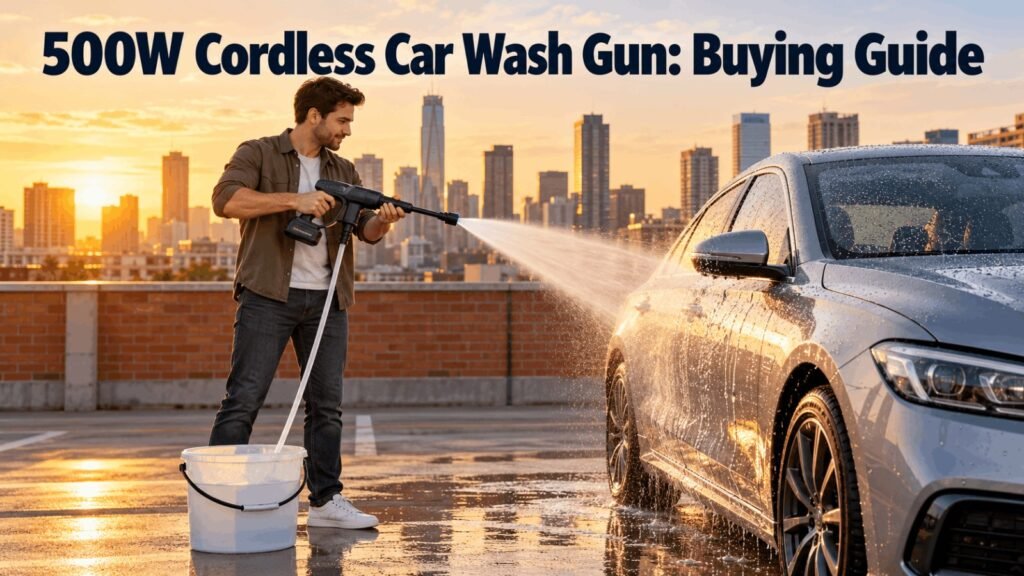
500W cordless car wash gun
Uncategorized

500W cordless car wash gun: Is It Right for Washing Your Car?

A cordless car wash gun can seem like an easy way to rinse a vehicle without dragging a large pressure washer and power cord across the driveway. But a listing that leads with “500W” still leaves the main buying questions unanswered: how much pressure and water flow does it deliver, how long will the battery last, and can it draw water from a bucket? The phrase 500W cordless car wash gun describes a product class, not one standardized machine; models can have different pumps, batteries, hoses, nozzles, and pressure claims. This is a buying guide 500W cordless car wash gun, not a hands-on test of an unidentified product. It explains which specifications to verify, what jobs suit a compact cleaner, and how car owners and DIY users can wash safely. 500W cordless car wash gun: What Does 500W Tell You? Watts describe power. They do not tell you the pressure at the nozzle or the amount of water flowing through it. A pressure rating is usually given in PSI or bar, while flow is shown in GPM or liters per minute. Those measurements describe different parts of cleaning: pressure helps loosen dirt, and flow carries loosened grit away. A 500W label also needs context. It may refer to the motor’s rated electrical input, output, or a peak figure. Those values are not interchangeable, and sellers may describe them differently. There is no dependable conversion from “500W” to one PSI or GPM number. A manufacturer-listed cordless cleaner shows why separate ratings matter: the WORX Hydroshot WG620 lists 415 maximum PSI, 320 rated PSI, and 0.53 GPM. Those figures do not predict an unidentified 500W gun. Compare maximum and working pressure, plus stated flow. For a plain explanation of those terms, read our beginner guide to pressure, flow, and cleaning units. If a seller gives only wattage or voltage, ask for the model number and manual. A peak PSI claim without working pressure or flow is not enough for a fair comparison. How a Cordless Car Wash Gun Works Most handheld cordless washers draw water through an inlet hose, pass it through a small pump, and send it through a trigger gun and nozzle. The battery powers the motor and pump. Some models connect to a garden hose; others can siphon from a bucket, tank, or other freshwater source. Some offer both options. Water pickup matters. A bucket-fed unit is handy where no tap is nearby, but the pump has limits on lift height and hose distance. A kink, clogged filter, low water level, or air leak can stop suction. Follow the manual’s priming steps and keep the intake filter submerged. A wide fan is generally easier to control on a vehicle than a narrow stream. A “foam bottle” applies detergent but does not guarantee thick foam; results depend on the bottle, dilution, flow, and soap. Is a Portable Cordless Pressure Washer for Car Washing Enough? For a light rinse, loose dust, pollen, or fresh road grime, a compact cleaner can be convenient. It can also rinse floor mats, bicycle frames, wheel wells, patio furniture, and outdoor gear when the manual permits those uses. It is especially useful when the main need is portability or access to water without a wall outlet. It is not a substitute for every full-size pressure washer. A low-flow portable tool may take longer to rinse soap from a whole SUV, and it may struggle with baked-on mud or heavy traffic film. It is not the right tool for quickly cleaning a large driveway or completing repeated paid detailing jobs unless its verified flow and duty limits fit that work. See our guide to the portable cordless pressure washer for how these compact tools differ from larger units. For car care, soap and safe contact washing often do more than raising pressure. Pre-rinse loose grit, apply a vehicle-safe wash product, use a clean mitt, rinse thoroughly, and dry with a clean towel. A compact gun can help with the rinse stages, but it cannot replace dirt removal by the mitt when bonded film remains. What to Check Before Buying a 500W Car Washer 500W Car Washer PSI and GPM Ask for the working PSI or bar rating, not only the “maximum” number. Maximum pressure may describe a brief peak under ideal conditions. Check GPM or liters per minute as well. A weak flow rate can make rinsing slow even when the headline pressure looks impressive. If the seller gives only a pressure range with no test method, treat it as incomplete information. Cordless Car Washer Battery Life and Runtime Check whether the battery and charger are included, how many batteries come in the box, and whether the battery can be replaced. Capacity is shown in amp-hours (Ah) or watt-hours (Wh). More capacity can extend work time, but pressure setting, trigger use, load, battery age, and temperature also matter. Check runtime at your intended setting and whether the figure means trigger-on time or elapsed time with breaks. A spare battery may matter more than a higher wattage claim. Batteries with the same voltage do not necessarily fit; platforms and connectors are brand-specific. Water Source and Inlet Setup Confirm whether the device connects directly to a tap, draws from a bucket, or supports both. Check the included intake-hose length, filter, bottle adapter, and any height or distance limits. If you rely on a bucket, a small container may run dry before the car is rinsed; plan how you will refill it without sucking up sand or debris from the bottom. Hose, Nozzle, and Controls A longer hose gives more reach, but it can be awkward to carry or store. Check the high-pressure hose length separately from the water-draw hose; product photos can make them easy to confuse. See whether the spray pattern adjusts at the nozzle or through a power setting, and whether replacement tips are available. A narrow jet may concentrate force on a small area. For vehicle panels, prefer a broad, controllable fan and keep a
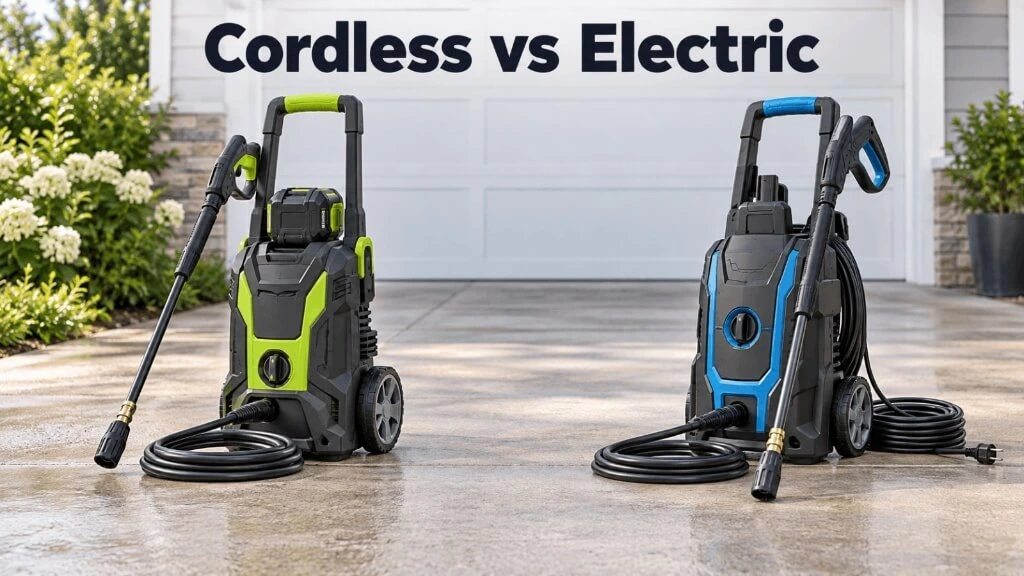
cordless vs electric pressure washer side by side comparison on a concrete driveway
Buying Guides

Cordless vs Electric Pressure Washer: Which Should You Buy?

The phrase “electric pressure washer” includes both cordless and corded machines. In this guide, cordless vs electric pressure washer means a battery-powered pressure washer versus a corded electric pressure washer that plugs into an outdoor outlet. Both types can clean cars, patios, outdoor furniture, bins, steps, bicycles, decks, and some concrete surfaces. The better choice depends on where you clean, how long the job takes, whether a water tap is available, and how much you value continuous power. Cordless models are convenient when you need to move away from an outlet. Corded electric models are usually more practical for longer jobs near a safe electrical connection and a garden hose. Neither category wins every comparison, and the exact model matters more than the label on the box. This article explains the differences using published category information, manufacturer instructions, and official safety guidance. It does not claim laboratory testing, field testing, or a universal performance ranking. Cordless vs Electric Pressure Washer at a Glance Decision Area Cordless Pressure Washer Corded Electric Pressure Washer Power source Rechargeable battery Outdoor electrical outlet Main advantage Mobility and quick setup Continuous operation Good fit Cars, bicycles, bins, furniture, and remote spot cleaning Patios, decks, siding, steps, and longer home jobs Main limitation Battery runtime and model-dependent water flow Needs safe power access and cable management Water options Some models draw from a bucket or tank; confirm in the manual Usually uses a garden hose; alternatives vary by model Ownership concern Charging, battery replacement, and platform compatibility Cord, GFCI protection, hose care, and storage This table is a category guide, not a promise about every product. A strong cordless machine may outperform a small corded unit, while a compact corded model may be designed only for light cleaning. What Is the Difference Between Cordless and Corded Electric? A cordless pressure washer uses a rechargeable battery to run its motor and pump. You can carry it to a vehicle, garden, boat, bicycle, or other location without routing a power cable from an outlet. Some models include a suction hose and allow water to be drawn from a bucket or tank. That feature is not universal, so the product manual must confirm it. A corded electric pressure washer uses mains electricity through a power cord. It normally connects to a garden hose and can continue operating while the outlet, water source, and machine remain suitable. Its cable must be protected from damage, and electrical connections must be kept away from standing water. The practical difference is simple: cordless removes the outlet from the setup, while corded electric removes battery runtime from the main limitation. Both still need a suitable water supply, safe handling, and correct maintenance. PSI and GPM: Which Type Cleans Better? PSI means pounds per square inch and describes water pressure. GPM means gallons per minute and describes water flow. Pressure helps loosen dirt; flow helps carry that loosened dirt away. Looking at PSI alone can give an incomplete view of cleaning performance. Cordless models often focus on portability and may provide lower sustained flow than a larger corded machine. That can be suitable for rinsing a car, bicycle, bin, or outdoor chair. It may take longer on a large driveway or heavily soiled patio because the cleaning path and rinsing speed are affected by flow. Corded electric models can draw power continuously, but that does not make every corded unit powerful. Pump design, motor size, nozzle choice, water supply, and the manufacturer’s rated specifications still control the result. When comparing products, record both the stated pressure and flow. Also check whether the figures are working, rated, or maximum values. Use this pressure washer PSI guide for different cleaning jobs to match output to the surface rather than choosing the biggest number. A Practical Rule For small, mobile jobs, usable handling and adequate flow may matter more than maximum PSI. For larger surfaces, look closely at GPM, hose reach, surface-cleaner compatibility, and the time the machine can operate without interruption. Battery Runtime vs Continuous Electricity Runtime is the main limit in a cordless pressure washer comparison. Actual battery life depends on battery capacity, spray pressure, water flow, temperature, battery age, and how often the trigger is held. Short bursts and pauses can cover more area than continuous spraying. Before buying, check whether the package includes the battery and charger. Some products are sold as bare tools for people who already own a compatible battery platform. A second battery may be more useful for a longer job than a small increase in advertised pressure. Corded electric models avoid charging pauses. They can be useful for repeated patio, driveway, or vehicle cleaning when a safe outlet and water tap are nearby. They are not automatically easier, however. A distant outlet may require careful planning, and unsuitable extension-cord use can create electrical hazards. How to Estimate Your Real Runtime Need Write down the largest job you normally complete. A quick car rinse may need only short bursts. A full vehicle wash, long patio, or driveway requires more continuous operation. If the job is likely to exceed one battery’s practical runtime, include the cost of a second approved battery or choose a corded model. Mobility and Setup Time Cordless equipment is strongest when access is difficult. You can move around a parked vehicle, garden, side path, or remote area without dragging a cable. A bucket-compatible machine may also work where a tap is unavailable, provided the pump supports that water source and the water is clean. Corded electric machines require an outlet and usually a hose connection. You must position the washer, route the cord safely, and keep plugs and connectors away from wet areas. Once connected, a corded model may need fewer pauses than a battery machine. Compare the complete setup weight, not just the bare tool. A cordless package may include a battery, suction hose, filter, spray gun, and water container. A corded machine may be heavier to roll but easier to use for a long session

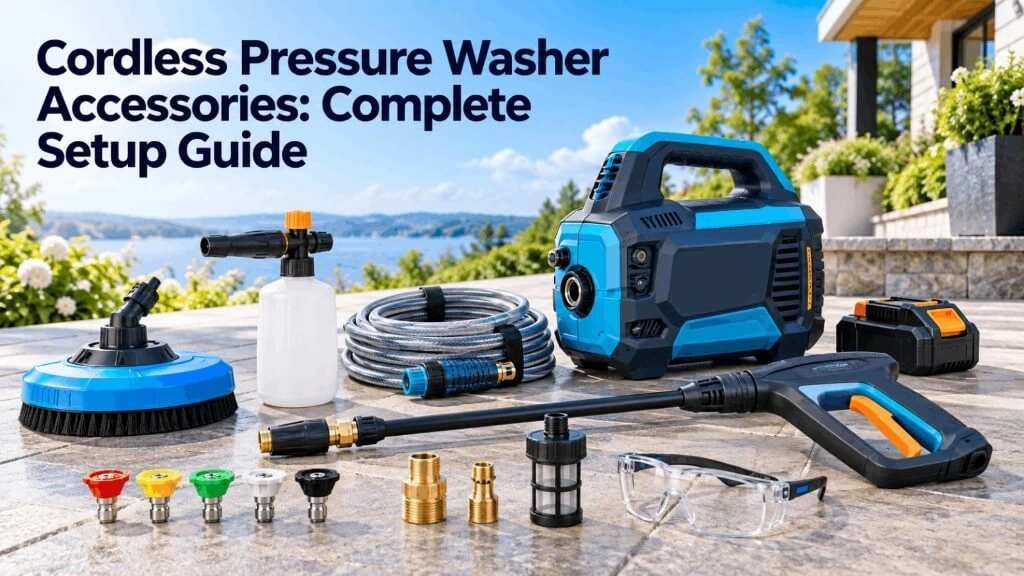
A complete setup of cordless pressure washer accessories including foam cannon, spray nozzles, surface cleaner, hose, and battery.
Guides & Tips

Cordless Pressure Washer Accessories: Complete Setup Guide

A cordless pressure washer is convenient until an accessory demands more water or power than the small pump and battery can provide. The tool may start normally, but the spray can pulse, the foam can stay thin, or the battery can drain before one job is finished. The best cordless pressure washer accessories are therefore the ones matched to the machine’s limits—not simply the largest kit. This guide explains how battery-powered washers differ from corded and gas machines, which accessories are useful for common jobs, and what to check before connecting anything. It is based on equipment specifications and practical cleaning situations, not invented product tests or brand claims. Quick answer: Start with an approved hose, correctly sized nozzle, spare seals, and a clean inlet screen. Add a foam cannon, short gun, extension wand, or surface cleaner only after checking its connector, working PSI, minimum flow, temperature limit, water-source requirements, and battery impact. What Makes Cordless Pressure Washer Accessories Different? Cordless units are designed for mobility. Many use a small onboard tank, a suction hose, or a garden-hose connection instead of a high-volume outdoor tap. Their pump normally produces less flow than a full-size electric or gas washer. That changes the accessory decision. An attachment can be physically compatible and still be a poor match. A large surface cleaner may need more GPM than the battery washer supplies. A long, narrow hose may increase pressure loss. A foam cannon may connect to the gun but fail to draw detergent correctly at a low flow rate. In practical cleaning situations, the most useful accessory is the one that works within the machine’s limits. Start with the jobs you actually perform. Car rinsing, bicycle cleaning, muddy boots, patio furniture, and small balcony areas usually suit cordless equipment. Large driveways, heavily stained concrete, and long daily work sessions usually call for a higher-flow machine and accessories designed for it. Job Useful first accessory Main check Car or bicycle rinsing Wide fan nozzle and flexible hose Surface-safe pressure, connector, and hose length Muddy boots or tools Rinse nozzle and inlet filter Water-source cleanliness and easy flushing Patio furniture Wide fan nozzle or approved detergent tool Material guidance and detergent compatibility Small balcony or steps Short gun or compact wand Reach, recoil, and safe footing Driveway spot cleaning Small approved surface cleaner Minimum GPM, pressure range, and surface condition Cordless Pressure Washer Specifications to Check First Before shopping, record four details from the manual or rating plate: working PSI, water flow in GPM or L/min, maximum water temperature, and the approved connector system. Also note whether the machine uses a battery platform, a removable tank, or a suction hose. PSI and flow determine accessory performance PSI describes pressure; GPM describes the amount of water delivered. A cordless washer may advertise a high peak PSI while providing modest working flow. Accessories such as rotating cleaners and foam cannons respond more to usable flow than to a peak number printed on a box. Cleaning units, calculated by multiplying PSI by GPM, are useful for rough comparisons only. They do not prove that a nozzle is safe on paint or that an attachment will fit. Use the accessory’s working range and the washer’s actual output, not a maximum or burst rating. Battery capacity affects more than runtime The battery must power the pump and sometimes a detergent feature. A larger-capacity battery can extend runtime, but it does not turn a low-flow washer into a commercial machine. Cold temperatures, an old battery, restricted water supply, and repeated trigger use can reduce working time. Keep a charged spare battery if the manufacturer offers one, but do not store or charge batteries in a wet area. Follow the battery maker’s temperature, charging, and storage instructions. Water source changes the accessory plan A bucket or tank makes a cordless washer portable, but every filter and hose in the suction path adds resistance. The container must be clean, stable, and large enough for the planned rinse. If the manual requires a minimum water depth or a particular suction hose, follow that instruction exactly. When using a tap, make sure the garden hose supplies water continuously. A partly closed tap or kink can make the machine appear weak and can cause an accessory to pulse. Cordless Pressure Washer Hose and Fittings The hose is often the most important upgrade for a portable unit because it determines how freely you can move around a car, balcony, or garden item. Choose hose length for the route Measure the route around the object rather than in a straight line. A very long hose adds weight and can reduce flow, while a very short hose forces repositioning. For a small cordless washer, a flexible manufacturer-approved hose is easier to handle than a heavy professional hose. Check the hose’s working pressure, temperature rating, internal diameter, and connector type. “Universal” wording does not confirm that the end fitting seals correctly. M22 fittings can have different insert sizes, and a quick-connect plug can look similar while using a different profile. Keep supply and high-pressure sides separate The garden hose or suction hose belongs before the pump. The high-pressure hose belongs after the pump and must be rated for that pressure. Do not attach a low-pressure garden-hose coupler to the discharge side simply because the threads engage. Use one correctly specified adapter for a known mismatch. Stacking several adapters adds leak points, weight, and restriction. Turn the machine off and release trapped pressure before changing a hose or fitting. Battery Pressure Washer Nozzle Selection by Surface Nozzles control spray shape and coverage. They do not increase the pump’s capacity, and a narrower spray is not automatically a better cleaning choice. Match the nozzle orifice to the washer The orifice is the small opening inside the tip. If it is too small, the pump can be overloaded or the spray can become harsh. If it is too large, the output may feel weak. Use the nozzle size listed in the manual or

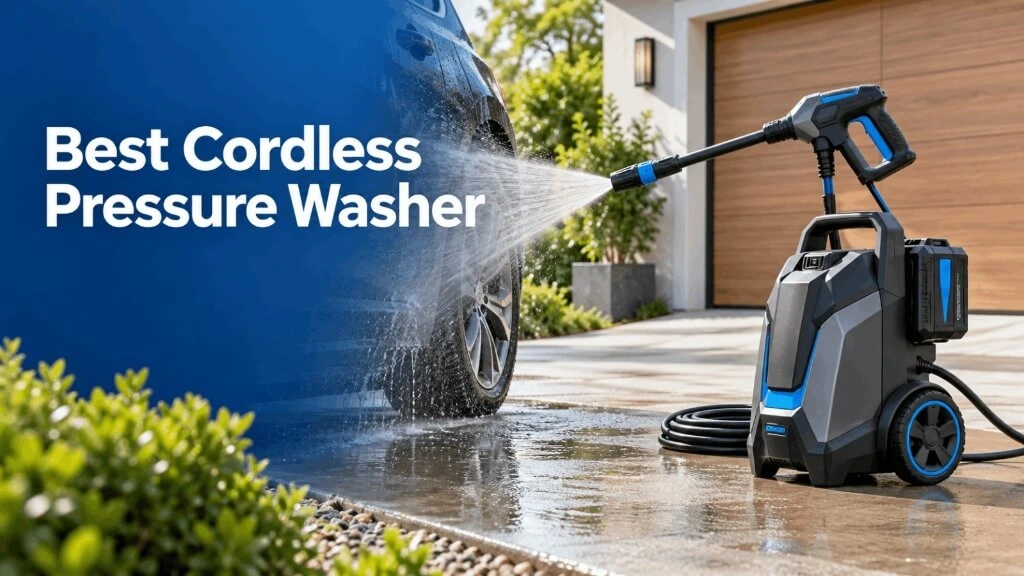
best cordless pressure washer for car cleaning
Buying Guides

Best Cordless Pressure Washer: How to Choose the Right Model

Finding the best cordless pressure washer is not just a matter of choosing the highest PSI number. The right model must match your cleaning job, water source, battery plan, spray control, runtime, and expectations. A compact battery pressure washer may be excellent for rinsing a car, bicycle, patio furniture, bins, or muddy tools. It may be frustrating on a large driveway or a long commercial cleaning session. This buyer guide explains what to compare before you order, including cordless pressure washer PSI, GPM, battery runtime, self-priming water intake, nozzles, safety, and total cost. Quick Answer: What Is the Best Cordless Pressure Washer? For most homeowners, the best cordless pressure washer is a model with: honest working-pressure and rated-flow information; adjustable spray control or useful nozzle choices; a battery and charger that are included or affordable on your existing platform; a hose, filter, and water inlet that suit your cleaning location; enough runtime for the largest job you actually plan to do; available replacement batteries, fittings, and pump-related support; and clear safety instructions and a useful warranty. Choose cordless when portability and quick setup solve a real problem. Choose a corded electric or gas machine when the main job requires longer continuous operation, higher flow, or large-area cleaning. This is a practical buyer guide, not a permanent ranking of specific models. Product packages, prices, batteries, and specifications change. Check the current manufacturer page and instruction manual before purchase. What Is a Cordless Pressure Washer? A cordless pressure washer uses a rechargeable battery to power its motor or pump. Some models connect to a normal garden hose. Others can draw clean water from a bucket, tank, or open container through a supplied suction hose. A few support both options. The main benefit is freedom from a wall outlet during use. You can rinse a bicycle at the end of a driveway, clean outdoor furniture on a balcony, wash muddy boots near a trail, or tidy a vehicle in a parking area without dragging a power cable across wet ground. The trade-off is limited stored energy and, on many compact models, lower water flow than a full-size machine. A cordless washer is best understood as a portable light- or medium-duty cleaning tool. Its advantage is access, speed, and control—not maximum force in every situation. Best Cordless Pressure Washer by Cleaning Job Match the tool to the job before comparing brands or battery voltage. Cleaning job Features to prioritize Main limitation to expect Car, bicycle, or motorcycle rinsing Wide spray, adjustable pressure, clean water filter, soap option, easy handling May be slow on thick mud or large vehicles Patio furniture, bins, and garden tools Gentle spray control, compact body, washable inlet filter, simple storage Battery may run down during a large batch of items Steps and small walkways Better rated flow, longer hose, spare battery, stable grip Embedded dirt may require repeated passes Remote or off-grid cleaning Self-priming inlet, suction hose, filter, tank compatibility, spare battery Depends on clean water and container size Small business spot cleaning Durable fittings, service support, battery-platform availability, predictable runtime Not a substitute for a high-flow commercial washer Large driveway or patio Higher sustained flow, longer runtime, efficient surface-cleaning attachment A cordless machine may take too long or require several batteries For a cordless pressure washer for a car, spray control and safe technique usually matter more than the highest advertised pressure. For a best portable pressure washer for home use, water access and battery availability may matter more than a small difference in PSI. PSI, GPM, and Cleaning Power PSI means pounds per square inch and describes water pressure. GPM means gallons per minute and describes water volume. Pressure helps loosen dirt; water flow helps rinse that dirt away. A machine with a high PSI figure but very low flow may feel forceful while taking a long time to clear a surface. A model with better flow may rinse more efficiently even if its peak PSI looks less impressive. Cleaning performance also changes with the nozzle, spray angle, hose, water supply, and trigger setting. Do not compare peak PSI alone Many product pages show a maximum or “MAX PSI” figure. That number may be measured with a particular nozzle, setting, or test condition. Manufacturer specifications can also list GPM under a different attachment. Read the footnotes and look for working or rated pressure and rated flow where available. An official cordless pressure-cleaner listing, for example, separates maximum PSI from GPM and identifies the nozzle used for those figures. That is why two products should not be compared from headline numbers alone. Review the manufacturer’s cordless pressure-cleaner specifications as an example of the details to check. Match power to the surface Vehicles and bicycles: Start with a wide spray and safe distance. Avoid forcing water into seals, sensors, bearings, and electrical connectors. Plastic furniture and bins: Use controlled pressure and test a hidden area before cleaning the full surface. Wood and painted surfaces: A narrow, close spray can remove paint, fibers, or protective coating. Concrete and pavers: Stubborn dirt needs more sustained flow, so a compact battery unit may be slower than a full-size washer. For a simple surface-by-surface explanation, see this pressure washer PSI guide for different cleaning jobs. Start gently and increase cleaning power only when the surface can tolerate it. Battery Voltage, Capacity, and Runtime Battery voltage is not a complete measure of cleaning performance. Pump design, battery capacity, flow rate, nozzle choice, trigger use, temperature, and battery age all affect the result. Two models with similar voltage can provide very different cleaning experiences. Runtime is also difficult to compare unless the test conditions are clear. Short bursts may cover several small jobs, while continuous spraying uses power much faster. Before buying, check: whether the battery and charger are included; the battery capacity and compatible platform; the stated runtime and how it was measured; charging time and the cost of a spare battery; whether replacement batteries remain available; and the complete working weight with the

Scroll to Top