A pressure washer sounds powerful, so it is reasonable to wonder what that motor is doing to your electricity bill. The answer is less alarming than the noise may suggest.
Do electric pressure washers use a lot of electricity? They can draw a fairly high amount of power while the motor is running, but most household cleaning jobs last only 30 minutes to a few hours. That usually makes the total electricity cost modest. A machine drawing 1.8 kilowatts continuously for one hour would use 1.8 kilowatt-hours (kWh). At an example rate of $0.15 per kWh, that equals $0.27.
Actual use depends on the motor rating, trigger time, total job length, automatic stop system, voltage, water supply, nozzle, and cleaning method. This guide shows how to read the machine label, calculate running cost, compare realistic scenarios, and avoid wasting electricity.
How these estimates were prepared: Calculations use manufacturer-listed input power and assume continuous motor operation unless stated otherwise. They are planning estimates, not laboratory measurements. Your machine, trigger time, voltage and electricity tariff will determine the actual cost.
Do Electric Pressure Washers Use a Lot of Electricity Per Hour?
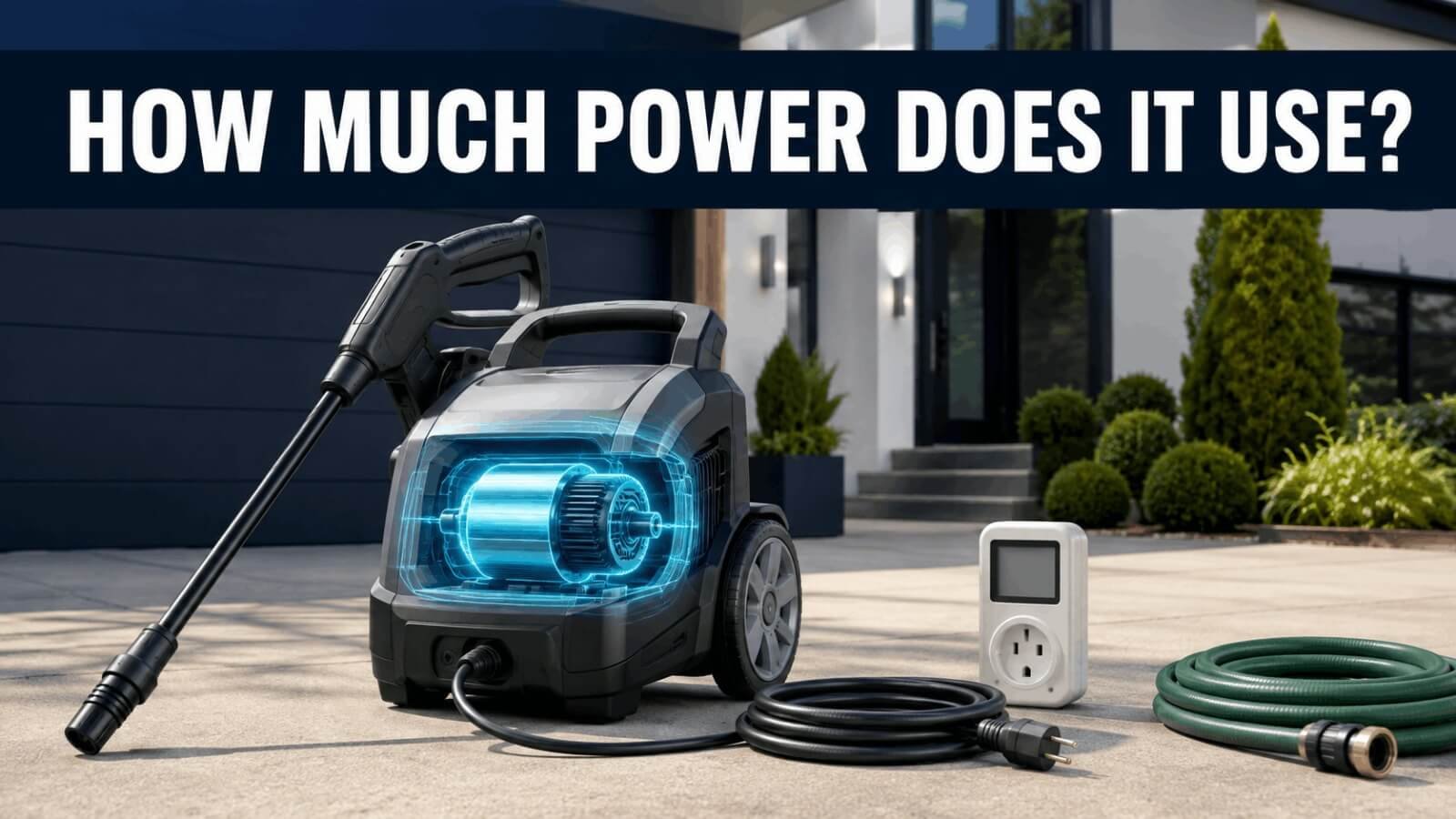
Corded residential pressure washers vary by market and cleaning class. Current manufacturer examples include 230V models rated from about 1.4 kW to 3.0 kW, while many North American homeowner units use a 120V, 13-amp motor. Always use the rating on your own machine rather than treating these examples as a universal range.
Those figures describe power demand while operating, not the amount charged on a monthly bill. Electricity billing is based mainly on energy use in kilowatt-hours:
Energy used (kWh) = Power (kW) × Running time (hours)
A 1.6 kW machine running for 45 minutes uses up to:
1.6 × 0.75 = 1.2 kWh
If electricity costs $0.20 per kWh, the estimated cost is:
1.2 × $0.20 = $0.24
This is a simple full-power estimate. Some electric pressure washers stop the motor when the trigger is released, reducing energy use during pauses. Motor load and power factor can also make measured consumption different from a nameplate calculation.
How to Find Your Pressure Washer’s Wattage
Check the rating label on the machine, motor, plug tag, or manual. Look for W or kW, together with voltage and amperage.
Use Listed Watts When Available
If the manufacturer lists rated input power, use that number. Convert watts to kilowatts by dividing by 1,000:
1,400 watts = 1.4 kW
1,800 watts = 1.8 kW
2,000 watts = 2.0 kW
Do not calculate electricity use from PSI or GPM. PSI measures water pressure, while GPM measures water flow. Neither tells you the exact electrical input.
Estimate From Volts and Amps
When only voltage and amperage are shown, multiply them for a basic circuit-demand estimate:
Volts × Amps = Volt-amperes (VA)
For example, 120V × 13A = 1,560 VA. People often treat that as roughly 1,560 watts for quick planning, but an AC motor’s true watts can differ because of power factor and operating load. A plug-in electricity meter rated for the machine’s current provides a better real-world measurement when the manufacturer allows its use outdoors and the setup remains safely GFCI-protected.
Why Voltage Alone Does Not Show Consumption
A 230V machine is not automatically twice as expensive to run as a 115V machine. Higher voltage can deliver the same power at lower current. Wattage and operating time—not voltage alone—determine energy use.
Electric Pressure Washer Cost Examples

The table below uses a 1.8 kW pressure washer and assumes continuous full-power operation. Replace the electricity rate with the amount shown on your utility bill.
| Cleaning time | Energy used | At $0.10/kWh | At $0.20/kWh | At $0.30/kWh |
| 30 minutes | 0.9 kWh | $0.09 | $0.18 | $0.27 |
| 1 hour | 1.8 kWh | $0.18 | $0.36 | $0.54 |
| 2 hours | 3.6 kWh | $0.36 | $0.72 | $1.08 |
For a 90-minute job at $0.20 per kWh:
1.8 kW × 1.5 hours × $0.20 = $0.54
This calculation is intentionally conservative if the motor stops whenever the trigger is released. It may underestimate use if the machine includes additional electric heating, a vacuum, or another powered system.
Estimate Monthly or Annual Cost
Suppose you run a 1.8 kW machine for one hour twice each month:
1.8 kW × 2 hours × 12 months = 43.2 kWh per year
At $0.20 per kWh, that equals $8.64 per year. This is only an example; local rates, cleaning frequency, and actual motor-on time will change the result.
What Affects Electricity Consumption?
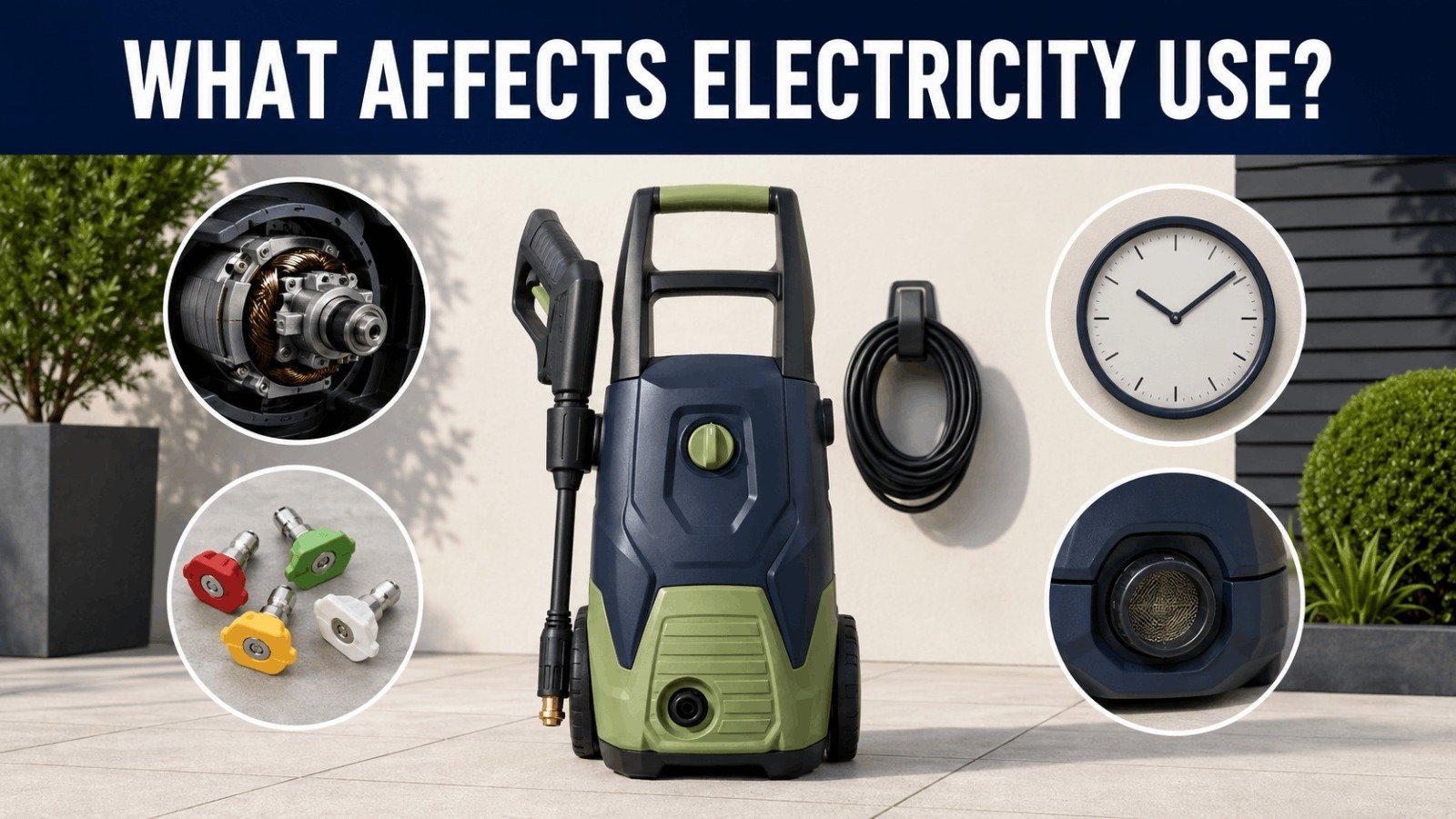
Motor Input Rating
A larger motor can draw more power, but it may also complete a suitable job faster. Comparing wattage alone does not show which machine will use less total energy.
Trigger Time and Automatic Stop
Many residential models use a total-stop system that switches off the motor when the spray-gun trigger is released. This reduces unnecessary runtime during repositioning, scrubbing, soap dwell time, or moving furniture. Confirm how your model behaves rather than assuming every machine stops completely.
Cleaning Time
Job duration often matters more than a small difference in wattage. A 1.8 kW machine used efficiently for 40 minutes can consume less energy than a 1.4 kW unit struggling for two hours.
Surface, Dirt, and Nozzle Choice
Heavy algae, compacted mud, and old concrete stains take longer than rinsing a car or patio chair. The correct nozzle and detergent can shorten the job, but excessive pressure can damage paint, wood, seals, and vehicle trim.
. Our guide to choosing the right PSI for different cleaning jobs helps match cleaning force to the surface.
Water Supply
A restricted tap, kinked hose, clogged inlet filter, or undersized supply hose can reduce performance. The motor may keep running while the user makes little progress. Confirm that the source can provide the water flow required by the manual.
Hot-Water and Commercial Machines
Do not apply homeowner cold-water estimates to commercial electric hot-water equipment. A heating element can require much more electricity than the pump motor and may need a dedicated high-voltage circuit. Check motor and heater ratings separately.
Is an Electric Pressure Washer Cheaper Than a Gas Model?
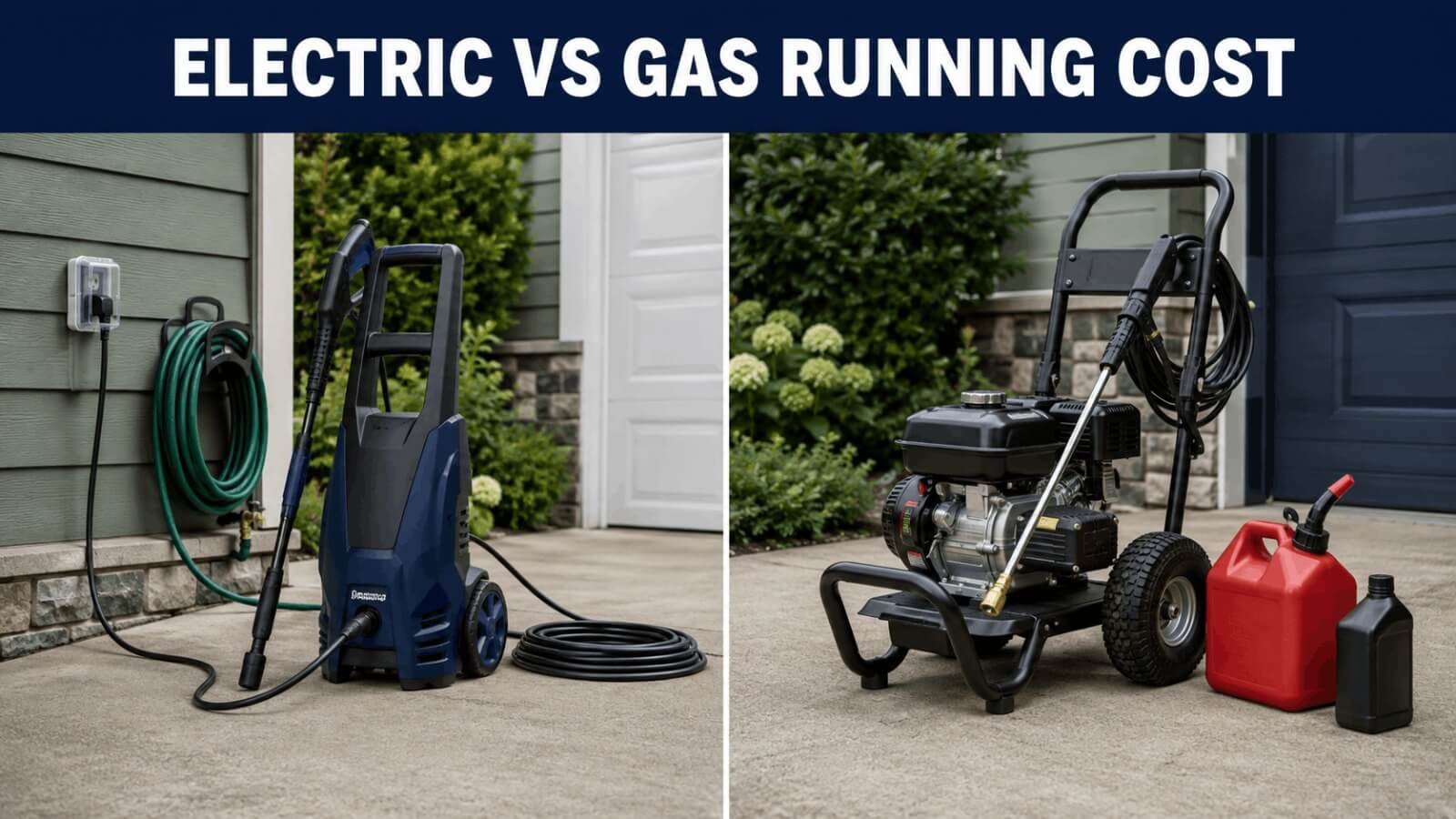
For occasional household work, an electric pressure washer is usually inexpensive to operate because it uses a modest number of kWh per session and needs no gasoline. It also avoids engine-oil changes, spark plugs, carburetor fuel storage, and exhaust-related maintenance.
A gas pressure washer may still be the practical choice for high-flow cleaning, remote locations, long driveways, construction equipment, or professional work where a normal outlet cannot supply enough power. The best comparison is not electricity versus gasoline price alone. It should include job speed, water flow, maintenance, portability, purchase price, and the surface being cleaned.
Electrical Supply and Safety Matter More Than Cost
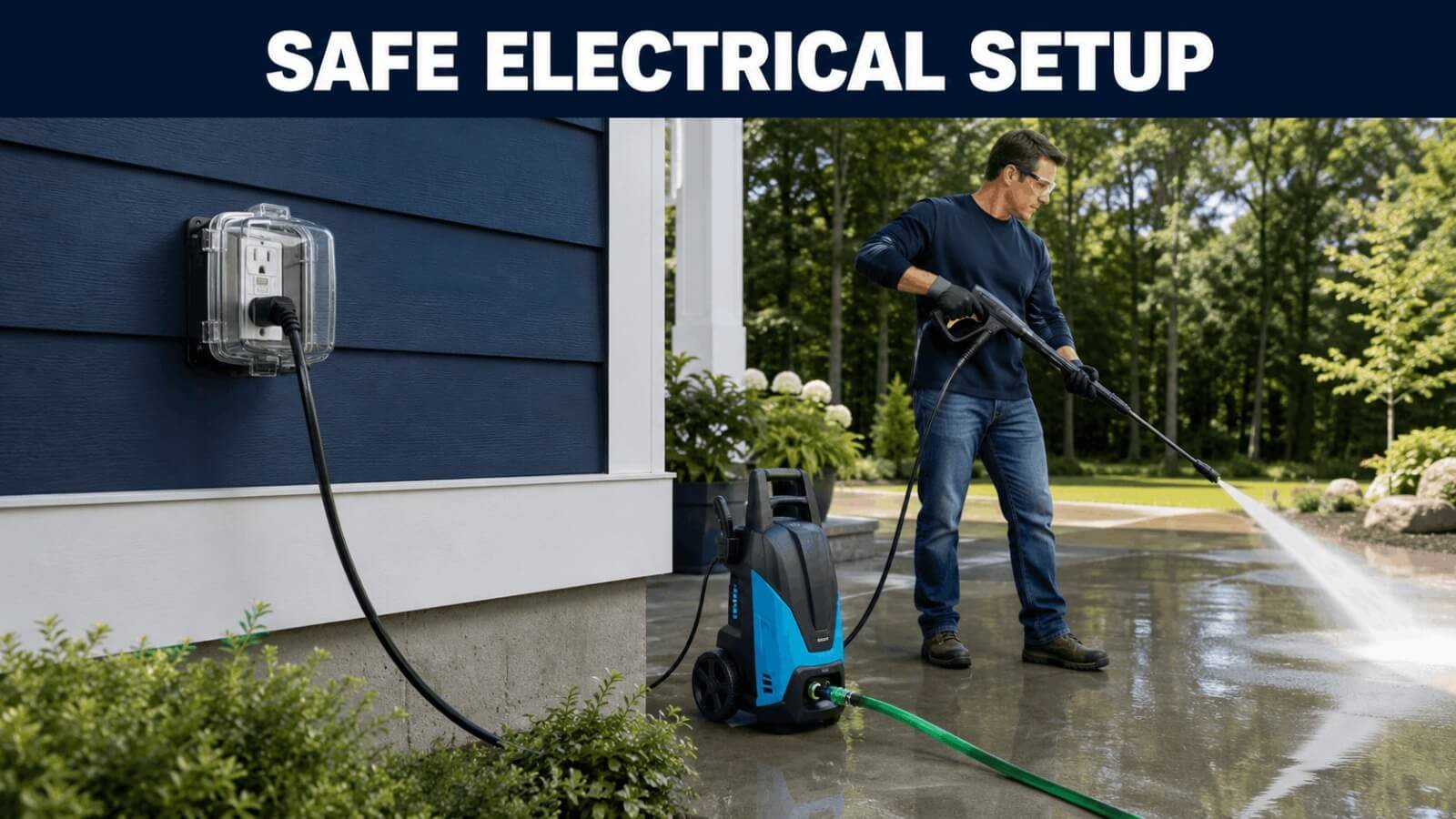
A residential electric pressure washer can use much of a standard branch circuit’s available capacity. A weak outlet, overloaded circuit, damaged cable, or unsuitable extension cord can create voltage drop, overheating, nuisance tripping, or shock risk.
Use a properly grounded outdoor outlet with GFCI protection. The U.S. Consumer Product Safety Commission recommends GFCI protection outdoors, keeping cord-connected devices away from water, and using only outdoor-rated extension cords. Keep plugs and connections dry and away from runoff. Inspect the cord before every use, and do not operate the machine with damaged insulation, a missing grounding pin, or a plug that becomes hot.
Avoid sharing the circuit with heavy loads such as a space heater, air conditioner, refrigerator, compressor, or power tool. If breakers trip repeatedly, stop and correct the electrical problem rather than using a larger breaker. Our complete guide to pressure-washer power requirements covers voltage, amperage, GFCI protection, generators, fuel, and water-supply checks
Extension-Cord Warning
Use an extension cord only when the pressure-washer manufacturer permits it. It must be outdoor-rated, grounded, heavy enough for the current, and no longer than allowed. Fully uncoil it and protect the connection from water. A thin or long cord can reduce voltage and overheat even though it does not meaningfully lower your electricity bill.
Follow the machine manual, detergent directions, surface manufacturer’s advice, and basic pressure-washing precautions. Wear eye protection and closed-toe footwear, control the wand with both hands, and never spray people, animals, outlets, or electrical equipment.
How to Reduce Electricity Use Without Reducing Results
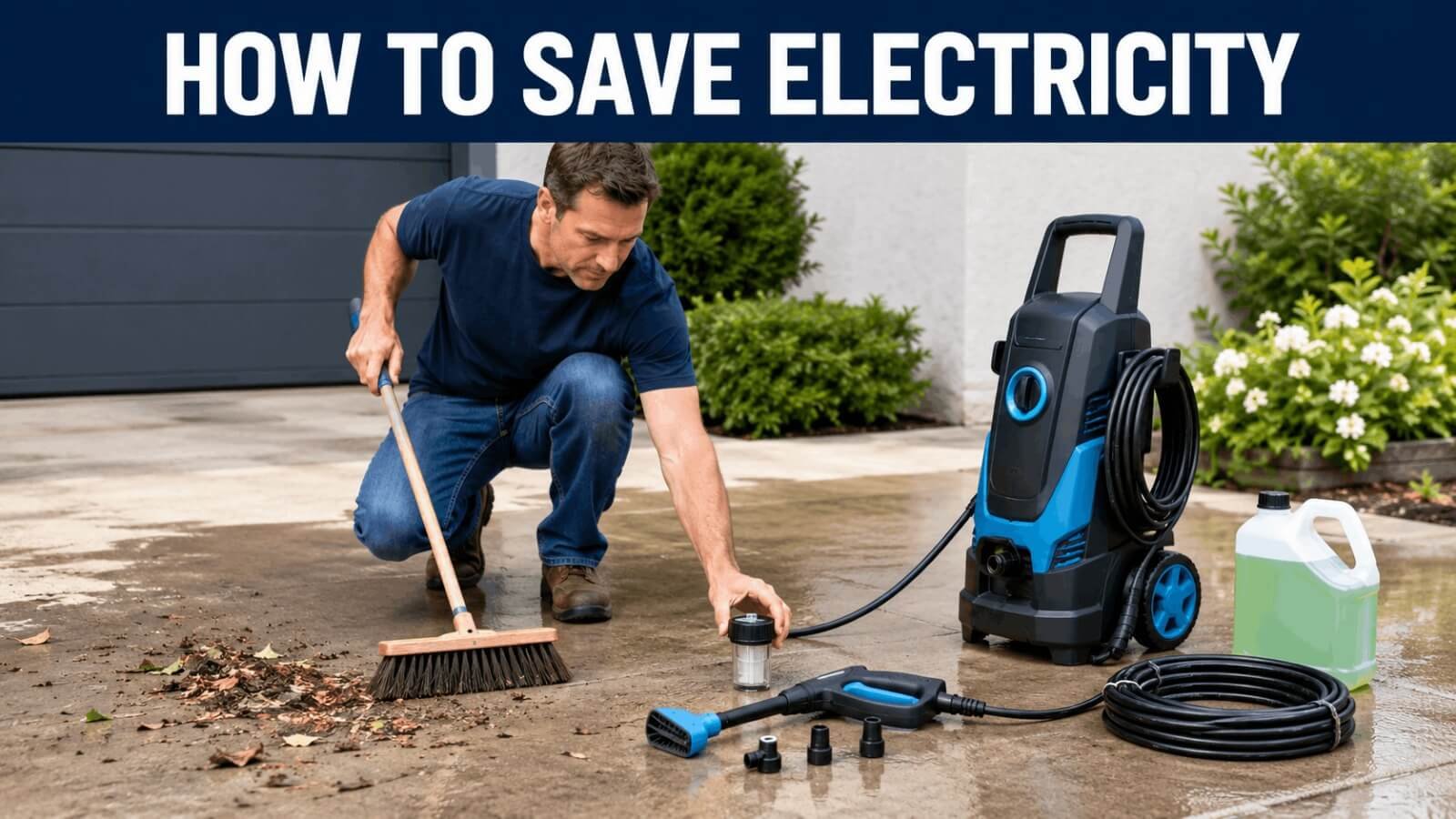
Prepare the Area First: Move furniture, sweep loose debris, connect hoses, select the nozzle, and prepare detergent before switching on the pressure washer. This prevents the motor from waiting while you organize the job.
Use the Right Nozzle and Distance: Start with a wider, safer spray angle and test an inconspicuous area. Move closer only within the surface and equipment guidance. The goal is steady cleaning, not maximum force.
Let Detergent Work: When an approved pressure-washer detergent suits the surface, proper dwell time can loosen grime before rinsing. Do not let detergent dry, and never use bleach or household chemicals unless the equipment and surface instructions explicitly allow them.
Work in an Orderly Pattern: Clean siding in planned sections and concrete in overlapping passes. Random movement causes repeated cleaning and extra motor time.
Maintain Water Flow and Accessories: Clean the inlet screen, remove hose kinks, clear the correct nozzle safely, and repair leaks. Good water delivery helps the machine perform as designed.
Choose the Right Size Machine: An undersized washer may run for too long, while an oversized unit can cost more and increase surface-damage risk. Match PSI, GPM, duty cycle, hose length, and accessories to the jobs you actually perform.
Common Mistakes People Make
Assuming the Motor Draws Maximum Power All Day: Electricity use depends on actual motor-on time. Correction: Track trigger use and calculate from realistic hours, not the time the machine sits nearby.
Calculating Cost From PSI: PSI is cleaning pressure, not electrical input. Correction: Use rated watts or an appropriate volts-and-amps estimate.
Ignoring the Utility Rate: Rates vary by location and tariff. Correction: Use the total per-kWh rate from your recent bill, including applicable energy charges.
Choosing the Smallest Motor to Save Power: A weak machine may take much longer. Correction: Compare expected job time, PSI, GPM, and motor rating together.
Using a Thin Extension Cord: An unsuitable cord can overheat and reduce motor voltage. Correction: Follow the manual’s gauge and maximum-length limits—or plug directly into the approved outlet.
Leaving Water Restrictions Unchecked: Poor flow wastes cleaning time and can harm the pump. Correction: Inspect the hose, tap, and inlet filter before starting.
Frequently Asked Questions
How much electricity does a pressure washer use in one hour?
A 1.8 kW machine running continuously for one hour uses about 1.8 kWh. Check your model’s rated input because smaller and larger machines differ.
How much does it cost to run an electric pressure washer?
Multiply rated kW by operating hours and your electricity price. For example, 1.8 kW for one hour at $0.20 per kWh costs about $0.36.
Does releasing the trigger save electricity?
It can when the machine has a total-stop system that shuts off the motor. Some designs behave differently, so confirm the feature in the manual.
Does a higher-PSI pressure washer use more electricity?
Not necessarily. PSI alone does not show motor input. Compare watts or amps, GPM, pump design, and expected cleaning time.
Can I run an electric pressure washer from a normal outlet?
Many residential models are designed for a suitable household outlet, but circuit, voltage, grounding, and GFCI requirements vary. Follow the machine label and manual.
Will an extension cord increase electricity use?
It can waste some energy as heat and cause voltage drop, but safety and motor performance are the larger concerns. Use one only when permitted and correctly sized.
Do electric pressure washers use power while the trigger is released?
Models with a true total-stop system normally stop the motor, while other designs may continue running or use a different control method. Listen and check the manual rather than assuming.
Final Thoughts
So, do electric pressure washers use a lot of electricity? They draw noticeable power while operating, but most household jobs use relatively few kilowatt-hours. For many homeowners, the cost per cleaning session is measured in cents rather than large additions to the monthly bill.
Check the machine’s wattage, multiply it by realistic motor-on time, and apply your own electricity rate. More importantly, use the correct circuit, GFCI protection, water supply, nozzle, and cleaning method. Efficient preparation and safe operation can reduce both cleaning time and energy use without sacrificing results.
Helpful Resources
- U.S. Department of Energy: Electricity 101 — Background on electricity and kilowatt-hour consumption.
- U.S. Consumer Product Safety Commission: Electrical Safety — GFCI, outdoor cord and wet-area safety guidance.
- Greenworks 2000 PSI Electric Pressure Washer — Example of a North American residential model using a 13-amp motor.
- Karcher K2 Classic Specifications — Example of a 1.4 kW residential pressure washer.