A pressure washer can make a grimy patio or muddy car easier to clean, but comparing Ryobi and Greenworks can be confusing when one model is cordless and another is rated for much higher pressure. The better choice depends on the exact washer, the surfaces you clean, water supply, access to power, and how often you use it.
This article compares representative models and power types, then explains how PSI, GPM, accessories, warranties, and job size affect the decision. It is a research-based comparison of manufacturer specifications, not a side-by-side hands-on test. Product lines and warranty terms vary by country, so check the exact model and local listing before buying.
Quick answer
Choose by model, not logo. Ryobi’s 40V RY40PW15 offers cordless portability with a published 1,500 PSI and 1.2 GPM. Greenworks offers corded and hybrid models, including higher-output electric options. For a driveway, compare flow and surface-cleaner compatibility; for a car or furniture, prioritize controllable pressure and safe technique.
Ryobi vs Greenworks: How the brands compare
| Buying factor | Ryobi | Greenworks |
| Power choices | Corded electric, gas, and cordless products; the range depends on market and model | Corded electric, battery, and selected hybrid models; confirm the exact configuration |
| Example model output | RY40PW15: up to 1,500 PSI and 1.2 GPM, with three settings from 1,000 to 1,500 PSI | Greenworks US Pro listing: up to 3,000 PSI and 2.0 GPM; verify the exact model and rating conditions |
| Portability | Battery models can be useful where an outlet is inconvenient; runtime depends on battery capacity and setting | Corded models need an outlet; hybrid models may offer a battery option, but are not automatically battery-only |
| Best fit | Existing Ryobi tool owners, light maintenance, and users who value a familiar battery system | Homeowners wanting a higher-output electric option for larger cleaning jobs |
| What to verify | Included batteries, runtime, hose and fitting details, and local warranty | Whether the model is corded, battery, or hybrid; rated flow, included accessories, and local warranty |
These figures describe specific US product listings, not every product from either brand. Compare model numbers, rated flow, accessories, and manuals; specifications and availability can vary by country and package.
Ryobi pressure washers: flexible choices and battery convenience
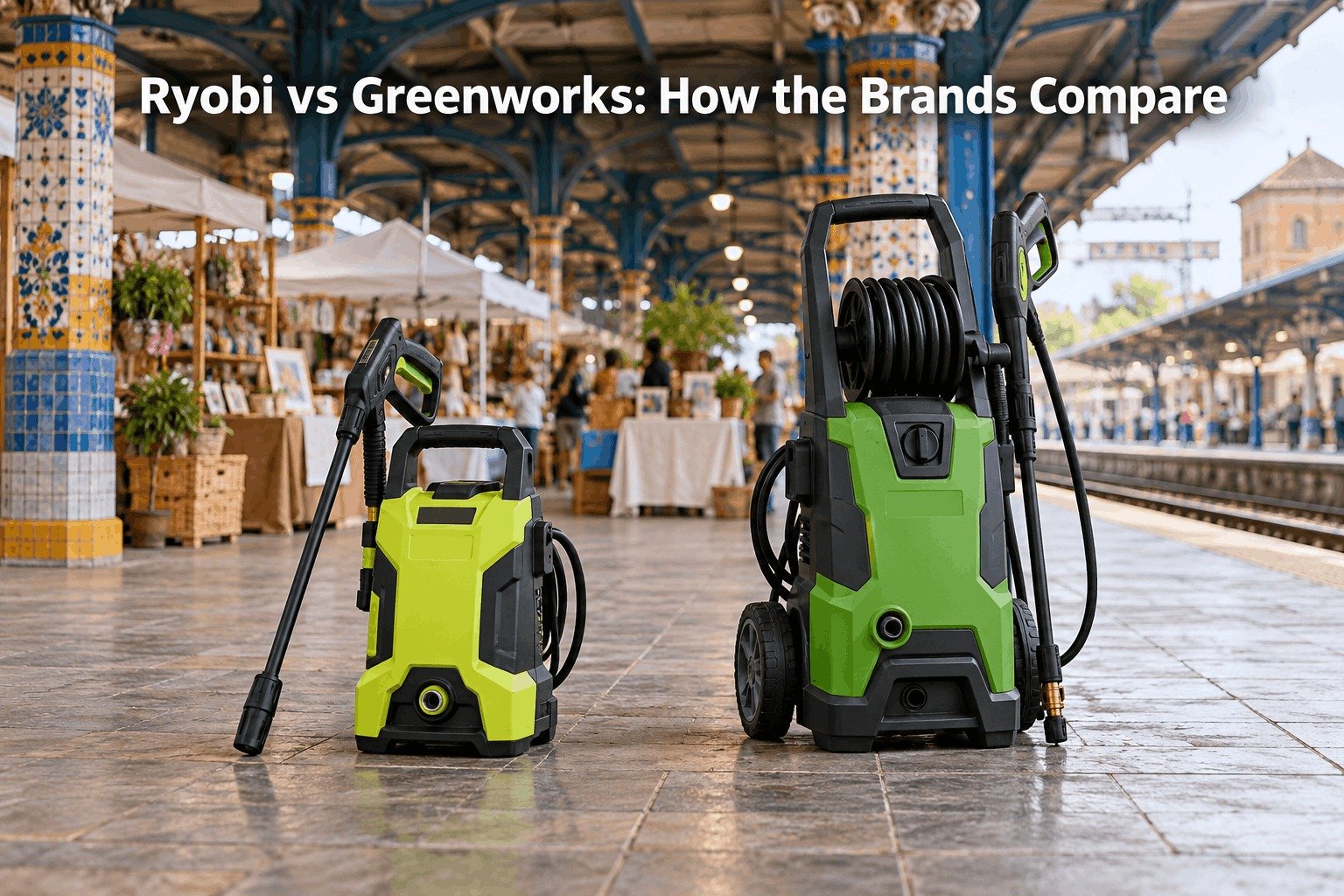
Ryobi sells several power styles, so the brand name alone does not tell you whether a machine is a light-duty cleaner or a larger electric or gas unit. The 40V HP Brushless Whisper Series RY40PW15 is listed at up to 1,500 PSI and 1.2 GPM, with three settings from 1,000 to 1,500 PSI. The US kit listing includes two 40V 6Ah batteries and advertises up to 25 minutes of runtime. Treat that as a stated maximum; setting, battery condition, and workload affect actual working time.
That output suits rinsing and spot cleaning where mobility matters, but it is not a high-flow solution for a large driveway. Ryobi’s compact power cleaners are a separate, lighter-duty category. Check the product type before comparing its headline number with a full-size washer.
Greenworks pressure washers: electric capacity and model variety
Greenworks corded electric washers can suit homeowners who want more cleaning capacity without gas-engine maintenance. For example, Greenworks’ US Pro GPW3001 listing advertises up to 3,000 PSI and 2.0 GPM. These are listing specifications; verify the model’s manual and the conditions behind its pressure and flow ratings. GPM, nozzle, and water supply affect cleaning speed.
Selected battery and hybrid configurations are also available. A hybrid model may run from household power or a compatible battery, depending on the product. Check the package contents and output in each mode; a battery or charger may not be included.
Pressure washer PSI and GPM: Compare the cleaning work
PSI describes water force; GPM describes how much water the pump moves. Pressure can loosen soil, while flow helps carry it away. A high-PSI, modest-flow washer may take longer on a wide surface than its headline suggests. For details, see our beginner’s pressure washer guide.
Also check whether the listed pressure is a maximum or a rating measured under a particular setup. Compare each model’s published pressure and flow figures on the same basis when possible. A surface cleaner must be matched to the washer’s flow and pressure range; an attachment that is too large may spin poorly or leave uneven stripes.
Pressure washer for driveway cleaning, cars, and decks
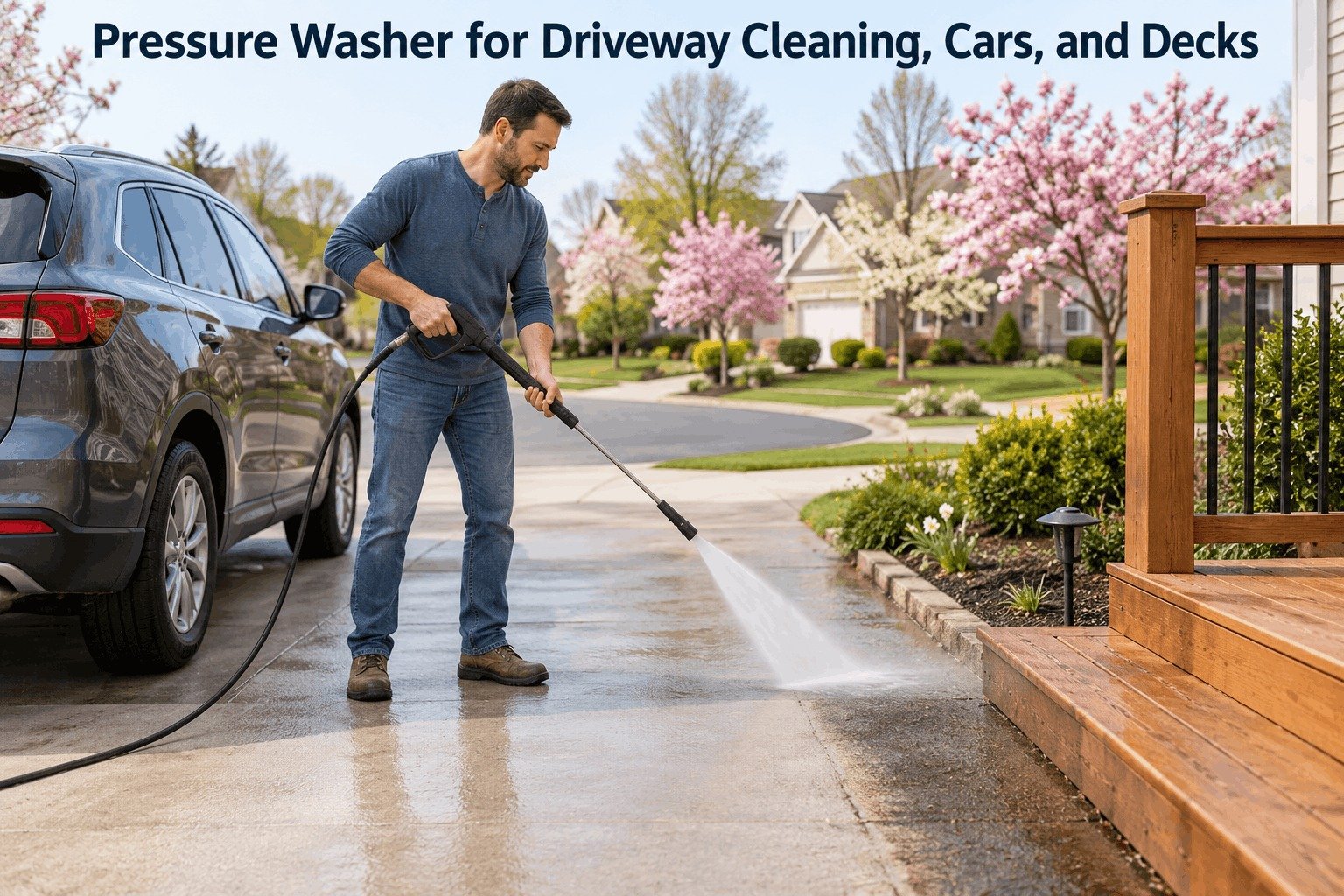
- Cars and outdoor furniture: Choose controllable output, a suitable detergent, and a broad spray pattern. Start at a safe distance and test a hidden spot. A close, powerful jet can damage trim, seals, or a soft finish.
- Decks and fences: Concentrated pressure can scar wood. Use a wider fan, keep moving, and follow the surface maker’s guidance. A lower setting and suitable cleaner may work better than blasting at every mark.
- Patios and driveways: Flow and surface-cleaner compatibility help cover ground evenly. A cordless model can handle a small spot but may be slow on broad concrete. Check the attachment’s GPM requirement.
- Siding and fixtures: Reach, nozzle, and technique matter more than raw force. Work from a stable position; avoid spraying behind siding, into vents, or toward electrical equipment.
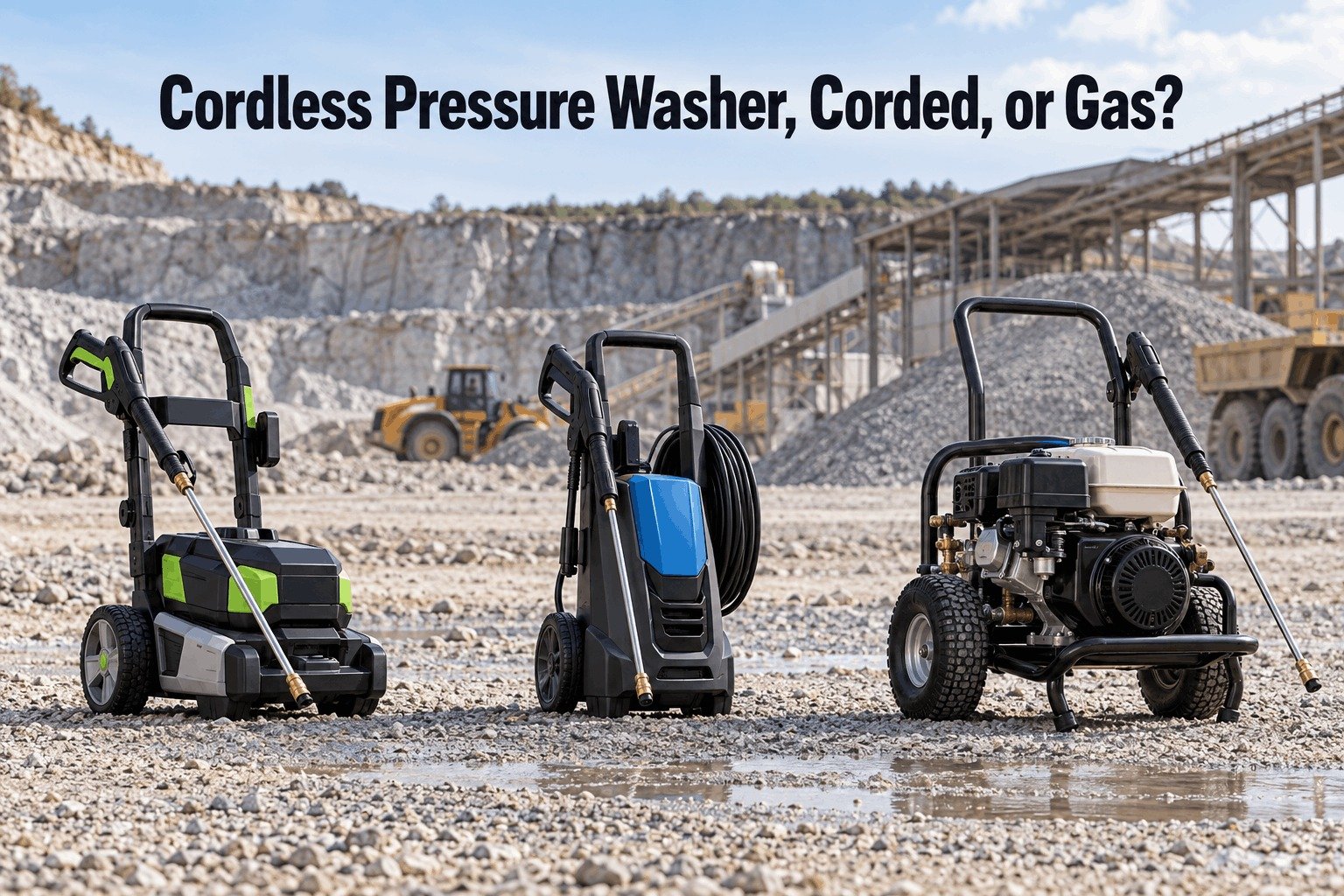
Cordless pressure washer, corded, or gas: What changes day to day?
A corded electric washer gives continuous power when a safe outdoor outlet is available and the manual permits the setup. You manage both the power cord and hose, but do not have to plan around battery runtime.
A cordless unit helps with quick jobs and places where outlet access is awkward. Runtime is an estimate for a particular setup, and higher settings use more battery. For several vehicles or a large patio, plan the workload and bring charged batteries.
Gas models suit demanding or remote work but add noise, exhaust, fuel storage, and maintenance. Use them outdoors, away from doors and windows. For occasional home cleaning, electric models are often simpler to store and start.
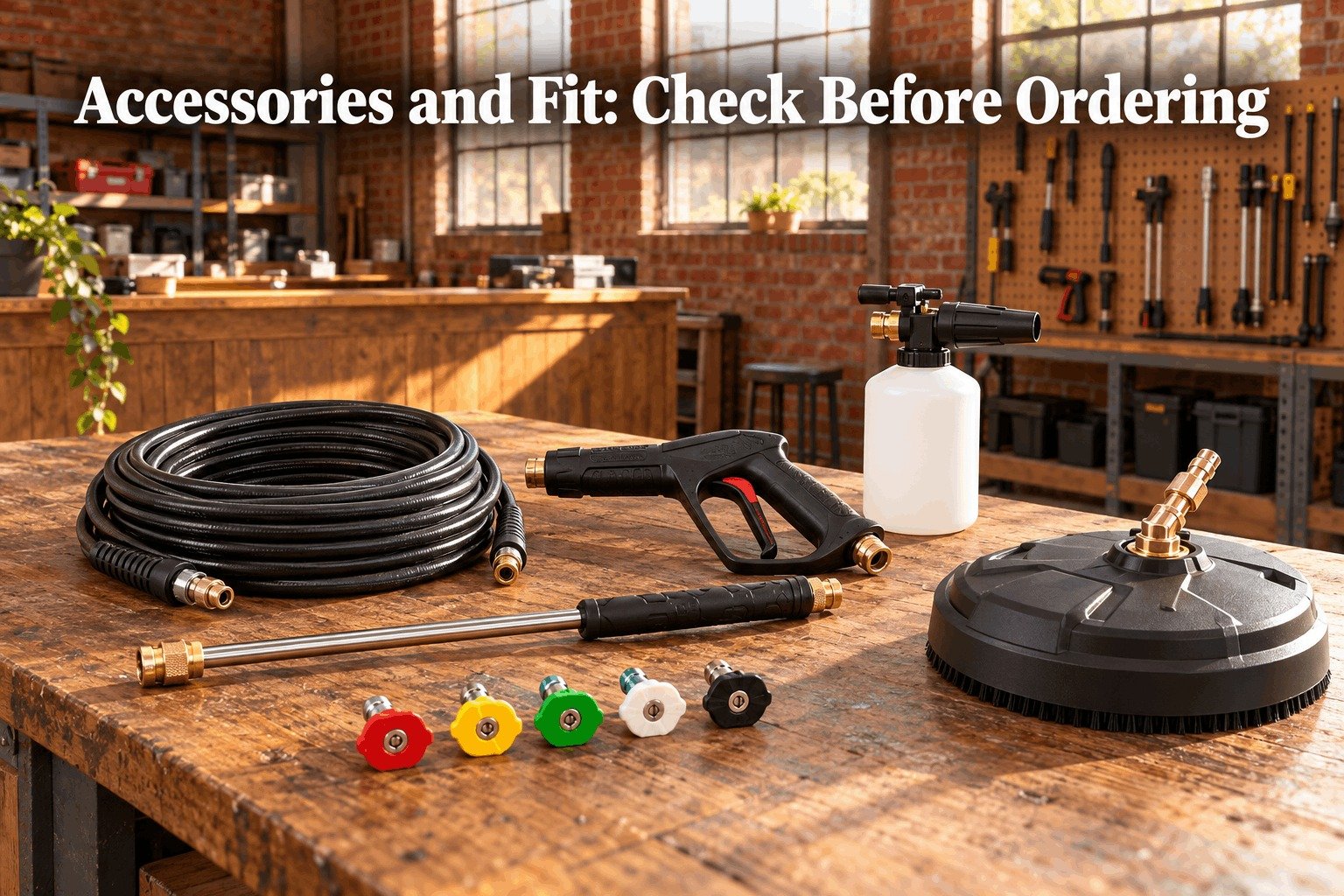
Accessories and fit: Check before ordering
Compare hose length, spray gun, wand, nozzle set, detergent setup, and quick-connect fittings. A longer hose reduces machine moves, but diameter and connector fit still matter. Do not assume that a Ryobi attachment fits a Greenworks washer or that two models from one brand share connectors.
A foam cannon can apply car soap if the detergent suits the washer and finish. A surface cleaner works best when its flow range matches the washer. Check local availability of replacement nozzles, O-rings, filters, and hoses.
Warranty, service, and ownership cost
Warranty terms vary by model, country, and component. Tool, motor, pump, and battery coverage may have different durations or exclusions. Do not assume that a warranty shown on a US brand site applies to a product sold in Pakistan or another market. Read the warranty document for the exact SKU, confirm whether registration is required, and keep the purchase receipt.
Compare the full setup, not just the bare machine. Existing batteries and a charger may reduce the cost of a cordless model; otherwise include them. Add any hose or surface cleaner you need, and check current package contents and local parts support.

Best for: Which brand fits your situation?
- Best for a Ryobi battery-tool owner: A compatible Ryobi cordless washer may be convenient for short rinsing and light cleanup. Check battery compatibility and runtime, not just the platform color.
- Best for a larger home cleaning area: Compare higher-output Greenworks corded models and Ryobi’s full-size electric models by rated GPM, accessories, and outlet access. Choose based on the exact specs, not the brand name.
- Best for car washing: Either brand can work if you can control the spray and use the right nozzle and soap. A compact cordless option is handy for a quick rinse; a corded washer is better suited to a longer session near the house.
- Best for occasional remote cleanup: A battery model from either lineup can be useful when carrying a cord is the main inconvenience. Confirm what battery and charger are included and whether the output is enough for the task.
- Best for a small cleaning business: Compare professional-duty specifications, expected operating hours, repair access, and warranty terms. A homeowner model may not be designed for repeated commercial use even if its maximum PSI looks high.
Buyer’s checklist
Before placing an order, write down the main surface you clean and how often you clean it. Then compare:
- Exact model number, power type, PSI, and GPM.
- Battery and charger inclusion, if applicable, plus realistic runtime for your workload.
- Hose length, included nozzles, detergent setup, and connector type.
- Surface-cleaner compatibility and replacement-part availability.
- Warranty coverage for the washer, pump or motor, and battery in your region.
- Outlet access, water supply, storage space, and the noise or exhaust you can tolerate.
This small check prevents a common mismatch: buying a portable machine for a large concrete area, or a powerful washer that is awkward and risky for delicate car care.
Safety Before You Wash
High-pressure water can cut skin, injure eyes, and force water or debris beneath the skin. Never point the wand at a person or pet, and do not test the spray on your hand. A pressure-washer puncture wound needs prompt medical attention, even if it looks small; see the CDC pressure washer safety guidance. Wear eye protection and closed-toe footwear; use hearing protection when the manual or noise level calls for it. Keep electrical connections dry, use an outdoor-rated outlet with appropriate ground-fault protection, and follow the manual for cord use. Operate gas equipment outdoors only.
Use the detergent and dilution recommended for the machine and surface. Avoid ladders while handling a pressure washer; recoil and hose movement can throw off balance. Follow the washer manual, detergent label, and surface manufacturer’s instructions. Our electric pressure washer safety guide covers setup and technique in more detail.
Three Steps Before You Buy
- Identify your largest regular cleaning job and whether a safe outdoor outlet is available.
- Compare the exact models by PSI, GPM, power type, battery/runtime, accessories, warranty, and local service.
- Before use, read the manual, confirm steady water flow, and begin with the least aggressive suitable nozzle on a hidden area.
FAQs
Is Ryobi or Greenworks better for a driveway?
For a large driveway, compare corded models by GPM and surface-cleaner compatibility. A compact cordless cleaner is more convenient for small spots but may take much longer over a broad area. The exact model matters more than the brand.
Is a 3,000 PSI pressure washer always better?
No. PSI is only one rating, and maximum figures may be measured under specific conditions. Flow, nozzle choice, cleaning time, surface sensitivity, and operator control all affect the result.
Can I use a Ryobi battery with a Greenworks washer?
Do not assume so. Battery platforms and electrical systems are brand- and model-specific. Use only the battery and charger specified for the washer.
Can I wash a car with either brand?
Yes, if the model allows a controlled spray and you use an appropriate nozzle, safe distance, and vehicle-safe soap. Avoid spraying directly into seals, bearings, electrical connectors, or chipped paint.
Are Greenworks hybrid washers cordless?
Some hybrid models can use a compatible battery, while also offering corded operation. Confirm the exact model’s power modes, included battery, and output in each mode before buying.
What should I compare besides PSI?
Compare GPM, power type, hose length, nozzle options, battery runtime or cord requirements, included accessories, warranty, and local replacement-part access.
Do the brands’ warranties cover commercial use?
Coverage can change by model and region, and commercial use may have different terms. Read the warranty document for the exact machine before using it for paid work.
Conclusion
The better choice is the washer that fits the work you actually do. Ryobi may suit a buyer who values a compatible battery platform and quick, portable cleanup; Greenworks may suit someone comparing corded electric capacity or a specific hybrid setup. For heavy surface cleaning, compare flow and accessory requirements. For cars and delicate finishes, prioritize control and safe technique. Check the exact model number, manual, warranty, and package contents before you buy, then start every job with the gentlest setup that can do it well.