Author name: Team Pressure Washer Wise

Maintenance

Pressure Washer Pump Maintenance Guide for Routine Care and Storage

Maintain a pressure washer pump by supplying clean water at the required flow and pressure, preventing overheating, following its authorized service schedule, and protecting it during storage. Before changing oil, identify the pump and confirm that its manufacturer permits oil service. Some pumps have serviceable oil reservoirs; others are factory sealed and should not be opened for routine lubrication. Low pressure, surging, and leaks do not automatically mean the pump needs replacing. A restricted inlet screen, an unsuitable nozzle, or trapped air can produce symptoms that resemble internal wear. Continuing to operate while the cause remains unresolved can turn a manageable external problem into a more serious repair. The useful starting point is therefore the pump model and its instructions, followed by a consistent inspection routine. This pressure washer pump maintenance guide focuses on portable cold-water machines used around homes and on smaller commercial jobs. The principles apply to both gas and electric equipment, but individual procedures depend on the design. Keep the machine manual and any separate pump documentation together so that oil specifications, inlet requirements, and storage directions remain available when needed. Identify your pump before choosing a maintenance procedure The engine or electric motor powers the pump, but its brand does not necessarily identify the pump manufacturer. A gasoline engine label may tell you which engine oil to use while saying nothing about pump lubrication. Look for the washer’s identification plate and a separate label, stamping, or model number on the pump assembly. Record both machine and pump details, particularly if a previous owner has replaced the original pump. Accurate pump model identification lets you match instructions to the equipment in front of you. Similar-looking pumps may use different lubricants, capacities, or service procedures. Find the operator manual for the complete machine and, where applicable, the pump manufacturer’s manual or parts diagram. If the documents appear to conflict, ask the equipment manufacturer or a qualified service provider to resolve the discrepancy before proceeding. A maintenance-free or sealed pump generally does not require owner-performed oil changes. Its lubrication is provided within a sealed assembly, and the absence of a scheduled oil change is intentional. Do not remove unidentified plugs or dismantle the housing to add oil because another pressure washer has a fill cap. Maintenance-free describes the lubrication arrangement, not immunity to dirt, overheating, freezing, or unsuitable chemicals. You may encounter the terms axial cam pump and triplex plunger pump while finding documentation. They describe aspects of pump construction, and manufacturers sometimes use overlapping terminology. Many compact consumer machines have sealed pump assemblies, while many service-oriented machines provide accessible oil checks and service instructions. Neither a general design label nor the machine’s gas or electric power source is enough to establish what maintenance you may perform. Understanding the pump’s two broad functions also prevents mistakes. Water moves through the inlet, pumping chambers, and outlet, while the drive mechanism moves the pistons or plungers. In an oil-lubricated design, the crankcase lubricant belongs to the drive section; it is not added through the garden-hose connection. Storage protector follows the water path and serves a different purpose. When identification is uncertain, photograph the complete machine, pump, ports, and remaining labels for the manufacturer. Describe any replacement history you know rather than assuming the installed pump matches the original specification. Until its requirements are confirmed, limit work to clearly authorized external care. Guessing at a drain plug or lubricant is an unnecessary way to create a problem. Build a pressure washer pump maintenance schedule around hours, dates, and condition A useful pressure washer pump maintenance schedule combines routine checks with the service intervals specified for your equipment. Before-use inspection catches problems introduced since the last job, such as a damaged hose or blocked screen. Hour-based maintenance addresses accumulated operation, while calendar requirements may apply even when the machine is used infrequently. Storage protection responds to temperature and disuse rather than operating hours alone. Do not substitute a familiar internet interval for the one in your manual. Cat Pumps’ general preventive-maintenance guidance, for example, calls for an initial oil change after 50 hours and subsequent changes every 500 hours. One SIMPSON use-and-care manual instead specifies an initial change after 50 hours, followed by changes every 100 hours or three months. These examples demonstrate variation; they are not competing options from which to choose a convenient schedule. Use the following framework to organize your own requirements. The serviceable-pump column applies only where the manual assigns that work to the owner. Maintenance trigger Care for all pump types Additional care for serviceable pumps Detail to record Before use Inspect supply connections, inlet screen, pressure hose, and visible condition Check accessible oil level and condition as instructed Defects or changes since the previous job After use Flush applicable chemical circuits, shut down, depressurize, and inspect Check for new oil leakage Operating hours and unusual symptoms Initial service Review the machine’s initial-service requirements Change oil if required and authorized First-service deadline and approved oil Recurring service Perform the manual’s scheduled inspections Complete specified lubrication and other assigned service Hours, calendar deadline, and work completed Seasonal or extended storage Apply the prescribed drainage and protection procedure Complete any oil service due before storage Protection product and next-start instructions Changed condition Stop and investigate abnormal operation Assess low level or suspected contamination before reuse Symptom, likely cause, and corrective action The table becomes useful when populated from the actual manual. If the instructions say “whichever comes first,” record both the hour threshold and calendar date. A machine that has accumulated few hours may still reach its calendar service deadline. Conversely, a frequently used washer can reach an hour limit long before the anniversary of its last service. A simple log is adequate for most owners. In a hypothetical entry, you might record that authorized pump oil service was completed at 62 total hours, identify the approved oil, and note the next deadline calculated from that machine’s instructions. Recording the quantity added can help identify a later discrepancy, but it does not replace checking

Winter-ready pressure washer in a clean garage with hose coiled and pump saver bottle
Maintenance

How to Winterize a Pressure Washer for Cold Weather Storage

How to winterize a pressure washer comes down to four jobs: drain every trace of water from the pump, hoses and gun, protect the pump with pump saver, treat the fuel on gas models, and store the machine somewhere dry. Water left in the pump can freeze and crack the housing, which often means buying a new pump. This guide follows Briggs and Stratton’s published steps, adds what other makers say, and gives you the numbers: how long to run the stabilizer, how long to flush, and how many times to pull the cord. We did not test these steps ourselves. Check your own manual for your model’s exact limits. When to Winterize a Pressure Washer Winterize before the first hard freeze, not after. Water expands when it turns to ice, and a pump can hold a surprising amount of water in its chambers even after you shut off the tap. The rule is simple. If the machine will sit anywhere that can drop to freezing, treat it. If it is stored indoors in a warm space, the risk is much lower, and some guides say you can skip antifreeze there because there is nothing to freeze. A garage, shed or trailer is not a safe bet in a cold snap. Also treat the machine before a long break, even in mild weather. Old fuel and dried-out seals cause just as many spring problems as ice does. What You Need Before You Start Gather everything first. Once the pump is open, you do not want to stop halfway. How to Winterize a Pressure Washer: Gas vs Electric Step Gas washer Electric washer Fuel treatment Add stabilizer, run the engine 2 minutes Not needed Flush with clean water 2 minutes at low pressure Run briefly with clean water Release pressure Squeeze the trigger, lock it Same Drain pump Pull the recoil handle about 6 times Unplug, then drain the hoses and gun Add pump saver Fill the pump, pull the cord twice Follow the pump saver label and manual Engine care Oil and spark plug per manual None The gas figures come from Briggs and Stratton’s winterizing page. Electric steps vary more by maker, so follow your manual for the pump saver step. Step 1: Treat the Fuel (Gas Models) Gasoline goes stale in about 30 days, according to Briggs and Stratton, and ethanol blends age quickly. Stale fuel is a leading cause of spring no-starts. Briggs and Stratton’s engines accept up to 10% ethanol fuel, so normal pump gas is fine when it is fresh. Our no-start guide explains what old fuel does to a carburetor. Step 2: Flush the Pump and Detergent System Clean water clears detergent residue, which can gum up the siphon tube and seals. Depending on your climate and make, Briggs and Stratton also lists an antifreeze flush at this point. Use the product your manual allows, not whatever is in the garage. Step 3: Release Pressure and Drain Everything Some guides add a last step: run the machine for a few seconds with the hose off to clear leftover water. Only do that with the water supply off and your manual’s approval, since running the pump dry for long damages it. Step 4: Choose the Right Protection Draining removes most of the water. Protection covers what is left and keeps seals soft. The table compares the common options. Product What it does Notes Pump saver Lubricates, resists rust, protects seals and low-temperature damage Usually the best choice, follow the label Pink RV or marine antifreeze Stops remaining water from freezing Use only if your manual allows it Green automotive antifreeze Not recommended Can harm seals and is toxic 50/50 antifreeze blend Used on some hot-water washers Alkota recommends a tester to check strength Fuel stabilizer Protects gasoline, not the pump Gas models only One retailer blog says properly treated units survive temperatures down to 10 degrees F. That is a blog claim, not a maker rating, so check the rating on your pump saver label. Step 5: Apply Pump Saver This is the step that protects the pump through winter. Work on a clean, dry surface with a tarp underneath. Other guides pump the product through until it comes out of the outlet, which shows the whole pump is coated. Follow the instructions on the bottle. Step 6: Engine Care and Storage Briggs and Stratton’s page does not cover engine oil or the spark plug, so follow your engine manual for those. A common routine is to change the oil before storage, and to pull the plug and check it for fouling. Then store the washer in a cool, dry place, cleaned of dirt and moisture. A frost-free spot is best. Cover it, coil the hose loosely with no kinks, and keep the spray gun and nozzles in a bin so nothing goes missing. Spring Startup Checklist When you bring the washer back into use, go through this short list. Our maintenance checklist has the full routine. Why Pressure Washer Pumps Freeze A pressure pump is not a hollow tube. It has chambers, valves, seals and a manifold that hold small pockets of water even after you drain the hose. When temperatures drop to freezing, that trapped water turns to ice and expands. The pump housing is rigid, so the expanding ice has nowhere to go. It can crack the housing or damage the seals and valves. The damage often does not show until spring, when you turn the washer on and water sprays from the pump body. By then, the repair is usually a pump replacement. How Long Does Winterizing Take? The active running time is short. Using Briggs and Stratton’s figures, a gas washer runs for 2 minutes with stabilizer and 2 minutes for the flush, plus about 6 cord pulls to drain and 2 more after the pump saver. That is roughly 4 minutes of engine time. Allow longer for cool-down, draining the hoses and wiping everything dry. Our own estimate,

Best Sun Joe SPX2688-MAX Electric Pressure
Maintenance

Pressure Washer Maintenance Checklist for Gas and Electric Models

A pressure washer maintenance checklist comes down to two short routines: a few checks before every use, and a few steps after every use. Gas models add engine checks on top. Do those consistently and most pump, hose and no-start problems never happen. This guide follows Briggs and Stratton’s published preventative maintenance page and adds figures from other makers where they differ. We did not test these steps ourselves. Where a maker gives no interval, we say so and point you to your manual instead of guessing. Pressure Washer Maintenance Checklist at a Glance When Task Applies to Before each use Check engine oil and fuel level Gas Before each use Check tire pressure, 15 to 25 PSI Wheeled gas models Before each use Flush and inspect the water inlet screen and in-line screens Gas and electric Before each use Inspect hoses, couplings and the spray gun for wear Gas and electric After each use Flush the detergent system for 2 minutes before stopping the engine Gas and electric After each use Release pressure, disconnect hoses, drain the pump Gas and electric After each use Pull the recoil handle about 6 times to push water out of the pump Gas By the manual’s schedule Engine oil, air filter, spark plug, pump oil Gas, some electric The before and after items come from Briggs and Stratton. Service intervals vary by engine and pump, so they are left to your manual. Find Your Model Number and Manuals First Similar-looking washers can have different oil capacities, filters and drain procedures. A pressure rating alone does not tell you how a machine should be serviced. Before you build a schedule, write down three things and keep them with the machine. Photograph those labels with your phone. A label that has faded or been pressure-washed clean is a common reason owners cannot order the right part later. Before Every Use: The Quick Safety Pass This takes about five minutes. Do it on level ground with the machine off. A damaged high-pressure hose is a safety problem, not just a nuisance. If you replace one, buy a hose whose pressure rating is higher than the maximum rating of your washer, as Briggs and Stratton advises. Check Water Flow and the Inlet Screen The pump depends on clean water at the right volume. Debris in the supply starves it and scores the seals. Flush the water inlet screen and any in-line screens before use, and look at them for grit or mineral build-up. Run the garden hose for a few seconds first so loose dirt leaves the line before it reaches the machine. Connect the water and squeeze the gun trigger until water flows steadily, then start the machine. This purges air from the pump. Running a pump with no water supply for long overheats the seals, which is one of the most common ways owners damage one. Inspect Hoses and Spray Components Hoses fail at the ends first. Check the area around each coupling, where the hose flexes most. High-pressure hose Run your hand along the length. A soft spot, a bulge or visible braid means replacement. Do not tape or patch it. Couplings and O-rings Quick-connect fittings use small rubber O-rings. Dry or flattened ones leak and cost pressure. They are cheap to replace. Spray gun, wand and nozzle If the spray pattern looks uneven or the pressure pulses, a partly blocked nozzle is the usual cause. A straightened paperclip is the standard tool for clearing a nozzle orifice. Turn the machine off and release pressure first. After Every Use: Flush, Release, Drain This is the routine most owners skip, and it matters more than the others. Detergent left in the system dries into a film that sticks seals and clogs the injector. Water left in the pump is what freezes and cracks it in cold weather. Our winterizing guide covers the extra steps for storage. Gas Engine Care Briggs and Stratton’s preventative maintenance page lists the before-use and after-use checks above but does not give oil type or service intervals. Those are in your engine manual, so use it. Some secondary guides suggest changing the engine oil about every 50 hours of use or once a year. Treat that as a rough rule only. Sources vary, and the figure in your engine manual wins. Part Why it matters Source for the interval Engine oil Low or dirty oil wears the engine fast Engine manual Air filter A clogged filter causes hard starting and rough running Engine manual Spark plug Fouled plugs cause misfires and no-starts Engine manual Fuel Stale fuel gums the carburetor Add stabilizer for storage If the engine will not start, see our no-start troubleshooting guide before replacing parts. Electric Washer Care Electric models skip the engine items but have their own. Inspect the power cord for cuts and crushed sections. Check the plug and any built-in ground fault protection, and test it as the manual says. Keep the motor vents free of dust and debris, since blocked vents cause overheating. Never run an electric washer with a damaged cord, and keep the plug and extension cord connections out of standing water. Pump Maintenance Pump types differ, and this is where owners get confused. Some pumps are sealed and need no routine oil changes. Others have a sight glass and a drain plug, and want fresh oil on a schedule. Find your pump model in the manual and check which kind you have. If it takes oil, use only the type the maker names. Milky oil means water has got in, and the pump needs service. Whatever the pump type, clean water and proper storage protect it. A Simple Seasonal Rhythm Most owners do not use a washer weekly, so a calendar is easier to follow than hour counts. Start of season Check the oil, replace fuel that is more than about a month old, inspect every hose and O-ring, and connect water and squeeze the trigger to purge air before

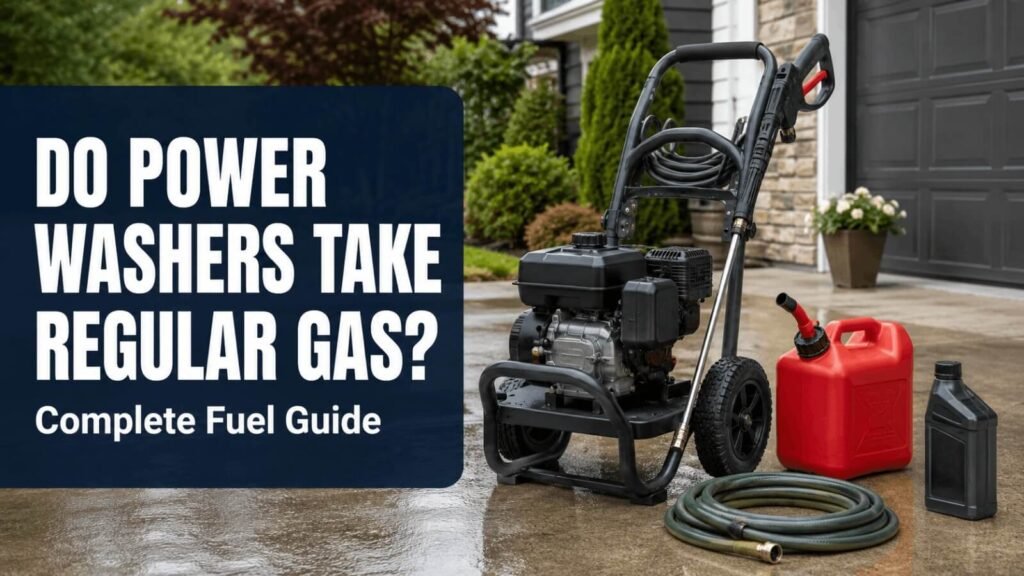
Educational guide graphic asking do power washers take regular gas next to a gas pressure washer, fuel can, and engine oil bottle.
How to Guides

Do Power Washers Take Regular Gas? Complete Fuel Guide

Editorial note: This educational guide explains common small-engine fuel practices; it is not a substitute for the fuel label or owner’s manual for your exact engine. Fuel requirements were checked against official Honda and Briggs & Stratton guidance, and safety advice was checked against the CDC. You arrive at a gas station with an empty fuel container and suddenly face several choices: regular, mid-grade, premium, E15, or perhaps ethanol-free gasoline. Do power washers take regular gas, or does a small engine need something more expensive? For most residential gas pressure washers, the answer is yes. They normally use fresh regular unleaded gasoline. Many small engines require at least 87 AKI in the United States, roughly 91 RON in countries using the RON system. Up to 10% ethanol is often permitted, but the engine manual is the final authority. These common figures are supported by Briggs & Stratton’s small-engine fuel guidance Choosing the right fuel matters because a pressure washer may sit unused for weeks. Old or unsuitable gasoline can cause carburetor deposits, hard starting, and expensive repairs. This guide explains what to buy, what to avoid, whether to mix oil with gas, and how to refuel and store the machine safely. Do Power Washers Take Regular Gas or Premium Gas? Most gas-powered pressure washers are designed to run on regular unleaded gasoline. Unless the engine manufacturer specifies otherwise, premium fuel usually provides no useful advantage. Octane measures resistance to engine knocking; it does not make gasoline fresher or cleaner. A typical pressure-washer engine does not need the extra knock resistance of premium fuel. For many machines, the practical starting point is: Fresh, clean, unleaded gasoline At least 87 AKI in the United States About 91 RON where fuel is sold using the RON scale No more than 10% ethanol, unless the manual sets a different limit No oil mixed into the gasoline for a standard four-stroke engine The exact requirement can vary by engine, model, country, altitude, and fuel formulation. Check the pressure-washer manual, the separate engine manual, and any marking near the fuel cap before filling the tank. Is Premium Gas Better for a Pressure Washer? Premium gasoline is not a performance upgrade when an engine is designed for regular fuel. It normally will not increase PSI, GPM, cleaning speed, or pump life. Those results depend on the engine, pump, nozzle, water supply, and condition of the machine—not on paying for a higher octane than required. Using premium is generally unnecessary rather than automatically harmful. Fresh regular gasoline that meets the manual is usually better than old premium fuel that has sat for months. When Might a Different Grade Be Required? Some models have special instructions. High-altitude use may require an engine adjustment rather than a different gasoline grade. If the engine knocks, loses power, or becomes hard to start with correct fresh fuel, review the manual or contact an authorized service provider. Which Pressure Washers Need Gas? Only pressure washers powered by an internal-combustion engine need gasoline. Corded electric models use household electricity, while cordless units use rechargeable batteries. They still need water, but they do not have a gasoline tank. Gas pressure washers suit driveways, masonry, equipment, fences, and demanding outdoor jobs. They often offer higher flow and do not need a nearby outlet. If you are comparing power types, our guide to the best gas pressure washers explains where these machines make practical sense. Professional hot-water machines can be more complicated: one tank may feed the engine while a separate burner uses another approved fuel. Never fill a tank based only on its location or cap color. Understanding Octane, AKI, and RON Fuel labels can create confusion because not every country displays octane in the same way. AKI in the United States American pumps normally show the Anti-Knock Index, or AKI. Regular unleaded is commonly marked 87. RON in Other Countries Many other markets display Research Octane Number, or RON. Around 91 RON is broadly comparable to 87 AKI; the numbers differ because the testing systems differ. Why the Manual Still Matters In an unfamiliar country, read the local manual or ask an authorized dealer which pump grade meets the requirement. Regional guidance may differ for fuel blends and altitude. Can You Use Gasoline With Ethanol? Many small pressure-washer engines permit gasoline containing up to 10% ethanol, labeled E10. However, ethanol can attract moisture, especially during poor or lengthy storage. E10 Gasoline  E10 contains up to 10% ethanol and is widely sold as regular gasoline. Use it only when the manual allows it, and keep it in a clean, sealed, approved container. Honda’s official fuel recommendations permit E10 in Honda engines but still direct owners to check the model’s manual. E15 and E85 E15 contains up to 15% ethanol, while E85 contains much more. They are unsuitable for most pressure-washer engines and can harm fuel-system parts. Do not choose them because the octane looks high or the price looks attractive. Ethanol-Free Gasoline Ethanol-free gasoline may help equipment used infrequently, but it costs more and is not required by every engine. It must still be fresh, the correct octane, and stored properly. It will not cure a dirty carburetor or poor maintenance. Do You Mix Oil With Gas for a Pressure Washer? Most modern gas pressure washers use a four-stroke engine. In this design, gasoline goes into the fuel tank and engine oil goes into a separate crankcase. Do not mix oil into the gasoline unless the manual clearly says the engine is a two-stroke design and provides a mixing ratio. Adding oil to the fuel of a four-stroke engine can cause smoke, spark-plug fouling, poor combustion, deposits, and engine damage. Running a four-stroke engine without enough oil can also cause severe internal damage. Check both fluids separately before operation. Engine Oil and Pump Oil Are Different A gas pressure washer may contain two separate oil systems: Engine oil lubricates the gasoline engine. Pump oil lubricates certain serviceable pressure-washer pumps. Check Whether the Pump Is Serviceable

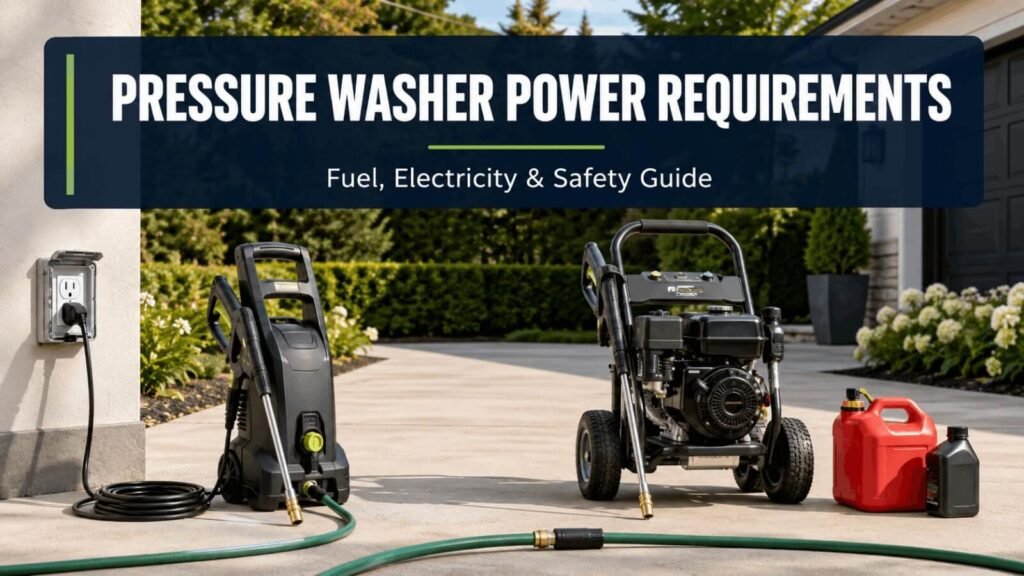
Pressure washer power requirements guide featuring electric and gas pressure washers side by side outdoors
How to Guides

Pressure Washer Power Requirements: Fuel, Electricity, and Safety Guide

A pressure washer needs the right power source before it needs a good nozzle. An electric model needs a 120-volt outlet on a 15-amp circuit that has GFCI protection. A gas model needs fresh 87-octane unleaded petrol with no more than 10% ethanol, plus separate engine oil. A battery model needs a charged pack and enough water flow. This guide covers pressure washer power requirements for all three types. You will get the numbers, the limits and the safety rules. We also say plainly where the sources disagree. Why you can trust this guide We did not test these machines. Every figure comes from maker manuals, spec sheets, dealer listings and safety agencies. We name each source in the text. Source order: maker manuals first, then safety agencies such as the CDC and CPSC, then dealer listings. Forum posts were used only to spot questions, never as proof. Limits: We could not open the full electrical code text. The circuit math below is standard arithmetic, and we mark it as ours. Always read your own manual and ask a licensed electrician about your wiring. Last checked: 7 November 2026. Pressure Washer Power Requirements at a Glance Start here if you only want the short answer. The table compares the three power types. Type Power source Key number Biggest risk Electric 120 V outlet, GFCI protected About 11 to 15 amps on most labels Tripped breakers, thin extension cords Gas Petrol plus 4-stroke engine oil 87 octane, E10 or less Stale fuel, carbon monoxide Battery Lithium pack (Ryobi uses 40V) Runtime depends on pack size Short run time, low flow Amp ranges vary by model. Read the rating label on your own unit before you plug anything in. Electricity Requirements for Electric Pressure Washers Electric pressure washers sold for home use run on standard household power. That means 120 volts in the United States. You do not need a special plug for most of them. Three numbers matter. They are volts, amps and watts. They are linked by one formula: watts = volts x amps. Voltage Must Match the Machine A US home outlet gives 120 volts. Most consumer electric washers are built for exactly that. A few heavy units want 240 volts, and those need a different outlet. The label on the motor or the manual will tell you. Never adapt a plug to force a fit. A wrong voltage can burn out the motor. Amps Tell You the Circuit Load Amps show how much current the motor pulls. Most home washers list somewhere between 11 and 15 amps. Check your label, because lighter models draw less. A standard bedroom or garage circuit is often 15 amps. A 20-amp circuit exists in many garages and kitchens. Your breaker panel shows which one you have. Here is the math, and it is our own arithmetic. A 15-amp circuit at 120 volts can deliver 1,800 watts. Many electricians size a long-running load to about 80% of that. That gives 1,440 watts, or 12 amps, for work that runs for hours. So a 13-amp washer on a 15-amp circuit may trip if anything else is running on it. A freezer, a shop light or a second tool is enough. Watts Help With Generator Planning Watts matter most when a generator is involved. An 11-amp washer pulls about 1,320 watts. A 15-amp washer pulls about 1,800 watts. Motors need a bigger jolt to start than to run. We cover that in the generator section below. Do Electric Pressure Washers Need a Dedicated Circuit? Not by law for a portable unit, but it helps. A dedicated circuit means nothing else shares the breaker. That removes the most common cause of nuisance trips. If you cannot do that, make sure the washer is the only load on that circuit while you work. Unplug the garage freezer only if you can check it again within a few hours. Frozen food is not worth a tripped breaker. GFCI and Outdoor Electrical Safety Water and electricity are a bad mix. A GFCI is a device that cuts power in a fraction of a second when current leaks to ground. That can prevent a shock. The National Electrical Code requires GFCI protection on outdoor 125-volt, 15- and 20-amp outlets at homes. Check your local code for exceptions. Many electric pressure washers also ship with a GFCI plug on the cord. Can You Use an Extension Cord With a Pressure Washer? Yes, but the cord is where many people go wrong. A thin cord drops voltage. The motor then runs hot and can burn out. Makers do not agree on the limits, so your manual wins. The table shows what the ones we found say. Source Gauge Length rule Sun Joe support page 14 AWG or heavier 25 ft max extension; combined with the built-in cord, no more than 60 ft Wen PW21 manual 14 AWG recommended No extension over 25 ft (washer has a 36 ft cord) Simoniz S1700 manual 14 AWG 50 ft maximum Chicago Electric chart (12 to 16 A load) 12 AWG minimum at 50 ft Never use 16 or 18 gauge Lower AWG numbers mean thicker wire. A 12-gauge cord is thicker than a 14-gauge one. Our takeaway is simple. Buy a 12-gauge, outdoor-rated cord and keep it as short as you can. Never go past the length in your manual, whatever the gauge. Uncoil the whole cord, because a coiled cord traps heat. Can You Run an Electric Pressure Washer on a Generator? Yes, if the generator is big enough. Size it to the starting watts, not the running watts. A motor can pull much more current for the first moment. Sizing guides we checked say the surge is roughly 1.5 to 2.5 times the running wattage. They commonly use a 2x multiplier. At 1,800 running watts, that is about 3,600 starting watts. One guide lists compact units rated 1,500 to 1,800 running watts with 3,000 to 3,600 surge. One rule of thumb in

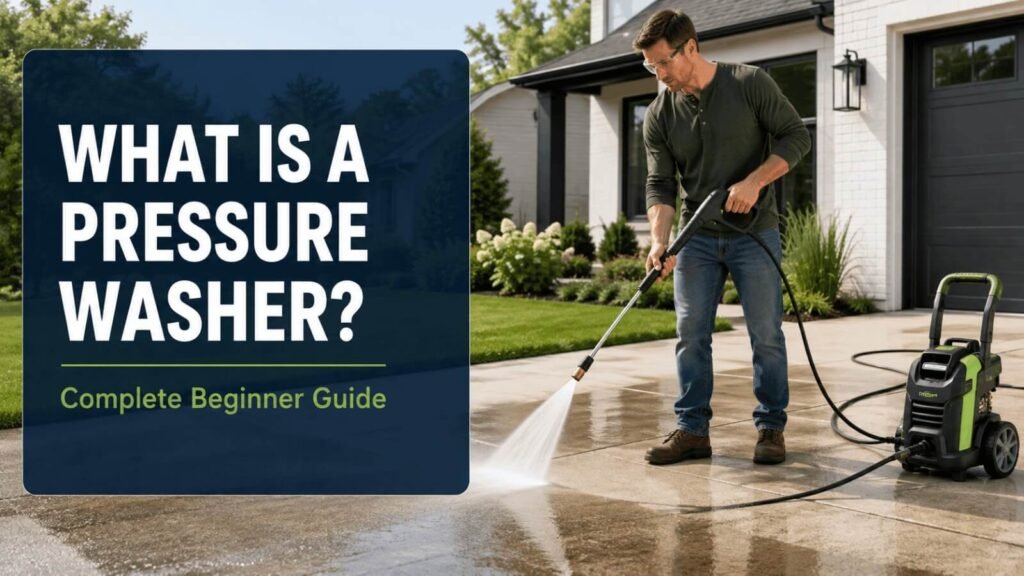
What is a pressure washer complete beginner guide showing a man cleaning a driveway
How to Guides

What Is a Pressure Washer? How It Works and How to Use One Safely

A pressure washer is a machine that pushes water through a pump and out of a small nozzle, so the water leaves at very high speed. That fast, narrow jet knocks dirt, mud, mildew and old grime off hard surfaces far better than a normal garden hose can. Most home models run between 1,300 and 3,200 PSI. This guide explains what is inside the machine, what the PSI and GPM numbers really mean, which type fits your yard, and how to use one without hurting yourself or your house. Why you can trust this guide Sources: maker spec sheets and retailer listings for model numbers, and published medical case reports for the injury section. Testing: we did not run these machines ourselves for this article. Where a number comes from a listing, we say so. Corrections: spec figures differ between model variants. For example, one Karcher K5 variant is listed at 1.4 GPM and another at 1.55 GPM. Always read the label on the exact model you buy. Last checked: 7 November 2026. What Is a Pressure Washer, in Plain Words? Think of a garden hose with a thumb over the end. The water speeds up because it has to squeeze through a smaller opening. A pressure washer does the same thing, only with a pump that builds far more force than your thumb ever could. The machine does not make water “stronger” by magic. It takes the water that arrives from your tap, pressurizes it, and sends it through a tiny hole in the nozzle. The smaller the hole and the stronger the pump, the harder the jet hits. That is why the same machine can strip a layer of green algae off concrete and also gouge soft pine. The tool is not the problem. The nozzle you pick and the distance you hold it from the surface decide the result. How a Pressure Washer Works Every pressure washer, whether electric or gas, follows the same water path. Knowing it makes troubleshooting much easier later. Water inlet. Your garden hose screws into the machine. Most home units need a steady supply, often around 1 to 2.5 gallons per minute depending on the model. Pump. A motor or engine drives the pump. The pump squeezes the water and raises its pressure. Unloader valve. When you release the trigger, this valve sends water back around inside the pump so pressure does not spike. Without it, the pump would be damaged within seconds. High pressure hose. A reinforced hose carries the pressurized water to the gun. Spray gun and wand. The trigger controls the flow. The wand points the jet where you want it. Nozzle. The tip at the end sets the spray angle and the force on the surface. Gas models swap the electric motor for a small engine, often a Honda or Briggs and Stratton unit. Everything after the motor works the same way. PSI, GPM and Cleaning Units Explained Three numbers show up on every box. They tell you almost everything about how the machine will behave. PSI means pounds per square inch. It measures how hard the water hits. Higher PSI lifts stuck-on dirt, but it also raises the risk of damage. GPM means gallons per minute. It measures how much water the machine moves. Higher GPM carries loosened dirt away faster, so the job finishes sooner. Cleaning units (CU) are PSI multiplied by GPM. It is a rough way to compare machines in one number. Here is the math with two common electric models from maker and retailer listings. A Karcher K5 at 2,000 PSI and 1.4 GPM gives 2,800 CU. A Greenworks GPW2000 at 2,000 PSI and 1.2 GPM gives 2,400 CU. Same PSI, but the K5 moves more water, so it should clean a flat area a little faster. One warning about CU. A machine with high flow and low PSI can score the same as one with low flow and high PSI. They do not feel the same on a surface. Use CU to compare similar machines, not to decide between a light electric unit and a heavy gas one. Electric, Gas and Cordless Pressure Washers Compared The motor type decides the weight, the noise, the maintenance and the kind of job the machine suits. This table uses ranges that retailers commonly list for home units. Type Typical PSI Typical GPM Best for Electric 1,300 to 2,400 1.2 to 2.5 Cars, patios, small decks, fences Gas 2,500 to 3,200+ 2.5 to 4.0 Large driveways, brick, stained concrete, whole house Cordless Varies, often below 1,000 Under 1.0 Quick rinses, bikes, grills, outdoor furniture Ranges are typical listing figures, not guarantees. Individual models fall outside them. Electric Electric units are quieter, lighter and start with a push of a button. They need an outlet within cord reach and a grounded, GFCI protected circuit. For most homes with a normal driveway and a deck, an electric model is enough. Gas Gas machines hit harder and keep moving more water. They are loud, heavier, and need fuel, oil and a bit of seasonal care. Tractor Supply suggests 2,500 to 3,000 PSI and 3.0 GPM or more for heavy work such as brick, stone or whole-house exteriors. Cordless Battery models are handy when no outlet is near. The trade-off is runtime and force. They suit light jobs, not oil-stained concrete. If you are still deciding, our cordless vs electric pressure washer comparison goes deeper on that one choice. Cold Water vs Hot Water Machines Nearly every home pressure washer is a cold water machine. It uses the water straight from your tap. Hot water models heat the water with a burner. Heat melts grease and oil much faster. You will mostly see them on commercial equipment, in restaurants, workshops and fleet washing. For a home owner, hot water is rarely worth the cost. A good degreaser and a bit of soak time handle most driveway oil stains on a cold water unit. What You Can Clean With a

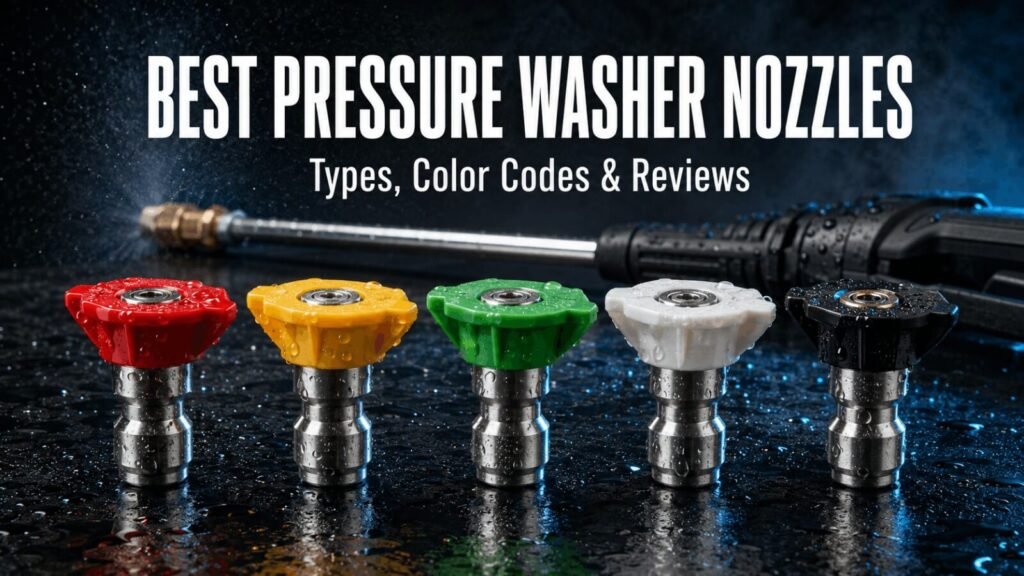
Best pressure washer nozzles guide showing spray tip types and color codes
Buying Guides

Best Pressure Washer Nozzles: Types, Colors and Sizes

The best pressure washer nozzles are the ones that match your job and your machine. For most people that means a set of five color-coded tips: red (0 degrees), yellow (15), green (25), white (40) and a black soap tip. Start with white or green, and only go narrower when the surface can take it. The second half of the answer is the size of the hole. A tip that is too small strains the pump, and one that is too large drops your pressure. This guide shows how to read the colors, how to size a nozzle with a simple calculation, and which tip to use on a driveway, deck, car or siding. Why you can trust this guide What this is: a buying and selection guide. We did not bench test individual nozzle brands for this article, so we do not rank brands. Sources: manufacturer and parts-supplier nozzle charts for the color and size conventions, and a published medical case report for the injury warning. Where sources disagree: the angle of the black soap tip is listed as 50 degrees on some kits and 65 degrees on others. We show both. Read the label on your own tip. Last checked: 7 November 2026. The 7 Best Pressure Washer Nozzles by Type When people say “best nozzle” they usually mean “best nozzle for this job.” Here are the seven tip types worth knowing, from sharpest to softest. Tip Spray angle Best for Avoid on Red 0 degrees Rust spots, tough stains on concrete Wood, siding, cars, skin Yellow 15 degrees Heavy dirt on concrete and brick Wood, painted surfaces Green 25 degrees General cleaning, decks, fences Soft wood at close range White 40 degrees Cars, siding, windows, rinsing Very stubborn stains Black (soap) 50 to 65 degrees Applying detergent Rinsing Turbo (rotary) Spinning 0 degree jet Fast cleaning on flat concrete Wood, soft stone, vehicles Surface cleaner tip Built into a disc Large flat areas Walls, steps Colors follow a common code across most brands, but a few sellers use their own scheme. The number printed on the tip is the one to trust. Pressure Washer Nozzle Colors Explained The spray angle is simple geometry. A small angle puts the same water on a small spot, so it hits hard. A wide angle spreads the water out, so it hits softly. Red, 0 degrees This tip fires a pencil thin jet. It is the one that cuts. It can chip concrete, gouge wood and slice skin. Most home owners rarely need it. If you do use it, keep it for a stubborn spot, hold it far back and keep it moving. Yellow, 15 degrees The yellow tip is the heavy cleaner. It makes a narrow fan that shifts caked-on dirt from concrete and brick. Use it on hard, sealed surfaces. Test on a hidden corner first, because it can still leave marks. Green, 25 degrees Green is the all-rounder. It is strong enough to lift grime from a deck or fence, and wide enough to avoid deep damage when you hold it at a sensible distance. If you only want to learn one tip first, learn this one. White, 40 degrees White is the gentle one. Use it to rinse cars, clean siding and wash windows. It is also the best tip to start with when you are unsure. Black soap tip This tip has a larger opening, so the pressure drops. That drop is what lets the machine pull detergent through the injector. It is only for applying soap, not for cleaning. If you spray with it and nothing comes out of the detergent tube, check that you have the black tip on and not the white one. Color Is Not Size: How Nozzle Sizing Works Here is the part most guides skip. The color tells you the angle. It does not tell you the size of the hole. Every nozzle also has a number stamped on it, such as 2.5 or 3.0. That number is the orifice size. Parts suppliers explain it this way: the size is the flow in gallons per minute that the hole passes at 4,000 PSI. So a size 4.0 tip passes 4.0 GPM at 4,000 PSI. Your machine probably does not run at 4,000 PSI. So you scale the number to your own pressure. Water flow through a hole rises with the square root of the pressure. That gives a simple formula: Nozzle size = your GPM divided by the square root of (your PSI divided by 4,000) This is our own working based on the 4,000 PSI rule, not a figure printed by a maker. Check it against your machine’s chart, and use the chart if they differ. Machine rating The math Closest size 2,000 PSI, 1.4 GPM 1.4 divided by 0.707 About 2.0 2,800 PSI, 2.3 GPM 2.3 divided by 0.837 About 2.75, so 2.5 or 3.0 3,000 PSI, 2.5 GPM 2.5 divided by 0.866 About 2.9, so 3.0 4,000 PSI, 4.0 GPM 4.0 divided by 1.0 4.0 The first row uses the ratings of an electric home unit such as the Karcher K5 listing (2,000 PSI, 1.4 GPM). Retail listings for this model also show a variant at 1.55 GPM, which would change the answer. What happens when the size is wrong Hole too small: pressure climbs above the rating. The pump works harder and can overheat or wear out sooner. Hole too large: pressure falls and cleaning feels weak, even though the pump is fine. Between sizes: parts suppliers commonly suggest the slightly larger one, because it eases the load on the pump at a small cost in force. Many consumer machines come with tips that have no number at all. If yours do, use the manual to find the right replacement size. Best Nozzle for the Job You Are Doing Use this list as a starting point. Always begin with a wider tip than you think you need. Concrete driveway: green or yellow for dirt, a

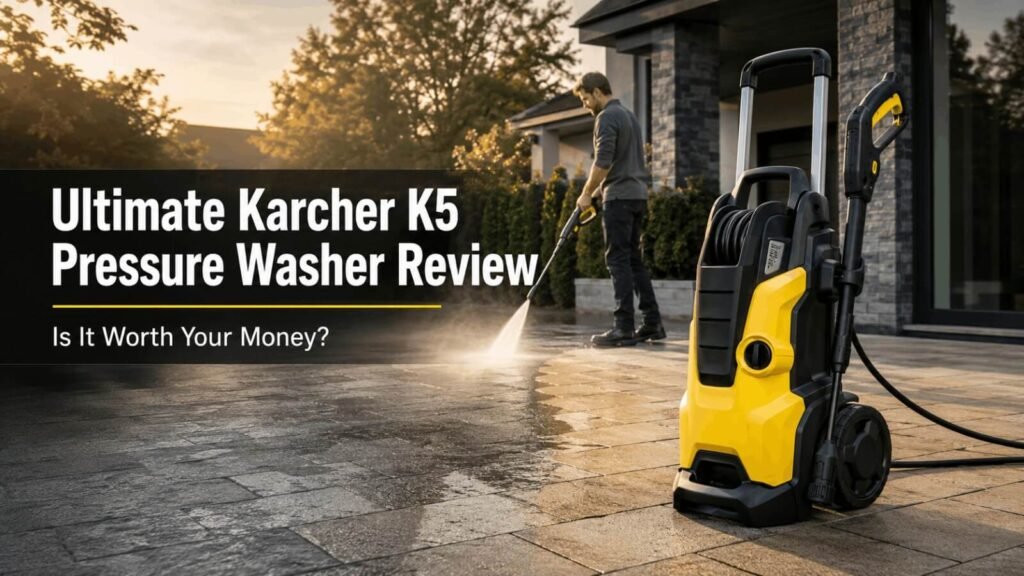
Karcher K5 pressure washer review banner showing outdoor patio cleaning
Buying Guides

Karcher K5 Pressure Washer Review: Specs, Problems and Who Should Buy It

The Karcher K5 pressure washer suits a house, a car, a patio and a fence. It is a slow choice for a big driveway you want clean in an hour. That is the short answer, and the rest of this guide shows where it comes from. One fact first. Kärcher’s US website now lists both the K 5 Premium and the K 5 Power Control as “not in our current range.” You can still find them in stores and online, so this guide also covers what to check before you buy. I did not test this machine myself. The specs come from Kärcher pages, retailer listings and published owner reviews. Where they disagree, you will see both numbers. Quick verdict: who should buy the Karcher K5 Karcher K5 pressure washer specs: what sources agree on I compared Kärcher’s own text with several retailer pages for the K 5 Premium with hose reel. Most numbers match. A few do not, and listings copy each other’s mistakes, so treat a single page with care. Spec What most listings say Where sources disagree Max pressure 2000 PSI No disagreement Water flow 1.4 GPM One Walmart title says 1.45 GPM, another listing says 1.2 GPM High-pressure hose 25 ft RONA lists 20 ft, a Walmart title says 32 ft Power cord 35 ft with a GFCI plug (two retailers) Many sellers do not list it Weight About 32 lb assembled KBC Tools lists 37.5 lb Motor Water-cooled induction motor (Kärcher’s description) Wattage is not listed on US pages I could open Warranty 2 years, limited Check the seller’s own terms The caption under the table is simple: trust 2000 PSI and 1.4 GPM, and confirm hose length, cord length and weight on the box or in the manual. Those three change between listings. Is the Karcher K5 pressure washer still for sale? When I checked on 27 October 2026, Kärcher’s US pages for the K 5 Premium (order number 1.603-361.0) and the K 5 Power Control (1.324-568.0) both said the product is not in the current range. The same pages say accessories, cleaning detergents and operating instructions are still available. That does not mean the machine is bad. It means stock will come from retailers, and prices can swing. Before you pay, do four things: What 2000 PSI and 1.4 GPM mean in real cleaning PSI is the force of the water. GPM is how much water leaves the nozzle each minute. Cleaning power depends on both. A common shortcut is to multiply them and call the result cleaning units. For the K5 that is 2000 x 1.4 = 2,800 cleaning units. The Sun Joe SPX3000, which we review in our own guide, is listed at 2030 PSI and 1.76 GPM, so about 3,570 units. On paper the Sun Joe cleans a flat area faster. The K5 gives you a better build, a quieter motor and a hose reel for the extra cost. One warning applies to every electric washer. Listings often show a peak PSI measured at the start of the spray. One reviewer of the Sun Joe reports about 1,450 PSI at the nozzle during normal use. Do not expect the K5 to hit its full number all the time either. Compare machines on the same basis and the gap between brands gets smaller. Lower flow is not only a weakness. It uses less water, it is gentler on soft surfaces, and a standard 15-amp household outlet can run it. The downside is speed on wide, flat areas like a two-car driveway. Features that matter on the Karcher K5 pressure washer Water-cooled motor Kärcher describes the K5 motor as water-cooled. In plain terms, the water that flows through the pump also helps cool the motor. Reviewers often link this to a quieter machine. One review calls the K5 Premium the quietest electric washer on its list. That is one opinion, not a decibel test, but it matches what the design is meant to do. Vario Power lance and Dirt Blaster The Vario Power lance changes from a soft spray to a hard jet when you twist it, so you do not need to swap nozzles. The Dirt Blaster uses a rotating jet for tough dirt such as moss and weathered surfaces. Kärcher’s datasheet describes both for its K 4 and K 5 class. Use the Dirt Blaster on concrete and brick. Test it on a hidden spot before you use it on wood, because a rotating jet can leave marks on soft grain. Plug ‘n’ Clean detergent system You push a Kärcher detergent bottle straight into the machine, and the washer adds soap as you spray. It is fast and there is no tank to fill. The catch is that the system is built for Kärcher’s own bottles. Check that you are happy buying them before you pick this machine. Hose reel and handle The K 5 Premium has a built-in hose reel. It keeps 25 feet of hose off the floor and stops the tangles that ruin cheaper washers. Kärcher’s datasheet for the Power Control version shows a telescopic handle and a storage net on the body instead. Reel or no reel is the main difference you will see when you unpack the box. Karcher K5 pressure washer models compared The K5 name covers several versions, and sellers mix them up. This table shows what each one adds. I list only what a Kärcher page or a named review states. Version What it adds Things to know K 5 Premium (1.603-361.0) Built-in hose reel, Vario Power lance, Dirt Blaster Kärcher US lists it as not in the current range K 5 Power Control (1.324-568.0 in the US) Pressure display on the gun, three pressure settings plus a detergent setting, app help, Plug ‘n’ Clean Also not in the current US range. Kärcher’s datasheet I read is for the 230 V European version K 5 Premium Smart Control Bluetooth and app, boost mode, screen on the gun, six pressure levels, hose

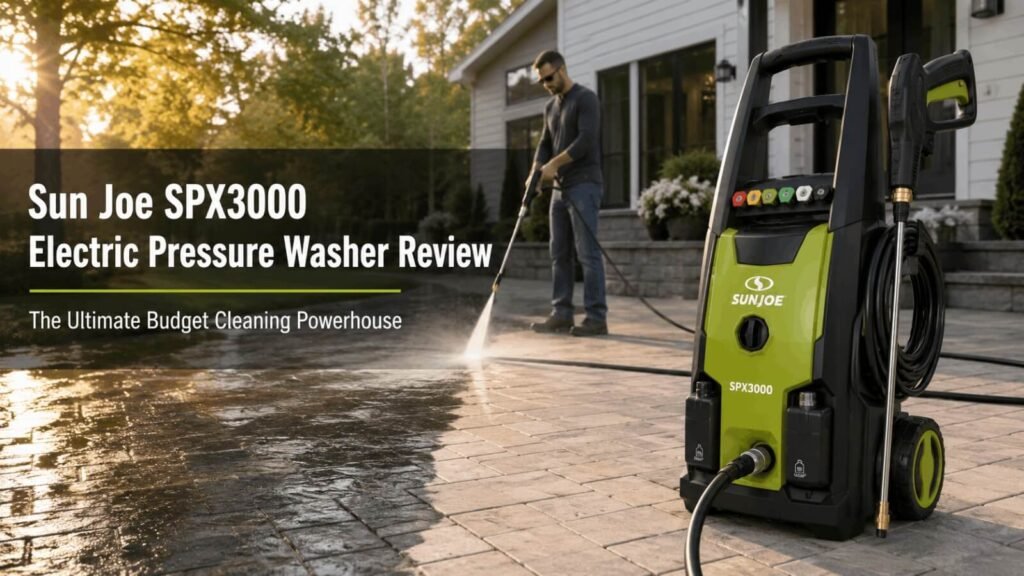
Sun Joe SPX3000 electric pressure washer cleaning a paved patio outdoor area.
Buying Guides

Sun Joe SPX3000 Electric Pressure Washer Review: The Ultimate Budget Cleaning Powerhouse

Sun Joe SPX3000 Electric Pressure Washer Review: The Ultimate Budget Cleaning Powerhouse Sun Joe SPX3000 Electric Pressure Washer Review: The Ultimate Budget Cleaning Powerhouse  Keeping your home’s exterior, driveway, patio, and vehicles clean requires consistent effort. While heavy-duty gas pressure washers offer massive power, they often come with high price tags, heavy frames, noisy engines, and constant mechanical upkeep. For most homeowners, an affordable, quiet, and user-friendly electric unit is the sweet spot. Enter the Sun Joe SPX3000 electric pressure washer. Widely recognized as one of the best-selling residential pressure washers on the market, this versatile machine is engineered to deliver reliable cleaning performance at an accessible price point. In this comprehensive Sun Joe SPX3000 electric pressure washer review, we will dive deep into its core specifications, standalone features, real-world applications, maintenance requirements, and how it performs against top competitors. Quick Specs Overview: Sun Joe SPX3000 Specification Feature Details Model Sun Joe SPX3000 Motor 14.5-Amp / 1800-Watt Motor Max Pressure Output 2030 PSI (Pounds per Square Inch) Max Water Flow Rate 1.2 GPM (Gallons per Minute) Total Cleaning Units (CU) ~2,436 Max CU (PSI × GPM) Spray Lance 34-inch Stainless Steel Spray Lance with Brass Fittings Pump Type Wobble Plate Axial Cam Pump Dual Detergent Tanks Two 0.9 L (0.24 Gal) Removable Onboard Tanks Safety Feature Total Stop System (TSS) Power Cord Length 35 ft. with GFCI Protection High-Pressure Hose 20 ft. High-Pressure Hose Nozzle Attachments 5 Quick-Connect Tips (0°, 15°, 25°, 40°, Soap) Weight ~31 lbs What Makes the Sun Joe SPX3000 Stand Out? The market for residential pressure washers is filled with options, but the Sun Joe SPX3000 2030 PSI 1.2 GPM unit consistently ranks as a fan favorite. It strikes an optimal balance between cleaning power, portability, and value. The core reasons behind its popularity include: Dual Detergent Tank System: Allows you to carry two different cleaning solutions simultaneously in onboard 0.9L tanks and switch between them seamlessly. Tough Components for Everyday Use: Features a 34-inch stainless steel spray lance with brass fittings and a 20-foot high-pressure hose designed to support deep cleaning during routine outdoor maintenance. Total Stop System (TSS): Automatically shuts off the pump when the trigger is disengaged, saving energy and dramatically extending pump life. Versatile Quick-Connect Nozzles: Comes equipped with five color-coded spray tips out of the box for tailored cleaning intensity. Low Maintenance: No oil changes, gas refilling, spark plug maintenance, or carburetor tuning required. In-Depth Feature Breakdown 1. Powerful 14.5-Amp / 1800-Watt Motor At the heart of the Sun Joe SPX3000 is a heavy-duty 14.5-amp motor. Pushing up to 2030 PSI of water pressure and 1.2 GPM water flow, this motor generates enough hydraulic force to lift embedded dirt, moss, mildew, and grime from homes, driveways, vehicles, RVs, and outdoor equipment. 2. Dual Detergent Tanks Unlike most entry-level electric pressure washers that feature either a single soap tank or an external siphon tube, the SPX3000 features dual detergent tanks. Dual Storage Capacity: Two onboard 0.9-liter removable tanks allow you to carry two different cleaning agents (e.g., a car wash soap in one tank and a heavy-duty driveway degreaser in the other). Detergent Selection Dial: A convenient selection knob lets you switch between tanks or adjust the chemical dilution ratio on the fly. [ Tank A: Car Wash Soap ] ──┐                             ├──> [ Selection Dial ] ──> [ Low-Pressure Soap Nozzle ] [ Tank B: Deck Cleaner ]  ──┘ 3. Total Stop System (TSS) Technology One of the most impressive safety and durability features of the Sun Joe SPX3000 is its Total Stop System (TSS). Automatic Pump Shut-Off: When you release the trigger wand, the internal switch detects the pressure lock and shuts off the motor entirely. Extended Pump Life: Prevents the pump from running continuously in bypass mode, which overheating and wearing out internal seals in traditional units. Energy Efficiency: Reduces electricity consumption and keeps the machine completely silent when you are resting or moving items out of the way. 4. 5 Quick-Connect Spray Nozzles Included To adapt to different cleaning tasks without damaging delicate surfaces, the unit includes five quick-connect nozzle tips to switch between narrow jet streams and wider fan patterns: 0° (Red / Blaster): Delivers a pinpoint stream for tough spots, rust stains, or hard-to-reach crevices. 15° (Yellow / Stripping): A narrow spray pattern ideal for stripping paint, cleaning concrete, and removing heavy grease. 25° (Green / Cleaning): A versatile medium-angle spray suitable for sweeping away dirt from brick, wood decks, and stone patios. 40° (White / Washing): A wide-angle spray designed for broad, delicate surfaces like windows, vinyl siding, and cars. Soap (Black / Siphon): A low-pressure nozzle applicator that activates the dual detergent tank siphoning mechanism. Performance in Action: What Can You Clean? [ Light Cleaning: Cars, Windows, Patio Furniture, RVs ]     └── Uses 40° White Nozzle or Black Soap Nozzle with Foam Cannon [ Medium Cleaning: Wood Decks, Fences, Vinyl Siding ]     └── Uses 25° Green Nozzle for balanced grime removal without wood splintering [ Heavy Cleaning: Driveways, Sidewalks, Brick Mortar ]     └── Uses 15° Yellow Nozzle or 0° Red Nozzle for deep concrete agitation 1. Car Washing and Foam Cannon Compatibility The Sun Joe SPX3000 for car washing and foam cannon setups is a top choice for auto detailers working on a budget. The 1.2 GPM water flow rate feeds aftermarket foam cannons effectively, producing rich foam that breaks down road film before hand washing. Pro Tip for Auto Care: Stick to the 40° white nozzle or a dedicated foam cannon. Avoid using the 0° or 15° nozzles directly on vehicle clear coats, headlights, or side mirrors. 2. Patio, Deck, and Fence Restoration Over time, wooden decks and composite patios gather green algae, mold, and grey oxidation. Using the 25° green quick-connect tip at a distance of 12 to 18 inches strips away organic growth safely without gouging soft cedar or pine boards. 3. Driveway and Concrete Cleaning Concrete driveways and brick walkways absorb oil stains, tire marks, and dirt. Using the 15°

Scroll to Top