Author name: Team Pressure Washer Wise

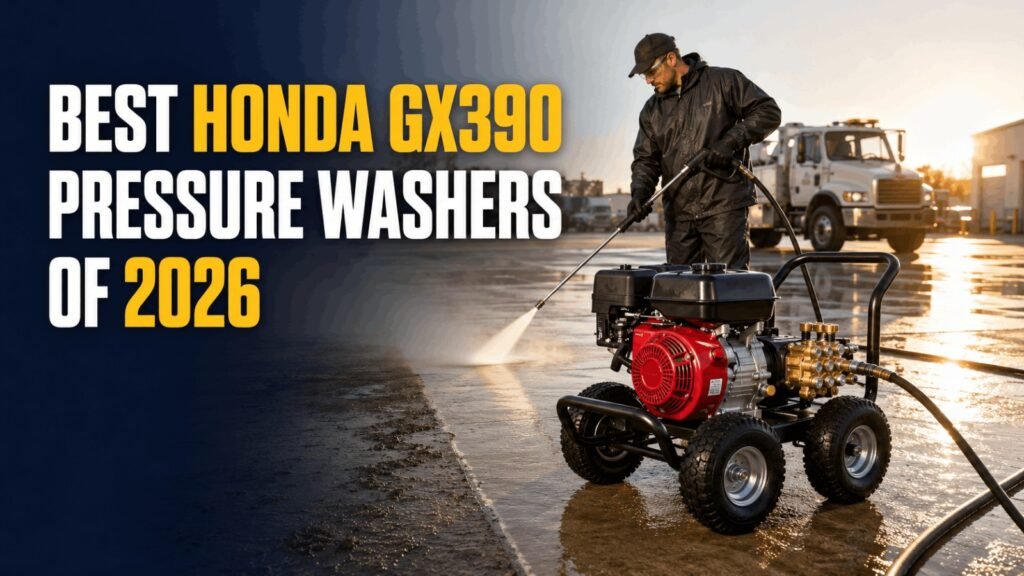
Best Honda GX390 Pressure Washers of 2026 Commercial Guide 2 honda feuture.jpg simpson-aluminum-4400-psi-honda-gx390.jpg Simpson Aluminum
Pressure Washers > Reviews

Best Honda GX390 Pressure Washers of 2026 (4000 PSI Powerhouse)

A Honda GX390 pressure washer is a gas washer built around one of the most common commercial engines in the business: a 389 cc, single-cylinder, air-cooled, four-stroke motor. Honda rates it at about 11.7 horsepower, and that is enough to drive a pump making 4,000 PSI at 4.0 GPM. This guide explains what the engine does, which washers use it, and what to check before you buy one. It is not a list of every machine with a Honda badge. Some well-known 4,000-plus PSI washers use other engines, and we say which ones. We also did not test any machine here. Specs come from maker sheets and dealer listings, and we flag every place where sources disagree. Why you can trust this guide Source order. We used maker spec sheets first, then dealer and parts listings. Each section says which one it relied on. Corrections. An earlier version of this page listed a Simpson “Aluminum Series 4,400 PSI” washer. We could not find that model. Simpson’s own sheet for the Aluminum Series ALH4240 shows 4,200 PSI, so this page now uses that number. Gaps we could not close. We could not open Honda’s own GX390 manual, so we do not quote exact service intervals. Where the engine data differs between sources, we show the range. Last checked: October 24, 2026. Model codes and prices change, so confirm them with the seller. Honda GX390 specs at a glance Several dealer and distributor pages agree on the core numbers. Honda itself uses these ratings, and the small differences below come from how each seller rounds them. Spec Honda GX390 Engine type Single-cylinder, air-cooled, four-stroke, overhead valve Displacement 389 cc (88 mm bore x 64 mm stroke) Power About 8.7 kW (11.7 hp) at 3,600 rpm; some listings show 8.2 kW (11.0 hp) Torque About 26.5 N·m (19.5 lb-ft) at 2,500 rpm Compression ratio 8.0:1 or 8.2:1, depending on the source Oil capacity About 1.1 L (1.16 US qt) Fuel tank About 6.1 L (6.4 US qt) Dry weight About 31.5 kg (69 lb) Why a 4,000 PSI washer needs an engine this size You can check the match with a simple formula. The power water carries is PSI times GPM divided by 1,714, and the answer is in horsepower. A washer making 4,000 PSI at 4.0 GPM needs about 9.3 hp of water power. At 4,200 PSI it needs 9.8 hp. At 4,400 PSI, 17,600 cleaning units, it needs about 10.3 hp. No pump is perfectly efficient, so the real engine load is higher. That is why makers use an engine rated near 11 to 12 hp for this class. A smaller engine would be overloaded, and a much larger one would add weight and cost for no gain. The GX390 also has a long record in rental yards and fleets, which means parts and service are easy to find in most US towns. That matters more to a working crew than any single number on the spec sheet. What that power means in real work Compare it with a home machine. The RYOBI RY142500 is rated at 2,500 PSI and 1.2 GPM, which is 3,000 cleaning units. A 4,200 PSI washer at 4.0 GPM is 16,800 units, about 5.6 times as much. In practice that shows up as speed. A GX390 machine can clear wide concrete, truck beds, equipment and storefronts in far less time, and the 4 GPM flow carries loosened dirt away instead of just pushing it around. You can read how the smaller class performs in our RYOBI 2500 PSI review. Cleaning units are only a yardstick, calculated from maximum ratings. Nozzle size, hose length and how close you hold the wand all change the spray you actually get. Pressure washers that use the Honda GX390 These four machines pair the engine with a triplex pump. All figures come from maker or dealer listings. 1. Simpson Aluminum Series ALH4240 Simpson’s sheet for part 60688 lists 4,200 PSI at 4.0 GPM, a Honda GX390 and a CAT triplex pump on an aircraft-grade aluminum frame. Sources give the weight as 124 to 133 pounds, which is light for the class. It suits crews that load the washer in and out of a truck every day. 2. DEWALT DXPW60605 A parts listing gives 4,200 PSI, 4 GPM, a Honda 389 cc engine, a CAT industrial triplex pump and direct drive. The weight is 139 pounds. The same listing says there is no detergent injection, so plan on a separate soap method. Do not mix it up with the DXPW60606, which has different specs. 3. Pressure-Pro EB4040HC Dealers list 4,000 PSI at 4 GPM, a Honda GX390, a CAT 5PP3140 triplex pump, a 50-foot hose and a chemical injector. Prices run from about $2,177 to $2,212. The model name appears as E4040HC and EB4040HC, and some dealers sell both belt-drive and direct-drive versions, so confirm the drive type. 4. BE B4013 series BE sells several 4,000 PSI, 4.0 GPM models under this name, all with a GX390. The pump depends on the model: one sheet lists a General EZ4040G with a 50-foot hose and a 163-pound shipping weight, and another lists a CAT 66DX40GG1 with a 25-foot hose at 162 pounds. Read the full model code before you buy. Side-by-side comparison Model PSI GPM Pump Weight Simpson ALH4240 4,200 4.0 CAT triplex 124 to 133 lb DEWALT DXPW60605 4,200 4.0 CAT triplex, direct drive 139 lb Pressure-Pro EB4040HC 4,000 4.0 CAT 5PP3140 triplex Not listed BE B4013 series 4,000 4.0 General EZ4040G or CAT 66DX40GG1 162 to 163 lb (shipping) Not every big washer has a Honda GX390 Do not assume the engine from the PSI rating. The Simpson PowerShot PS60843 makes 4,400 PSI at 4.0 GPM, but it uses a 420 cc Simpson CRX420 engine. Kärcher’s HD 3.0/27 runs a Honda GX200, a smaller engine, and makes 2,700 PSI at 3.0 GPM. You will also see “GX390-compatible” or “13 hp” engines on very cheap washers. These are copies, not Honda
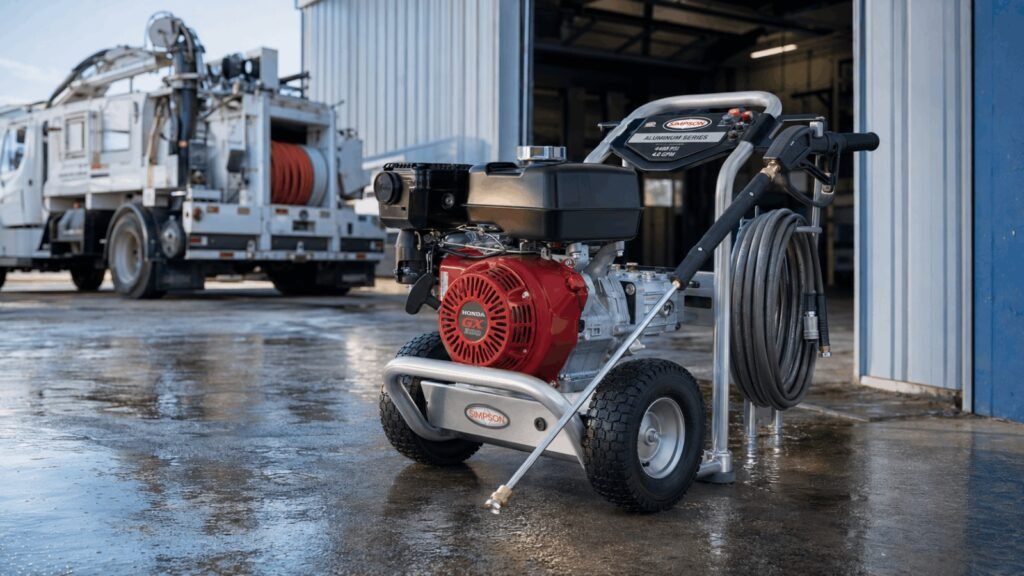
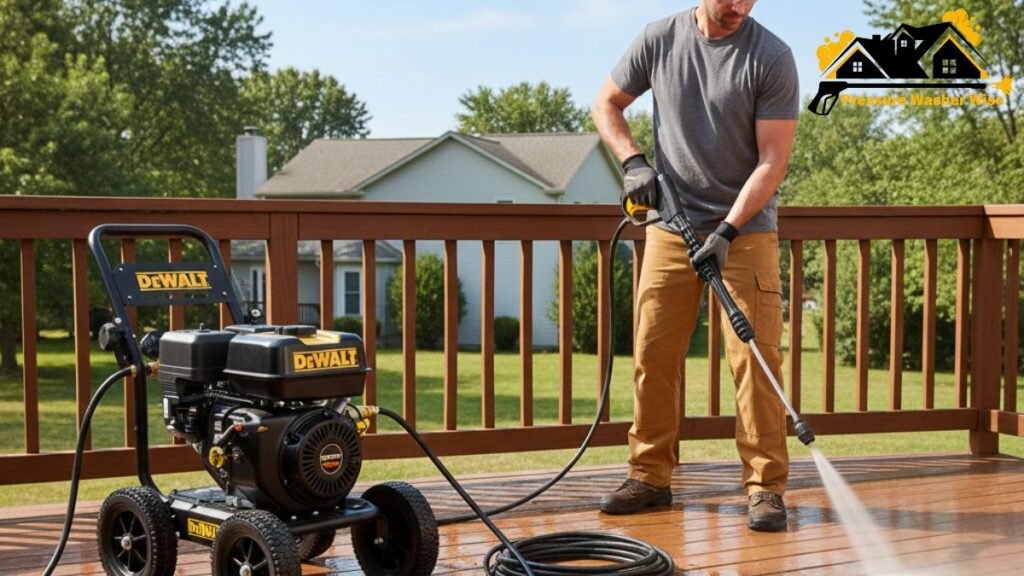
Top rated commercial pressure washer with Honda engine for heavy duty cleaning
Pressure Washers > Reviews

7 Best Commercial Pressure Washers in 2026 (Heavy-Duty Performance)

If you clean trucks, job sites, parking lots or restaurant kitchens for a living, a home pressure washer will not last long. You need a machine that can run for hours, with a strong pump and an engine built for daily work. This guide looks at seven options, from a 4,400 PSI gas unit to a small hot-water electric washer, and explains who each one fits. The best commercial pressure washer for you depends on the surface you clean, the water you have, and how many hours a week you spray. One honest note first. We did not test these machines ourselves. Everything below comes from maker spec sheets, dealer listings and published parts data. We point out where sources disagree, because that happens a lot with commercial washers. Before you buy, check the model number on the box or ask the seller. Why you can trust this guide Here is how we checked the facts, and where the limits are. What “commercial” means for a pressure washer There is no legal rule that says what counts as commercial. In practice, the word usually means three things: a strong pump, an engine that can run for long jobs, and parts that a shop can repair. Two numbers describe the power. PSI is the force of the water. GPM is how much water comes out each minute. Multiply them and you get “cleaning units.” A 4,200 PSI washer at 4.0 GPM gives 16,800 cleaning units. A typical home washer at 2,000 PSI and 1.4 GPM gives only 2,800. That gap is why a commercial machine cleans a large lot so much faster. The pump matters as much as the engine. Most machines here use a triplex plunger pump, which has three pistons and is built to be rebuilt. Cheap home washers often use a smaller axial pump that is not meant for heavy use. If you want to learn more about pump care, read our pressure washer pump maintenance guide. Quick comparison of the seven washers The figures below come from maker sheets and dealer listings. “Cleaning units” is PSI times GPM, a rough way to compare speed. This table helps you shortlist the best commercial pressure washer before you read the details. Model Engine or power PSI GPM Cleaning units Pump Simpson Aluminum Series ALH4240 Honda GX390 (389 cc) 4,200 4.0 16,800 CAT triplex DEWALT DXPW60605 Honda 389 cc 4,200 4.0 16,800 CAT triplex, direct drive Simpson PowerShot PS60843 Simpson CRX420 (420 cc) 4,400 4.0 17,600 AAA triplex Pressure-Pro EB4040HC Honda GX390 4,000 4.0 16,000 CAT 5PP3140 triplex BE B4013 series Honda GX390 4,000 4.0 16,000 General or CAT triplex Kärcher HD 3.0/27 G Honda GX200 2,700 3.0 8,100 Kärcher direct drive AR Blue Clean AR630HW Electric, hot-water rated 1,600 2.3 3,680 AR nickel-plated brass triplex 1. Simpson Aluminum Series ALH4240: a light frame with a big engine This is the machine the old version of this article called a “4,400 PSI” model. Simpson’s own sheet for the ALH4240 (part number 60688) shows 4,200 PSI at 4.0 GPM, so that is the number to trust. It pairs a Honda GX390 engine with a CAT triplex pump and an aircraft-grade aluminum frame. The aluminum frame is the selling point. Sources list the weight at 124 to 133 pounds, which is lighter than most steel-frame machines of the same power. That helps if you load it into a truck bed every day. It is a good fit for a mobile cleaner who lifts the washer a lot and wants a name with easy parts support. It is not the cheapest way to get 4,000 PSI, so compare it with the PowerShot below. For people who carry the machine daily, it is a strong candidate for the best commercial pressure washer. 2. DEWALT DXPW60605: built for rough job sites A parts listing for the DXPW60605 gives 4,200 PSI, 4 GPM, a Honda 389 cc engine, a CAT industrial triplex pump and direct drive. It weighs 139 pounds and measures about 38 inches long, 22.5 inches wide and 28.5 inches tall. The same listing says it has no detergent injection. If you wash with soap all day, you will need a separate way to apply it, such as a downstream injector or a foam cannon. Be careful with similar model numbers. The DXPW60606 is a different machine with a different weight, so do not copy specs from one to the other. Choose it for construction sites, equipment yards and anywhere the machine will be bumped and dragged. Do not choose it if you need built-in soap. On a rough job site it can be the best commercial pressure washer simply because it survives bumps. 3. Simpson PowerShot PS60843: the 4,400 PSI value pick The PS60843 is the strongest machine on this list by the numbers: 4,400 PSI at 4.0 GPM, or 17,600 cleaning units. It uses a 420 cc Simpson CRX420 engine and an AAA triplex plunger pump with a built-in unloader and thermal relief. It comes with a 50-foot, 3/8-inch hose, a rear-load spray gun, a 31-inch wand and five quick-connect tips: 0, 15, 25 and 40 degrees, plus soap. Listings put the weight near 107 pounds. It is a 49-state model, which means it is not sold in California. Deal sites have shown it around $500, but prices change, so check the current one. For a small business that wants strong output without a $2,000 price tag, this is the best commercial pressure washer on the list in terms of value. The trade-off is the Simpson engine, which has a shorter track record than a Honda. 4. Pressure-Pro EB4040HC: a belt-drive machine for daily work Dealer listings describe this as a 4,000 PSI, 4 GPM washer with a Honda GX390 engine, a CAT 5PP3140 triplex pump and an aluminum frame. It includes a 50-foot hose with quick connects, a chemical injector, four color-coded nozzles and a soap nozzle. Listed prices run from about $2,177 to $2,212. Model names are messy here.

DEWALT pressure washer — cordless 20V/60V unit, 2100 PSI electric, and 3000 PSI gas model cleaning a driveway and car
Commercial Pressure Washers, Gas Pressure Washers

How Much PSI Do You Need? A Simple Guide for Every Cleaning Job

How much PSI do you need? For most home jobs, 1,500 to 2,800 PSI is enough. Cars and outdoor furniture need less, wood decks and fences need much less, and big concrete driveways can use more. The right number depends on the surface, the nozzle and your water flow, not just the biggest PSI on the box. I did not test pressure washers for this guide. The ranges below come from retailer and maker guides, and I show where they disagree. Sources do not agree on every surface, so treat each range as a starting point and test a small hidden spot first. The old version of this page was a Honda 4000 PSI review under the wrong title. I moved that content out, and our Honda GX390 guide covers those machines. How much PSI do you need: the short answer More PSI is not better. Too much pressure scars wood, strips paint, chips mortar and can push water behind siding. Start low, then step up only if the dirt does not move. PSI and GPM: what the numbers mean PSI is the force of the water. GPM is how much water flows each minute. PSI cleans the dirt off. GPM rinses it away and sets how fast you work. Retail guides often multiply the two to get a rough cleaning-power number. A 2,000 PSI washer at 1.4 GPM gives 2,800. A 1,700 PSI washer at 2.5 GPM gives 4,250 and will usually clean flat areas faster, even though its PSI is lower. This is why two washers with the same PSI can feel very different. Our Karcher K5 review shows a 2,000 PSI machine with a modest 1.4 GPM, which is great on a car and slow on a big driveway. How much PSI do you need for each job? A quick chart This table uses ranges from several retailer and maker guides. Where sources conflict, I give the cautious end first. Job Starting PSI range Nozzle Notes Car, truck, motorbike 900 to 1,900 40 degree or soap One source suggests 900 to 1,200 PSI at about 2 GPM for detailing. Keep a safe distance from paint. Outdoor furniture, grill, bikes Up to 1,900 25 to 40 degree Light-duty tier. Soft plastic needs the wide nozzle. Wood deck and fence 500 to 1,500 40 degree Soft woods like pine and cedar need the low end. One source says keep the tip at least 12 inches away from a stained fence. Vinyl siding, painted wood 1,300 to 2,500 25 to 40 degree Sources conflict. Some allow higher, so follow the siding maker’s guidance. Patios, walkways, steps 1,500 to 2,800 25 degree or surface cleaner Medium-duty tier. A surface cleaner avoids stripes. Concrete driveway, brick 2,000 to 3,000 Surface cleaner One guide says some brick and concrete can take 3,000 or more. Asphalt, paint removal, heavy build-up 3,000 to 4,000 15 to 25 degree Mostly pro work. Easy to damage a surface. Treat these as a map, not a rulebook. Your siding, your wood and your paint may be more delicate than the average. If the surface is old, soft or painted, start lower. Light, medium and heavy duty: PSI tiers explained Retailers group washers into tiers. The numbers vary a little between stores, but a common split looks like this: Tier PSI Typical flow Good for Light duty 1,500 to 1,900 Up to about 1.5 GPM Cars, furniture, grills, small patios Medium duty 2,000 to 2,800 About 1.4 to 2.5 GPM Decks, fences, siding, driveways Heavy duty 2,900 to 3,200 2.5 GPM and up Concrete, big driveways, tough stains Extra heavy 3,300 and up Often 4 GPM and up Professional work, paint removal Most homeowners land in light or medium duty. Heavy duty gas machines make sense if you clean large areas often. Our guide to the best commercial pressure washers shows what the top tier looks like. Electric or gas: which one gives you the PSI you need? Electric washers are quieter, lighter and need little upkeep. Most land between 1,500 and 3,000 PSI, which covers cars, patios, decks and standard driveways. They are limited by cord length and by how much flow a small motor can make. Gas washers give more power and move around freely, but they need fuel and care and they make exhaust, so you must run them outdoors. If you plan to clean large concrete areas every year, a gas model near 3,000 PSI is a good match. If your jobs are small, electric is simpler. Nozzles change how much pressure the surface feels The nozzle matters as much as the PSI on the label. A narrow tip focuses the water, and a wide tip spreads it out. Colors can differ by brand, but these angles are common: Distance changes force too. Keep the tip moving. If you see any marks on the surface, back off or switch to a wider tip right away. For a full chart, read our guide to pressure washer nozzles, and see the maker’s Alkota nozzle guide for an example of angles and sizes. How much PSI do you need for a car? Less than you think. Sources suggest about 900 to 1,200 PSI for detailing and up to 1,900 for general washing. A 2 GPM flow rinses well without hammering the paint. Use the white or soap nozzle, keep a safe distance, and never aim a hard jet at peeling paint, loose trim or rubber seals. How much PSI do you need for a deck or fence? Wood is easy to damage. Aim for about 500 to 1,500 PSI, and use the lower end for soft woods like pine and cedar. Use a wide tip and work with the grain. Test a spot first. One source suggests keeping the tip at least 12 inches from a stained fence, so you do not strip the stain. If the wood is gray and old, you may see fuzzy fibers after cleaning. That means the pressure was too high or

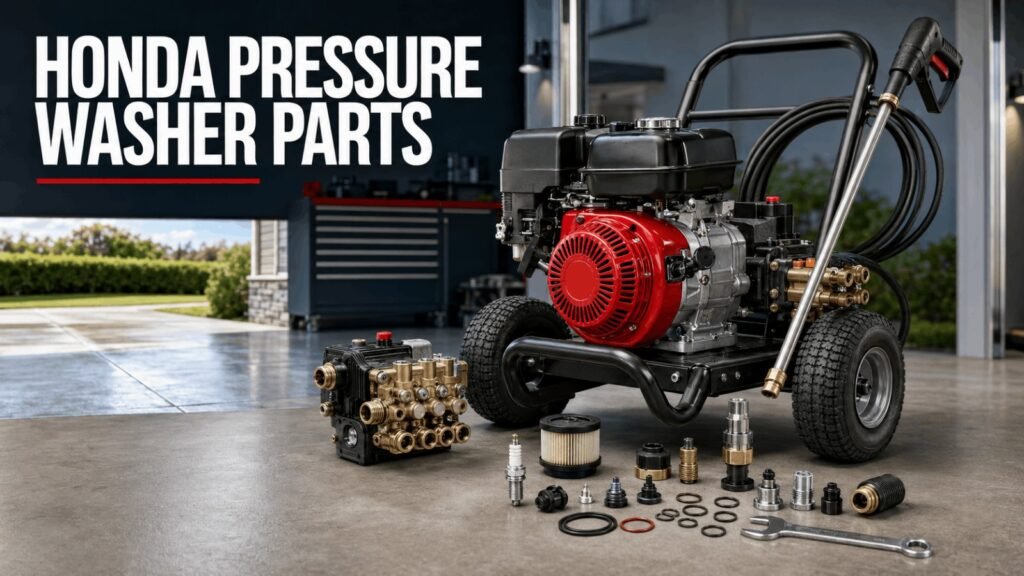
Honda pressure washer parts with replacement engine filters, nozzles, and triplex pump components
Pressure Washer Maintenance & Parts

Honda Pressure Washer Parts: Complete Guide to GX390 Pumps, Repairs & Replacement (2026)

A pressure washer can lose pressure, leak water, run unevenly, or refuse to start even when its Honda engine is still in excellent condition. The difficult part is knowing whether you need Honda pressure washer parts, pump components, or a completely new pump. This distinction matters because Honda usually supplies the engine—not the complete pressure washer pump. A machine advertised as a “Honda GX390 pressure washer” may use a pump made by CAT Pumps, General Pump, AR, Comet, AAA, or another manufacturer. This guide explains how to identify the correct GX390 engine parts, diagnose pump problems, compare repair with replacement, and choose a compatible pump without relying on PSI alone. It is written for homeowners, DIY users, equipment owners, and cleaning professionals who want to avoid ordering the wrong component. Honda Pressure Washer Parts: Know Which System You Are Repairing A gas pressure washer has two major mechanical systems: the engine and the pump. They work together, but their parts normally come from different manufacturers. The Honda engine turns fuel into mechanical power. The pump uses that power to pressurize the incoming water. A problem in either system can make the machine appear weak or unusable. System Main function Common parts Honda engine Produces rotational power Air filter, spark plug, carburettor, fuel valve, recoil starter, ignition coil, gaskets and crankshaft Pressure washer pump Creates water pressure and flow Seals, check valves, plungers, unloader valve, manifold, thermal relief valve and oil seals Water delivery system Carries water to and from the pump Inlet filter, hose, spray gun, fittings, O-rings and nozzle Detergent system Draws and applies cleaning solution Chemical injector, siphon tube, filter and soap nozzle If the engine starts and runs smoothly but the spray is weak, the problem is more likely connected to water flow, the nozzle, unloader, valves, seals, or pump. If the engine will not start, surges without a water load, smokes, or stalls, begin with the Honda engine system. Before buying anything, find both identification labels: The engine model, type code, and serial number. The pump manufacturer and exact pump model. The pressure washer’s complete model and serial number. A photograph of each label is more useful than relying on the words “GX390 pressure washer.” Honda GX390 Pressure Washer Parts The Honda GX390 is a 389cc, air-cooled, four-stroke OHV engine. Current published specifications list net power at approximately 11.7 horsepower at 3,600 rpm. Older listings and advertisements may describe it as a 13-horsepower engine, but net output is the more useful figure when matching a pump. GX390-powered pressure washers are commonly used for concrete cleaning, equipment washing, fleet work, paint preparation, agricultural cleaning, and other demanding jobs. They are larger and more powerful than typical residential machines. Common GX390 Engine Replacement Parts Part Common signs of trouble What to check first Air filter Power loss, rich running or black exhaust Dirt, oil saturation and incorrect installation Spark plug Hard starting, misfiring or rough running Electrode wear, deposits and correct gap Carburetor Surging, fuel leaks or poor starting Old fuel, blocked jet, dirty bowl or damaged gasket Fuel valve and line Fuel starvation or leakage Cracks, blockage, loose clamps and valve operation Recoil starter Rope does not retract or engage Rope, spring, starter pawls and housing Ignition coil No spark or intermittent shutdown Wiring, stop-switch circuit and spark-plug condition Oil Alert system Engine stops or will not start Correct oil level and level ground Muffler and guard Excessive noise or damaged protection Loose fasteners, corrosion and cracks Engine gaskets and seals Oil or fuel leakage Source of leak before ordering a gasket Crankshaft or key Vibration or pump-coupling problems Shaft damage, worn keyway and incorrect pump fit Routine parts such as the air filter and spark plug are usually straightforward to replace. Internal engine repairs involving valve timing, crankshaft damage, low compression, or major oil leakage require more experience and may be better handled by a qualified small-engine technician. Why the GX390 Type Code Matters “GX390” identifies the engine family, but it does not describe every detail of your engine. GX390 versions may differ in: PTO shaft diameter, length, and design Keyway dimensions Recoil or electric starting system Charging coil and wiring Air-cleaner configuration Fuel tank arrangement Control-box design Emissions equipment Regional specifications Two engines can both carry the GX390 name while using different shafts, starter assemblies, carburetors, or electrical parts. Ordering from the full model and type code is safer than choosing a component because a marketplace listing says “fits GX390.” Genuine, OEM-Specification, or Aftermarket Parts? Genuine Honda parts are normally the safest choice when fit, calibration, and long-term reliability matter. They are particularly valuable for carburetors, ignition components, internal engine parts, and parts connected to the Oil Alert system. Good-quality aftermarket filters, starter ropes, gaskets, and routine service items can be practical when their measurements and specifications match. However, very cheap carburetors and ignition coils can produce difficult-to-diagnose problems, including surging, poor fuel control, or inconsistent spark. For commercial machines, saving a small amount on an uncertain part may not be worthwhile if it creates downtime during paid work. Honda GX390 Pressure Washer Pump: What You Need to Know The phrase “Honda GX390 pressure washer pump” can be misleading. It usually means a pump powered by a Honda GX390 engine, not a pump manufactured by Honda. The pump has its own brand, model, specifications, service requirements, and repair kits. A seal kit for one 4,000 PSI triplex pump will not necessarily fit another 4,000 PSI triplex pump. Main Parts Inside a Triplex Pump Commercial GX390 machines commonly use triplex plunger pumps. These pumps use three plungers moving in sequence to create consistent water flow. Important components include: Plungers: Move back and forth to pressurize water. Water seals or packings: Prevent high-pressure water from escaping around the plungers. Oil seals: Keep pump oil separate from the water section. Check valves: Control the direction of water through the pump. Manifold: Contains the high-pressure water passages, valves, and seals. Unloader valve: Redirects water when the spray-gun trigger

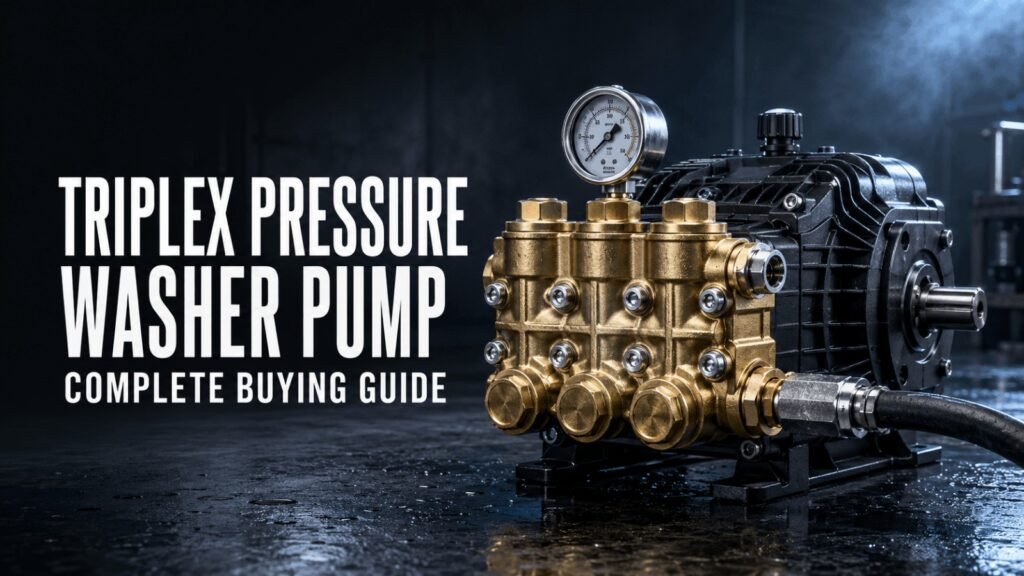
Triplex Pressure Washer Pump Complete Buying Guide Banner
Pressure Washers ➔ Guides & Tips

Triplex Pressure Washer Pump Buying Guide (2026): Types, Specs & Selection

A pressure washer may have a powerful engine, a durable frame, and a professional spray gun, but it cannot clean properly without the right pump. The pump is the core component that converts incoming water into a controlled, high-pressure flow. For demanding cleaning work, a Triplex Pressure Washer Pump is often the preferred choice. It is engineered to deliver steady pressure, handle longer operating sessions, and allow straightforward servicing when seals, valves, or other wear parts need replacement. However, choosing a triplex pump is not as simple as buying the model with the highest PSI. The pump must match your pressure washer’s engine, shaft, mounting pattern, operating speed, water supply, hose, unloader, and intended cleaning work. This comprehensive guide explains how triplex pumps work, how they compare with axial and wobble-plate pumps, what specifications matter most, and how to avoid expensive compatibility mistakes. Pressure Washer Pump: What It Does and Why It Matters A pressure washer pump receives water from a garden hose, tank, or other approved water source. It then moves that water through internal valves and sends it toward the high-pressure hose, spray gun, and nozzle. The pump does not simply “make water powerful.” Its job is to control two critical metrics of pressure washer performance: PSI (Pounds per Square Inch): Represents the force of the water hitting a surface. GPM (Gallons per Minute): Represents the volume of water passing through the system every minute. Both measurements matter. High PSI helps loosen stubborn dirt, while adequate GPM carries the broken dirt away and helps clean a larger area faster. Why the Pump Directly Affects Cleaning Performance A strong engine cannot compensate for a damaged, undersized, or incorrectly matched pump. Common symptoms of a pump-related problem include: Low or inconsistent operating pressure Pulsing flow at the spray gun Water leaking from the pump body Pump oil appearing milky or cloudy Excessive vibration or unusual mechanical noise Pressure dropping significantly after a few minutes of operation Water spraying from the thermal relief valve The engine struggling or stalling when the trigger is pulled Note: Not every pressure problem is caused by the pump. A clogged nozzle, restricted water inlet, leaking hose, dirty filter, trapped air, or incorrectly adjusted unloader can produce similar symptoms. The safer approach is to inspect the complete water path before deciding that the pump must be replaced. Main Pressure Washer Pump Types Compared Most pressure washers use one of three general pump designs depending on their intended application, price point, and serviceability. Pump Type Common Application Serviceability Expected Workload Wobble-Plate Pump Small, affordable electric washers Usually limited / Non-serviceable Occasional light home cleaning Axial-Cam Pump Residential electric and gas washers Varies by model Regular homeowner maintenance Triplex Plunger Pump Prosumer and professional machines Fully serviceable / Rebuildable Frequent or extended heavy cleaning This comparison does not mean every triplex pump will outlast every axial pump. Build quality, maintenance, water conditions, correct installation, and operating temperature all affect overall pump life. A well-built axial pump used correctly may be a better purchase for an occasional homeowner than a poorly matched triplex replacement. High Pressure Washer Pump: Understanding PSI, GPM, and Cleaning Output A High Pressure Washer Pump must deliver the right balance of pressure and water flow for the machine and cleaning job. Choosing only by maximum PSI is one of the most common buying mistakes in the pressure washing industry. PSI Measures Physical Cleaning Force PSI tells you how much pressure the pump can produce under its rated operating conditions. Higher pressure helps with: Cleaning durable concrete and masonry Removing thick, baked-on mud from heavy equipment Stripping loose paint from suitable surfaces Removing heavy environmental buildup from commercial areas However, more PSI is not automatically safer or more useful. Too much pressure can damage vehicle paint, wood fibers, vinyl siding, seals, outdoor furniture, grout, and soft stone. The nozzle angle, distance from the surface, cleaning chemical, water flow, and operator technique are often more important than using maximum pressure. GPM Affects Cleaning Speed and Rinsing Ability GPM measures water volume. A pump with higher GPM can usually rinse loosened debris faster and cover a larger area in less time. For example, two machines may both produce 3,000 PSI. If one delivers 2.3 GPM and the other delivers 4.0 GPM, the 4.0 GPM machine will generally clean large concrete areas twice as fast, provided the engine, nozzle, surface cleaner, and water supply are correctly matched. Higher GPM is especially useful for: Driveway and parking-area cleaning Large patios and building exteriors Commercial surface cleaning & fleet washing Farm and construction equipment Rinsing thick soap or chemical detergents Critical Supply Warning: The property must supply enough water. Installing a 4.0 GPM pump on a water source that only supplies 2.5 GPM can starve the pump. This causes pressure loss, overheating, vibration, and severe cavitation damage. What Are Cleaning Units (CU)? Cleaning units provide a simple way to compare theoretical cleaning output: $$text{Cleaning Units (CU)} = text{PSI} times text{GPM}$$ 3,000 PSI @ 2.5 GPM: $3,000 times 2.5 = 7,500 text{ CU}$ 4,000 PSI @ 4.0 GPM: $4,000 times 4.0 = 16,000 text{ CU}$ Cleaning units are useful for basic comparison, but they do not measure build quality, pump life, nozzle efficiency, chemical effectiveness, or surface safety. Before selecting a commercial setup, always compare the complete machine specifications. If you are looking for a heavy-duty commercial system, check out our detailed guide on the pressure washer honda 4000 psi to see how engine horsepower, pump flow, and structural durability work together. Rated Pressure vs. Maximum Pressure Some product listings emphasize maximum or peak pressure. This figure may only be reached briefly under specific ideal conditions. Rated (working) pressure is far more useful because it represents the continuous pressure the pump is designed to deliver during normal operation. When comparing pumps, always verify: Rated operating pressure & Rated GPM Maximum allowable pressure Maximum RPM Required engine or motor horsepower (HP) Recommended nozzle orifice size Triplex Pressure Washer Pump: How the Design

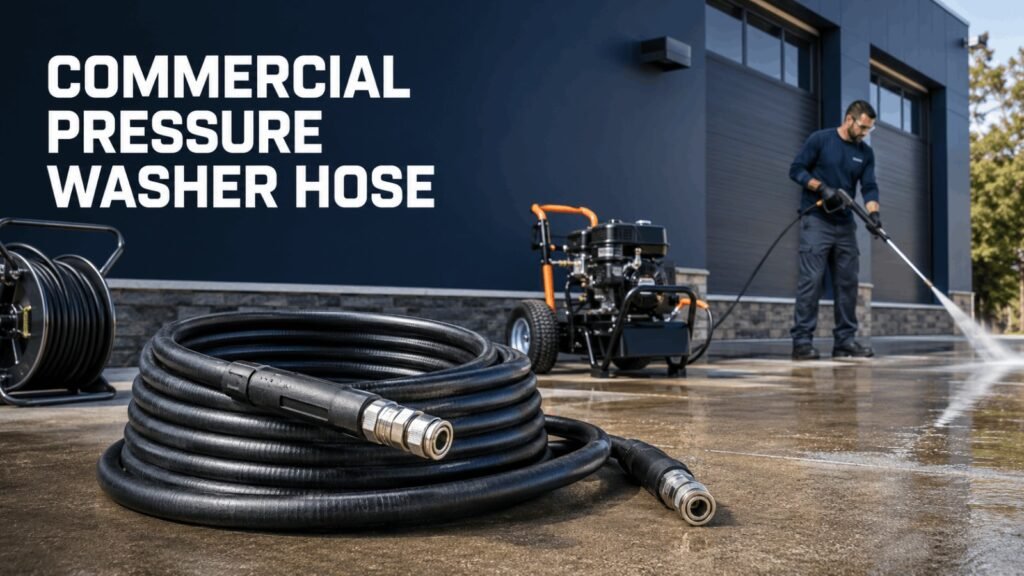
Commercial pressure washer hose guide banner
Pressure Washer Accessories

Commercial Pressure Washer Hose: Ultimate Buyer’s & Safety Guide

A pressure washer can have a strong engine and a reliable pump, yet still perform poorly because of the hose connected to it. A hose that is too narrow, incorrectly rated, badly kinked, or fitted with incompatible connectors can restrict movement, interrupt water flow, and create a serious safety risk. A commercial pressure washer hose is designed for higher pressure, longer working hours, frequent dragging, and demanding cleaning environments compared to a basic residential hose. It is essential for cleaning driveways, parking areas, commercial vehicles, heavy machinery, building exteriors, patios, and large workshops. This comprehensive guide covers hose pressure ratings, inside diameters, construction materials, temperature limits, fittings, extension options, reels, maintenance, and replacement. Whether you are upgrading a homeowner machine or building a professional cleaning setup, this guide will help you choose a commercial pressure washer hose that safely matches your equipment and daily workload. What Is a Commercial Pressure Washer Hose and Why Does It Matter? A commercial pressure washer hose carries pressurized water from the pump outlet directly to the spray gun or surface cleaner attachment. It must withstand high operational pressure and water flow while remaining flexible enough to maneuver around vehicles, buildings, and outdoor obstacles. This high-pressure outlet line is fundamentally different from a standard garden hose. A garden hose operates on the low-pressure inlet side. Using an unsuitable hose on the high-pressure outlet side can result in severe leaks, line ruptures, or pressure-related injuries. Because continuous high-pressure flow originates directly from a heavy-duty Triplex Pressure Washer Pump, your outlet hose must be structurally rated to handle that intense volume without failing. Key Benefits of a Quality Commercial Hose Consistent Water Delivery: Maintains maximum flow rate directly to the spray nozzle. Enhanced Safety: Built with high burst thresholds to prevent high-pressure ruptures. Abrasion Resistance: Heavy-duty outer covers withstand rough asphalt and concrete dragging. Minimal Downtime: Reduces work interruptions caused by tangles, kinks, and structural twists. High Compatibility: Connects seamlessly with commercial surface cleaners, extension wands, and pro spray guns. Extended Reach: Allows long-distance setups without having to constantly move the pressure washer unit. Note: The hose itself does not generate pressure—the pump creates the pressure and flow rate. However, a restricted, kinked, or undersized hose will prevent your entire pressure washer setup from reaching its full potential. Commercial Grade Pressure Washer Hose vs. Residential Hose Choosing between a commercial grade pressure washer hose and a standard residential model depends on your workload, machine specs, and usage frequency. Commercial Hoses feature multi-layer inner reinforcement (like steel wire braids), thicker outer covers, robust bend restrictors, and industrial quick-connect fittings made for continuous use. Residential Hoses are lighter and easy to coil. They work fine for washing cars, patio furniture, and small decks. However, their limitations quickly show when exposed to high GPM machines, hot engines, or rough concrete surfaces. If you are servicing or upgrading a commercial gas unit, pairing the right hose with genuine Honda Pressure Washer Parts ensures maximum engine performance and long-term reliability. Comparison Table: Residential vs. Commercial Pressure Washer Hose Feature Residential Pressure Washer Hose Commercial Pressure Washer Hose Intended Use Occasional home maintenance Daily or regular commercial cleaning Compatible Machines Light electric / Small DIY gas units Commercial gas / Industrial electric units Common Hose Diameter Typically 1/4 inch Standard 3/8 inch Internal Reinforcement Light thermoplastic or textile braid High-tensile textile or steel-wire braid Abrasion Resistance Basic to moderate Heavy-duty / Industrial-grade Temperature Rating Cold-water only (up to 140°F) Cold- or Hot-water options (up to 250°F+) Standard Fittings M22 screw threads or plastic snap-fits 3/8-inch brass/stainless steel quick-connects Commercial does not automatically mean better for every situation. A heavy steel-braided hose can be awkward and unnecessarily bulky for a small electric pressure washer. Always pick a hose that fits your machine’s specs and job scope. If you are currently evaluating pressure washing equipment, check out our detailed guide on commercial pressure washer options to pair the right unit with your hose. Understanding High Pressure Washer Hose Ratings Every high-pressure hose features a clearly defined working-pressure rating (measured in PSI). This number represents the maximum pressure level the manufacturer specifies for safe daily operation. Always choose a working-pressure rating that meets or exceeds your washer’s maximum PSI output. For example, if your pressure washer generates 3,500 PSI, do not pair it with a 3,000 PSI hose. Working Pressure vs. Burst Pressure Do not confuse working pressure with burst pressure. Working Pressure: The safe, continuous operating pressure threshold. Burst Pressure: A laboratory stress-test rating at which a new hose will structurally rupture. Never run your machine based on the burst pressure rating.  Critical Specifications Checklist When checking a high pressure washer hose rating, evaluate these factors together: Maximum Working Pressure (PSI) Inside Diameter (ID) Water Temperature Limits (°F / °C) Overall Hose Length Fitting Type & Material (M22 vs. Quick-Connect) Flow Rate Capacity (GPM) Is a 4000 PSI Commercial Pressure Washer Hose Right for You? A commercial pressure washer hose 4000 PSI is one of the most popular configurations for contractors, fleet cleaners, agricultural operations, and building maintenance teams. When to Choose a 4,000 PSI Hose: Your pressure washer output is rated near or at 4,000 PSI. You operate a commercial-grade gas pressure washer. You regularly clean heavy machinery, commercial fleets, or large concrete areas. You use high-flow surface cleaners or dual-lance wands. You need long hose extension runs across large job sites. Important: Buying a 4,000 PSI rated hose will not increase the pressure output of a 3,000 PSI machine. The hose simply tolerates higher pressure without failing. 3/8 Inch Pressure Washer Hose: The Commercial Standard The inside diameter (ID) of a hose determines how easily water flows through it. A 3/8 inch pressure washer hose is considered the industry standard for professional cleaning operations because it handles high water volume with minimal flow restriction. Choosing the Right Hose Diameter:          1/4″ ID                      5/16″ ID                  

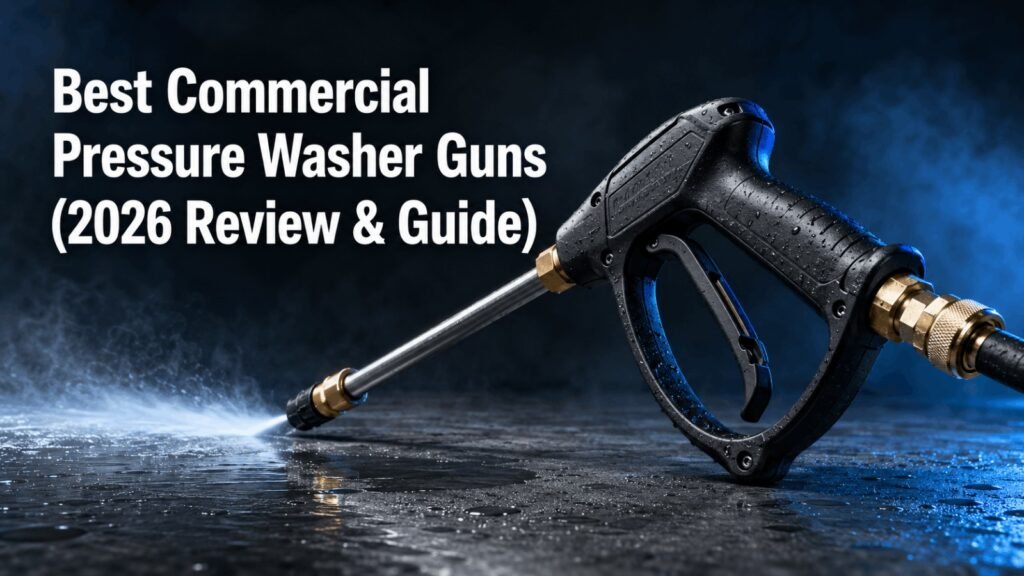
Best Commercial Pressure Washer Guns 2026 Review and Guide featured banner showing heavy duty spray gun
Accessories

Best Commercial Pressure Washer Guns (2026 Review & Buying Guide

A commercial pressure washer gun is a trigger gun built to handle higher pressure, higher flow and hotter water than a home-grade gun, and to survive daily use. The ratings that matter are max PSI, max GPM and max water temperature. Pick a gun whose ratings sit at or above your pump’s output, with a matching inlet thread. This guide compares four guns from Suttner, General Pump, Pressure-Pro and MTM Hydro using maker manuals and dealer listings. We did not test these guns ourselves. Where sources disagree, we show both numbers and say which one to trust. Why a Commercial Pressure Washer Gun Matters The gun is the part you hold all day, and it sees the full pump pressure every time you squeeze the trigger. Cheap guns often use plastic internals and soft seals. They leak at the trigger, stick when hot, and tire your hand. Commercial guns solve four problems: 1. Higher PSI and GPM Ratings Many commercial guns are rated for 4,000 to 5,000 PSI and 10 to 12 GPM. A home gun is often rated far lower. If the gun’s rating is below your pump’s output, the gun is the weak link. 2. Hot Water Compatibility Hot-water machines push water well above 200 degrees F. The guns below list ceilings from about 300 to 320 degrees F, with special seals for heat. 3. Less Hand Fatigue Wider triggers and linear pull designs spread the load across your fingers. That matters on an eight-hour day. 4. Repairable Construction Seats, seals and swivels can be replaced on most commercial guns, so one gun can last for years. Top Features to Look for in a Heavy-Duty Spray Gun Pressure (PSI) and Flow Rate (GPM) Ratings Match or beat your pump on both numbers. A pump that makes 4 GPM at 4,000 PSI delivers 16,000 cleaning units (4,000 x 4). A gun rated 5,000 PSI and 12 GPM has plenty of headroom for that pump. A gun rated 3,000 PSI does not. Inlet and Outlet Connection Types Most guns here use a 3/8 inch female inlet and a 1/4 inch female outlet. Some guns have a swivel inlet, which stops the hose from twisting. Check the thread type too. Suttner’s manual lists a BSP 3/8 inlet on the ST-2600, while US dealers sell NPT versions of similar guns. Mixing thread types causes leaks. Heat Resistance and Internal Valve Materials For hot water, look for fluorocarbon (Viton) seals and a stated temperature rating. Acid or chemical work needs a ceramic ball and a corrosion-resistant seat. Detailed Reviews: Commercial Pressure Washer Spray Guns The table gives the headline numbers. Details follow for each gun. Gun Max pressure Max flow Max temperature Source quality Suttner ST-2600 310 bar (about 4,500 PSI) 45 L/min (about 12 GPM) 90 C constant, 150 C short term Maker manual Suttner ST-2300 4,500 or 5,000 PSI 12 GPM 300 F Dealer listings differ General Pump DG5010 5,000 PSI 10 to 10.5 GPM 320 F Dealer listings Pressure-Pro ST-601 4,000 PSI 12 GPM Not found One dealer listing MTM Hydro SG35 / SGS35 5,000 PSI 12 GPM 320 F (stainless swivel version) Dealer listings Only the ST-2600 numbers come from a maker manual. The rest come from dealers, so check the part number on the gun before you buy. 1. Suttner ST-2300 and ST-2600 Series Suttner is a German maker, and the ST-2600 manual is the most authoritative document in this comparison. It gives a maximum permissible pressure of 310 bar, a maximum flow of 45 liters per minute, and a permanent water temperature of 90 C, with short-term water up to 150 C. Converted, that is about 4,500 PSI, about 12 GPM, and 194 F continuous with brief peaks near 302 F. Some US dealers advertise the ST-2600 at 5,000 PSI. That looks like a dealer rating, not the manual’s limit, so trust 310 bar. The ST-2300 is listed by dealers as a 12 GPM anti-fatigue gun with a 300 F ceiling. One dealer says 4,500 PSI with a weep seat. Another says 5,000 PSI with a zero-leak seat. The version depends on the part number. A weep seat lets a small amount of water escape to protect against freezing, while a zero-leak seat holds fully shut. Good for: daily professional use and hot water. Watch for: the exact part number, seat type and thread. 2. General Pump DG5010 The DG5010 is a rear-inlet gun listed at 5,000 PSI and 320 F, with Viton seals and added venting for heat. It is built from brass, stainless steel, plastic and Viton. Dealers list the flow as 10 GPM, and a few say 10.5 GPM. General Pump’s own datasheet did not show up in our search, so these numbers are dealer figures. Related guns carry different suffixes. The DCG5010 is a compensating version, and the DGE5010 is listed at 10.5 GPM. A 10 GPM gun is still more than most single-operator machines produce. Good for: high-pressure work and hot water. Watch for: the model suffix, since flow and design differ. 3. Pressure-Pro Linear Trigger Gun We found one dealer listing for the Pressure-Pro ST-601 (model 200 601 610) giving up to 4,000 PSI and 12 GPM with a 3/8 inch inlet and 1/4 inch outlet. We found no temperature rating, so do not assume it is a hot-water gun. A 4,000 PSI limit also means it cannot take the full output of a 5,000 PSI pump. A generic linear trigger gun from another dealer showed 4,000 PSI, 10.5 GPM and 300 F, but that listing did not name the brand, so we left it out of the comparison. Good for: cold-water work at up to 4,000 PSI where hand comfort matters. Watch for: the missing heat rating. 4. MTM Hydro SG35 and Acqualine SGS35 The SG35 family is listed at 5,000 PSI and 12 GPM. The SGS35 with a built-in stainless swivel and quick connects is listed at 320 F. One retailer shows 5,075 PSI instead of 5,000, which

Best commercial electric pressure washer heavy duty unit spraying water outdoors
Buying Guides

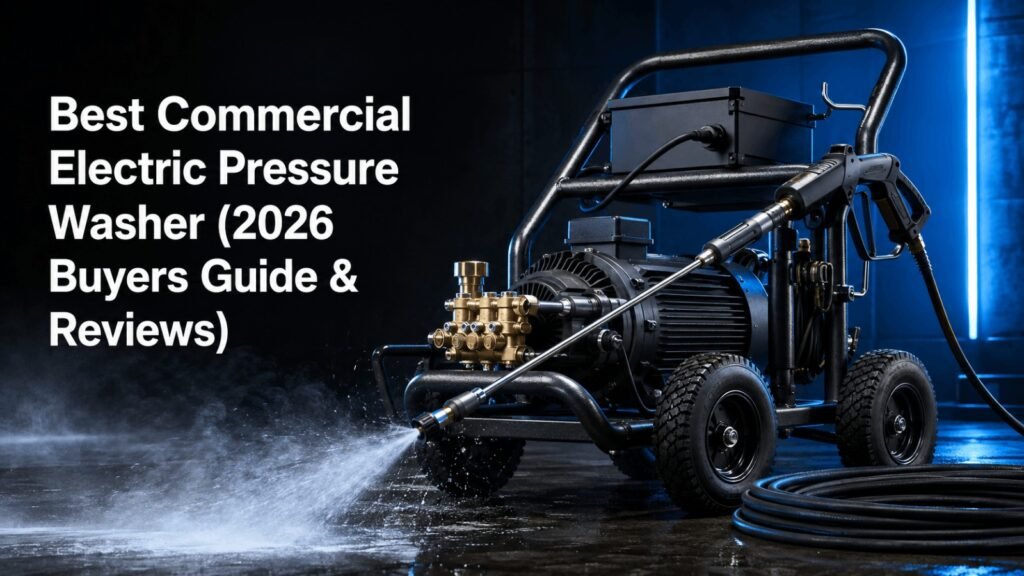
Best Commercial Electric Pressure Washer (2026 Buyers Guide & Reviews)

The best commercial electric pressure washer depends first on your power supply, not the brand. A 120 volt machine suits detailing and light shop work at about 1,900 PSI and 2 GPM. A 230 volt machine reaches 3,000 PSI and 3.5 to 4 GPM, which is what most true commercial jobs need. Hot water is a separate choice for grease. I did not test any washer in this guide. The specs come from dealer listings and one maker page, and I show where they disagree. The old version of this page also listed three products I could not verify at all: a Canpump unit, an Epps unit and a Kärcher HD 3.0/20-4 M Cage. I removed them rather than repeat numbers I could not check. Best commercial electric pressure washer: quick picks by job Comparison: models I could check from dealer listings These figures come from dealer listings, not from my own tests. Where numbers differ between sellers, the last column says so. Model Power Pressure and flow Water Where sources disagree AR Blue Clean AR630TSS 120 V, 60 Hz (one dealer lists 20 A) About 1,900 PSI, 2.1 GPM Cold A Gen 2 AR630 is listed at 1,600 PSI and 2.3 GPM. Old page said 2,030 PSI, which I could not confirm AR Blue Clean AR630HW 120 V 1,600 PSI, 2.3 GPM Hot Another hot variant lists 1,500 PSI at 2.1 GPM and 19 A Pressure Pro EE3015G wall mount 230 V, 3 HP 1,500 PSI, 3 GPM Cold Dealer listing only Pressure Pro EE3530G 230 V single phase, 35 A 3,000 PSI, 3.5 GPM Cold Direct-drive General pump per one dealer DEWALT 60783 230 V single phase 3,000 PSI, 4 GPM Cold Check amperage on the nameplate Mi-T-M CW Premium 3000 230 V, 8 to 10 HP depending on model 3,000 PSI, 3.5 to 3.9 GPM Cold Single and three phase versions exist, amps vary DEWALT also lists a DXPW3000E 3,000 PSI, 4.0 GPM electric pressure washer on its own site, so check the exact model number before you buy. Why pick the best commercial electric pressure washer over a gas one The trade-off with any commercial electric pressure washer is power supply and portability. A gas engine works anywhere. An electric unit needs the right outlet or circuit and a cord. If you move between job sites, gas or a generator-powered setup may still make more sense. See our Honda GX390 guide for the gas side. Power: the biggest factor in choosing a commercial electric washer 120 volt units Ordinary outlets in the U.S. are 120 volts, and consumer-style electric washers usually draw 13 to 15 amps. One forum discussion notes that a 15 amp, 120 volt circuit limits output to roughly 2.4 electric horsepower, which is why higher-pressure work moves to 230 volts. That is anecdotal, but it matches what the specs show: 120 volt machines top out around 2,000 PSI and about 2 GPM. 230 volt units Commercial machines at 3,000 PSI are normally 230 volt. A 3,000 PSI, 3.5 GPM unit like the Pressure Pro EE3530G is listed at 35 amps. That is a dedicated circuit, not a wall outlet. Have a licensed electrician check your panel, breaker size and wiring before you buy, and follow the nameplate and local code. Extension cords and GFCI One cord calculator suggests 12 AWG outdoor-rated cord for a typical pressure washer, with thicker wire for long runs, for example 10 AWG at 100 feet. Keep plugs dry and use GFCI protection. Never run a 230 volt commercial unit through a household extension cord. The best commercial electric pressure washer is useless if the circuit trips every five minutes. PSI and GPM for commercial electric work Pressure loosens dirt. Flow rinses it and sets your speed. Multiply them for a rough cleaning-power number. A 1,900 PSI, 2.1 GPM unit is about 3,990. A 3,000 PSI, 4 GPM unit is 12,000, which is three times faster on flat concrete. Our guide on how much PSI you need shows safe ranges by surface. If you will clean big slabs, pair a 4 GPM machine with a surface cleaner. Our guide to the best commercial pressure washer surface cleaner explains how to match size to flow. Cold water or hot water? Cold water is enough for dirt, mud, algae and most vehicle washing. Hot water helps with grease, oil and sticky residue. Electric hot water models exist, but they add cost, and heating needs power or fuel. Check the temperature rating on any hose, gun and accessory before you run hot water. One 120 volt manufacturer model lists a maximum inlet temperature of 122 degrees Fahrenheit, so inlet limits are real. Triplex pump or axial pump? Commercial washers use a triplex plunger pump, which has three pistons and is built for long hours. Cheaper residential machines use an axial cam pump, which wears faster. Dealer pages often name the pump brand, like General Pump on some Pressure Pro models, so look for that. Direct drive pumps are compact. Belt drive models run slower and are often marketed as longer lasting. Commercial versus residential electric pressure washers A commercial machine is built for daily use, and the best commercial electric pressure washer for a busy shop is the one sized for that workload. It has a stronger motor, a metal pump head, a better warranty and parts you can replace. A residential machine is built for a few hours a month. If you use a washer on most workdays, buy commercial. If you wash a car and a patio, you do not need it. What to check before you buy the best commercial electric pressure washer Maintenance that protects a commercial electric washer Our pump maintenance guide and winterizing guide cover the routine. For nozzles, read our nozzle guide. Match the best commercial electric pressure washer to the job Most buying mistakes come from sizing for the hardest job you do once a year. Size for the job you do every

Best commercial hot water pressure washer unit spraying high temperature steam on factory floor
Equipment Reviews

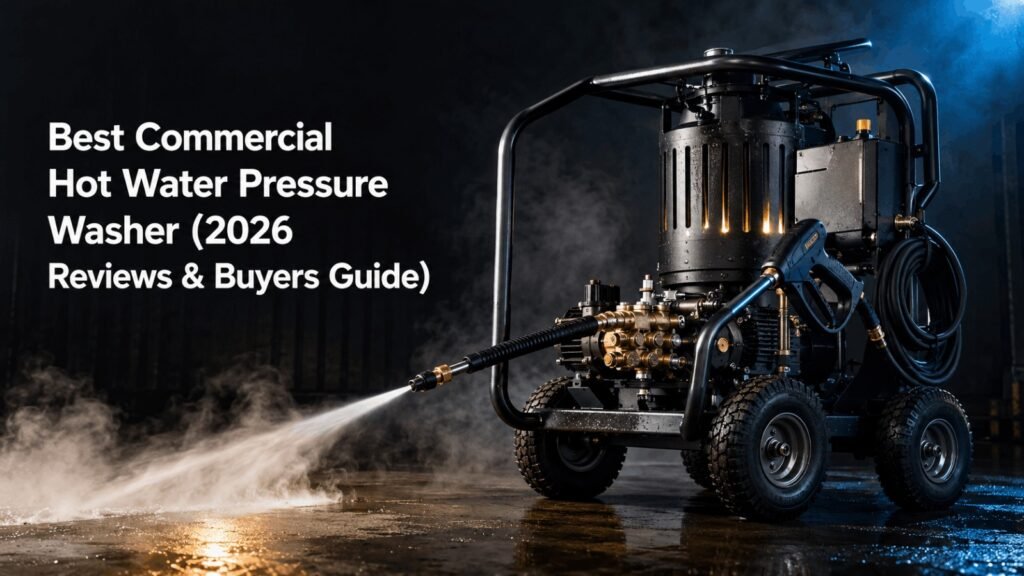
Best Commercial Hot Water Pressure Washer (2026 Reviews & Buyers Guide)

When cleaning tough grease, heavy oil, grime, and industrial dirt, commercial spaces require thermal power, high water volume, and supreme mechanical reliability. While cold water pressure washers work well for loose mud and surface dust, they struggle when facing petroleum-based greases, animal fats, and thick sludge. Investing in the best commercial hot water pressure washer completely changes the outcome. By combining high pressure (PSI) and high water flow (GPM) with water heated up to 200°F (93°C), these industrial machines break down molecular bonds in stubborn grime in seconds. Whether you manage a commercial fleet, an auto detail shop, a food processing facility, or an agricultural operation, choosing the right commercial hot water system is critical to maintaining operational efficiency and sanitizing your property. In this comprehensive guide, we review top-rated commercial models, break down essential heating coil technologies, and explain the key metrics you need to evaluate before buying. Quick Comparison: Top Commercial Hot Water Pressure Washers Model Max Pressure (PSI) Water Flow (GPM) Drive & Burner Source Best For Kärcher HDS 3.5/30-4 Eg 3,000 PSI 3.5 GPM Electric Motor / Diesel Burner Indoor Wash Bays & Auto Detailing Simpson Brute 4400 PSI 4,400 PSI 4.0 GPM Gas Engine (Honda) / Diesel Burner Mobile Contractors & Job Sites Easy-Kleen Commercial Series 2,400 PSI 3.0 GPM Electric Motor / Diesel Burner Food Processing & Sanitation NorthStar Towable Skid Unit 4,000 PSI 4.0 GPM Gas Engine (Honda) / Diesel Burner Heavy Fleet & Agriculture 1. Why Invest in a Commercial Grade Hot Water Pressure Washer? Understanding the physics of thermal cleaning makes it clear why heavy industrial jobs require heat rather than cold water alone. The Thermal Advantage: Breaking Molecular Bonds Cold water cleans through force alone, which can take hours when dealing with oily deposits. A commercial grade hot water pressure washer heats water to near-boiling temperatures. Heat acts as a natural solvent, liquefying oil and grease on contact. This thermal action reduces chemical detergent consumption by up to 60%, lowering your ongoing supply costs while cleaning up to 40% faster. Rapid Sanitation for Commercial Facilities For commercial kitchens, food processing plants, and livestock facilities, hygiene is regulated by strict standards. Water temperatures exceeding 180°F kill bacteria, algae, and pathogens without relying heavily on harsh chemical sanitizers. Faster Surface Drying Times Hot water evaporates significantly faster than cold water. When cleaning concrete driveways, parking garages, or indoor warehouse floors, using hot water ensures surfaces dry quickly, reducing slip-and-fall hazards for employees and customers. 2. In-Depth Reviews: The Best Commercial Hot Water Pressure Washer Models 1. Kärcher HDS 3.5/30-4 Eg – Best Heavy Duty Hot Water Pressure Washer The Kärcher HDS series is globally recognized as a premier heavy duty hot water pressure washer built for daily commercial operation. Powered by a quiet electric motor and equipped with a highly efficient vertical heating coil, this machine delivers consistent heat and high rinsing force. Key Specifications: PSI: 3,000 PSI GPM: 3.5 GPM Drive Motor: 7.5 HP Electric Motor (230V / 1-Phase) Burner Fuel: Diesel / Kerosene Pump: Kärcher Crankshaft Triplex Plunger Pump Features & Benefits Kärcher’s Eco!efficiency mode optimizes fuel consumption, reducing burner fuel usage by 20% without sacrificing water temperature. The ceramic-piston triplex pump ensures thousands of service hours, while its low-speed motor reduces wear on pump seals and internal valves. Pros: Exceptional fuel efficiency with integrated thermostat control. Continuous-duty induction motor ideal for enclosed wash bays. Built-in hard water scale protection system. Cons: Requires dedicated 230V electrical wiring. If your business operates inside a warehouse, factory, or auto detail shop, investing in the Best Commercial Electric Pressure Washer like the Easy-Kleen Commercial Series provides zero motor exhaust while keeping water temperatures boiling hot. 2. Simpson Brute 4400 PSI – Best Gas Commercial Hot Water Pressure Washer For mobile contractors who need massive stripping force without relying on electrical outlets, the Simpson Brute stands out as the best gas commercial hot water pressure washer on the market. Key Specifications: PSI: 4,400 PSI GPM: 4.0 GPM Engine: Honda GX390 Commercial Series Gas Engine Burner Fuel: Diesel-Fired Burner Pump: AAA Industrial Triplex Plunger Pump Features & Benefits Driven by the ultra-reliable Honda GX390 engine, this unit generates enough force to strip paint, clean heavy machinery, and remove baked-on road tar. The heavy-duty steel cage frame features pneumatic tires, making it easy to maneuver across rough construction sites. Pros: Unmatched raw cleaning power (17,600 Cleaning Units). Honda GX390 engine offers easy pull-starts and commercial durability. Heavy-duty steel wrap-around frame protects vital components during transport. Cons: Gas exhaust requires outdoor operation only. 3. Easy-Kleen Commercial Series – Best Electric Hot Water Pressure Washer Commercial If your business operates inside a warehouse, factory, or auto detail shop, an electric hot water pressure washer commercial unit like the Easy-Kleen Commercial Series provides zero motor exhaust while keeping water temperatures boiling hot. Key Specifications: PSI: 2,400 PSI GPM: 3.0 GPM Drive Motor: 5.0 HP Heavy-Duty Electric Motor (230V) Burner Fuel: Diesel / Heating Oil Pump: General Pump Ceramic Triplex Plunger Pump Features & Benefits Easy-Kleen designs its machines with open-frame architecture, allowing quick maintenance access to the pump, motor, and heating coils. Equipped with a high-efficiency Schedule 80 steel heating coil, this unit brings cold inlet water up to 200°F rapidly. Pros: Zero indoor motor emissions. Premium General Pump triplex head with solid ceramic plungers. Adjustable thermostat allows precise temperature control. Cons: Heavy frame best suited for stationary placement or wash bay mounting. 4. NorthStar Towable Skid Unit – Best Portable Commercial Hot Water Pressure Washer When fleet washing or municipal maintenance demands a self-contained washing system, a portable commercial hot water pressure washer configured as a skid or trailer mount is essential. The NorthStar Towable Skid Unit delivers extreme water output on the go. Key Specifications: PSI: 4,000 PSI GPM: 4.0 GPM Engine: Honda GX390 Gas Engine with Electric Start Burner Fuel: Diesel / Heating Oil Pump: CAT Pumps Commercial Triplex Plunger Pump Features & Benefits Featuring a legendary CAT triplex pump, this skid-mounted unit is built

Troubleshooting

Why Won’t My Pressure Washer Start?

Common causes of a pressure washer that won’t start fall into four groups: no power, old fuel, low oil, or a safety switch that never closed. On an electric washer, the usual culprit is a tripped GFCI plug or an undersized extension cord. On a gas washer, it is stale fuel or the low-oil shutoff. This guide works in the order that saves time. You start with the free checks, move to the common faults, and only then touch the spark plug or carburetor. If your question is “why won’t my pressure washer start,” pick your engine type below and follow the steps. Common causes by symptom: find yours first Use this table to jump to the likely cause. Every row is explained in detail further down. What you see Likely cause First thing to try Electric: nothing happens, no sound Tripped GFCI, dead outlet, tripped breaker Press RESET on the plug, test the outlet with a lamp Electric: hums but the motor won’t spin Pressure trapped in the pump, weak power, bad capacitor Squeeze the trigger to release pressure, plug in without an extension cord Electric: runs a minute, then dies Thermal overload from heat or a thin cord Unplug, let it cool 20 to 30 minutes, use a heavier cord Gas: pulls fine, no sign of firing Stale fuel, choke or fuel valve in the wrong spot Check the fuel valve, choke and fuel age Gas: cranks, never catches Low oil sensor, fouled spark plug Check the dipstick, then pull the plug Gas: pull cord is stiff or locked Water or pressure locked in the pump Shut off water, squeeze the trigger, try again Gas: starts, then stalls Clogged fuel cap vent, dirty carburetor, choke left on Loosen the fuel cap, open the choke slowly None of these fixes needs special tools. The spark plug socket is the only item most people have to buy. Safety checks before you touch anything Do three things before you open or test the machine. They take two minutes and prevent most injuries. Also let a hot engine cool before you touch the muffler or open the fuel cap. A warm engine can spray fuel when you remove the cap. Check the basics that fool everyone Before blaming the engine, run through the small stuff. Maker troubleshooting guides all list these first, because they fix a surprising number of “dead” machines. If none of these helps, split into the electric or gas section below. Electric pressure washer won’t start Electric washers have fewer moving parts, so the fault is usually in the power path. Work from the wall outlet toward the motor. 1. Tripped GFCI Most electric washers have a GFCI built into the plug. Press the RESET button firmly. If it clicks and the washer starts, you are done. If the GFCI won’t reset, plug the washer into a different outlet. If it still won’t reset, the plug or the power cord is damaged. A damaged cord can trip the GFCI instantly, so inspect the whole length for nicks and crushed spots. 2. Dead outlet or tripped breaker Plug a lamp or phone charger into the same outlet. If that is dead too, check the breaker panel and the GFCI outlet in the garage or bathroom, since outdoor outlets are often fed from there. Reset it and try again. 3. The extension cord problem A thin or long cord causes a voltage drop. The motor then pulls more current, gets hot, and cuts out. Maker manuals warn against extension cords for this reason, and the numbers they give differ by brand. Source Cord advice Karcher K 280 M manual 25 ft of 12/2 cord, or 50 ft of 10/2 cord Simpson-style guidance 25 ft or shorter, 14/3 or thicker, outdoor rated Other dealer guides 14 gauge, no longer than 50 ft These figures disagree, and a lower gauge number means a thicker wire. The manual for your model should be the tiebreaker. The safest test is to plug the washer straight into a known-good outlet with no extension cord at all. 4. Thermal overload Electric motors have a thermal protector that cuts power when the motor overheats. It can trip after a long job, in a hot garage, or when a thin cord forces the motor to work harder. Unplug the washer and wait 20 to 30 minutes. Some units reset by themselves once they cool, and others have a small reset button on the motor housing. If it trips again within minutes, suspect the cord or a worn pump. 5. Total Stop System, trigger and pressure switch Many electric washers only run while you hold the trigger. When you release it, a pressure switch or Total Stop System shuts the motor off. If the system sticks or air is trapped in the lines, the motor may not respond. 6. Hum, but no spin A hum with no movement points to a locked pump or a weak start capacitor. Release the trigger pressure first, then try again on a short cord. If the motor still only hums, stop. Running it can burn out the windings, and the repair is a job for a service center. Gas pressure washer won’t start A gas engine needs three things at the same moment: fuel, spark and air, plus enough oil to pass the low-oil sensor. Check them in the order below, because the first two cause most no-starts. 1. Oil level and the low-oil sensor Many engines have a low-oil shutdown that blocks the ignition. Honda’s manuals describe this as an oil alert system. The engine cranks, but no spark reaches the plug. Put the machine on level ground. Wipe the dipstick, push it in without screwing it, and read the level. Top up if it is low. An overfilled crankcase is also a problem, so drain it back to the full mark if you overshoot. 2. Fuel: the most common cause Old gasoline is the top reason outdoor equipment won’t start, according

Scroll to Top