Author name: Team Pressure Washer Wise

greenworks electric pressure washer 2000 psi
Electric Pressure Washers

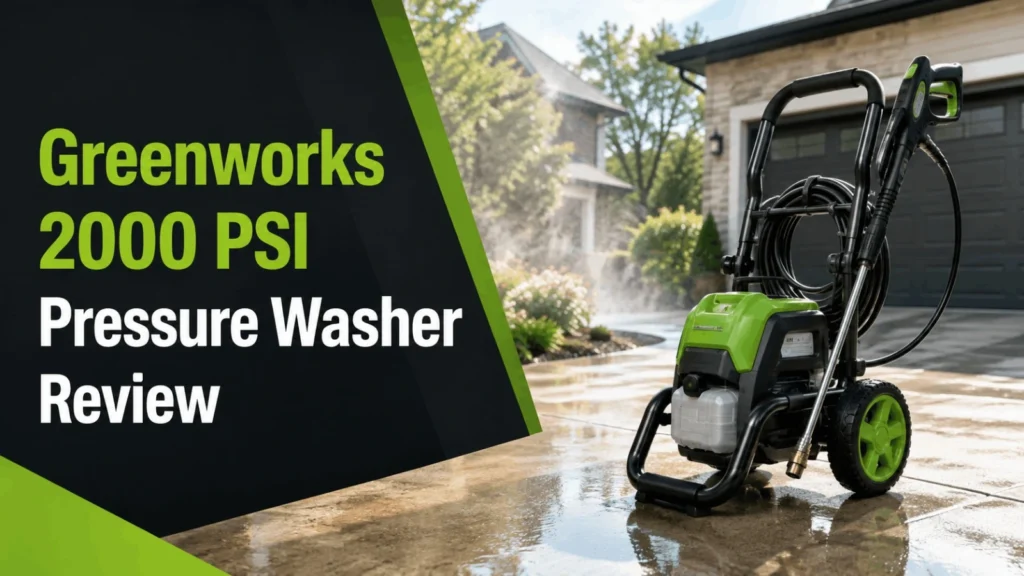
Greenworks Electric Pressure Washer 2000 PSI Review: Specs, Uses, and Common Problems

The Greenworks electric pressure washer 2000 PSI is designed for routine residential cleaning without the fuel, exhaust, or engine maintenance of a gas machine. The GPW2003 combines a claimed maximum pressure of 2,000 PSI with an open-frame design, onboard detergent tank, and four spray options. It suits cars, furniture, fences, siding, decks, and modest paved areas better than large or commercial jobs. Review methodology: This is an editorial, specification- and manual-based review of model GPW2003 (SKU 5118202), not a claim of hands-on testing. Product details were checked against Greenworks’ official product information and support guidance on August 27, 2026. Performance comments below are reasoned from the verified specifications and intended applications. Always follow the manual supplied with your machine. Greenworks Electric Pressure Washer 2000 PSI: Quick Verdict The GPW2003 is a useful middle ground between a basic light-duty washer and a high-flow gas model. Its long cord, wheeled frame, soap tank, and varied nozzles suit household cleaning. However, its listed 1.2 GPM maximum means broad or heavily soiled surfaces may take longer. Its universal motor is also a value-oriented design rather than an induction or brushless type. Best for: cars, outdoor furniture, fences, siding, decks, steps, and small patios or driveways. Consider another machine if: you regularly clean extensive concrete, need commercial durability, or lack a suitable grounded outdoor electrical supply. Which Greenworks 2000 PSI Model Is This Review About? Greenworks sells several 2,000 PSI pressure washers with different motors, flow ratings, hoses, and accessories. Confirm the model number rather than relying on color or headline pressure. Product Model / SKU Listed flow Important distinction Main model reviewed GPW2003 / 5118202 1.2 GPM max 14-amp universal motor, 25-foot hose, onboard soap tank Green-frame version GPW2000-1RG / 5117002 1.2 GPM max 13-amp motor, 20-foot hose, siphon detergent tube Black-frame version PWA201 / 5111802 1.1 GPM max Different motor and accessory configuration Check the rating label before buying parts. Retailer bundles can vary, so official model-specific specifications should take priority. Greenworks 2000 PSI Pressure Washer Specifications The following details apply to GPW2003, SKU 5118202: Specification Official listing Maximum pressure 2,000 PSI Maximum water flow 1.2 GPM Motor 14-amp universal motor; not brushless High-pressure hose 25 feet, kink-resistant Power cord 35 feet with inline GFCI Detergent system Onboard soap tank Included spray options Turbo, 25°, 40°, and black soap nozzle Mobility Open steel frame and 10-inch never-flat wheels Connections M22 14 mm hose fittings; 1/4-inch quick-connect nozzles Certification PWMA certified Tool warranty Three-year limited warranty, subject to terms Pressure and flow figures require context. Greenworks lists 2,000 PSI as maximum pressure but describes 1.2 GPM flow at 100 PSI in the product’s key features. Buyers should not assume the machine produces both maximum figures simultaneously. That distinction matters because PSI helps loosen grime, while GPM helps rinse it away and influences how quickly a large area can be completed. Greenworks 2000 PSI Pressure Washer Features 14-Amp Universal Motor The corded motor requires no fuel mixing, oil changes, pull cord, or exhaust. However, the GPW2003 is not an induction- or brushless-motor model; buyers expecting long, frequent duty cycles may prefer another design. 35-Foot GFCI Cord and 25-Foot Pressure Hose The combined reach limits repositioning. Test the inline ground-fault circuit interrupter before use, keep connections dry, and use a grounded receptacle. Open Frame, Wheels, and Onboard Storage The steel frame and 10-inch wheels aid movement, while integrated storage organizes the hose, wand, cord, and nozzles. Onboard Detergent Tank Use only pressure-washer detergent in the built-in tank. Greenworks warns against harsh bleach, alkaline, or ammonia-based cleaners. Soap dispenses at low pressure through the black nozzle. Greenworks 2000 PSI Pressure Washer for Cars, Patios, and Decks Greenworks 2000 PSI Pressure Washer for Cars Begin with the 40° nozzle, keep your distance, and test an inconspicuous area. Never hold the turbo or a narrow stream close to paint, trim, seals, cameras, or damaged clear coat. Rinse loose grit first and follow the vehicle maker’s care guidance. Greenworks 2000 PSI for Patios and Small Driveways The washer can remove ordinary dirt from concrete, pavers, and steps. Its modest flow makes large slabs and embedded stains slower; pretreatment or a higher-flow machine may help. Test pavers and mortar to avoid etching or dislodging joints. Greenworks 2000 PSI for Decks, Siding, and Outdoor Furniture Use the widest effective fan and greater distance on wood, vinyl, paint, and resin furniture. Work with timber grain and avoid forcing water behind siding. Excessive pressure can raise fibers, strip paint, or damage seals. Greenworks 2000 PSI Nozzle and Soap Guide Nozzle Best starting use Main caution Turbo Stubborn grime on durable concrete or masonry Concentrated action can mark softer surfaces 25° General cleaning of many hard outdoor surfaces Test distance before approaching the surface 40° Cars, furniture, siding, and gentle rinsing May clean slowly on embedded grime Black soap Applying approved pressure-washer detergent Low-pressure soap application only Turn the machine off, release trigger pressure, and confirm the quick-connect nozzle is locked before restarting. Never change a nozzle while the spray gun is pressurized. How to Use a Greenworks 2000 PSI Pressure Washer 1. Inspect the Water and Electrical Supply Place the washer on a stable surface. Inspect the cord, GFCI, hoses, gun, wand, O-rings, and inlet filter. Connect cold water; Greenworks specifies a 104°F (40°C) maximum. Never start the motor before water is flowing. 2. Connect the Hose and Purge Trapped Air Connect both hoses and open the tap fully. With the motor off and nozzle removed, hold the trigger until flow is steady. Greenworks recommends purging for about three minutes when air is trapped. 3. Install the Correct Nozzle Choose the widest suitable nozzle. Insert it fully into the quick-connect collar, release the collar, and tug gently to confirm it is secure. Start far from the surface. 4. Start, Test, and Clean in Sections Use a grounded outlet, test the GFCI, and switch on the washer. Keep the wand moving in overlapping passes. Avoid people, animals, windows, vents, electrical equipment, and unstable ladders.
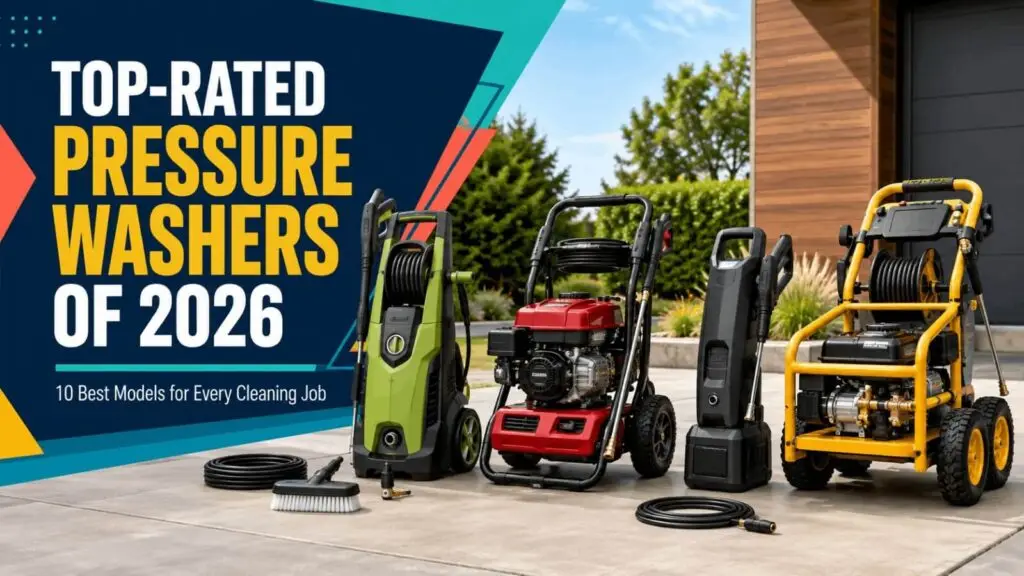
Top-rated pressure washers of 2026 graphic showing 10 best gas, electric, and cordless models.
PSI & GPM Guides

Top Rated Pressure Washers of 2026: 10 Models Compared

The top-rated pressure washers are not simply the machines with the highest PSI. A powerful gas washer may be ideal for a long concrete driveway but inconvenient for washing one car. A compact electric model is easier to start and store, while a cordless washer offers freedom from a power outlet at a higher purchase price. This guide compares ten pressure washers for different buyers and cleaning jobs. Our selections include corded electric, battery-powered and gas machines, from entry-level homeowner units to professional models with triplex pumps. Quick recommendation: Based on published specifications and task suitability, the Greenworks Pro GPW3002A is our best overall choice for most homeowners. Choose the Westinghouse WPX3400 when you need residential gas power, or the SIMPSON PowerShot PS3228 for frequent professional work. Top Rated Pressure Washers briefly Category Model Power source Published output Best use Best overall Greenworks Pro GPW3002A Corded electric 3,000 max PSI at 1.1 GPM Regular home cleaning Best residential gas Westinghouse WPX3400 Gas 3,400 PSI, 2.6 GPM Driveways and heavy dirt Best professional SIMPSON PowerShot PS3228 Gas 3,300 PSI, 2.5 GPM Contractors and frequent use Best cordless EGO HPW3204-2 Dual-battery 3,200 PSI at 1.2 GPM Portable cleaning Best easy-to-use electric RYOBI RY142500 Corded electric 2,500 PSI, 1.2 GPM General residential work Best high-flow electric Kärcher K5 FC Corded electric 2,000 max PSI; up to 2.0 GPM Large home-cleaning areas Best compact DEWALT DWPW2100 Corded electric 2,100 PSI, 1.2 GPM Small homes and storage spaces Best entry-level Sun Joe SPX3000 Corded electric 2,030 rated PSI, 1.2 rated GPM Cars, furniture and patios Best accessory system Generac Speed Wash 3200 Gas 3,200 PSI, 2.7 GPM Versatile outdoor cleaning Best heavy-duty Generac G0088730 Gas 4,200 PSI, 4.0 GPM Large and commercial jobs Published output figures come from the manufacturers. “Maximum” PSI and GPM may be measured under different operating conditions and may not occur together. How We Selected the Top-Rated Pressure Washers This is a research-based buying guide; we did not perform hands-on testing. We compared manufacturer specifications, pressure and flow, pump and motor design, hose length, nozzle selection, detergent delivery, portability, maintenance needs, warranty coverage and suitability for common cleaning jobs. Manufacturer product pages were verified on August 20, 2026. Category winners are editorial recommendations based on their intended use, not laboratory rankings. Prices, stock, specifications and included accessories can change, so confirm the exact model, package and warranty before ordering. 1. Greenworks Pro GPW3002A — Best Overall Pressure Washer The Greenworks Pro GPW3002A is our best overall choice for homeowners who want strong cleaning without gasoline maintenance. Its brushless motor supplies up to 3,000 PSI at 1.1 GPM, while its high-flow mode reaches 2.0 GPM at 100 PSI. Those figures should not be combined as one operating point. The package includes a 25-foot kink-resistant hose, 35-foot GFCI power cord and five nozzles: 15°, 25°, 40°, soap and turbo. Ten-inch wheels make the open-frame machine easier to move, and vertical storage reduces its garage footprint. Pros Strong performance for a residential electric washer Brushless motor with automatic pressure and flow adjustment Five useful nozzles and long power cord Ten-year motor and three-year tool warranty stated by Greenworks Cons Bulkier than compact electric machines Maximum PSI and maximum flow do not occur together 2. Westinghouse WPX3400 — Best Residential Gas Pressure Washer The Westinghouse WPX3400 delivers 3,400 PSI and 2.6 GPM from a 212cc four-stroke engine. That output is well suited to concrete, brick, fences, siding and other demanding residential jobs. It includes a 25-foot hose, five quick-connect tips and a 0.5-gallon detergent tank. The steel frame and 12-inch never-flat wheels are practical for uneven outdoor surfaces. Its axial-cam pump needs less attention than a serviceable triplex design, although it is aimed more at homeowner use than daily contracting. Pros High cleaning output at a competitive gas-machine level Five nozzle tips and large onboard soap tank Strong wheels and steel frame Cons Recoil starting and normal gas-engine maintenance Manufacturer lists this version as not CARB compliant 3. SIMPSON PowerShot PS3228 — Best for Professionals The SIMPSON PowerShot PS3228 is designed for contractors and serious users. Its Honda GX200 engine powers an AAA triplex pump at 3,300 PSI and 2.5 GPM. Unlike a basic residential axial pump, the triplex design is intended for more demanding and frequent work. The package provides a 25-foot MorFlex hose, five nozzles, welded steel frame and 10-inch pneumatic tires. At 77 pounds, it is not lightweight, but its build is better matched to deck restoration, paint preparation and repeated property cleaning. Pros Honda GX200 engine and serviceable triplex pump Flexible, abrasion-resistant MorFlex hose Commercial warranty coverage on engine, pump and frame Cons Heavy and more expensive than homeowner models This PS3228 version is not sold in California 4. EGO HPW3204-2 — Best Cordless Pressure Washer The EGO POWER+ HPW3204-2 removes the need for both fuel and a wall outlet. Two included 56V 6.0Ah batteries provide up to 3,200 PSI at 1.2 GPM, with a maximum-flow mode of up to 2.0 GPM. EGO states a runtime of up to 60 minutes, although actual runtime depends on the selected mode and workload. The washer can use a garden hose or draw clean water through its included siphon hose. ECO, High and Turbo modes are selected through the wand display. A foam cannon, five nozzles and 25-foot hose are included. Pros True cordless operation with strong peak pressure Can draw from a clean portable water source Good accessory package and five-year tool warranty Cons Much more expensive than most corded machines Runtime and maximum output depend on battery charge 5. RYOBI RY142500 — Best Easy-to-Use Electric Model The RYOBI RY142500 is a sensible middle-ground choice for decks, fences, siding, sidewalks and small driveways. Its brushless electric motor produces 2,500 PSI at 1.2 GPM without the starting, fuel and oil requirements of a gas engine. It has a 25-foot hose, metal wand, onboard soap tank and 12-inch flat-free wheels. The machine stores its hose, wand, cord and nozzles onboard, which helps reduce setup

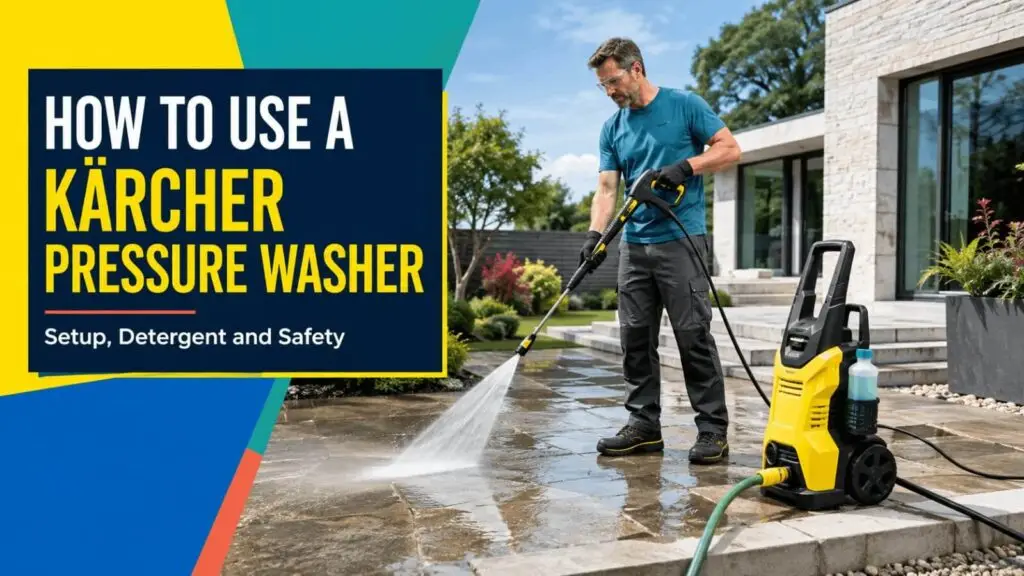
How to use a Kärcher pressure washer setup detergent and safety guide header
How to Guides

How to Use a Kärcher Pressure Washer: Setup, Detergent and Safety

Learning how to use a Kärcher pressure washer is simple, but detergent systems and controls vary by model. The basic sequence is the same: connect the hoses, open the water, remove trapped air, connect power safely, select a gentle pressure and test the spray. This guide covers those steps and explains the main Kärcher detergent systems. Quick answer: Set the washer on level ground, connect the high-pressure hose and spray gun, attach the garden hose, turn on the water, and squeeze the trigger until the flow is steady. Connect the washer to a protected electrical supply, switch it on and begin with the Vario Power lance at a low setting. Apply detergent only through the system designed for your model and only in its low-pressure or MIX setting. Check Your Kärcher Model Before Starting  K2 through K7 identify performance classes, but machines within one class can have different hoses, guns and controls. Find the full model and part number on the machine’s rating plate. Then check the supplied manual or download the correct version from Kärcher’s official operating-manual finder. The model manual must take priority if one of its instructions differs from this general guide. Common Kärcher detergent and control systems System or range What you may see How detergent is normally selected K2/K3 and some Classic models Small suction hose with filter Put the filtered end in approved detergent and turn the Vario lance to its lowest-pressure setting K4/K5 Power Control and selected models Plug ’n’ Clean bottle inlet Insert the compatible bottle as directed and select the detergent position on the lance Smart Control models 3-in-1 Multi Jet lance and gun display Turn the lance to MIX; confirm the Plug ’n’ Clean bottle is seated correctly Newer Comfort models 2Way!Wash detergent system Follow the model guide for bottle or foam-nozzle delivery and dosage control Foam-nozzle kits Bottle attached to a separate foam jet Fit the foam jet to the trigger gun and adjust the detergent control on the attachment Do not force a bottle into a machine that uses a suction tube or assume every K5 works identically. The official Kärcher range page explains newer features. What You Need Before Setup Prepare everything before connecting the power: Your Kärcher pressure washer and the correct manual Kärcher-compatible trigger gun and high-pressure hose Vario Power, Multi Jet or another suitable spray lance A clean garden hose with the correct inlet connector A reliable cold-water supply Pressure-washer detergent suitable for the surface, if required Safety glasses, gloves and closed-toe, nonslip footwear An outdoor electrical outlet protected by an RCD or GFCI, as applicable in your country Inspect the cord, plug, pressure hose, gun, lance and couplings. Do not operate the washer with a damaged cord, bulging hose, cracked gun or connector that will not lock. Stop and contact support if the cord becomes unusually warm or the hose swells. How to Use a Kärcher Pressure Washer Step by Step 1. Place the washer on stable ground Position the machine on firm, level ground, away from direct spray and standing water. Uncoil the hose and cable to prevent twists and trip hazards. Keep the cable away from the wet work area, separate it from the water hose and prevent children or pets from entering. Use the operating position shown in your manual. 2. Connect the high-pressure hose With the machine switched off and unplugged, connect the high-pressure hose to the washer’s high-pressure outlet. On a Quick Connect model, push the hose end in until it locks. Attach the other end to the trigger gun if it is not already fitted. Give each connection a gentle pull. Do not force plastic couplings or use a hose or gun rated below the machine’s requirement. 3. Fit the correct spray lance Insert the lance into the trigger gun and turn or click it into its locked position, depending on the connector. Start with the Vario Power or adjustable flat-spray lance. It gives more control and is safer for testing an unfamiliar surface. The Dirt Blaster’s concentrated rotating jet is for stubborn dirt on hard materials. It can strip paint or damage wood, vehicle finishes and soft stone, so begin with the Vario lance. 4. Connect the cold-water supply Check that the small inlet filter is clean and correctly installed. Attach the hose connector to the washer’s water inlet, then connect the garden hose. Avoid a kinked, crushed or leaking supply hose. Turn the tap on fully. Domestic Kärcher pressure washers are normally cold-water machines. Kärcher states that the inlet temperature for its residential electric models should not exceed 40°C/104°F. Hot water can damage a pump that was not designed for it. If your model can draw from a tank, use the specified filtered suction hose and priming method. Not every model supports this feature. 5. Purge trapped air before switching on Leave the machine switched off. With the water supply open, release the trigger safety lock and squeeze the trigger. Water may cough or pulse at first as air leaves the hose, pump and gun. Keep holding the trigger until a smooth, steady stream comes from the lance. This step gives the pump a proper water supply before the motor starts. Running the unit without water, even briefly, can damage the pump. If no water appears, switch nothing on. Recheck the tap, inlet connector, hose kinks and inlet filter. 6. Connect electrical power safely Dry your hands and confirm that the switch is in the OFF or 0 position. Connect the plug directly to a suitable outdoor outlet protected by a working residual-current device. North American versions may have a GFCI built into the plug; Kärcher advises testing it as part of startup and not using the washer if the test fails. Avoid an extension lead. If the manual permits one, it must be outdoor-rated, correctly grounded where required, heavy enough for the load and within the stated length. Never join several leads or remove a grounding pin. Keep the plug, outlet and cable

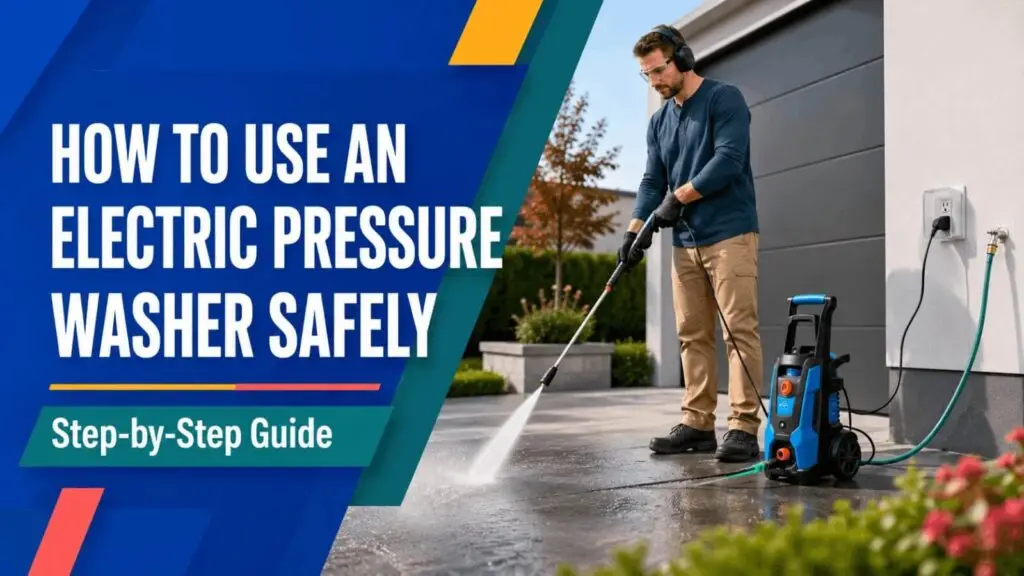
How to use an electric pressure washer safely step-by-step guide featuring a person pressure washing a concrete driveway
Guides & Tips

How to Use an Electric Pressure Washer Safely: Step-by-Step Guide

An electric pressure washer looks simple: connect a hose, plug it in, and pull the trigger. That shortcut is also how beginners end up with a pulsing pump, a tripped GFCI, damaged paint, or a machine that runs without enough water. Learning how to use an electric pressure washer safely means following the correct order. Connect the water system first, remove trapped air, establish a dry protected power connection, select a surface-safe nozzle, and test before cleaning the full area. This guide covers common residential corded machines from inspection through storage. Your model’s manual always takes priority. How this guide was prepared: This guide uses manufacturer instructions and recognized electrical-safety guidance. Always follow the manual supplied with your model. What an Electric Pressure Washer Does An electric motor drives a pump that increases the pressure of water supplied by a garden hose. The spray gun controls the flow, while the wand and nozzle shape the water into a narrow or wide pattern. Two ratings help describe cleaning performance: PSI (pounds per square inch) indicates water pressure. GPM (gallons per minute) indicates water flow. PSI loosens dirt, while GPM helps carry it away. More pressure is not automatically better; paint, wood, siding, vehicles, and furniture need more care than concrete. Most residential electric models also use a total-stop system that switches the motor off when the trigger is released. Not every machine behaves identically, so become familiar with its switch, trigger lock, nozzle system, detergent method, and shutdown procedure before starting. What You Need Before Starting Gather and inspect the equipment before connecting power: Electric pressure washer and its manual Garden hose capable of supplying the required water flow High-pressure hose, spray gun, and wand Correct nozzles or adjustable lance Clean water-inlet filter Pressure-washer-approved detergent when needed Safety glasses, closed-toe non-slip footwear, gloves, and hearing protection Grounded outdoor outlet with required GFCI protection Move children, pets, vehicles, fragile decorations, and loose objects away. Avoid sensitive outlets and fixtures without trapping water against electrical equipment. Inspect the cleaning surface for cracks, loose paint, damaged mortar, soft wood, open windows, and areas where water could enter. Sweep away stones and loose debris that the spray could throw. How to Use an Electric Pressure Washer Step by Step Step 1: Inspect the Machine and Work Area Place the pressure washer upright on stable, level ground. Check the power cord, plug, GFCI module, high-pressure hose, spray gun, couplings, and machine housing. Do not use equipment with exposed wire, a missing ground pin, hose bubbles, cuts, leaks, or broken guards. Plan separate routes for the electrical cord and garden hose. Keep the plug, outlet, and all cord connections away from runoff and the direction of spray. Step 2: Connect the High-Pressure Hose With the machine switched off and unplugged, connect one end of the high-pressure hose to the pump outlet and the other to the spray gun. Push or thread each fitting fully according to the manual. Tug gently on quick-connect fittings to confirm they have locked. Straighten the hose before pressure builds. Tight loops and kinks can restrict movement, make the hose difficult to handle, and place stress on fittings. Step 3: Attach the Spray Wand Connect the wand to the trigger gun using the model’s twist-lock, threaded, or quick-connect system. Engage the trigger safety lock while assembling accessories. Inspect the nozzle opening for debris. Never look into the nozzle or point the gun toward your hand while checking it. Use the cleaning tool recommended by the manufacturer if a nozzle is clogged. Step 4: Connect and Turn On the Water Supply Check that the inlet screen is clean and correctly seated. Attach the garden hose to the water inlet and tighten it by hand without damaging plastic threads. Open the tap fully unless the manual specifies otherwise. The water source must provide the required flow. A partly closed tap, narrow hose, kink, blocked filter, or leaking connector can cause low pressure, pulsing, overheating, or pump damage. Do not start the motor without water flowing through the pump. Some specialty machines can draw from a tank, but a normal garden-hose model should not be assumed to have that ability. Step 5: Purge Air With the Motor Off Keep the pressure washer unplugged and switched off. Point the spray gun in a safe direction, release the trigger lock, and squeeze the trigger. Let low-pressure water flow until the stream becomes steady and free from sputtering. Some manuals instruct users to purge the system without a nozzle or lance attached. Follow the procedure for your model. Once purging is complete, release the trigger, engage the safety lock, and install the appropriate nozzle if it was removed. Purging matters because trapped air can make the spray pulse and place unnecessary stress on the pump and hose. Step 6: Select the Safest Nozzle Start with a wide fan nozzle or the lowest adjustable-pressure setting. A narrow spray concentrates force into a small area and increases the chance of etching concrete, cutting wood fibers, lifting paint, or damaging vehicle trim. Common color coding may include white for a wider fan, green for general cleaning, yellow for a narrower pattern, red for a concentrated jet, and black for low-pressure detergent. Color conventions are common but not universal. Confirm the angle and purpose marked in your manual. For surface-specific guidance, see how much pressure different cleaning jobs require. Use the gentlest setup that completes the job. Step 7: Connect to Safe Electrical Power Dry your hands and confirm the machine switch is off. Plug the washer into a properly grounded outdoor outlet with the GFCI protection specified by the manufacturer. Test and reset the GFCI exactly as directed. The U.S. Consumer Product Safety Commission recommends GFCI protection outdoors, keeping cord-connected equipment away from water, and using only outdoor-rated extension cords. Keep the outlet and plug area dry, raised, and away from runoff. Do not remove the grounding pin, use an adapter, or defeat a GFCI that trips. Extension-Cord Warning Use an

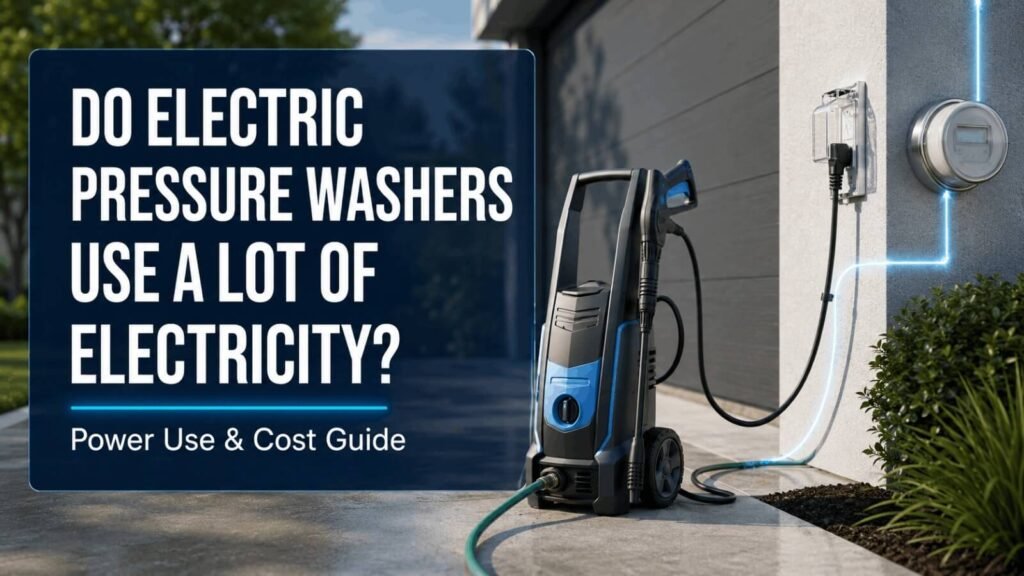
: Electric pressure washer connected safely to an outdoor outlet with electricity-cost graphics
Electric Pressure Washers

Do Electric Pressure Washers Use a Lot of Electricity? Cost Guide

A pressure washer sounds powerful, so it is reasonable to wonder what that motor is doing to your electricity bill. The answer is less alarming than the noise may suggest. Do electric pressure washers use a lot of electricity? They can draw a fairly high amount of power while the motor is running, but most household cleaning jobs last only 30 minutes to a few hours. That usually makes the total electricity cost modest. A machine drawing 1.8 kilowatts continuously for one hour would use 1.8 kilowatt-hours (kWh). At an example rate of $0.15 per kWh, that equals $0.27. Actual use depends on the motor rating, trigger time, total job length, automatic stop system, voltage, water supply, nozzle, and cleaning method. This guide shows how to read the machine label, calculate running cost, compare realistic scenarios, and avoid wasting electricity. How these estimates were prepared: Calculations use manufacturer-listed input power and assume continuous motor operation unless stated otherwise. They are planning estimates, not laboratory measurements. Your machine, trigger time, voltage and electricity tariff will determine the actual cost. Do Electric Pressure Washers Use a Lot of Electricity Per Hour? Corded residential pressure washers vary by market and cleaning class. Current manufacturer examples include 230V models rated from about 1.4 kW to 3.0 kW, while many North American homeowner units use a 120V, 13-amp motor. Always use the rating on your own machine rather than treating these examples as a universal range. Those figures describe power demand while operating, not the amount charged on a monthly bill. Electricity billing is based mainly on energy use in kilowatt-hours: Energy used (kWh) = Power (kW) × Running time (hours) A 1.6 kW machine running for 45 minutes uses up to: 1.6 × 0.75 = 1.2 kWh If electricity costs $0.20 per kWh, the estimated cost is: 1.2 × $0.20 = $0.24 This is a simple full-power estimate. Some electric pressure washers stop the motor when the trigger is released, reducing energy use during pauses. Motor load and power factor can also make measured consumption different from a nameplate calculation. How to Find Your Pressure Washer’s Wattage Check the rating label on the machine, motor, plug tag, or manual. Look for W or kW, together with voltage and amperage. Use Listed Watts When Available If the manufacturer lists rated input power, use that number. Convert watts to kilowatts by dividing by 1,000: 1,400 watts = 1.4 kW 1,800 watts = 1.8 kW 2,000 watts = 2.0 kW Do not calculate electricity use from PSI or GPM. PSI measures water pressure, while GPM measures water flow. Neither tells you the exact electrical input. Estimate From Volts and Amps When only voltage and amperage are shown, multiply them for a basic circuit-demand estimate: Volts × Amps = Volt-amperes (VA) For example, 120V × 13A = 1,560 VA. People often treat that as roughly 1,560 watts for quick planning, but an AC motor’s true watts can differ because of power factor and operating load. A plug-in electricity meter rated for the machine’s current provides a better real-world measurement when the manufacturer allows its use outdoors and the setup remains safely GFCI-protected. Why Voltage Alone Does Not Show Consumption A 230V machine is not automatically twice as expensive to run as a 115V machine. Higher voltage can deliver the same power at lower current. Wattage and operating time—not voltage alone—determine energy use. Electric Pressure Washer Cost Examples The table below uses a 1.8 kW pressure washer and assumes continuous full-power operation. Replace the electricity rate with the amount shown on your utility bill. Cleaning time Energy used At $0.10/kWh At $0.20/kWh At $0.30/kWh 30 minutes 0.9 kWh $0.09 $0.18 $0.27 1 hour 1.8 kWh $0.18 $0.36 $0.54 2 hours 3.6 kWh $0.36 $0.72 $1.08 For a 90-minute job at $0.20 per kWh: 1.8 kW × 1.5 hours × $0.20 = $0.54 This calculation is intentionally conservative if the motor stops whenever the trigger is released. It may underestimate use if the machine includes additional electric heating, a vacuum, or another powered system. Estimate Monthly or Annual Cost Suppose you run a 1.8 kW machine for one hour twice each month: 1.8 kW × 2 hours × 12 months = 43.2 kWh per year At $0.20 per kWh, that equals $8.64 per year. This is only an example; local rates, cleaning frequency, and actual motor-on time will change the result. What Affects Electricity Consumption? Motor Input Rating A larger motor can draw more power, but it may also complete a suitable job faster. Comparing wattage alone does not show which machine will use less total energy. Trigger Time and Automatic Stop Many residential models use a total-stop system that switches off the motor when the spray-gun trigger is released. This reduces unnecessary runtime during repositioning, scrubbing, soap dwell time, or moving furniture. Confirm how your model behaves rather than assuming every machine stops completely. Cleaning Time Job duration often matters more than a small difference in wattage. A 1.8 kW machine used efficiently for 40 minutes can consume less energy than a 1.4 kW unit struggling for two hours. Surface, Dirt, and Nozzle Choice Heavy algae, compacted mud, and old concrete stains take longer than rinsing a car or patio chair. The correct nozzle and detergent can shorten the job, but excessive pressure can damage paint, wood, seals, and vehicle trim. . Our guide to choosing the right PSI for different cleaning jobs helps match cleaning force to the surface. Water Supply A restricted tap, kinked hose, clogged inlet filter, or undersized supply hose can reduce performance. The motor may keep running while the user makes little progress. Confirm that the source can provide the water flow required by the manual. Hot-Water and Commercial Machines Do not apply homeowner cold-water estimates to commercial electric hot-water equipment. A heating element can require much more electricity than the pump motor and may need a dedicated high-voltage circuit. Check motor and heater ratings separately. Is an Electric Pressure Washer Cheaper Than

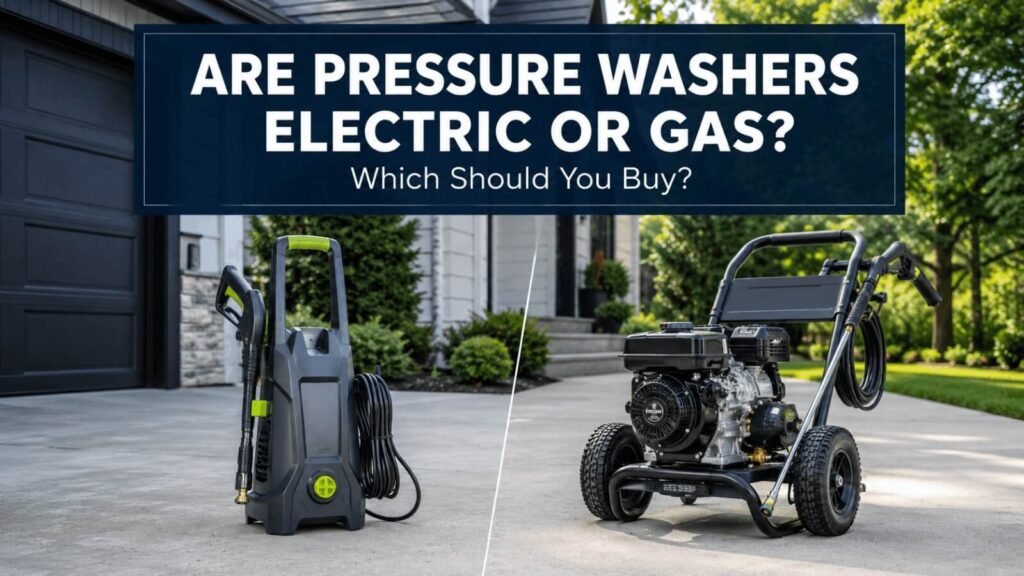
Electric pressure washer and gas pressure washer
Comparisons

Are Pressure Washers Electric or Gas? Which Should You Buy?

Pressure washers come in both electric and gas versions, and the choice changes how much cleaning power you get. Gas washers deliver far more flow and pressure. Electric washers are lighter, quieter and need almost no upkeep. This guide compares the two using real model numbers from maker pages, so you can see the gap in numbers. It also covers power needs, running care, safety and the jobs each type suits best. We did not test these machines. Every figure comes from a maker spec or a named listing. Are Pressure Washers Electric or Gas? The Short Answer Both. The right one depends on what you clean and how often. If you only clean a few times a year and your jobs are small, an electric model is usually the better value. If you have a lot of concrete to do, gas saves hours. Electric vs Gas Pressure Washer: Quick Comparison The table uses figures from the maker models we have covered. Electric examples are the Greenworks GPW2003. Gas examples are the Generac 2900 PSI, Simpson MS61039 and Westinghouse WPX3400. Factor Electric Gas Typical pressure About 2,000 PSI max (Greenworks GPW2003) 2,900 to 3,400 PSI (Generac, Simpson, Westinghouse) Typical flow 1.2 GPM max (Greenworks GPW2003) 2.4 to 2.6 GPM Power source Outlet, 14-amp motor on the GPW2003 Gas engine, 196cc to 212cc Mobility Limited by a 35 ft cord Go anywhere you can roll it Weight Lighter, check the box label 52.1 lb (Simpson), 57 lb (Generac) Upkeep Cord and pump care, no fuel Oil, fuel, spark plug, carburetor Safety extras GFCI in the plug Carbon monoxide risk, outdoors only Sources: Greenworks, Generac, Simpson and Westinghouse listings as cited in our model reviews. Always check your own model’s label, since many models vary by number. How Electric Pressure Washers Work An electric washer uses a motor to drive a pump. You plug it into a wall outlet and turn it on. There is no engine, so it starts at once and runs quietly compared with gas. The Greenworks GPW2003 is a good example. It has a 14-amp universal motor, a 25 ft hose and a 35 ft power cord with an inline GFCI plug. The GFCI cuts power quickly if it detects a fault, which matters when water and electricity share a work area. Extension cords are the usual weak point. A thin or long cord drops voltage, makes the motor hot and can trip its thermal protector. Karcher’s manuals list 25 ft of 12/2 cord or 50 ft of 10/2 cord for one model, and other makers give different limits, so follow your manual. Our guide on why a pressure washer won’t start covers cord and GFCI checks. How Gas Pressure Washers Work A gas washer uses a small engine to drive the pump. The engine runs on gasoline and needs oil, just like a lawn mower. Because it makes its own power, it can run strong pumps and high flow. The Generac 2900 PSI uses a 196cc OHV engine and delivers 2.4 GPM. The Westinghouse WPX3400 uses a 212cc engine for 3400 PSI and 2.6 GPM. These machines are heavier, louder and need regular care, but they clean much faster. Check the oil before each use, use fresh fuel and run water before you start. Some models, like the Generac we reviewed, have no low-oil shutoff, so you have to watch the dipstick yourself. See our Generac 2900 PSI review for details. PSI and GPM: Which Type Has More Cleaning Power? PSI is force and GPM is volume. Multiply them for cleaning units, a simple way to compare machines. The table shows models we have already checked against maker pages. Model Type PSI x GPM Cleaning units Greenworks GPW2003 Electric 2,000 x 1.2 2,400 Westinghouse WPX3400e Electric 3,000 x 1.1 (rated) 3,300 Generac 2900 PSI Gas 2,900 x 2.4 6,960 Simpson MS61039 Gas 3,000 x 2.4 7,200 Westinghouse WPX3400 Gas 3,400 x 2.6 8,840 The pattern is clear. The gas examples deliver roughly three times the cleaning units of the Greenworks electric. The Westinghouse electric WPX3400e shows that some electric units are closer, but it still falls well below the gas models. Note that the Greenworks listing gives 1.2 GPM measured at 100 PSI, so you should not assume the maximum PSI and flow occur together. Treat these as comparison figures, not guaranteed results on the surface. Which Type Is Better for Common Cleaning Jobs? Whichever you choose, test a hidden spot first, and keep the wand moving. For a pick of models by use, see our home-use buying guide. Power and Space Needs Electric washers need an outlet within reach. A 14-amp motor draws most of a standard 15-amp household circuit, so avoid sharing the circuit with other heavy tools. Common electrical guidance is to keep continuous loads below about 80% of a circuit’s rating, which leaves roughly 12 amps on a 15-amp circuit. Read your manual for the exact requirement. Gas washers need open air. You have to run them outdoors, away from windows, doors and vents. They also need a place to store fuel safely. See our power requirements guide for fuel and electrical details. Running Care and Upkeep Electric washers are simpler. Inspect the cord, GFCI and hose, rinse the inlet screen, and drain the pump before freezing weather. Gas washers need more. Our maintenance checklist and winterizing guide cover both types. What About Cordless Pressure Washers? A third option sits below electric in power. Cordless washers run on batteries, so there is no cord and no fuel. They are handy for quick jobs like bikes, patio furniture and cars, but their runtime and pressure are limited. If you are weighing that route, our guides on portable cordless pressure washers and cordless vs electric pressure washers go through the trade-offs. For heavy concrete work, gas is still the faster tool. Safety Differences Between Electric and Gas A Worked Example: Amps and Outlets Here is the math behind the 14-amp figure. A 14-amp motor

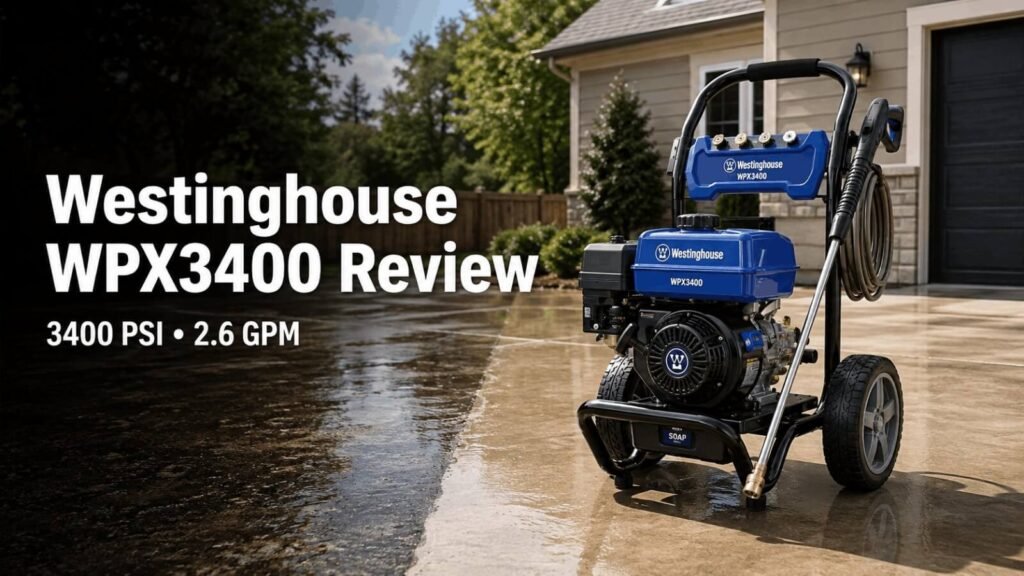
Westinghouse WPX3400 gas pressure washer product review featuring 3400 PSI and 2.6 GPM performance specs.
Buying Guides, Safety Tips

Westinghouse WPX3400 Gas Pressure Washer Review: The Ultimate Heavy-Duty Cleaning Powerhouse

If you are struggling with stubborn oil stains on driveways, weathered wooden decks, moss-covered patios, or peeling exterior paint, entry-level electric pressure washers simply lack the necessary force. The Westinghouse WPX3400 Gas Pressure Washer steps in as a commercial-grade, heavy-duty cleaning solution engineered for homeowners, contractors, and DIY enthusiasts who demand unyielding cleaning power. Delivering an impressive 3,400 PSI (Pounds per Square Inch) at 2.6 GPM (Gallons per Minute), the WPX3400 produces a total cleaning power score of 8,840 Cleaning Units (CU). Driven by a robust 212cc 4-stroke OHV engine, an axial cam brass-head pump, and a heavy-duty steel cart with 12-inch never-flat wheels, this machine blends durability, mobility, and sheer cleaning efficiency. In this comprehensive, data-backed review, we examine every aspect of the Westinghouse WPX3400—from unboxing and assembly to real-world cleaning tests, maintenance practices, and head-to-head comparisons. Key Technical Specifications at a Glance Feature / Spec Westinghouse WPX3400 Specification Model Name Westinghouse WPX3400 Gas Pressure Washer Maximum Pressure 3,400 PSI Maximum Flow Rate 2.6 GPM Total Cleaning Power 8,840 Cleaning Units (PSI × GPM) Engine Type 212cc 4-Stroke Westinghouse OHV (Horizontal Shaft) Starting Mechanism Manual Recoil Pull Start with Choke & Fuel Valve Pump Type Maintenance-Free Axial Cam Pump Fuel Tank Capacity 1.0 Gallon (3.8 Liters) Unleaded Gasoline Onboard Soap / Detergent Tank 0.5 Gallon (1.9 Liters) Built-in Reservoir High-Pressure Hose 25-Foot Super-Flex Abrasion-Resistant Hose (M22 Fittings) Included Nozzles 5 Quick-Connect Tips (0°, 15°, 25°, 40°, & Soap Applicator) Wheel Diameter & Type 12-Inch High-Profile, Never-Flat Solid Rubber Wheels Frame Construction Heavy-Duty Tubular Steel with Corrosion-Resistant Coating Unit Weight 28.6 kg (Approx. 63 lbs) Product Dimensions 19″ L x 18.5″ W x 21.7″ H Warranty 3-Year Limited Manufacturer Warranty (Service, Labor & Parts) 1. Engine & Pump Architecture: The Heart of the WPX3400 At the core of the Westinghouse WPX3400 lies a commercial-grade 212cc 4-Stroke OHV (Overhead Valve) horizontal shaft engine. Unlike underpowered consumer models that rely on vertical-shaft engines prone to heat buildup, horizontal shaft configurations offer superior heat dissipation, smoother torque delivery, and significantly longer operational lifespans. +——————————————————————-+ |               Westinghouse WPX3400 Power Train                    | |                                                                   | |   [212cc 4-Stroke OHV Engine] ───> [Maintenance-Free Axial Pump]  | |               │                                    │              | |        (Recoil Start)                     (3,400 PSI @ 2.6 GPM)   | |               │                                    │              | |   [1.0 Gallon Fuel Tank]             [Thermal Relief Protection]  | +——————————————————————-+ Axial Cam Pump Performance Coupled directly to the 212cc engine is an axial cam pump. This pump design is factory-sealed and engineered to be 100% maintenance-free—meaning you do not need to constantly change pump oil or grease internal bearings under normal residential use. Key advantages of this engine and pump synergy include: Consistent Pressure Output: The axial cam mechanism delivers a steady 3,400 PSI without pulsing or sudden drops in water pressure. Thermal Relief Valve: Protects the pump from overheating if the trigger is released while the engine continues to idle. Optimized Fuel Economy: The 1-gallon fuel tank provides up to 1.5 to 2 hours of continuous run time depending on the nozzle tip and throttle level. 2. Real-World Cleaning Applications & Versatility With 8,840 Cleaning Units, the Westinghouse WPX3400 is not limited to light chores. It effortlessly handles the toughest residential and semi-commercial tasks: A. Concrete Driveways, Sidewalks, and Garage Floors Oil drips, tire marks, embedded moss, and years of baked-on dirt lift off instantly under 3,400 PSI. When paired with an optional 15-inch or 16.5-inch surface cleaner attachment, cleaning times on expansive driveways are cut by up to 60%. B. Wooden Decks, Fences, and Composite Railings Using the wider 25° or 40° nozzle tips, the WPX3400 strips away weathered grey oxidation, mildew, and failing stain without gouging soft cedar or pine wood grain when maintained at a safe 12-to-18-inch distance. C. Home Siding, Stucco, and Brick Facades Algae and mildew clinging to vinyl siding or porous brick mortar vanish quickly. The onboard half-gallon detergent tank allows you to pre-treat walls with specialized siding cleaner before switching to the rinse nozzles. D. Vehicle, Boat, and RV Detailing While 3,400 PSI is too intense for direct car paint, the 40° white tip combined with the onboard soap reservoir (or an aftermarket M22 foam cannon) provides a rich foam lather followed by a gentle, broad rinse that leaves clear coats spotless. 3. Included Nozzle Tips & How to Use Them The Westinghouse WPX3400 comes standard with 5 color-coded quick-connect spray nozzles that dock neatly into the integrated dashboard holder on the handle: [0° Red Tip]     ──> Extreme Pinpoint Jet (Concrete cracks, paint stripping, metal rust) [15° Yellow Tip] ──> Heavy-Duty Chiseling (Brickwork, masonry, unpainted concrete) [25° Green Tip]  ──> General Cleaning (Wood decks, stone patios, vinyl siding, fences) [40° White Tip]  ──> Wide Gentle Wash (Cars, RVs, outdoor glass, painted surfaces) [Black Soap Tip] ──> Low-Pressure Detergent Dispenser (Activates onboard soap siphon) 0° Red (Pinpoint Blast): Produces a razor-sharp, concentrated jet of water. Reserved exclusively for heavy rust removal, hard stain eradication in concrete joints, or peeling paint. (Never use on wood or vehicles!) 15° Yellow (Chisel Fan): Excellent for aggressive surface stripping, concrete preparation, and removing stubborn biological growth. 25° Green (All-Around Workhorse): The most versatile nozzle for washing decks, walkways, aluminum siding, and garden furniture. 40° White (Wide Fan):

RYOBI 2500 PSI 1.2 GPM electric pressure washer review cover image on outdoor driveway
Buying Guides, Safety Tips

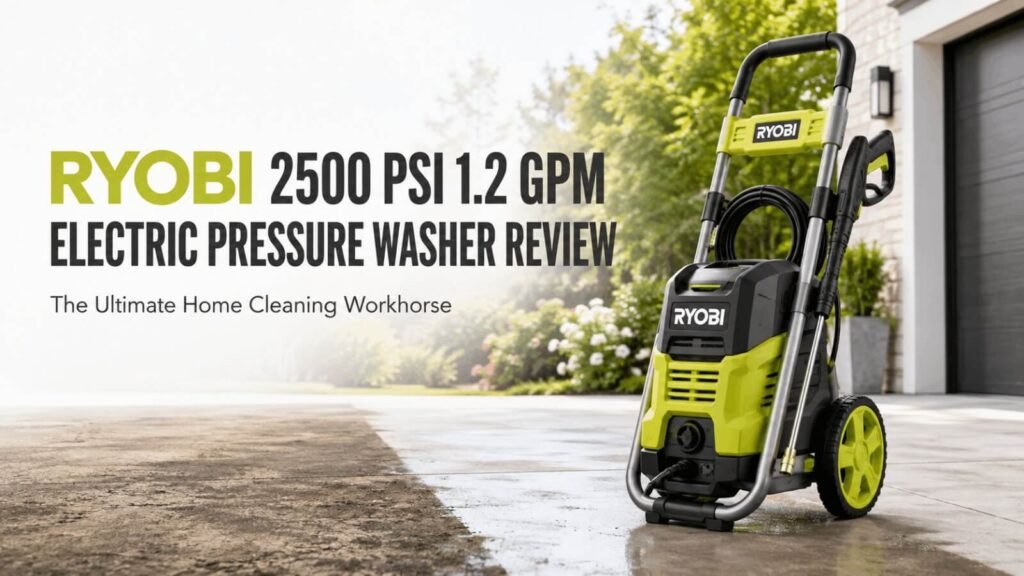
RYOBI 2500 PSI 1.2 GPM Electric Pressure Washer Review

The RYOBI 2500 PSI 1.2 GPM electric pressure washer (model RY142500) is a sensible pick for a typical house and yard: decks, fences, siding, patio furniture, the odd car. It plugs into a normal 120-volt outlet, weighs about 43 pounds, and costs $329 at Ryobi’s own store. What it is not is a fast machine for big concrete jobs. Its flow rate of 1.2 gallons per minute is on the low side, and that matters more than the 2,500 PSI number on the box. A quick note on how this review was put together. We have not spent our own hours on this unit, so you will not find “I tested it for a month” claims here. The page is built from Ryobi’s published specifications, retailer listings and what owners say in public reviews. Where those disagree, I say so. RYOBI 2500 PSI 1.2 GPM specs at a glance Most of these figures come from Ryobi’s product page and a spec sheet on Toolstash. Where sources disagree, the next sections say so. Spec RY142500 Pressure / flow 2,500 PSI / 1.2 GPM Motor Brushless, 120 V, 60 Hz, 13 A Pump Aluminum axial cam Power cord 35 ft, with GFCI protection High-pressure hose 25 ft, non-marring Wheels 12-inch flat-free Weight 43.36 lb (per Toolstash’s spec sheet) Nozzles 15-degree, turbo, soap Soap system On-board tank Warranty 3-year limited Listed price $329 on ryobitools.com What comes in the box You get the washer, a trigger gun, a metal wand with a quick-connect coupler, the 25-foot hose and three nozzles. There’s a built-in tank for detergent, and the frame has places to hang the wand, hose, cord and nozzles when you’re done. Two things are not included. A foam cannon is sold separately; Ryobi lists its Foam Blaster at $38.47. A surface cleaner is also extra, although Home Depot sells a bundle that pairs this washer with a 12-inch surface cleaner. If you plan to clean a driveway or a patio, price that bundle against buying the parts one by one. Is the RYOBI 2500 PSI 1.2 GPM powerful enough? PSI tells you how hard the water hits. GPM tells you how much water arrives to carry the dirt away. Pressure washer makers often multiply the two into “cleaning units”: 2,500 × 1.2 gives this washer 3,000. A Westinghouse ePX3500 listed beside it on Toolstash is rated 2,500 max PSI and 1.76 max GPM, which works out to about 4,400. The PSI figures match; the flow doesn’t. On a wide, flat surface the higher-flow machine should finish sooner. That’s the main trade-off here. For jobs where you work a small area at a time, such as a fence panel, a set of steps or a chair, 1.2 GPM is fine. For a 600-square-foot driveway, expect to spend longer than you would with a gas washer or a stronger electric one. One more thing about the numbers. Ryobi’s manual references the PWMA PW101 standard for its pressure rating, and these are maximum ratings at the pump. The spray that reaches the surface changes with the nozzle, the length of hose and how close you hold the wand. Another published review quotes a measured flow near 1.8 GPM, well above Ryobi’s rating, and a Canadian Home Depot listing shows 1.1 GPM for the same model number. Neither figure is the official one, and the manufacturer says 1.2. If flow matters for your job, check the label on the machine you actually receive. What it cleans well at home Ryobi positions the washer for fencing, decking, siding, sidewalks and patio furniture, and that matches what the spec supports. Wood decks and fences are where the turbo and 15-degree tips earn their keep, as long as you don’t hold them close to soft wood. Vinyl siding does well with the soap nozzle and a rinse from top to bottom. Patio furniture and grills are quick work. Cars are fine with the wide fan tip and the soap nozzle, kept at a distance. Never use the turbo tip on paint, glass seals or plastic trim. Concrete is the weak spot. It works, but slowly, and a surface cleaner attachment helps more than any nozzle swap. Heavy oil stains and ground-in rust will need a degreaser and patience. Weight, cart and reach At roughly 43 pounds, the washer is easy enough to tip onto its wheels and roll. The 12-inch flat-free wheels are a good detail, since you can’t get a flat from a nail in the driveway. Weight figures vary by source: Product Review Crew lists 57 pounds, which is probably the shipping weight with packaging, while Ryobi-linked specs and Toolstash show 43.36 pounds. Your working reach is the 25-foot high-pressure hose plus however far your garden hose stretches, and the 35-foot cord lets you place the washer near an outlet. The cord has a GFCI plug, so you can use it outdoors, but you should avoid adding long extension cords. If you must, use a heavy-gauge outdoor-rated cord and keep the connection off wet ground. Those numbers make the RYOBI 2500 PSI 1.2 GPM one of the easier electric washers to move around a yard. Check your water supply first An electric pressure washer can only spray as much water as your hose delivers. The RY142500 is rated at 1.2 GPM, so your outdoor tap needs to supply at least that much. There’s an easy way to find out. Turn the tap on fully with nothing attached but the garden hose, and time how long it takes to fill a 5-gallon bucket. Anything under about four minutes means you’re delivering 1.25 GPM or more. If it takes longer, the pump may starve for water, which causes pulsing spray and extra wear. Use a standard 5/8-inch garden hose, keep it straight, and don’t use a long, thin or kinked hose between the tap and the washer. Flush the hose for a few seconds before you connect it so that grit doesn’t end up in the inlet screen.

Simpson 3500 PSI pressure washer review title banner with heavy-duty cleaning unit on driveway
Buying Guides

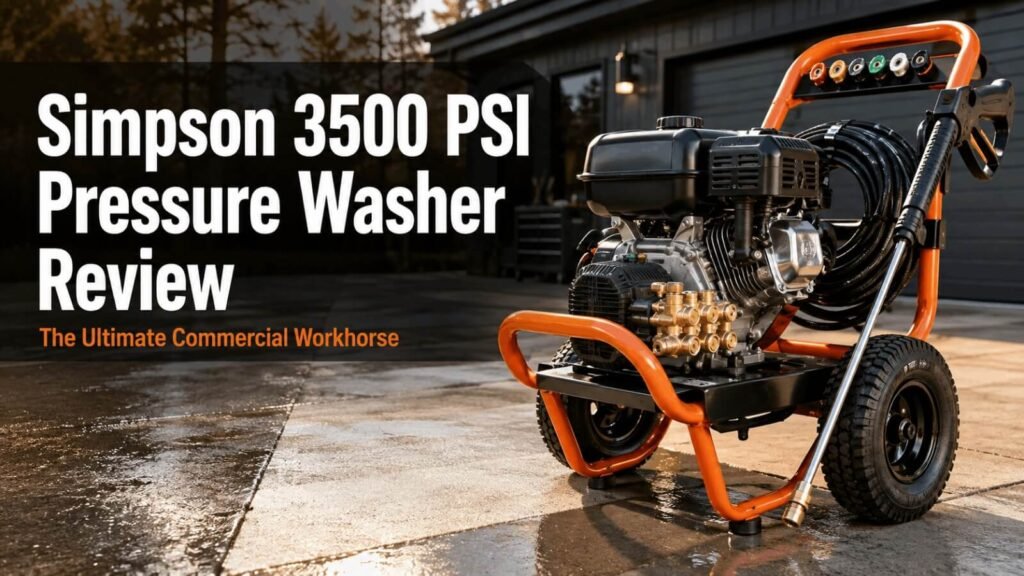
Simpson 3500 PSI Pressure Washer Review (PowerShot PS61002)

The Simpson 3500 PSI pressure washer, sold as the PowerShot PS61002 (part 61014), is a gas washer for homeowners and small crews who want a Honda engine without paying for a big commercial machine. Simpson rates it at 3,500 PSI and 2.5 GPM, with a Honda GX200 engine, and it weighs 74 pounds. That is strong enough for driveways, decks, fences and siding. It is not built for all-day work on large lots, and this guide explains why. We did not test this machine ourselves. This is a research review, built from Simpson’s own spec pages, Honda’s engine data and dealer listings. Where those sources disagree, we say so, because there is one real disagreement about the pump that you should know about before you buy. Why you can trust this guide Simpson PS61002 specs at a glance These figures come from Simpson’s product page for the PS61002, unless noted. The part number on retail listings is 61014. These numbers define the Simpson 3500 PSI pressure washer as a mid-power gas machine. Spec Simpson PowerShot PS61002 (61014) Pressure / flow 3,500 PSI / 2.5 GPM, cold water Engine Honda GX200 (196 cc per Honda’s table), 49-state compliant Pump Listed as “AAA Triplex”; the spec line says “AAA AX300 axial cam” Hose 5/16 in. x 25 ft MorFlex Spray gear Rear-load M22 gun, 16 in. quick-connect lance, five tips (0, 15, 25, 40 degrees and soap) Weight and size 74 lb; about 21 x 24 x 34 in. Frame and tires Welded, powder-coated steel; 10 in. pneumatic tires Unloader Integrated, adjustable, with thermal relief Warranty Engine 3 years, pump 2 years, frame 10 years, accessories 90 days (limited commercial terms) What 3,500 PSI at 2.5 GPM really means PSI is the force of the water, and GPM is how much arrives each minute. Multiply them and you get cleaning units: 3,500 times 2.5 is 8,750. For comparison, a typical plug-in washer such as the RYOBI RY142500 is about 3,000 units, and a 4,200 PSI, 4.0 GPM commercial machine is 16,800. So the Simpson cleans roughly three times faster than the plug-in washer and about half as fast as a full commercial unit. In practice, that makes it a good match for 400 to 800 square feet of concrete, a deck, a fence line or a house wash in an afternoon. A large parking lot would take far longer. You can read how the plug-in class compares in our RYOBI 2500 PSI review, and what the top class looks like in our commercial washer guide. In short, the Simpson 3500 PSI pressure washer sits in the middle of the market. The Honda GX200 engine Honda’s published table lists the GX200 at 196 cc and 5.5 horsepower (4.1 kW) net at 3,600 rpm. Net torque is about 9.1 lb-ft at 2,500 rpm. The engine holds about 0.6 liters of oil and 3.1 liters of fuel, and Honda lists a dry weight near 35 pounds. Some sellers advertise higher “gross” figures such as 6.5 hp, but net numbers are the ones to trust. Here is a useful check. The water leaving the pump carries PSI times GPM divided by 1,714 in horsepower, which is 3,500 x 2.5 / 1,714, or about 5.1 hp. The engine’s net rating is 5.5 hp. Pumps lose some power as heat and friction, so this engine works close to its limit when you spray at full pressure. That is normal for this class, but it is one reason a washer like this is best for jobs measured in hours, not whole days. Do not confuse this engine with the larger GX390 used on 4,000 PSI commercial washers. That one is 389 cc and about 11.7 hp, and we cover it in our Honda GX390 pressure washer guide. The engine is the main reason people shop for this Simpson 3500 PSI pressure washer. The pump: one detail to check before you buy Simpson’s own pages disagree with themselves. The product list describes the PS61002 with an “AAA Triplex” pump. The product page spec line names an “AAA AX300 axial cam” pump. These are two different designs. A triplex pump uses three plungers and is usually rebuildable, while an axial cam pump is more compact and often cheaper to replace than to repair. Several dealer listings also show the AX300 axial cam name. We cannot tell which is correct for the unit that ships today. If the pump matters to you, look at the label on the machine or ask the seller to confirm in writing. The warranty is the same either way: two years on the pump. Our pump maintenance guide explains how to look after either type. Frame, wheels and weight At 74 pounds, the PS61002 is light for a gas machine with a Honda engine. The frame is welded steel with a powder-coat finish, and Simpson gives it a 10-year limited warranty. The 10-inch pneumatic tires roll over gravel and grass better than small hard wheels, though air tires can go flat, so check the pressure now and then. Because it is not heavy, one person can lift it into a pickup bed with a ramp or a partner. For heavier options, see the machines in our commercial guide, which weigh 100 to 160 pounds. Weight is a strong point of the Simpson 3500 PSI pressure washer. Hose, gun and tips The hose is 5/16 inch by 25 feet, which is short. Many bigger washers include 50 feet. If you clean tall siding or a long driveway, you will move the machine often, or you will want to buy a longer hose with the same fittings. The kit includes a rear-load M22 gun, a 16-inch lance and five quick-connect tips. The Simpson 3500 PSI pressure washer comes with five tips, which is a good set. Where the Simpson 3500 PSI pressure washer works well, and where it does not This machine suits wood and composite decks, vinyl siding, concrete driveways and patios, fences, and equipment like lawn

5 Best Commercial Pressure Washer Surface Cleaners of 2026 Buying Guide
Pressure Washers > Accessories

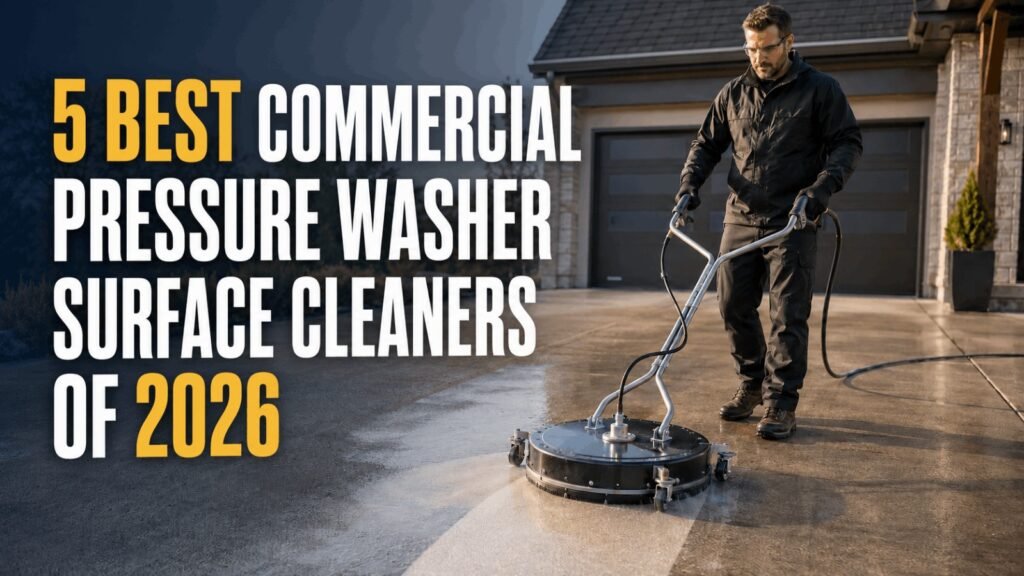
Best Commercial Pressure Washer Surface Cleaner: 5 Models Compared

The best commercial pressure washer surface cleaner is the one that matches your machine’s flow rate, not the biggest one on the shelf. For most gas pressure washers that make 4 GPM, a 16 to 20 inch cleaner is the sweet spot. If you run hot water, pick one rated for it. If your machine is small, go down to 15 inches. I did not test any of the five cleaners below. This guide compares published specs from the makers and from dealers, and it shows you where those sources disagree. The old version of this page said “driveway tested” in the title. I removed that claim because it was not true, and I fixed several spec errors I found while checking. Best commercial pressure washer surface cleaner: quick picks Here is the best commercial pressure washer surface cleaner for each kind of job, based on published specs. What a surface cleaner does and why contractors use one A surface cleaner is a round housing with a spinning bar that holds two or more nozzles. The housing keeps the spray close to the ground and holds in the splash. The result is even cleaning with no stripes, and you finish flat areas much faster than with a wand. Wands leave lines because your hand speed and angle change. A surface cleaner holds one angle and one height, so the only thing you control is walking speed. That is why a driveway, patio or parking lot goes quicker and looks more even. Picking the best commercial pressure washer surface cleaner starts with understanding flow. Surface cleaners are not for small electric washers. They need real flow. If you own a 1.4 GPM electric model like the one in our Karcher K5 review, a cleaner built for 4 GPM will spin slowly or stall. Comparison of the best commercial pressure washer surface cleaner models The best commercial pressure washer surface cleaner models differ most in flow range and water temperature. This table uses the most common numbers across maker pages and dealer listings. Where sources disagree, the last column says so. Model Width Pressure rating Flow Water temperature Where sources disagree Whisper Wash Classic 19″ 19 in 2,000 to 4,000 PSI (Platinum models up to 5,000) About 4 to 10 GPM Up to 212°F in most listings Cover is called ABS, Xenoy or spun aluminum depending on the seller BE Whirl-A-Way 20″ 20 in 3,000 to 4,000 PSI 4.0 to 8.0 GPM Up to 185°F (model 85.403.007) Stainless model 85.403.009 is sold for hot and cold water; check the model number Simpson 80182 20″ 20 in 3,450 to 4,500 PSI About 2.3 to 3.8 GPM (one dealer) 212°F in most listings One dealer says 300°F; flow figures are not on the maker page General Pump Hammerhead 20″ 20 in 1,000 to 4,000 PSI Up to 8 GPM (some say 3 to 8) 180°F or 280°F, depending on the seller Weight listed from 17 to 30 lb; one dealer says 2,000 PSI minimum Kärcher 15″ Hard Surface Cleaner 15 in 2,600 to 4,000 PSI Up to 4.0 GPM Cold water only Spec comes from Kärcher’s Canadian page One correction from the old table: it listed a minimum of 3.0 GPM for the Whisper Wash and 3.5 GPM for the Simpson. Dealer listings give about 4 GPM as the low end for the Whisper Wash, and about 2.3 GPM at the low end for the Simpson. Always check the model number on the box. Whisper Wash Classic 19″: the wide-range workhorse The Whisper Wash Classic comes up in nearly every dealer list. Most listings give a 2,000 to 4,000 PSI range and flow from about 4 up to 10 GPM. Platinum models are listed up to 5,000 PSI. It comes with two 25-degree tips (size 2.0 or 2.5) or four tips on the 4-nozzle version, and a 2 inch nylon brush skirt. It suits a contractor who owns more than one machine, because the wide range lets you move it between them. The weight is listed at 17 to 19 lb. The downside is simple: cover material changes by model, so check what you are buying. BE Power Equipment Whirl-A-Way 20″: built for daily jobs The Whirl-A-Way is a 20 inch cleaner sold in several versions. The greaseable model 85.403.007 is listed at 4,000 PSI maximum, 3,000 PSI minimum, and 4.0 to 8.0 GPM, with a 185°F limit. The stainless model 85.403.009 is sold by Home Depot for hot and cold water. BE suggests a 2.0 orifice, 25 degree nozzle for a 4 GPM, 4,000 PSI machine. Casters and a greasable swivel make it a good fit for crews that clean every day. The old article said it was polypropylene. I could not confirm that, so I took it out. Simpson 80182 20″: the hot water choice Simpson lists this universal cleaner for hot and cold water machines, with a recommended minimum of 3,450 PSI and a maximum of 4,500 PSI. Most dealers give 212°F as the temperature limit. One dealer says 300°F, so read the manual before you push it. One dealer lists flow from about 2.3 to 3.8 GPM, but I could not find those numbers on the maker’s own page. It fits contractors who clean oily slabs, truck bays or restaurant pads with a hot water machine. The 3/8 inch quick connection fits most commercial hoses. General Pump Hammerhead 20″: best for varied machines The Hammerhead is listed at up to 4,000 PSI and up to 8 GPM, which covers a big range of gas machines. It has a 3/8 inch female quick coupler, an ABS cover and a greasable swivel on some models. Model numbers appear as DCFSCP20GZ and DFSCP20GZ. The weak spot is that dealers do not agree on temperature (180°F or 280°F) or weight (17 to 30 lb). If you plan to run hot water, ask the seller for the manufacturer sheet first. Compact 15 inch cleaners for smaller machines A 15 inch cleaner is the right

Scroll to Top