Author name: Team Pressure Washer Wise

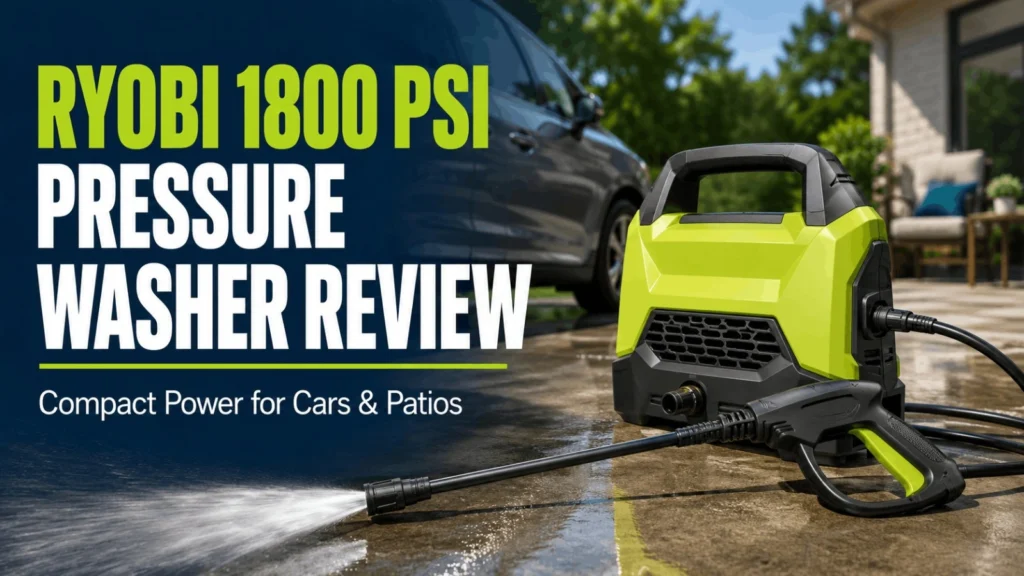
Ryobi 1800 PSI pressure washer compact power for cars and patios review
Pressure Washers > Reviews

Ryobi Pressure Washer 1800 PSI Review: Compact Power for Cars and Patios

A large pressure washer can be unnecessary when you only need to clean a car, grill, garden chairs, windows, or a small patio. The Ryobi pressure washer 1800 PSI is designed for these lighter household jobs. It offers corded-electric convenience in a compact machine that is easier to carry and store than a full-size cart model. This review focuses on the current Ryobi RY141802. It also explains the related RY141803 and discontinued RY141820 because all three may appear in search results under the same 1,800 PSI name. How we reviewed it: This is an independent, specification-based review. We checked Ryobi’s current product information, model differences, support pages, and public safety guidance. We did not perform instrumented PSI or GPM testing, so performance comments are practical suitability judgments rather than laboratory results. Maximum output figures are manufacturer ratings. Quick Verdict: Is the Ryobi 1800 PSI Pressure Washer Any Good? The Ryobi 1800 PSI pressure washer is a sensible light-duty choice for buyers who value portability, simple electric starting, and compact storage. Its rated 1,800 PSI and 1.2 GPM output is suitable for routine cleaning of cars, patio furniture, grills, windows, fencing, and small hard surfaces when the correct nozzle and distance are used. Its main limitation is cleaning speed. The 1.2 GPM flow and 20-foot pressure hose can make large driveways, heavily stained concrete, and frequent demanding work slow. It should be viewed as a maintenance cleaner, not a professional restoration machine. Buying decision Assessment Best for: Cars, grills, windows, outdoor furniture, small patios and walkways Less suitable for: Large driveways, deep stains, heavy equipment and commercial work Power type: Corded electric Main strength: Compact 16-pound design and easy starting Main limitation: Modest flow and limited working reach Overall verdict: Good value when matched to light, occasional cleaning  Ryobi RY141802 vs RY141803 vs RY141820 The model number is important because not every Ryobi 1800 pressure washer includes the same body design, hose, storage, or accessories. Model Status and main difference RY141802: Current compact carry-style model reviewed here. Ryobi lists a 15-degree nozzle, turbo nozzle, separate soap applicator, and 16-pound weight. RY141803: Related current model with the same rated pressure and flow. It adds onboard accessory storage and a 20-foot Ultra Flex high-pressure hose. RY141820: Older model that Ryobi marks as discontinued. Used units and remaining stock may still appear online. Do not order a hose, nozzle, gun, or replacement part from the pressure rating alone. Check the rating label and match the complete model number to the seller’s listing, manual, and compatible-parts information.  Ryobi 1800 PSI Pressure Washer Specifications The following table covers the RY141802. Confirm the current package before buying because retailer bundles can change. Specification Ryobi RY141802 Maximum pressure: 1,800 PSI Maximum water flow: 1.2 GPM Power supply: 120V, 60Hz AC Motor: 13 amp electric High-pressure hose: 20 feet Included spray options: 15-degree nozzle and turbo nozzle Detergent system: Separate soap applicator Nozzle connection: 1/4-inch quick-connect coupler Approximate weight: 16 pounds Electrical protection: GFCI-equipped plug Water type: Cold household water supply PSI describes spray pressure, while GPM describes water flow. Pressure helps loosen dirt; flow helps carry it away. That is why a 1.2 GPM washer may remove normal dirt but still take longer than a higher-flow machine on broad surfaces. Ryobi’s official RY141802 page describes it as a light-duty residential cleaner and identifies cars, grills, windows, patio furniture, and similar outdoor uses. It also confirms the 1/4-inch quick-connect wand, two included nozzles, soap applicator, and 16-pound design.  Ryobi Electric Pressure Washer 1800 PSI: Key Features Compact 16-Pound Carry Design The small body is the main reason to choose this model. It can fit on a garage shelf and is easy to move between short jobs. However, it is a carry-style unit rather than a tall wheeled cart. A buyer who cannot comfortably lift the machine may prefer a larger model with wheels and a telescoping handle.  1,800 PSI and 1.2 GPM Cleaning Output This output is appropriate for regular surface dirt, dust, light mud, pollen, and outdoor buildup. It is not designed for rapid removal of deeply embedded stains across a large driveway. Actual results depend on water supply, nozzle choice, spray distance, surface condition, and cleaning method.  15-Degree and Turbo Nozzles The 15-degree nozzle creates a focused fan for general cleaning. The turbo nozzle uses a rotating concentrated spray for stubborn dirt on durable surfaces. It can also damage paint, weathered wood, soft materials, seals, and weak masonry. Always test a hidden area and begin farther from the surface. Separate Soap Applicator The included applicator connects to the trigger handle and applies approved pressure-washer detergent at low pressure. It is simple, but switching from soap to rinsing requires changing the attachment. Use only detergent approved for pressure washers and follow both the cleaner and surface manufacturer’s directions.  20-Foot High-Pressure Hose The hose is adequate for small jobs but may require you to move the machine around a vehicle or patio. Before purchasing, consider the positions of your outdoor outlet and water connection as well as the total working reach.  Ryobi 1800 PSI Pressure Washer for Cars, Patios, and Home Cleaning  Cars, Bikes, Boats, and Recreational Vehicles The machine can handle vehicle rinsing when used carefully. Select the less aggressive spray, begin at a safe distance, and avoid close pressure on damaged paint, decals, badges, sensors, cameras, tires, seals, and electrical parts. Follow the vehicle manufacturer’s cleaning instructions. Pressure washing may loosen surface dirt, but bonded road film can still require a gentle hand wash.  Patio Furniture, Grills, Bins, and Garden Tools These short jobs suit a portable electric pressure washer. Let hot grill surfaces cool, disconnect powered equipment, protect openings, and use a mild spray on painted or plastic items. Test older furniture because sun-damaged plastic, loose coatings, and weakened wood can be harmed even by a compact washer. Small Patios, Decks, and Walkways The RY141802 can clean a small concrete, paver, or suitable deck area with ordinary dirt. The turbo nozzle should be tested cautiously
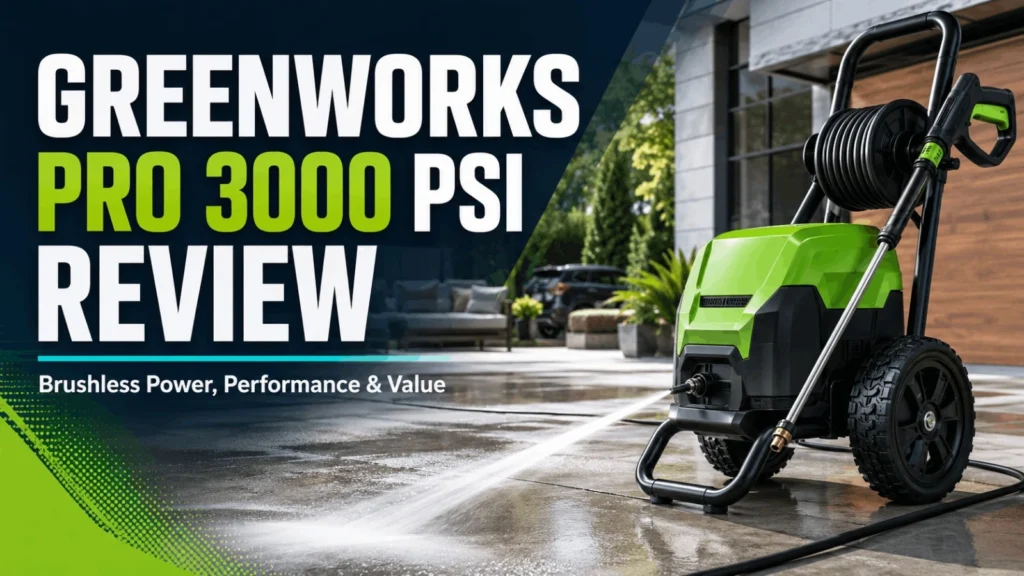
Greenworks Pro 3000 PSI brushless pressure washer review banner showing unit on driveway
Electric Pressure Washers

Greenworks Pro 3000 PSI Brushless Pressure Washer Review: Power and Value

Electric pressure washers are easy to start and maintain, but many compact models feel slow when the job moves from washing a car to cleaning concrete. The Greenworks Pro 3000 PSI brushless pressure washer is designed to offer stronger residential cleaning without gasoline, exhaust, oil changes, or a pull cord. The headline figures require careful explanation. Greenworks lists 3,000 PSI at 1.1 GPM and 2.0 GPM at 100 PSI. These are separate operating points—not 3,000 PSI and 2.0 GPM at the same time. This review covers that important difference, along with the GPW3001 and GPW3002A models, included features, suitable surfaces, common problems, safety, and overall value. How we reviewed it: This is an independent, specification-based review. We checked Greenworks’ current product pages, support information, model details, and public safety guidance. We did not perform instrumented pressure or flow testing, so performance comments are informed suitability judgments rather than laboratory results. Greenworks 3000 PSI Electric Pressure Washer: Quick Verdict The Greenworks Pro 3000 is a capable residential electric washer for concrete, patios, pavers, decks, fencing, siding, vehicles, and outdoor equipment. Its brushless motor, five spray nozzles, 25-foot hose, 35-foot GFCI power cord, onboard soap tank, and 10-inch wheels make it more useful than a basic carry-style machine. Its main limitation is flow at maximum pressure. At 3,000 PSI, the rated flow is 1.1 GPM, so a higher-flow gas washer can rinse a large driveway or heavy mud faster. The Greenworks also needs a suitable 120-volt outlet and dependable water supply. Buying decision Assessment Best for Regular residential cleaning with electric convenience Suitable surfaces Sound concrete, patios, fences, decks, siding, cars and outdoor furniture Main advantage Strong maximum pressure with five nozzles and no gas engine Main limitation 1.1 GPM at maximum pressure limits rinsing speed Portability Steel frame with 10-inch never-flat wheels Overall view Strong choice when its features match frequent home-cleaning jobs Greenworks Pro 3000 PSI Pressure Washer Models: GPW3001 vs GPW3002A Search results can show several Greenworks machines with a 3,000 PSI label. This review covers the corded brushless residential line, mainly the GPW3001, and compares it with the current GPW3002A Gen 2. Model What buyers should know GPW3001 — SKU 5113902 Original corded brushless version. Greenworks lists vertical storage, a one-gallon detergent tank, 25-foot steel-braided hose, 35-foot cord, five nozzles, and 10-inch wheels. GPW3002A — SKU 5128802 Gen 2 corded brushless model with the same rated output, five nozzles, 25-foot hose, 35-foot cord, and open-frame design. 60V/AC and 80V models Different hybrid or battery-powered products. Their batteries, runtime, packages, prices, and warranty terms are outside this review. Always check the complete model and SKU before ordering parts or accessories. Do not assume every “Greenworks 3000 PSI” listing has the same frame, detergent system, package, or warranty. Greenworks Pressure Washer 3000 PSI Specifications The following specifications describe the main GPW3001 configuration. Retail bundles can add accessories, so compare the listing with the supplied manual. Specification Greenworks Pro GPW3001 Power type Corded electric Motor Smart-sensing brushless motor Electrical supply 120V, 60Hz AC Maximum pressure 3,000 PSI Flow at 3,000 PSI 1.1 GPM Maximum flow 2.0 GPM at 100 PSI High-pressure hose 25-foot kink-resistant steel-braided hose Power cord 35 feet with waterproof plug and inline GFCI Included nozzles 15°, 25°, 40°, soap, and turbo Nozzle connection 1/4-inch quick-connect Detergent system One-gallon onboard tank Wheels 10-inch never-flat wheels Certification PWMA-certified performance claims Advertised warranty Three-year tool and ten-year brushless motor warranty for GPW3001 Understanding 3,000 PSI and 2.0 GPM PSI describes water pressure, while GPM describes water flow. Pressure helps loosen dirt; flow helps carry it away. Greenworks lists 3,000 PSI at 1.1 GPM and 2.0 GPM at only 100 PSI. Multiplying 3,000 PSI by 2.0 GPM would therefore create a misleading comparison. This means the washer can apply concentrated pressure to stubborn dirt, but it may rinse wide concrete areas more slowly than a machine delivering higher flow at working pressure. Greenworks Pro 3000: Brushless Motor and Key Features Smart-Sensing Brushless Motor Greenworks says its TRUBRUSHLESS motor adjusts pressure and flow according to the installed nozzle. A brushless electric motor avoids carbon brushes and gas-engine tasks such as fuel storage, oil changes, spark plugs, and pull-cord starting. However, the pump, hoses, fittings, nozzles, screen, detergent tank, and power cord still require inspection and care. Five Quick-Connect Nozzles 15-degree nozzle: Focused high pressure for durable hard surfaces. 25-degree nozzle: Balanced spray for general outdoor cleaning. 40-degree nozzle: Wider, gentler spray for rinsing and more sensitive surfaces. Soap nozzle: Low-pressure detergent application through the tank. Turbo nozzle: Rotating concentrated spray for suitable hard surfaces. The 1/4-inch quick-connect can accept many accessories, but the fitting, pressure rating, flow range, and manufacturer limits must all match. One-Gallon Soap Tank The GPW3001’s large onboard tank reduces refilling during extended jobs. Detergent applies through the black low-pressure soap nozzle. Greenworks recommends designated pressure-washer soap and warns against harsh chemicals such as bleach, ammonia, and strongly alkaline cleaners. Hose, Cord, Wheels, and Vertical Storage The 25-foot steel-braided hose offers better abrasion and kink resistance than many basic hoses, although a large property may still require repositioning. The 35-foot cord adds reach and includes inline GFCI protection. Ten-inch never-flat wheels help on uneven outdoor surfaces, while vertical storage reduces the machine’s garage footprint. Greenworks Pro 3000 Performance on Driveways, Decks, and Cars Driveways, Concrete, and Pavers The 15-degree or turbo nozzle can target dirt on sound concrete. A compatible surface cleaner may produce more even passes, but it is not included in the standard package. Begin with a less aggressive nozzle because damaged joints, loose pavers, weak concrete, and painted surfaces can be marked. Large, stained areas may take time at 1.1 GPM. Decks, Fences, and Siding Use the 25- or 40-degree nozzle, begin farther away, and test an unseen area. Concentrated spray can cut wood fibers or remove coatings. On siding, direct the spray downward where appropriate and keep water away from seams, vents, soffits, outlets, and light fixtures. Cars, RVs, and Boats Use the 40-degree nozzle

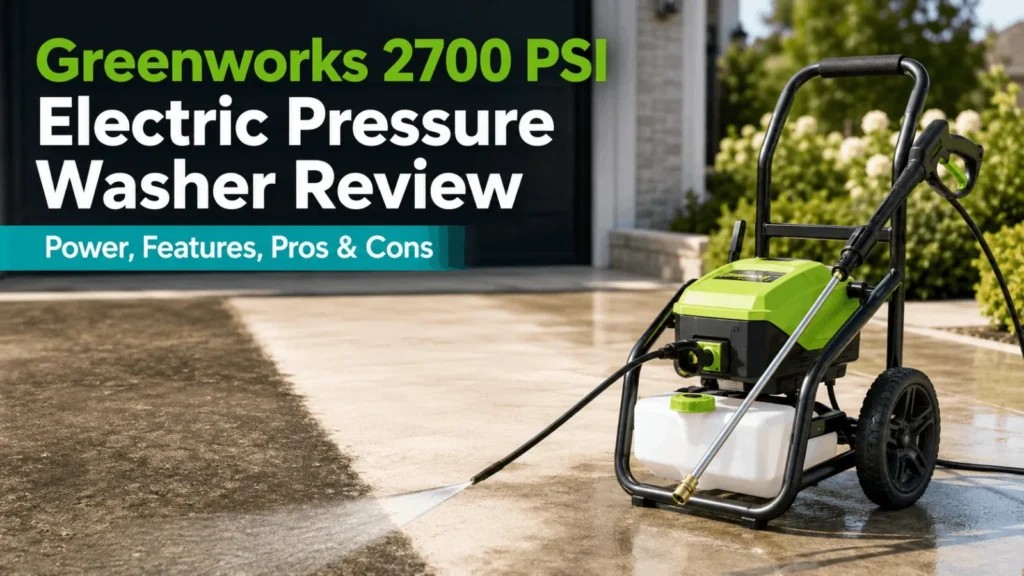
Greenworks 2700 PSI electric pressure washer review banner showing features, pros and cons
Pressure Washers > Reviews

Greenworks 2700 PSI Electric Pressure Washer Review: Is the GPW2702A Worth It?

The Greenworks 2700 PSI electric pressure washer is made for homeowners who want more cleaning force than a small electric unit but do not want the fuel, noise or engine care of a gas model. The GPW2702A combines a brushless motor, five quick-connect nozzles, a one-gallon detergent tank, a 25-foot pressure hose and a 35-foot GFCI power cord. Its headline numbers need a little explanation. The machine provides 2,700 PSI at a rated flow of 1.2 GPM. It can reach 2.3 GPM only in its low-pressure, 100 PSI mode. Those are two different operating points, so buyers should not assume it produces 2,700 PSI and 2.3 GPM at the same time. This research-based review covers the GPW2702A, SKU 5128402. It explains the published specifications, likely performance, useful features, limitations and buying considerations. It is based on the current Greenworks product page, the official operator manual and manufacturer warranty information. We have not claimed hands-on testing or created an unsupported performance score. Quick Verdict The Greenworks GPW2702A is a capable medium-duty residential pressure washer. It should work well for routine cleaning of small and medium driveways, patios, walkways, fences, siding, vehicles and outdoor equipment. Its wide nozzle selection and low-pressure high-flow mode make it more flexible than many entry-level electric models. The main limitation is water flow. At full pressure, 1.2 GPM is enough for home cleaning but may rinse large concrete areas more slowly than a higher-flow gas machine. The open frame is also larger to store than a compact upright washer, and its continuous-run motor should be switched off during long pauses. Best for: Homeowners who want strong electric cleaning for several outdoor jobs near a suitable outlet. Skip it if: You need a machine for daily paid work, very large properties, remote areas without electricity or frequent heavy stain removal. Greenworks GPW2702A Specifications Confirm the model number before buying because Greenworks has sold more than one 2,700 PSI pressure washer. This review covers GPW2702A, SKU 5128402, not the older GWP2700 or a retailer-specific package. Specification GPW2702A Published Information Maximum pressure 2,700 PSI Rated flow at maximum pressure 1.2 GPM at 2,700 PSI Maximum low-pressure flow 2.3 GPM at 100 PSI Motor Smart-sensing brushless motor with JETTFlow technology Power source 120-volt corded electric Power cord 35 feet with inline GFCI High-pressure hose 25 feet, kink-resistant Spray nozzles 15°, 25°, 40°, soap and turbo Detergent tank One gallon, onboard Wheels 10-inch never-flat wheels Nozzle connection 1/4-inch quick connect Certification PWMA certified Published warranty Three years for the tool and ten years for the motor, subject to current terms There is one specification conflict worth noting. The current Greenworks page describes the motor as 14 amps in one section and 15 amps in another. Check the rating label on the machine and the manual supplied with your exact unit before choosing a circuit or extension cord. How Powerful Is This 2700 PSI Electric Pressure Washer? Pressure and water flow perform different jobs. PSI helps loosen bonded dirt, while GPM carries the loosened material away. The GPW2702A delivers its highest pressure with 1.2 GPM and its highest flow with only 100 PSI. That split rating is not automatically a weakness. High pressure helps with marks on durable surfaces, while the higher-flow low-pressure mode is useful for rinsing and detergent work. However, it is misleading to multiply 2,700 PSI by 2.3 GPM because the machine does not reach both figures together. When comparing high-pressure performance, use the rated 2,700 PSI at 1.2 GPM. The pressure is strong for a corded residential unit, but cleaning speed depends on more than the largest PSI number. Surface condition, nozzle choice, detergent, water supply and technique all affect the result. Old oil, paint, rust and stains absorbed deep into concrete may still need special treatment. Performance by Cleaning Job Driveways, Patios and Walkways The machine has enough rated pressure for routine residential concrete cleaning. The 25° nozzle is the safest general starting point. The 15° or turbo nozzle can help on stubborn areas, but both should be tested first and kept moving to avoid visible lines or surface damage. A compatible 15-inch surface cleaner may produce a more even finish and reduce splash. Still, the 1.2 GPM high-pressure flow means a long driveway will take more time than it would with a higher-flow gas washer. Decks, Fences and House Siding Begin with the 40° nozzle from a generous distance. Too much pressure can raise wood grain, remove stain, mark soft material or push water behind siding. Test a hidden area before cleaning the full surface. Do not use a pressure-washer gun while standing on a ladder. A jet can create sudden kickback. Use approved ground-level extensions for high work and follow the surface manufacturer’s cleaning instructions. Cars, Boats and Outdoor Furniture The 40° nozzle or low-pressure rinse mode is the sensible choice for vehicle washing. Keep a safe distance and avoid direct close spray on damaged paint, seals, tires, cameras, electrical connectors, bearings and decals. Apply only detergent approved for pressure washers. Test painted or delicate furniture underneath before washing the visible area. Soft brushes and a garden hose may be safer for fragile materials. Lawn and Outdoor Equipment The washer can remove mud from mowers, carts and garden tools. Allow hot engines to cool first, and avoid air intakes, bearings, electrical parts, seals and warning labels. More pressure is not always better around moving components. Key Greenworks GPW2702A Features Brushless Motor and JETTFlow Technology Greenworks says its smart-sensing motor recognizes the selected nozzle and adjusts water flow for the task. A brushless design removes motor-brush wear and can support efficient operation. It does not make the whole machine maintenance-free; hoses, filters, nozzles, seals and the pump still need inspection and proper storage. Continuous-Run Motor Unlike some compact electric washers that stop the motor when the trigger is released, the GPW2702A uses a continuous-run design. This provides immediate pressure when you pull the trigger. During a long break, turn off the washer instead of leaving water

greenworks electric pressure washer 2000 psi
Electric Pressure Washers

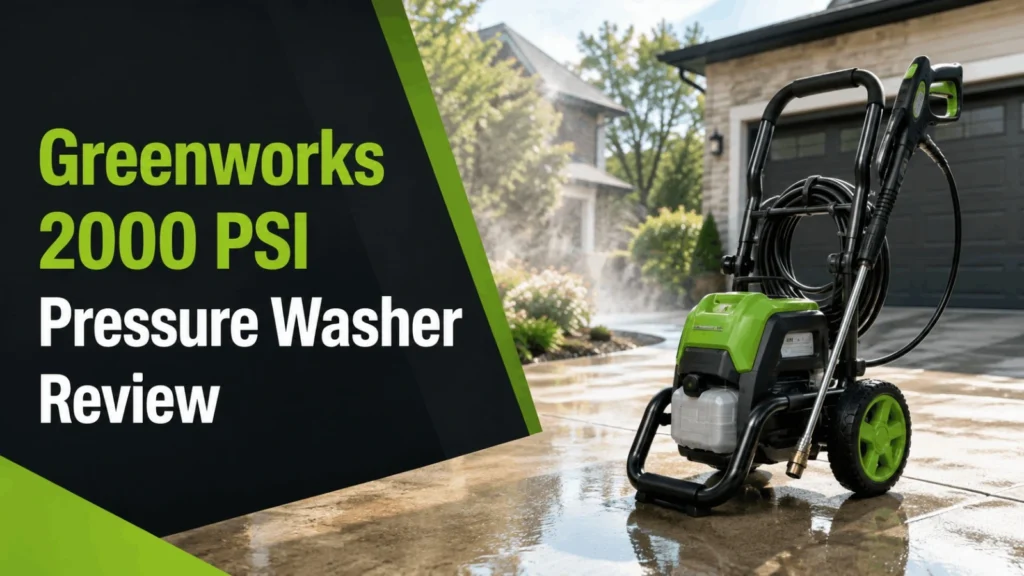
Greenworks Electric Pressure Washer 2000 PSI Review: Specs, Uses, and Common Problems

The Greenworks electric pressure washer 2000 PSI is designed for routine residential cleaning without the fuel, exhaust, or engine maintenance of a gas machine. The GPW2003 combines a claimed maximum pressure of 2,000 PSI with an open-frame design, onboard detergent tank, and four spray options. It suits cars, furniture, fences, siding, decks, and modest paved areas better than large or commercial jobs. Review methodology: This is an editorial, specification- and manual-based review of model GPW2003 (SKU 5118202), not a claim of hands-on testing. Product details were checked against Greenworks’ official product information and support guidance on August 27, 2026. Performance comments below are reasoned from the verified specifications and intended applications. Always follow the manual supplied with your machine. Greenworks Electric Pressure Washer 2000 PSI: Quick Verdict The GPW2003 is a useful middle ground between a basic light-duty washer and a high-flow gas model. Its long cord, wheeled frame, soap tank, and varied nozzles suit household cleaning. However, its listed 1.2 GPM maximum means broad or heavily soiled surfaces may take longer. Its universal motor is also a value-oriented design rather than an induction or brushless type. Best for: cars, outdoor furniture, fences, siding, decks, steps, and small patios or driveways. Consider another machine if: you regularly clean extensive concrete, need commercial durability, or lack a suitable grounded outdoor electrical supply. Which Greenworks 2000 PSI Model Is This Review About? Greenworks sells several 2,000 PSI pressure washers with different motors, flow ratings, hoses, and accessories. Confirm the model number rather than relying on color or headline pressure. Product Model / SKU Listed flow Important distinction Main model reviewed GPW2003 / 5118202 1.2 GPM max 14-amp universal motor, 25-foot hose, onboard soap tank Green-frame version GPW2000-1RG / 5117002 1.2 GPM max 13-amp motor, 20-foot hose, siphon detergent tube Black-frame version PWA201 / 5111802 1.1 GPM max Different motor and accessory configuration Check the rating label before buying parts. Retailer bundles can vary, so official model-specific specifications should take priority. Greenworks 2000 PSI Pressure Washer Specifications The following details apply to GPW2003, SKU 5118202: Specification Official listing Maximum pressure 2,000 PSI Maximum water flow 1.2 GPM Motor 14-amp universal motor; not brushless High-pressure hose 25 feet, kink-resistant Power cord 35 feet with inline GFCI Detergent system Onboard soap tank Included spray options Turbo, 25°, 40°, and black soap nozzle Mobility Open steel frame and 10-inch never-flat wheels Connections M22 14 mm hose fittings; 1/4-inch quick-connect nozzles Certification PWMA certified Tool warranty Three-year limited warranty, subject to terms Pressure and flow figures require context. Greenworks lists 2,000 PSI as maximum pressure but describes 1.2 GPM flow at 100 PSI in the product’s key features. Buyers should not assume the machine produces both maximum figures simultaneously. That distinction matters because PSI helps loosen grime, while GPM helps rinse it away and influences how quickly a large area can be completed. Greenworks 2000 PSI Pressure Washer Features 14-Amp Universal Motor The corded motor requires no fuel mixing, oil changes, pull cord, or exhaust. However, the GPW2003 is not an induction- or brushless-motor model; buyers expecting long, frequent duty cycles may prefer another design. 35-Foot GFCI Cord and 25-Foot Pressure Hose The combined reach limits repositioning. Test the inline ground-fault circuit interrupter before use, keep connections dry, and use a grounded receptacle. Open Frame, Wheels, and Onboard Storage The steel frame and 10-inch wheels aid movement, while integrated storage organizes the hose, wand, cord, and nozzles. Onboard Detergent Tank Use only pressure-washer detergent in the built-in tank. Greenworks warns against harsh bleach, alkaline, or ammonia-based cleaners. Soap dispenses at low pressure through the black nozzle. Greenworks 2000 PSI Pressure Washer for Cars, Patios, and Decks Greenworks 2000 PSI Pressure Washer for Cars Begin with the 40° nozzle, keep your distance, and test an inconspicuous area. Never hold the turbo or a narrow stream close to paint, trim, seals, cameras, or damaged clear coat. Rinse loose grit first and follow the vehicle maker’s care guidance. Greenworks 2000 PSI for Patios and Small Driveways The washer can remove ordinary dirt from concrete, pavers, and steps. Its modest flow makes large slabs and embedded stains slower; pretreatment or a higher-flow machine may help. Test pavers and mortar to avoid etching or dislodging joints. Greenworks 2000 PSI for Decks, Siding, and Outdoor Furniture Use the widest effective fan and greater distance on wood, vinyl, paint, and resin furniture. Work with timber grain and avoid forcing water behind siding. Excessive pressure can raise fibers, strip paint, or damage seals. Greenworks 2000 PSI Nozzle and Soap Guide Nozzle Best starting use Main caution Turbo Stubborn grime on durable concrete or masonry Concentrated action can mark softer surfaces 25° General cleaning of many hard outdoor surfaces Test distance before approaching the surface 40° Cars, furniture, siding, and gentle rinsing May clean slowly on embedded grime Black soap Applying approved pressure-washer detergent Low-pressure soap application only Turn the machine off, release trigger pressure, and confirm the quick-connect nozzle is locked before restarting. Never change a nozzle while the spray gun is pressurized. How to Use a Greenworks 2000 PSI Pressure Washer 1. Inspect the Water and Electrical Supply Place the washer on a stable surface. Inspect the cord, GFCI, hoses, gun, wand, O-rings, and inlet filter. Connect cold water; Greenworks specifies a 104°F (40°C) maximum. Never start the motor before water is flowing. 2. Connect the Hose and Purge Trapped Air Connect both hoses and open the tap fully. With the motor off and nozzle removed, hold the trigger until flow is steady. Greenworks recommends purging for about three minutes when air is trapped. 3. Install the Correct Nozzle Choose the widest suitable nozzle. Insert it fully into the quick-connect collar, release the collar, and tug gently to confirm it is secure. Start far from the surface. 4. Start, Test, and Clean in Sections Use a grounded outlet, test the GFCI, and switch on the washer. Keep the wand moving in overlapping passes. Avoid people, animals, windows, vents, electrical equipment, and unstable ladders.

Top-rated pressure washers of 2026 graphic showing 10 best gas, electric, and cordless models.
PSI & GPM Guides

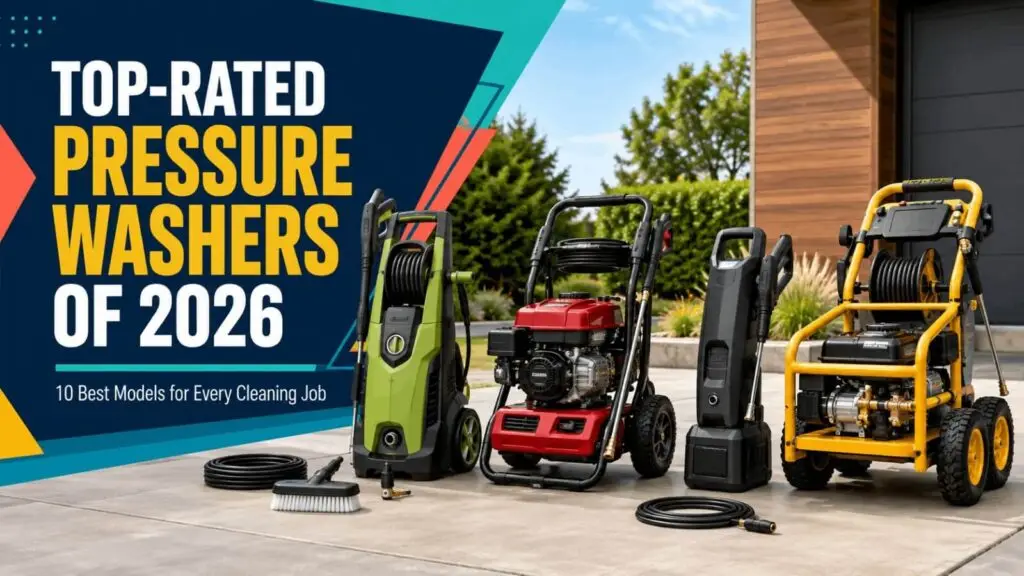
Top Rated Pressure Washers of 2026: 10 Models Compared

The top-rated pressure washers are not simply the machines with the highest PSI. A powerful gas washer may be ideal for a long concrete driveway but inconvenient for washing one car. A compact electric model is easier to start and store, while a cordless washer offers freedom from a power outlet at a higher purchase price. This guide compares ten pressure washers for different buyers and cleaning jobs. Our selections include corded electric, battery-powered and gas machines, from entry-level homeowner units to professional models with triplex pumps. Quick recommendation: Based on published specifications and task suitability, the Greenworks Pro GPW3002A is our best overall choice for most homeowners. Choose the Westinghouse WPX3400 when you need residential gas power, or the SIMPSON PowerShot PS3228 for frequent professional work. Top Rated Pressure Washers briefly Category Model Power source Published output Best use Best overall Greenworks Pro GPW3002A Corded electric 3,000 max PSI at 1.1 GPM Regular home cleaning Best residential gas Westinghouse WPX3400 Gas 3,400 PSI, 2.6 GPM Driveways and heavy dirt Best professional SIMPSON PowerShot PS3228 Gas 3,300 PSI, 2.5 GPM Contractors and frequent use Best cordless EGO HPW3204-2 Dual-battery 3,200 PSI at 1.2 GPM Portable cleaning Best easy-to-use electric RYOBI RY142500 Corded electric 2,500 PSI, 1.2 GPM General residential work Best high-flow electric Kärcher K5 FC Corded electric 2,000 max PSI; up to 2.0 GPM Large home-cleaning areas Best compact DEWALT DWPW2100 Corded electric 2,100 PSI, 1.2 GPM Small homes and storage spaces Best entry-level Sun Joe SPX3000 Corded electric 2,030 rated PSI, 1.2 rated GPM Cars, furniture and patios Best accessory system Generac Speed Wash 3200 Gas 3,200 PSI, 2.7 GPM Versatile outdoor cleaning Best heavy-duty Generac G0088730 Gas 4,200 PSI, 4.0 GPM Large and commercial jobs Published output figures come from the manufacturers. “Maximum” PSI and GPM may be measured under different operating conditions and may not occur together. How We Selected the Top-Rated Pressure Washers This is a research-based buying guide; we did not perform hands-on testing. We compared manufacturer specifications, pressure and flow, pump and motor design, hose length, nozzle selection, detergent delivery, portability, maintenance needs, warranty coverage and suitability for common cleaning jobs. Manufacturer product pages were verified on August 20, 2026. Category winners are editorial recommendations based on their intended use, not laboratory rankings. Prices, stock, specifications and included accessories can change, so confirm the exact model, package and warranty before ordering. 1. Greenworks Pro GPW3002A — Best Overall Pressure Washer The Greenworks Pro GPW3002A is our best overall choice for homeowners who want strong cleaning without gasoline maintenance. Its brushless motor supplies up to 3,000 PSI at 1.1 GPM, while its high-flow mode reaches 2.0 GPM at 100 PSI. Those figures should not be combined as one operating point. The package includes a 25-foot kink-resistant hose, 35-foot GFCI power cord and five nozzles: 15°, 25°, 40°, soap and turbo. Ten-inch wheels make the open-frame machine easier to move, and vertical storage reduces its garage footprint. Pros Strong performance for a residential electric washer Brushless motor with automatic pressure and flow adjustment Five useful nozzles and long power cord Ten-year motor and three-year tool warranty stated by Greenworks Cons Bulkier than compact electric machines Maximum PSI and maximum flow do not occur together 2. Westinghouse WPX3400 — Best Residential Gas Pressure Washer The Westinghouse WPX3400 delivers 3,400 PSI and 2.6 GPM from a 212cc four-stroke engine. That output is well suited to concrete, brick, fences, siding and other demanding residential jobs. It includes a 25-foot hose, five quick-connect tips and a 0.5-gallon detergent tank. The steel frame and 12-inch never-flat wheels are practical for uneven outdoor surfaces. Its axial-cam pump needs less attention than a serviceable triplex design, although it is aimed more at homeowner use than daily contracting. Pros High cleaning output at a competitive gas-machine level Five nozzle tips and large onboard soap tank Strong wheels and steel frame Cons Recoil starting and normal gas-engine maintenance Manufacturer lists this version as not CARB compliant 3. SIMPSON PowerShot PS3228 — Best for Professionals The SIMPSON PowerShot PS3228 is designed for contractors and serious users. Its Honda GX200 engine powers an AAA triplex pump at 3,300 PSI and 2.5 GPM. Unlike a basic residential axial pump, the triplex design is intended for more demanding and frequent work. The package provides a 25-foot MorFlex hose, five nozzles, welded steel frame and 10-inch pneumatic tires. At 77 pounds, it is not lightweight, but its build is better matched to deck restoration, paint preparation and repeated property cleaning. Pros Honda GX200 engine and serviceable triplex pump Flexible, abrasion-resistant MorFlex hose Commercial warranty coverage on engine, pump and frame Cons Heavy and more expensive than homeowner models This PS3228 version is not sold in California 4. EGO HPW3204-2 — Best Cordless Pressure Washer The EGO POWER+ HPW3204-2 removes the need for both fuel and a wall outlet. Two included 56V 6.0Ah batteries provide up to 3,200 PSI at 1.2 GPM, with a maximum-flow mode of up to 2.0 GPM. EGO states a runtime of up to 60 minutes, although actual runtime depends on the selected mode and workload. The washer can use a garden hose or draw clean water through its included siphon hose. ECO, High and Turbo modes are selected through the wand display. A foam cannon, five nozzles and 25-foot hose are included. Pros True cordless operation with strong peak pressure Can draw from a clean portable water source Good accessory package and five-year tool warranty Cons Much more expensive than most corded machines Runtime and maximum output depend on battery charge 5. RYOBI RY142500 — Best Easy-to-Use Electric Model The RYOBI RY142500 is a sensible middle-ground choice for decks, fences, siding, sidewalks and small driveways. Its brushless electric motor produces 2,500 PSI at 1.2 GPM without the starting, fuel and oil requirements of a gas engine. It has a 25-foot hose, metal wand, onboard soap tank and 12-inch flat-free wheels. The machine stores its hose, wand, cord and nozzles onboard, which helps reduce setup

How to use a Kärcher pressure washer setup detergent and safety guide header
How to Guides

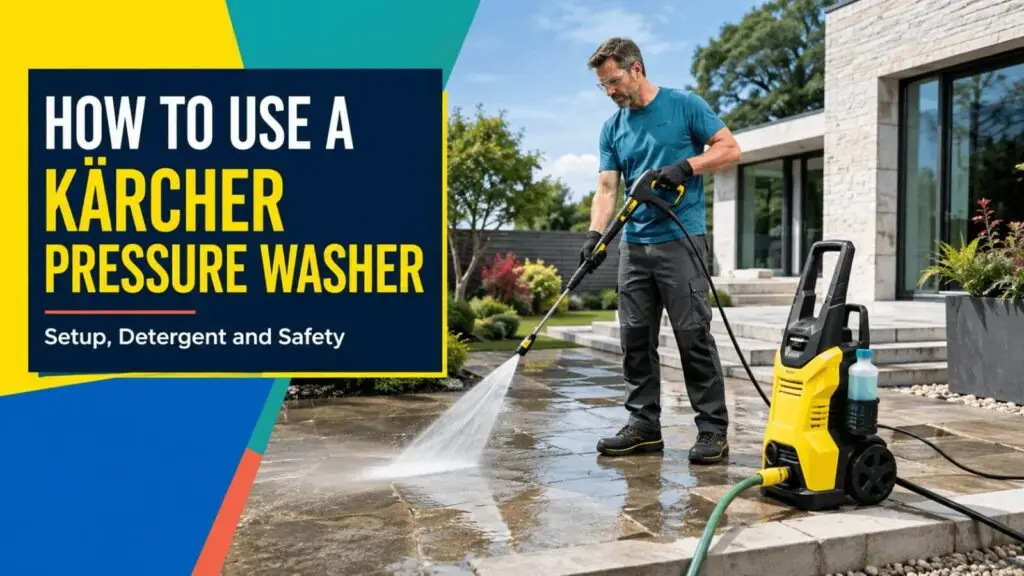
How to Use a Kärcher Pressure Washer: Setup, Detergent and Safety

Learning how to use a Kärcher pressure washer is simple, but detergent systems and controls vary by model. The basic sequence is the same: connect the hoses, open the water, remove trapped air, connect power safely, select a gentle pressure and test the spray. This guide covers those steps and explains the main Kärcher detergent systems. Quick answer: Set the washer on level ground, connect the high-pressure hose and spray gun, attach the garden hose, turn on the water, and squeeze the trigger until the flow is steady. Connect the washer to a protected electrical supply, switch it on and begin with the Vario Power lance at a low setting. Apply detergent only through the system designed for your model and only in its low-pressure or MIX setting. Check Your Kärcher Model Before Starting  K2 through K7 identify performance classes, but machines within one class can have different hoses, guns and controls. Find the full model and part number on the machine’s rating plate. Then check the supplied manual or download the correct version from Kärcher’s official operating-manual finder. The model manual must take priority if one of its instructions differs from this general guide. Common Kärcher detergent and control systems System or range What you may see How detergent is normally selected K2/K3 and some Classic models Small suction hose with filter Put the filtered end in approved detergent and turn the Vario lance to its lowest-pressure setting K4/K5 Power Control and selected models Plug ’n’ Clean bottle inlet Insert the compatible bottle as directed and select the detergent position on the lance Smart Control models 3-in-1 Multi Jet lance and gun display Turn the lance to MIX; confirm the Plug ’n’ Clean bottle is seated correctly Newer Comfort models 2Way!Wash detergent system Follow the model guide for bottle or foam-nozzle delivery and dosage control Foam-nozzle kits Bottle attached to a separate foam jet Fit the foam jet to the trigger gun and adjust the detergent control on the attachment Do not force a bottle into a machine that uses a suction tube or assume every K5 works identically. The official Kärcher range page explains newer features. What You Need Before Setup Prepare everything before connecting the power: Your Kärcher pressure washer and the correct manual Kärcher-compatible trigger gun and high-pressure hose Vario Power, Multi Jet or another suitable spray lance A clean garden hose with the correct inlet connector A reliable cold-water supply Pressure-washer detergent suitable for the surface, if required Safety glasses, gloves and closed-toe, nonslip footwear An outdoor electrical outlet protected by an RCD or GFCI, as applicable in your country Inspect the cord, plug, pressure hose, gun, lance and couplings. Do not operate the washer with a damaged cord, bulging hose, cracked gun or connector that will not lock. Stop and contact support if the cord becomes unusually warm or the hose swells. How to Use a Kärcher Pressure Washer Step by Step 1. Place the washer on stable ground Position the machine on firm, level ground, away from direct spray and standing water. Uncoil the hose and cable to prevent twists and trip hazards. Keep the cable away from the wet work area, separate it from the water hose and prevent children or pets from entering. Use the operating position shown in your manual. 2. Connect the high-pressure hose With the machine switched off and unplugged, connect the high-pressure hose to the washer’s high-pressure outlet. On a Quick Connect model, push the hose end in until it locks. Attach the other end to the trigger gun if it is not already fitted. Give each connection a gentle pull. Do not force plastic couplings or use a hose or gun rated below the machine’s requirement. 3. Fit the correct spray lance Insert the lance into the trigger gun and turn or click it into its locked position, depending on the connector. Start with the Vario Power or adjustable flat-spray lance. It gives more control and is safer for testing an unfamiliar surface. The Dirt Blaster’s concentrated rotating jet is for stubborn dirt on hard materials. It can strip paint or damage wood, vehicle finishes and soft stone, so begin with the Vario lance. 4. Connect the cold-water supply Check that the small inlet filter is clean and correctly installed. Attach the hose connector to the washer’s water inlet, then connect the garden hose. Avoid a kinked, crushed or leaking supply hose. Turn the tap on fully. Domestic Kärcher pressure washers are normally cold-water machines. Kärcher states that the inlet temperature for its residential electric models should not exceed 40°C/104°F. Hot water can damage a pump that was not designed for it. If your model can draw from a tank, use the specified filtered suction hose and priming method. Not every model supports this feature. 5. Purge trapped air before switching on Leave the machine switched off. With the water supply open, release the trigger safety lock and squeeze the trigger. Water may cough or pulse at first as air leaves the hose, pump and gun. Keep holding the trigger until a smooth, steady stream comes from the lance. This step gives the pump a proper water supply before the motor starts. Running the unit without water, even briefly, can damage the pump. If no water appears, switch nothing on. Recheck the tap, inlet connector, hose kinks and inlet filter. 6. Connect electrical power safely Dry your hands and confirm that the switch is in the OFF or 0 position. Connect the plug directly to a suitable outdoor outlet protected by a working residual-current device. North American versions may have a GFCI built into the plug; Kärcher advises testing it as part of startup and not using the washer if the test fails. Avoid an extension lead. If the manual permits one, it must be outdoor-rated, correctly grounded where required, heavy enough for the load and within the stated length. Never join several leads or remove a grounding pin. Keep the plug, outlet and cable

How to use an electric pressure washer safely step-by-step guide featuring a person pressure washing a concrete driveway
Guides & Tips

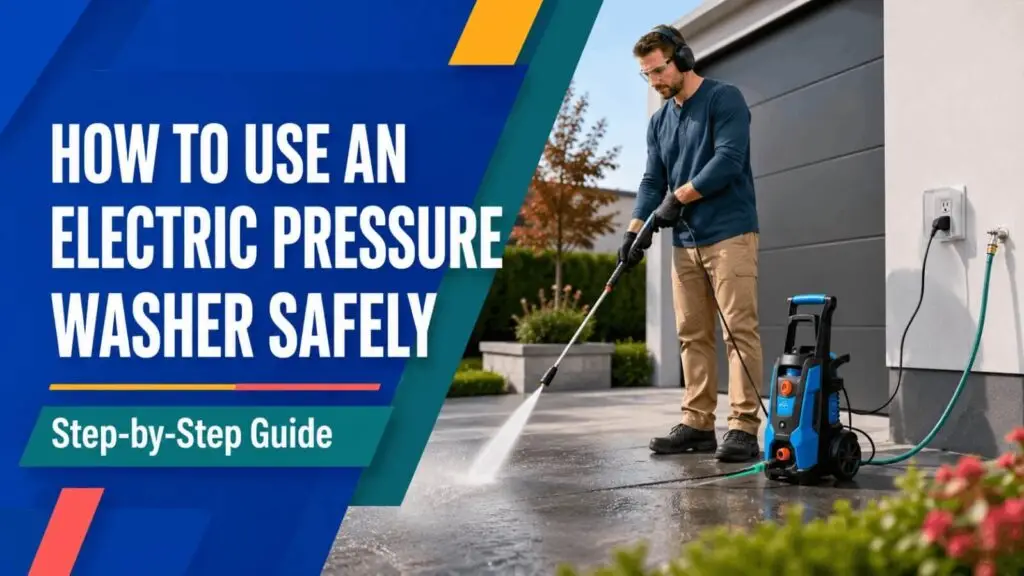
How to Use an Electric Pressure Washer Safely: Step-by-Step Guide

An electric pressure washer looks simple: connect a hose, plug it in, and pull the trigger. That shortcut is also how beginners end up with a pulsing pump, a tripped GFCI, damaged paint, or a machine that runs without enough water. Learning how to use an electric pressure washer safely means following the correct order. Connect the water system first, remove trapped air, establish a dry protected power connection, select a surface-safe nozzle, and test before cleaning the full area. This guide covers common residential corded machines from inspection through storage. Your model’s manual always takes priority. How this guide was prepared: This guide uses manufacturer instructions and recognized electrical-safety guidance. Always follow the manual supplied with your model. What an Electric Pressure Washer Does An electric motor drives a pump that increases the pressure of water supplied by a garden hose. The spray gun controls the flow, while the wand and nozzle shape the water into a narrow or wide pattern. Two ratings help describe cleaning performance: PSI (pounds per square inch) indicates water pressure. GPM (gallons per minute) indicates water flow. PSI loosens dirt, while GPM helps carry it away. More pressure is not automatically better; paint, wood, siding, vehicles, and furniture need more care than concrete. Most residential electric models also use a total-stop system that switches the motor off when the trigger is released. Not every machine behaves identically, so become familiar with its switch, trigger lock, nozzle system, detergent method, and shutdown procedure before starting. What You Need Before Starting Gather and inspect the equipment before connecting power: Electric pressure washer and its manual Garden hose capable of supplying the required water flow High-pressure hose, spray gun, and wand Correct nozzles or adjustable lance Clean water-inlet filter Pressure-washer-approved detergent when needed Safety glasses, closed-toe non-slip footwear, gloves, and hearing protection Grounded outdoor outlet with required GFCI protection Move children, pets, vehicles, fragile decorations, and loose objects away. Avoid sensitive outlets and fixtures without trapping water against electrical equipment. Inspect the cleaning surface for cracks, loose paint, damaged mortar, soft wood, open windows, and areas where water could enter. Sweep away stones and loose debris that the spray could throw. How to Use an Electric Pressure Washer Step by Step Step 1: Inspect the Machine and Work Area Place the pressure washer upright on stable, level ground. Check the power cord, plug, GFCI module, high-pressure hose, spray gun, couplings, and machine housing. Do not use equipment with exposed wire, a missing ground pin, hose bubbles, cuts, leaks, or broken guards. Plan separate routes for the electrical cord and garden hose. Keep the plug, outlet, and all cord connections away from runoff and the direction of spray. Step 2: Connect the High-Pressure Hose With the machine switched off and unplugged, connect one end of the high-pressure hose to the pump outlet and the other to the spray gun. Push or thread each fitting fully according to the manual. Tug gently on quick-connect fittings to confirm they have locked. Straighten the hose before pressure builds. Tight loops and kinks can restrict movement, make the hose difficult to handle, and place stress on fittings. Step 3: Attach the Spray Wand Connect the wand to the trigger gun using the model’s twist-lock, threaded, or quick-connect system. Engage the trigger safety lock while assembling accessories. Inspect the nozzle opening for debris. Never look into the nozzle or point the gun toward your hand while checking it. Use the cleaning tool recommended by the manufacturer if a nozzle is clogged. Step 4: Connect and Turn On the Water Supply Check that the inlet screen is clean and correctly seated. Attach the garden hose to the water inlet and tighten it by hand without damaging plastic threads. Open the tap fully unless the manual specifies otherwise. The water source must provide the required flow. A partly closed tap, narrow hose, kink, blocked filter, or leaking connector can cause low pressure, pulsing, overheating, or pump damage. Do not start the motor without water flowing through the pump. Some specialty machines can draw from a tank, but a normal garden-hose model should not be assumed to have that ability. Step 5: Purge Air With the Motor Off Keep the pressure washer unplugged and switched off. Point the spray gun in a safe direction, release the trigger lock, and squeeze the trigger. Let low-pressure water flow until the stream becomes steady and free from sputtering. Some manuals instruct users to purge the system without a nozzle or lance attached. Follow the procedure for your model. Once purging is complete, release the trigger, engage the safety lock, and install the appropriate nozzle if it was removed. Purging matters because trapped air can make the spray pulse and place unnecessary stress on the pump and hose. Step 6: Select the Safest Nozzle Start with a wide fan nozzle or the lowest adjustable-pressure setting. A narrow spray concentrates force into a small area and increases the chance of etching concrete, cutting wood fibers, lifting paint, or damaging vehicle trim. Common color coding may include white for a wider fan, green for general cleaning, yellow for a narrower pattern, red for a concentrated jet, and black for low-pressure detergent. Color conventions are common but not universal. Confirm the angle and purpose marked in your manual. For surface-specific guidance, see how much pressure different cleaning jobs require. Use the gentlest setup that completes the job. Step 7: Connect to Safe Electrical Power Dry your hands and confirm the machine switch is off. Plug the washer into a properly grounded outdoor outlet with the GFCI protection specified by the manufacturer. Test and reset the GFCI exactly as directed. The U.S. Consumer Product Safety Commission recommends GFCI protection outdoors, keeping cord-connected equipment away from water, and using only outdoor-rated extension cords. Keep the outlet and plug area dry, raised, and away from runoff. Do not remove the grounding pin, use an adapter, or defeat a GFCI that trips. Extension-Cord Warning Use an

: Electric pressure washer connected safely to an outdoor outlet with electricity-cost graphics
Electric Pressure Washers

Do Electric Pressure Washers Use a Lot of Electricity? Cost Guide

A pressure washer sounds powerful, so it is reasonable to wonder what that motor is doing to your electricity bill. The answer is less alarming than the noise may suggest. Do electric pressure washers use a lot of electricity? They can draw a fairly high amount of power while the motor is running, but most household cleaning jobs last only 30 minutes to a few hours. That usually makes the total electricity cost modest. A machine drawing 1.8 kilowatts continuously for one hour would use 1.8 kilowatt-hours (kWh). At an example rate of $0.15 per kWh, that equals $0.27. Actual use depends on the motor rating, trigger time, total job length, automatic stop system, voltage, water supply, nozzle, and cleaning method. This guide shows how to read the machine label, calculate running cost, compare realistic scenarios, and avoid wasting electricity. How these estimates were prepared: Calculations use manufacturer-listed input power and assume continuous motor operation unless stated otherwise. They are planning estimates, not laboratory measurements. Your machine, trigger time, voltage and electricity tariff will determine the actual cost. Do Electric Pressure Washers Use a Lot of Electricity Per Hour? Corded residential pressure washers vary by market and cleaning class. Current manufacturer examples include 230V models rated from about 1.4 kW to 3.0 kW, while many North American homeowner units use a 120V, 13-amp motor. Always use the rating on your own machine rather than treating these examples as a universal range. Those figures describe power demand while operating, not the amount charged on a monthly bill. Electricity billing is based mainly on energy use in kilowatt-hours: Energy used (kWh) = Power (kW) × Running time (hours) A 1.6 kW machine running for 45 minutes uses up to: 1.6 × 0.75 = 1.2 kWh If electricity costs $0.20 per kWh, the estimated cost is: 1.2 × $0.20 = $0.24 This is a simple full-power estimate. Some electric pressure washers stop the motor when the trigger is released, reducing energy use during pauses. Motor load and power factor can also make measured consumption different from a nameplate calculation. How to Find Your Pressure Washer’s Wattage Check the rating label on the machine, motor, plug tag, or manual. Look for W or kW, together with voltage and amperage. Use Listed Watts When Available If the manufacturer lists rated input power, use that number. Convert watts to kilowatts by dividing by 1,000: 1,400 watts = 1.4 kW 1,800 watts = 1.8 kW 2,000 watts = 2.0 kW Do not calculate electricity use from PSI or GPM. PSI measures water pressure, while GPM measures water flow. Neither tells you the exact electrical input. Estimate From Volts and Amps When only voltage and amperage are shown, multiply them for a basic circuit-demand estimate: Volts × Amps = Volt-amperes (VA) For example, 120V × 13A = 1,560 VA. People often treat that as roughly 1,560 watts for quick planning, but an AC motor’s true watts can differ because of power factor and operating load. A plug-in electricity meter rated for the machine’s current provides a better real-world measurement when the manufacturer allows its use outdoors and the setup remains safely GFCI-protected. Why Voltage Alone Does Not Show Consumption A 230V machine is not automatically twice as expensive to run as a 115V machine. Higher voltage can deliver the same power at lower current. Wattage and operating time—not voltage alone—determine energy use. Electric Pressure Washer Cost Examples The table below uses a 1.8 kW pressure washer and assumes continuous full-power operation. Replace the electricity rate with the amount shown on your utility bill. Cleaning time Energy used At $0.10/kWh At $0.20/kWh At $0.30/kWh 30 minutes 0.9 kWh $0.09 $0.18 $0.27 1 hour 1.8 kWh $0.18 $0.36 $0.54 2 hours 3.6 kWh $0.36 $0.72 $1.08 For a 90-minute job at $0.20 per kWh: 1.8 kW × 1.5 hours × $0.20 = $0.54 This calculation is intentionally conservative if the motor stops whenever the trigger is released. It may underestimate use if the machine includes additional electric heating, a vacuum, or another powered system. Estimate Monthly or Annual Cost Suppose you run a 1.8 kW machine for one hour twice each month: 1.8 kW × 2 hours × 12 months = 43.2 kWh per year At $0.20 per kWh, that equals $8.64 per year. This is only an example; local rates, cleaning frequency, and actual motor-on time will change the result. What Affects Electricity Consumption? Motor Input Rating A larger motor can draw more power, but it may also complete a suitable job faster. Comparing wattage alone does not show which machine will use less total energy. Trigger Time and Automatic Stop Many residential models use a total-stop system that switches off the motor when the spray-gun trigger is released. This reduces unnecessary runtime during repositioning, scrubbing, soap dwell time, or moving furniture. Confirm how your model behaves rather than assuming every machine stops completely. Cleaning Time Job duration often matters more than a small difference in wattage. A 1.8 kW machine used efficiently for 40 minutes can consume less energy than a 1.4 kW unit struggling for two hours. Surface, Dirt, and Nozzle Choice Heavy algae, compacted mud, and old concrete stains take longer than rinsing a car or patio chair. The correct nozzle and detergent can shorten the job, but excessive pressure can damage paint, wood, seals, and vehicle trim. . Our guide to choosing the right PSI for different cleaning jobs helps match cleaning force to the surface. Water Supply A restricted tap, kinked hose, clogged inlet filter, or undersized supply hose can reduce performance. The motor may keep running while the user makes little progress. Confirm that the source can provide the water flow required by the manual. Hot-Water and Commercial Machines Do not apply homeowner cold-water estimates to commercial electric hot-water equipment. A heating element can require much more electricity than the pump motor and may need a dedicated high-voltage circuit. Check motor and heater ratings separately. Is an Electric Pressure Washer Cheaper Than

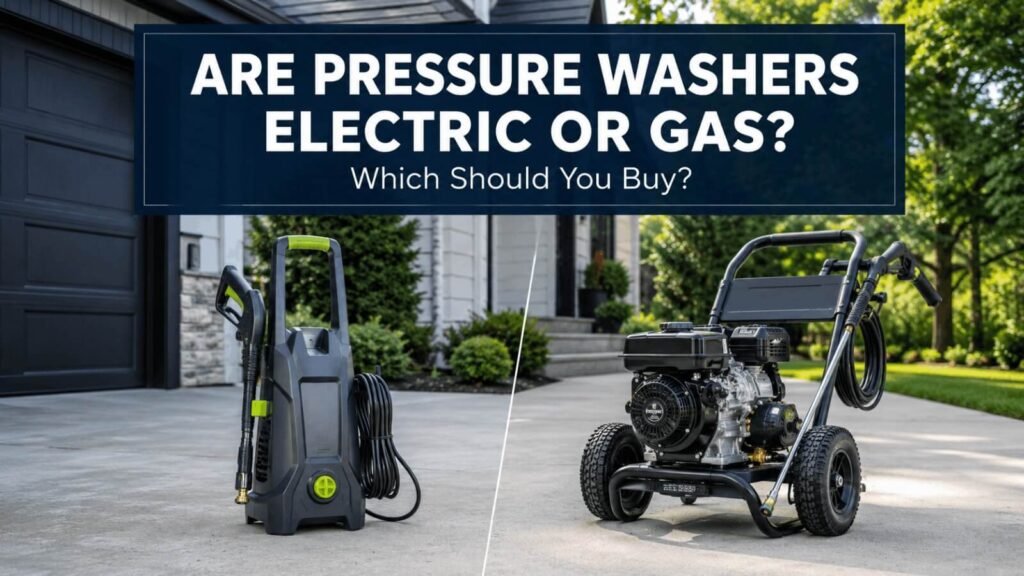
Electric pressure washer and gas pressure washer
Comparisons

Are Pressure Washers Electric or Gas? Which Should You Buy?

Editorial note: This educational comparison explains common differences between electric and gas pressure washers; it is not a hands-on test of specific models. Safety information was checked against current CDC guidance. Always follow the manual for your machine and the care instructions for the surface. Two pressure washers can look almost identical in a product photo yet behave very differently on a driveway. One plugs into an outdoor outlet, starts with a switch, and stores easily in a garage. The other has a gasoline engine, makes more noise, and may clean a large concrete area much faster. Are Pressure Washers Electric or Gas? They can be either. Electric pressure washers use a motor powered by a cord, battery, or dedicated electrical supply. Gas pressure washers use a small combustion engine. Both drive a pump that increases water pressure, but their power, water flow, mobility, maintenance, noise, and best uses are different. Electric is usually simpler for cars, furniture, siding, and small patios. Gas suits large driveways, heavy equipment, big properties, and repeated demanding work. Choose according to the job, not the biggest number on the box. Pressure washers are available in both electric and gas-powered designs. Corded electric machines are common for light and medium home cleaning. Gas models are popular when higher flow, stronger output, and freedom from a power cord are needed. Battery-powered cleaners also exist, but most are designed for portable rinsing and smaller jobs. The power source does not clean the surface directly. It turns the pump. Water enters through a garden hose, the pump raises its pressure, and a high-pressure hose carries it to the spray gun and nozzle. The nozzle then controls the shape and intensity of the spray. Both types can clean effectively. The real question is which provides the right pressure, water flow, reach, control, and durability for your regular jobs. Electric vs Gas Pressure Washer: Quick Comparison Factor Electric Pressure Washer Gas Pressure Washer Power source Corded motor, battery, or dedicated electrical supply Gasoline engine Best for Cars, furniture, small patios, routine siding and light home cleaning Large driveways, long fences, equipment and repeated heavy work Output pattern Usually lower GPM and easier to control Usually higher PSI and GPM for faster heavy cleaning Mobility Limited by cord and outlet on corded models Not tied to an outlet, but still needs a water supply Noise Generally quieter Louder; hearing protection may be needed Maintenance Lower; no fuel, engine oil or spark plug Engine oil, fuel system, air filter and spark plug need attention Weight and storage Usually lighter and more compact Usually heavier and requires fuel-safe storage Exhaust No engine exhaust at the machine Produces carbon monoxide and must remain outdoors Starting Switch or trigger-controlled system Recoil or electric start, depending on model Typical buyer Homeowner or occasional user Large-property owner, contractor or frequent heavy-duty user These are common patterns, not strict rules. Commercial electric and compact gas machines may differ, so compare exact specifications and the manual. How Electric Pressure Washers Work An electric motor drives the pump. Most residential units use a standard household outdoor circuit, while commercial machines may require higher-voltage service. Main Advantages of Electric Models Easy starting: Connect the water, purge air, plug into a suitable protected outlet, and follow the start procedure. Lower maintenance: No gasoline, engine oil, air filter, carburetor, or spark plug is required. Quieter and lighter: Electric machines are generally easier to use, move, and store. No engine exhaust: There are no combustion fumes at the machine. Useful control: Their output often suits cars, furniture, small decks, and other delicate work. Main Limitations of Electric Models The cord limits range and must be managed around hoses and runoff. Use an extension cord only when the manufacturer permits it and specifies the outdoor rating, gauge, and length. Many electric models also move less water than gas machines, so a large driveway may take longer. Budget units may have short hoses, proprietary fittings, or non-serviceable pumps. Who Should Choose Electric? Choose electric for vehicles, furniture, bins, small patios, short fences, and occasional low-pressure siding washing near a suitable outlet. It is also the easier choice when storage space is limited or you want to avoid fuel and engine maintenance. An electric pressure washer may not be the best choice if the farthest cleaning point is beyond safe cord reach or if you regularly clean large, heavily soiled concrete areas. How Gas Pressure Washers Work A gasoline engine turns the pump. It can move around a large property without an outlet, but it still needs an adequate water supply. Main Advantages of Gas Models Higher output: Gas machines commonly combine stronger pressure with more water flow. Faster large-area work: Higher GPM clears loosened dirt from concrete and equipment more quickly. Outlet-free mobility: Useful on farms, jobsites, and large properties. Heavy-duty options: Strong frames, long hoses, and serviceable triplex pumps are available. Accessory support: Higher flow can run larger compatible surface cleaners effectively. Main Limitations of Gas Models Gas units are louder, heavier, and harder to maintain. Fuel can degrade in storage, while engine oil, filters, and spark plugs need service. Exhaust is the most important limitation. A gasoline engine produces carbon monoxide, an invisible and potentially deadly gas. Never run a gas pressure washer inside a home, garage, basement, shed, warehouse, or partly enclosed space. The CDC advises keeping gasoline-powered pressure washers outdoors and at least 20 feet from doors, windows, and vents. Who Should Choose Gas? Choose gas for large driveways, long walkways, equipment, broad hardscapes, properties without suitable outlets, and commercial work that demands higher flow. Before buying, compare pump type, service access, hose length, nozzle set, frame construction, and engine support. . Our gas pressure washer guide explains these factors in more detail. PSI and GPM: Which Type Has More Cleaning Power? Gas pressure washers generally provide higher pressure and water flow in the residential market, but the numbers need context. PSI describes cleaning force, while GPM describes water flow. PSI

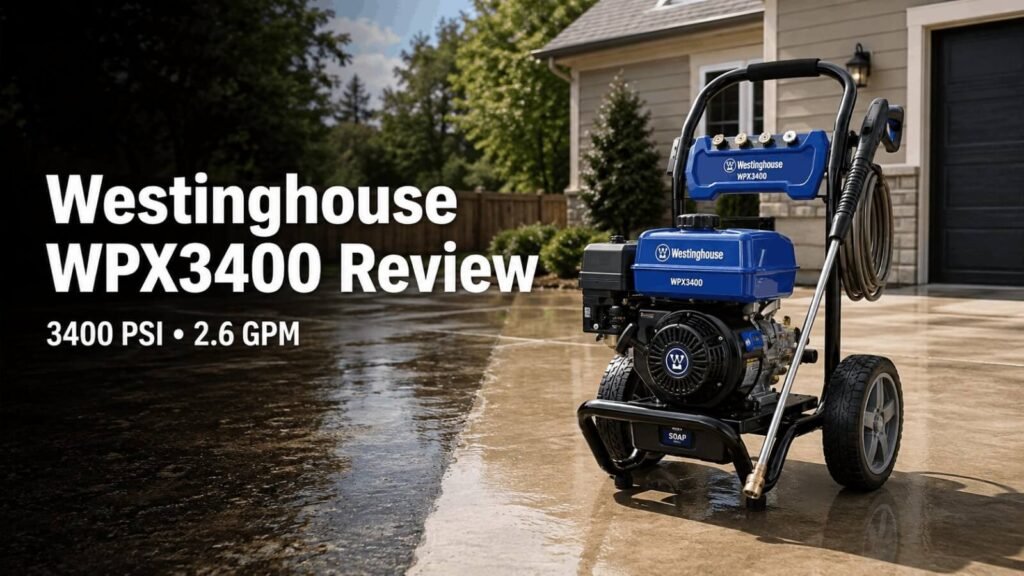
Westinghouse WPX3400 gas pressure washer product review featuring 3400 PSI and 2.6 GPM performance specs.
Buying Guides, Safety Tips

Westinghouse WPX3400 Gas Pressure Washer Review: The Ultimate Heavy-Duty Cleaning Powerhouse

If you are struggling with stubborn oil stains on driveways, weathered wooden decks, moss-covered patios, or peeling exterior paint, entry-level electric pressure washers simply lack the necessary force. The Westinghouse WPX3400 Gas Pressure Washer steps in as a commercial-grade, heavy-duty cleaning solution engineered for homeowners, contractors, and DIY enthusiasts who demand unyielding cleaning power. Delivering an impressive 3,400 PSI (Pounds per Square Inch) at 2.6 GPM (Gallons per Minute), the WPX3400 produces a total cleaning power score of 8,840 Cleaning Units (CU). Driven by a robust 212cc 4-stroke OHV engine, an axial cam brass-head pump, and a heavy-duty steel cart with 12-inch never-flat wheels, this machine blends durability, mobility, and sheer cleaning efficiency. In this comprehensive, data-backed review, we examine every aspect of the Westinghouse WPX3400—from unboxing and assembly to real-world cleaning tests, maintenance practices, and head-to-head comparisons. Key Technical Specifications at a Glance Feature / Spec Westinghouse WPX3400 Specification Model Name Westinghouse WPX3400 Gas Pressure Washer Maximum Pressure 3,400 PSI Maximum Flow Rate 2.6 GPM Total Cleaning Power 8,840 Cleaning Units (PSI × GPM) Engine Type 212cc 4-Stroke Westinghouse OHV (Horizontal Shaft) Starting Mechanism Manual Recoil Pull Start with Choke & Fuel Valve Pump Type Maintenance-Free Axial Cam Pump Fuel Tank Capacity 1.0 Gallon (3.8 Liters) Unleaded Gasoline Onboard Soap / Detergent Tank 0.5 Gallon (1.9 Liters) Built-in Reservoir High-Pressure Hose 25-Foot Super-Flex Abrasion-Resistant Hose (M22 Fittings) Included Nozzles 5 Quick-Connect Tips (0°, 15°, 25°, 40°, & Soap Applicator) Wheel Diameter & Type 12-Inch High-Profile, Never-Flat Solid Rubber Wheels Frame Construction Heavy-Duty Tubular Steel with Corrosion-Resistant Coating Unit Weight 28.6 kg (Approx. 63 lbs) Product Dimensions 19″ L x 18.5″ W x 21.7″ H Warranty 3-Year Limited Manufacturer Warranty (Service, Labor & Parts) 1. Engine & Pump Architecture: The Heart of the WPX3400 At the core of the Westinghouse WPX3400 lies a commercial-grade 212cc 4-Stroke OHV (Overhead Valve) horizontal shaft engine. Unlike underpowered consumer models that rely on vertical-shaft engines prone to heat buildup, horizontal shaft configurations offer superior heat dissipation, smoother torque delivery, and significantly longer operational lifespans. +——————————————————————-+ |               Westinghouse WPX3400 Power Train                    | |                                                                   | |   [212cc 4-Stroke OHV Engine] ───> [Maintenance-Free Axial Pump]  | |               │                                    │              | |        (Recoil Start)                     (3,400 PSI @ 2.6 GPM)   | |               │                                    │              | |   [1.0 Gallon Fuel Tank]             [Thermal Relief Protection]  | +——————————————————————-+ Axial Cam Pump Performance Coupled directly to the 212cc engine is an axial cam pump. This pump design is factory-sealed and engineered to be 100% maintenance-free—meaning you do not need to constantly change pump oil or grease internal bearings under normal residential use. Key advantages of this engine and pump synergy include: Consistent Pressure Output: The axial cam mechanism delivers a steady 3,400 PSI without pulsing or sudden drops in water pressure. Thermal Relief Valve: Protects the pump from overheating if the trigger is released while the engine continues to idle. Optimized Fuel Economy: The 1-gallon fuel tank provides up to 1.5 to 2 hours of continuous run time depending on the nozzle tip and throttle level. 2. Real-World Cleaning Applications & Versatility With 8,840 Cleaning Units, the Westinghouse WPX3400 is not limited to light chores. It effortlessly handles the toughest residential and semi-commercial tasks: A. Concrete Driveways, Sidewalks, and Garage Floors Oil drips, tire marks, embedded moss, and years of baked-on dirt lift off instantly under 3,400 PSI. When paired with an optional 15-inch or 16.5-inch surface cleaner attachment, cleaning times on expansive driveways are cut by up to 60%. B. Wooden Decks, Fences, and Composite Railings Using the wider 25° or 40° nozzle tips, the WPX3400 strips away weathered grey oxidation, mildew, and failing stain without gouging soft cedar or pine wood grain when maintained at a safe 12-to-18-inch distance. C. Home Siding, Stucco, and Brick Facades Algae and mildew clinging to vinyl siding or porous brick mortar vanish quickly. The onboard half-gallon detergent tank allows you to pre-treat walls with specialized siding cleaner before switching to the rinse nozzles. D. Vehicle, Boat, and RV Detailing While 3,400 PSI is too intense for direct car paint, the 40° white tip combined with the onboard soap reservoir (or an aftermarket M22 foam cannon) provides a rich foam lather followed by a gentle, broad rinse that leaves clear coats spotless. 3. Included Nozzle Tips & How to Use Them The Westinghouse WPX3400 comes standard with 5 color-coded quick-connect spray nozzles that dock neatly into the integrated dashboard holder on the handle: [0° Red Tip]     ──> Extreme Pinpoint Jet (Concrete cracks, paint stripping, metal rust) [15° Yellow Tip] ──> Heavy-Duty Chiseling (Brickwork, masonry, unpainted concrete) [25° Green Tip]  ──> General Cleaning (Wood decks, stone patios, vinyl siding, fences) [40° White Tip]  ──> Wide Gentle Wash (Cars, RVs, outdoor glass, painted surfaces) [Black Soap Tip] ──> Low-Pressure Detergent Dispenser (Activates onboard soap siphon) 0° Red (Pinpoint Blast): Produces a razor-sharp, concentrated jet of water. Reserved exclusively for heavy rust removal, hard stain eradication in concrete joints, or peeling paint. (Never use on wood or vehicles!) 15° Yellow (Chisel Fan): Excellent for aggressive surface stripping, concrete preparation, and removing stubborn biological growth. 25° Green (All-Around Workhorse): The most versatile nozzle for washing decks, walkways, aluminum siding, and garden furniture. 40° White (Wide Fan):

Scroll to Top