If you clean trucks, job sites, parking lots or restaurant kitchens for a living, a home pressure washer will not last long. You need a machine that can run for hours, with a strong pump and an engine built for daily work. This guide looks at seven options, from a 4,400 PSI gas unit to a small hot-water electric washer, and explains who each one fits. The best commercial pressure washer for you depends on the surface you clean, the water you have, and how many hours a week you spray.
One honest note first. We did not test these machines ourselves. Everything below comes from maker spec sheets, dealer listings and published parts data. We point out where sources disagree, because that happens a lot with commercial washers. Before you buy, check the model number on the box or ask the seller.
Why you can trust this guide
Here is how we checked the facts, and where the limits are.
- Source order. We used the maker’s own spec sheet first. If none was online, we used dealer and parts listings, and we say so in the text.
- Corrections. An earlier version of this page had some wrong details. It listed a Simpson “Aluminum 4400 PSI” model that we could not find (Simpson’s sheet shows 4,200 PSI) and a Kärcher “HD 3.0/27 PB” that Kärcher does not list. We fixed both.
- Where sources disagree. We show both numbers and tell you which one to check on the data plate.
- What we did not do. We did not run these machines, so we make no claims about noise, vibration or how they feel in the hand.
- Last checked. October 22, 2026. Prices and model codes change, so check the current listing.
What “commercial” means for a pressure washer
There is no legal rule that says what counts as commercial. In practice, the word usually means three things: a strong pump, an engine that can run for long jobs, and parts that a shop can repair.
Two numbers describe the power. PSI is the force of the water. GPM is how much water comes out each minute. Multiply them and you get “cleaning units.” A 4,200 PSI washer at 4.0 GPM gives 16,800 cleaning units. A typical home washer at 2,000 PSI and 1.4 GPM gives only 2,800. That gap is why a commercial machine cleans a large lot so much faster.
The pump matters as much as the engine. Most machines here use a triplex plunger pump, which has three pistons and is built to be rebuilt. Cheap home washers often use a smaller axial pump that is not meant for heavy use. If you want to learn more about pump care, read our pressure washer pump maintenance guide.
Quick comparison of the seven washers
The figures below come from maker sheets and dealer listings. “Cleaning units” is PSI times GPM, a rough way to compare speed. This table helps you shortlist the best commercial pressure washer before you read the details.
| Model | Engine or power | PSI | GPM | Cleaning units | Pump |
|---|---|---|---|---|---|
| Simpson Aluminum Series ALH4240 | Honda GX390 (389 cc) | 4,200 | 4.0 | 16,800 | CAT triplex |
| DEWALT DXPW60605 | Honda 389 cc | 4,200 | 4.0 | 16,800 | CAT triplex, direct drive |
| Simpson PowerShot PS60843 | Simpson CRX420 (420 cc) | 4,400 | 4.0 | 17,600 | AAA triplex |
| Pressure-Pro EB4040HC | Honda GX390 | 4,000 | 4.0 | 16,000 | CAT 5PP3140 triplex |
| BE B4013 series | Honda GX390 | 4,000 | 4.0 | 16,000 | General or CAT triplex |
| Kärcher HD 3.0/27 G | Honda GX200 | 2,700 | 3.0 | 8,100 | Kärcher direct drive |
| AR Blue Clean AR630HW | Electric, hot-water rated | 1,600 | 2.3 | 3,680 | AR nickel-plated brass triplex |
1. Simpson Aluminum Series ALH4240: a light frame with a big engine
This is the machine the old version of this article called a “4,400 PSI” model. Simpson’s own sheet for the ALH4240 (part number 60688) shows 4,200 PSI at 4.0 GPM, so that is the number to trust. It pairs a Honda GX390 engine with a CAT triplex pump and an aircraft-grade aluminum frame.
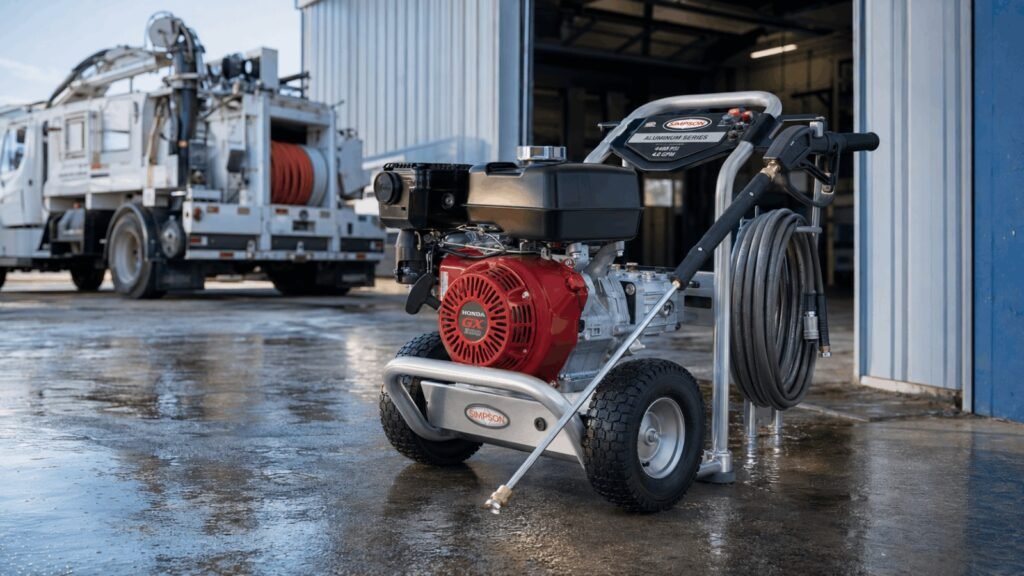
The aluminum frame is the selling point. Sources list the weight at 124 to 133 pounds, which is lighter than most steel-frame machines of the same power. That helps if you load it into a truck bed every day.
It is a good fit for a mobile cleaner who lifts the washer a lot and wants a name with easy parts support. It is not the cheapest way to get 4,000 PSI, so compare it with the PowerShot below. For people who carry the machine daily, it is a strong candidate for the best commercial pressure washer.
2. DEWALT DXPW60605: built for rough job sites
A parts listing for the DXPW60605 gives 4,200 PSI, 4 GPM, a Honda 389 cc engine, a CAT industrial triplex pump and direct drive. It weighs 139 pounds and measures about 38 inches long, 22.5 inches wide and 28.5 inches tall.
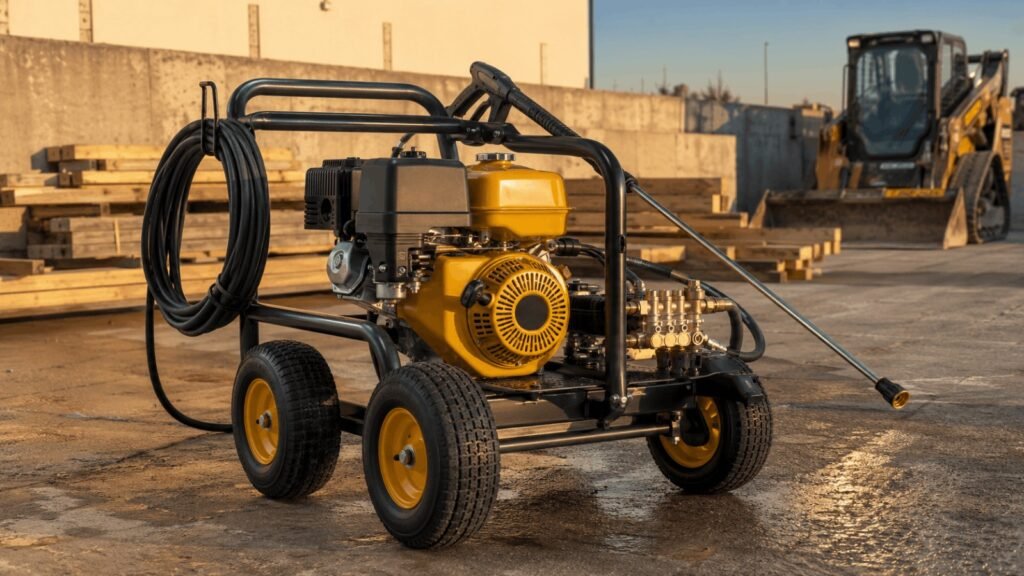
The same listing says it has no detergent injection. If you wash with soap all day, you will need a separate way to apply it, such as a downstream injector or a foam cannon. Be careful with similar model numbers. The DXPW60606 is a different machine with a different weight, so do not copy specs from one to the other.
Choose it for construction sites, equipment yards and anywhere the machine will be bumped and dragged. Do not choose it if you need built-in soap. On a rough job site it can be the best commercial pressure washer simply because it survives bumps.
3. Simpson PowerShot PS60843: the 4,400 PSI value pick
The PS60843 is the strongest machine on this list by the numbers: 4,400 PSI at 4.0 GPM, or 17,600 cleaning units. It uses a 420 cc Simpson CRX420 engine and an AAA triplex plunger pump with a built-in unloader and thermal relief.

It comes with a 50-foot, 3/8-inch hose, a rear-load spray gun, a 31-inch wand and five quick-connect tips: 0, 15, 25 and 40 degrees, plus soap. Listings put the weight near 107 pounds. It is a 49-state model, which means it is not sold in California. Deal sites have shown it around $500, but prices change, so check the current one.
For a small business that wants strong output without a $2,000 price tag, this is the best commercial pressure washer on the list in terms of value. The trade-off is the Simpson engine, which has a shorter track record than a Honda.
4. Pressure-Pro EB4040HC: a belt-drive machine for daily work
Dealer listings describe this as a 4,000 PSI, 4 GPM washer with a Honda GX390 engine, a CAT 5PP3140 triplex pump and an aluminum frame. It includes a 50-foot hose with quick connects, a chemical injector, four color-coded nozzles and a soap nozzle. Listed prices run from about $2,177 to $2,212.

Model names are messy here. The older name in our article was “E4040HC,” and dealers list the same machine as “EB4040HC.” One page also shows that Pressure-Pro sells belt-drive and direct-drive versions of similar models, so confirm which one you are buying. The belt-drive version is the reason to pay this price. Belts slow the pump down compared with the engine, which usually means less heat and wear over long days.
It suits a cleaner who runs the machine most days of the week and wants a pump that lasts. If you only wash a few times a month, it is more machine than you need. For all-day use, many owners would call a belt-drive unit the best commercial pressure washer.
5. BE B4013 series: an industrial build with several pump choices
BE Power Equipment makes a family of 4,000 PSI, 4.0 GPM machines under the B4013 name, all with a Honda GX390 engine. The pump changes by model. One BE spec sheet lists a General EZ4040G pump with a 50-foot hose and a shipping weight of 163 pounds. Another lists a CAT 66DX40GG1 pump, a 25-foot hose and 162 pounds. Both have an external unloader.

We could not confirm the exact model the old article used, the B4013HTB. A close relative, the B4013HTBG, is made to mount on a truck or trailer, and its Home Depot page says it is discontinued. So treat this entry as a family guide. Look at the full model code before you order, because the pump and hose length depend on it.
A good match for trailer rigs and shops that want a repairable pump from a brand that sells parts.
6. Kärcher HD 3.0/27 G: smaller output, tidy design
Kärcher’s own pages list the HD 3.0/27 at 2,700 PSI and 3.0 GPM, with a Honda GX200 engine. The base “G” model uses a Kärcher KPP2535 direct-drive pump and ships at about 145 pounds with packaging. The “GB” model uses a belt-drive KBP3030R pump and ships at about 181 pounds.

We could not find a model called “HD 3.0/27 PB,” which is what the old article used. The G and GB models are the ones Kärcher lists, so use those names when you shop.
At 8,100 cleaning units, it is about half as fast as the 4,000 PSI machines. That makes it a good choice for mobile detailing, small restaurants and light fleet work, but a poor one for large concrete lots. It is not the best commercial pressure washer for big lots, but it suits light work well.
7. AR Blue Clean AR630HW: a small hot-water electric washer
This one is different from the rest. Retail listings give 1,600 PSI and 2.3 GPM, an Annovi Reverberi nickel-plated brass triplex pump, and a 1-year limited warranty. It accepts water up to 180°F, which helps with grease and oil in kitchens or workshops.

The important detail is that it does not heat water by itself. You must feed it hot water from another source. One parts listing under a similar number shows 1,900 PSI and 2.1 GPM, but that looks like a different part or pump, so check the data plate on the machine.
It fits an indoor or covered cleaning job with an electric outlet and a hot-water supply. It is not a good fit for large outdoor surfaces, where the lower flow will slow you down.
Direct drive or belt drive?
This choice affects how long the pump lasts. Here is how they differ in simple terms.
| Feature | Direct drive | Belt drive |
|---|---|---|
| How it works | Pump attaches straight to the engine shaft | Belts connect the engine to the pump |
| Pump speed | Same speed as the engine | Slower than the engine |
| Weight and cost | Usually lighter and cheaper | Usually heavier and more expensive |
| Wear on long days | More heat and vibration | Usually runs cooler |
| Best for | Short or medium jobs | Daily, long jobs |
The DEWALT and the Kärcher G are direct drive. The Kärcher GB and some Pressure-Pro models are belt drive. If you spray more than a few hours every week, the belt-drive version is usually worth the extra money. Drive type is one of the biggest factors in picking the best commercial pressure washer for daily work.
How to choose the best commercial pressure washer for your work
Start with the job, not the brand. Here are the questions that matter.
How much water do you have? A 4.0 GPM machine needs at least 4 gallons per minute from the tap. Time how long a 5-gallon bucket takes to fill. If it takes more than 75 seconds, the washer may starve for water and the pump can be damaged. A water tank or a bigger hose solves it.
Hot or cold water? Cold water is fine for dirt, mud and most vehicle washing. Grease, oil and food residue clean much faster with hot water. A true hot-water washer has its own heater. The AR630HW above does not.
Where will you use it? Gas engines make carbon monoxide, so never run them in a closed garage or shop. For indoor work, choose electric.
Where do you live? Some machines, like the PowerShot PS60843, are not sold in California. Check local rules before you order.
Who will fix it? A pump with easy-to-find parts saves money. CAT, General and AR pumps have wide parts networks.
Which one is the best commercial pressure washer for each job?
There is no single winner, so here is a simple match by job, based on the specs above.
- Best value for power: the Simpson PowerShot PS60843. It has the highest rating on the list, 17,600 cleaning units, at a much lower price than the others.
- Best for rough job sites: the DEWALT DXPW60605, because of its CAT pump, Honda engine and sturdy cage frame.
- Best for lifting in and out of a truck: the Simpson ALH4240, thanks to its aluminum frame.
- Best for daily, all-day work: the Pressure-Pro EB4040HC, if you confirm the belt-drive version.
- Best for small jobs and detailing: the Kärcher HD 3.0/27 G. It has less output, so it is not for big lots.
- Best for grease indoors: the AR630HW, as long as you have a hot-water supply and an outlet.
If you only need one machine and cannot decide, the best commercial pressure washer for most small cleaning businesses is a 4,000 PSI, 4.0 GPM unit with a triplex pump. The PowerShot is the lowest-cost way in, and the Pressure-Pro is the one to buy if you plan to run it every day for years.
Safety rules that apply to every washer here
High-pressure water can cut skin, and a gas engine gives off carbon monoxide. Keep these rules in mind. Never point the wand at a person or at your own feet. Use closed-toe boots, eye protection and hearing protection. Do not run a gas washer in a closed space. Let the engine cool before you refuel, and store fuel in an approved can. Trigger guns can kick, so hold the wand with both hands. Read the manual for the exact start-up steps of your model.
Keep a commercial washer running longer
A few habits protect a pump that costs hundreds of dollars to replace. Never run it without water. Change the pump oil on the schedule in the manual. Clean the inlet screen. Drain the machine and use pump saver before winter. Our pressure washer maintenance checklist lists what to check before each use, and our guide to winterizing a pressure washer explains cold-weather storage. If you want a lower-cost option, see our Honda GX390 pressure washer guide. Good care is what lets the best commercial pressure washer last for years.
Questions people ask
How much PSI do I need for commercial cleaning?
Most commercial gas washers sit between 3,000 and 4,400 PSI. But flow matters just as much. For wide, flat surfaces, a 4.0 GPM machine is much faster than a 2.0 GPM machine at the same PSI.
Do I need a Honda engine?
No, but a Honda GX engine is easy to repair and parts are everywhere. The PowerShot uses a Simpson engine and costs much less, so it is a fair trade if budget matters most.
Is a belt-drive machine better?
For all-day use, usually yes. For a few hours a week, direct drive is fine.
Can a gas washer run indoors?
No. Gas engines give off carbon monoxide. Use an electric washer indoors.
Sources used
Spec data comes from the Simpson ALH4240 sheet, the Simpson PowerShot series page, Kärcher’s HD 3.0/27 G page, BE’s spec sheet and dealer or parts listings for the DEWALT, Pressure-Pro and AR models. Specs and prices change, so verify before you buy.