
This guide was built from maker manuals and dealer listings first, then from retailer and contractor guides. The Sun Joe SPX3000 operator manual, NorthStar manuals from Northern Tool, and Karcher and Simpson listings were checked for specs. We did not test these machines on a driveway for this guide, and we did not test the detergents named here. If a manual and a retail page disagree, this guide shows both numbers and says which one to trust. Last checked: 19 November 2026.
The short answer: how to pressure wash a driveway
To learn how to pressure wash a driveway, start with a test patch, pre-treat stains, apply detergent with the black soap nozzle, and then wash in slow, overlapping passes with a green 25-degree nozzle or a surface cleaner. For most cured concrete driveways, start at 2,000 to 3,000 PSI, held about 12 inches from the surface and kept moving.
This guide covers only the driveway job. It does not repeat the buying, nozzle, electric washer, or maintenance guides already on this site. Those are linked at the end. The steps below work for concrete. Asphalt, pavers, and stamped concrete need lower pressure.
What your driveway is made of
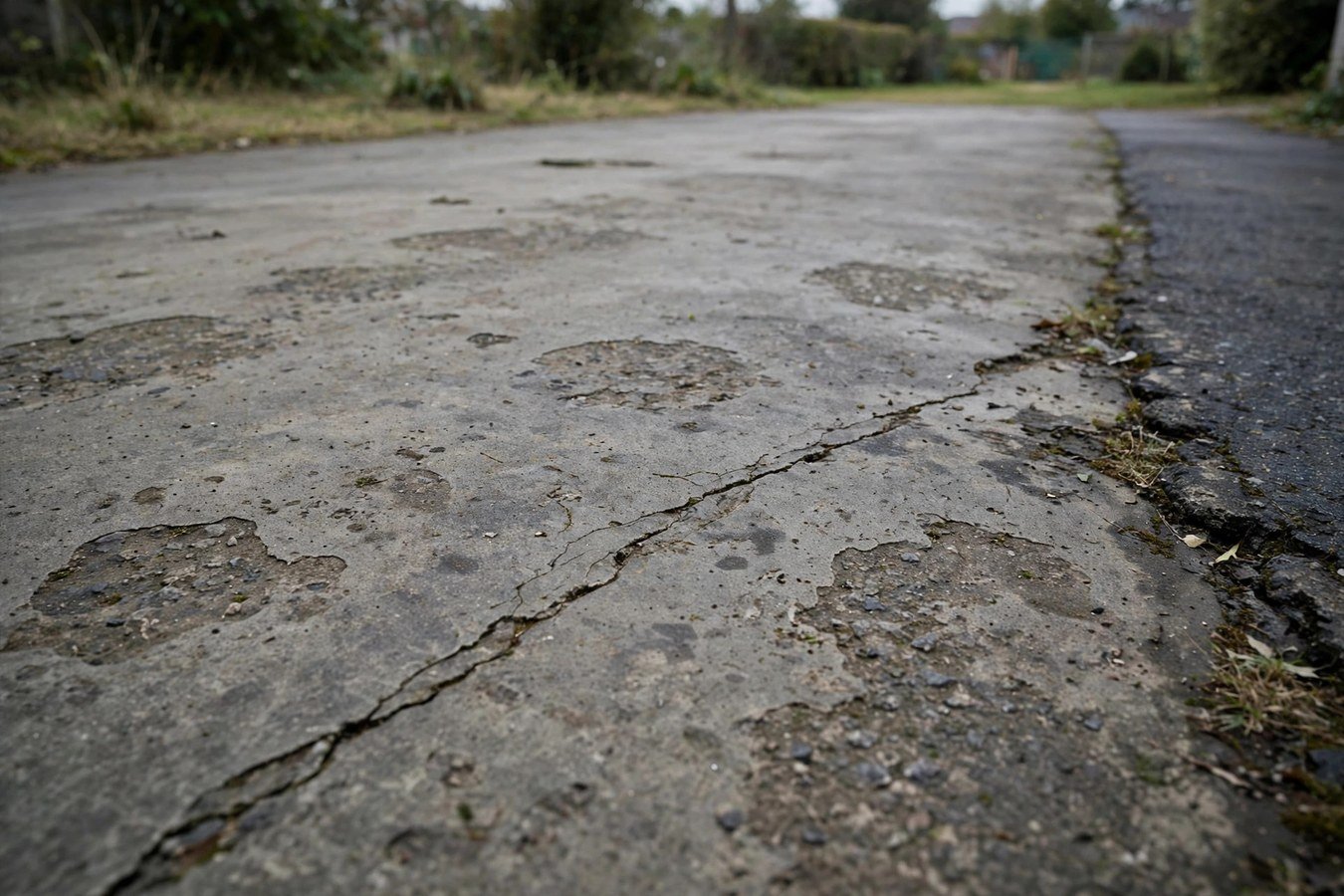
A driveway is usually concrete, asphalt, pavers, or stamped concrete. Concrete is the hardest and takes the most pressure. Asphalt is softer and can lose loose stones. Pavers can lose joint sand. Stamped concrete has a pattern and often a sealer coat, and both can be marked by a narrow spray.
New concrete needs about 28 days to cure, per concrete supplier guidance. Wait at least 28 days before deep pressure washing or sealing. A light rinse with a garden hose is safer in the first month. Walk the driveway first and mark cracks with chalk. Keep the wand farther back over weak spots. If a slab rocks, or a large area is crumbling, fix the slab first.
How much pressure and flow do you need?
PSI means pounds per square inch. It is the force of the water. GPM means gallons per minute. It is the flow. PSI breaks dirt loose. GPM carries it away. Both numbers matter.
Sources do not agree on one PSI number for concrete. Buckhorn Power Wash lists 2,000 to 3,500 PSI, and a second contractor guide lists 2,500 to 4,000 PSI. A home exterior guide lists 2,000 to 3,000 PSI as a starting range for plain, cured, unsealed concrete. Trust the lower range first. Start at 2,000 to 3,000 PSI and test a hidden corner.
Most home electric washers deliver 1.2 to 1.8 GPM. Most home gas washers deliver 2.0 to 2.5 GPM. A 2.0 GPM machine running for 60 minutes uses 120 gallons. A 2.5 GPM machine uses 150 gallons. GPM times minutes equals gallons.
Cleaning units give you one number to compare machines: cleaning units = PSI x GPM. The Sun Joe SPX3000 manual lists a rated pressure of 1,450 PSI, a max pressure of 2,030 PSI, and a max flow of 1.76 GPM. Trust the manual: rated pressure is the working pressure, and max pressure is a short peak figure.
| Machine type | PSI | GPM | Cleaning units |
|---|---|---|---|
| Sun Joe SPX3000, rated | 1,450 | 1.76 | 2,552 |
| Sun Joe SPX3000, max | 2,030 | 1.76 | 3,573 |
| Home gas washer, mid range | 2,800 | 2.5 | 7,000 |
| Home gas washer, high end | 3,000 | 2.0 | 6,000 |
A 3,000 PSI machine at 2.0 GPM gives 6,000 cleaning units. A 2,800 PSI machine at 2.5 GPM gives 7,000. For a large flat driveway, flow is what saves time.
Which nozzle to use
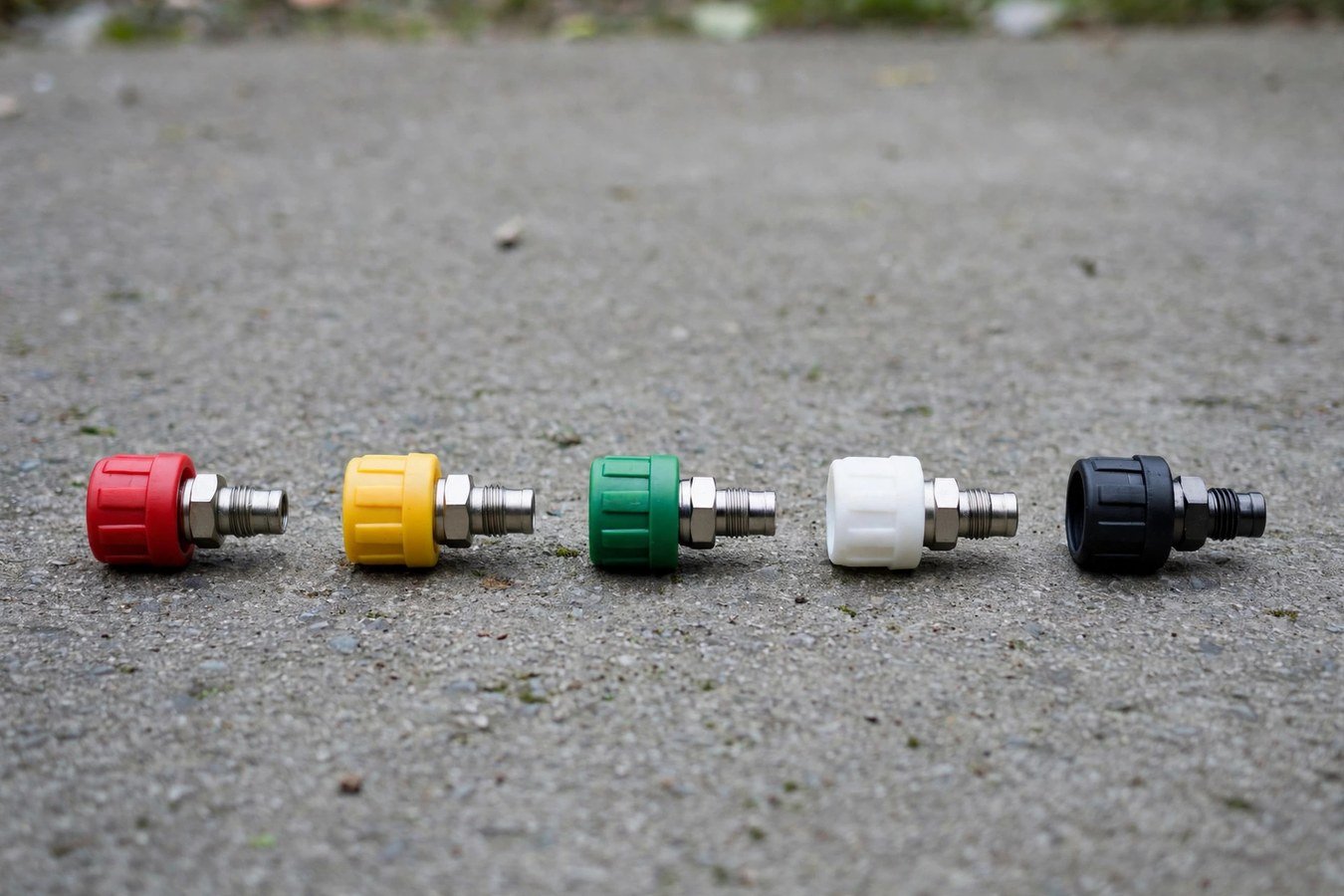
Nozzles are color coded in most home kits, and the colors are the same across most brands, including Ryobi, Sun Joe, and Greenworks.
| Nozzle color | Spray angle | Use on a driveway |
|---|---|---|
| Red | 0 degrees | Do not use. It can etch concrete in seconds. |
| Yellow | 15 degrees | Tough spots on cured concrete only, after a test patch. |
| Green | 25 degrees | Start here. Main washing nozzle for concrete. |
| White | 40 degrees | Rinse, light dirt, and delicate edges. |
| Black | 65 degrees, low pressure | Soap and detergent only. |
Start with the green 25-degree nozzle, about 12 inches from the surface. Some guides say 6 to 12 inches, and some say 8 to 18 inches. Start at 12 inches and move closer only if the surface is not cleaning and shows no marks. Never hold the wand still.
The black soap nozzle has a large opening, so pressure drops and the machine can draw detergent from its tank or siphon tube. That is why detergent will not flow through a green or yellow nozzle on most machines. Apply soap with the black nozzle first, then switch to the green nozzle to wash.
Surface cleaner or wand
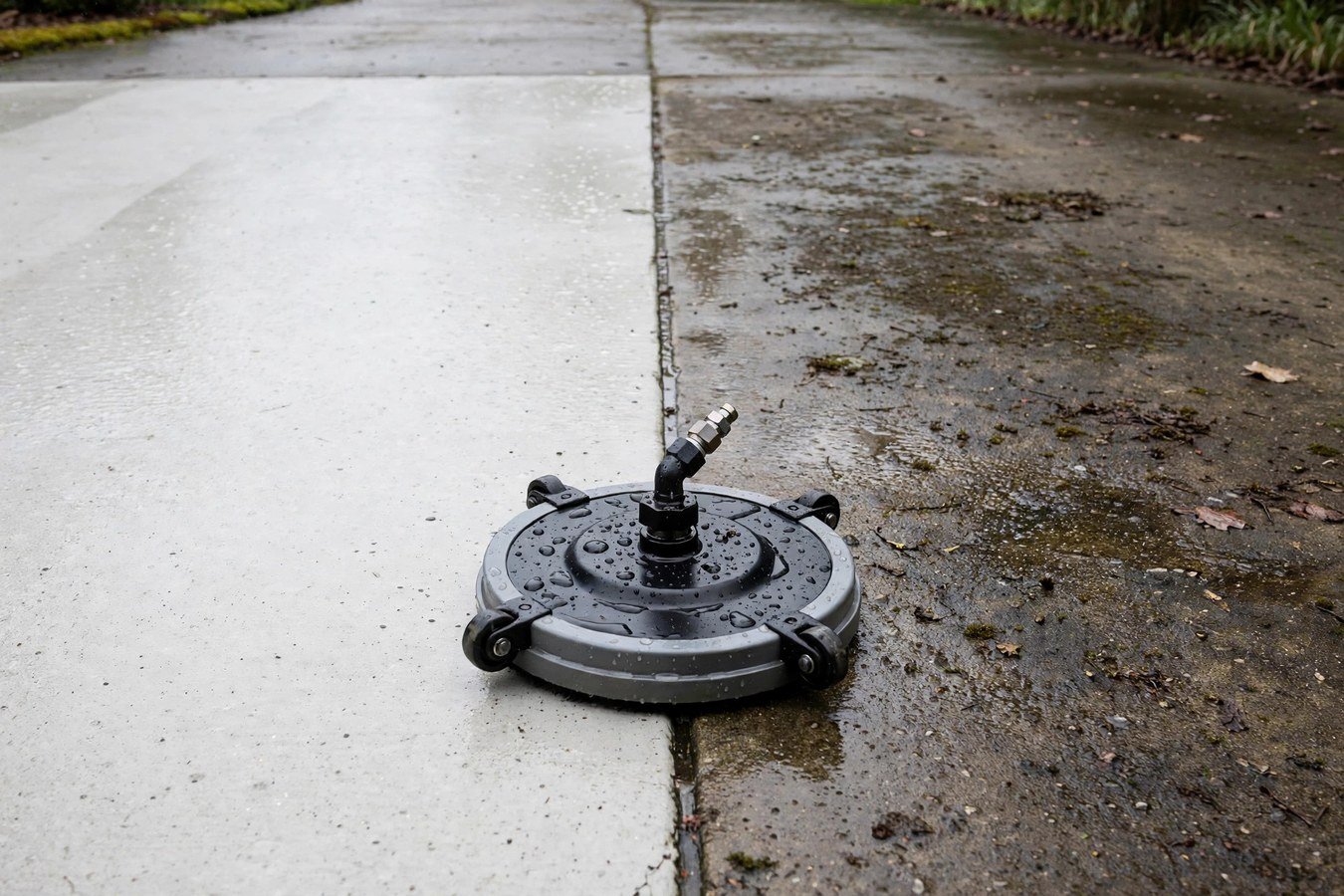
A surface cleaner is a round disc with two spinning nozzles under a cover. It cleans a wide path in one pass and keeps the spray at a fixed height, so it leaves fewer stripes than a wand. A wand cleans a narrow path, and the result depends on how steady your hand is.
Size the surface cleaner to your machine’s flow, not to its PSI. A common rule is 4 inches of deck per 1 GPM of flow. The Simpson Universal 15 inch cleaner is rated to 3,700 PSI and 3.0 GPM. The Karcher 15 inch cleaner is rated for 2,600 to 3,200 PSI. The Simpson 20 inch model is rated to 4,000 PSI and 5.0 GPM, and guides say it needs at least 3.5 GPM.
For most home gas washers, a 15 inch or 16 inch deck is right. For most home electric washers, a 12 inch to 14 inch deck is right. A 20 inch deck on a 2.0 GPM electric washer will spin too slowly and leave stripes. Use a surface cleaner for the main area, and the wand for edges and steps.
Detergent and pre-treatment
Water alone will lift loose dirt. It will not lift oil, tire marks, or mold well. Detergent does much of the work when you learn how to pressure wash a driveway, so do not skip it. Use a cleaner made for pressure washers and for concrete. Read the label for dilution and dwell time.
- General concrete cleaner: a mild alkaline cleaner for dirt and light grime.
- Degreaser: a stronger alkaline cleaner for oil and grease. Apply it only to the stain, unless the label says otherwise.
- Mold and algae cleaner: a cleaner for organic growth. Some are bleach based. Follow the label and keep it off plants.
- Rust remover: a separate product for rust marks. A degreaser will not remove rust well.
Dwell time is the time the cleaner sits before you rinse it. Most concrete cleaners list 5 to 10 minutes. Some guides list 10 to 15 minutes for a degreaser on a bad oil stain. Do not let the cleaner dry on the concrete. If a stain is still there, apply it a second time and scrub it with a stiff brush.
Do not mix bleach with other cleaners. Wear gloves and eye protection. Wet down nearby grass and plants before you start, and rinse them again after you finish. For oil, first soak up fresh oil with cat litter or sand, then apply degreaser for 10 minutes, scrub, and wash.

How to pressure wash a driveway in 10 steps
- Clear and sweep. Move cars, bins, planters, and toys. Sweep loose dirt and grit off the slab.
- Map the stains. Look for oil, tire marks, rust, algae, and mold. Note cracks with chalk.
- Protect what is nearby. Close windows and doors. Move potted plants back. Wet down garden beds and grass.
- Set up the machine. Connect the garden hose and check for leaks. NorthStar manuals say the supply flow should be at least 20 percent higher than the machine’s flow rate. For a gas machine, run it outdoors only, at least 20 feet from the home. For an electric machine, use a GFCI outlet.
- Do a test patch. Pick a hidden corner. Apply cleaner, wait the label time, and wash a small square. Let it dry and look at it in daylight. If the surface looks scoured, drop the pressure or use a wider nozzle.
- Pre-treat the stains. Apply degreaser to oil, a mold cleaner to green or black patches, and a rust remover to rust marks. Give each cleaner 5 to 10 minutes and keep it wet.
- Apply detergent. Fit the black soap nozzle. Work in sections so the soap does not dry. Start at the high point and move down.
- Wash. Switch to the green 25-degree nozzle or fit the surface cleaner. This is the core of how to pressure wash a driveway: start at the high point near the garage, work toward the street, hold the wand about 12 inches from the surface, and keep it moving.
- Rinse. Switch to the white 40-degree nozzle. Rinse from the high point down. Make sure no soap or dirt is left in low spots or joints.
- Let it dry. Let the concrete dry for at least 24 hours before you park a car on it. If a stain is still there, pre-treat it again and wash that spot only. If you plan to seal, wait at least 72 hours after washing, and 28 days after a new pour.
How long does it take, and how much water will you use?
A one car driveway, about 200 square feet, can take 30 to 60 minutes of washing time with a home gas washer, plus 15 to 30 minutes of prep. A two car driveway, about 400 to 600 square feet, can take 1 to 2 hours, plus prep. That time is normal for how to pressure wash a driveway with a home machine. A small electric washer takes longer. A surface cleaner cuts the time.
Water use is simple: GPM times minutes of trigger time. A 2.0 GPM machine used for 60 minutes uses 120 gallons. A 2.5 GPM machine uses 150 gallons. A 1.76 GPM machine uses about 106 gallons. Pre-treat stains well and do not make extra passes over clean concrete.
Mistakes that cause stripes and etching
Stripes are the most common problem when learning how to pressure wash a driveway. They come from uneven passes. Overlap each pass by about one third, keep the wand at the same distance, and keep it moving at a steady speed. A surface cleaner helps, because it keeps the height fixed, but it can still leave stripes if you walk too fast or if the deck is too large for your machine’s flow.
Etching is a pale mark where the spray cut into the concrete. It comes from holding the wand too close, holding it still, or using a red 0-degree nozzle. Do not use the red nozzle on a driveway. Dull patches can come from cleaner that dried on the surface, or from soap that was not rinsed off. Rinse in sections and do not let detergent dry in the sun.
Safety: read this before you start
A pressure washer can hurt you. NorthStar manuals warn that high pressure spray can pierce skin and the tissue under it, and that an injection injury can lead to blood poisoning, severe tissue damage, and in some cases amputation. A small puncture wound can look minor and still need a doctor at once. If fluid pierces your skin, seek medical help right away.
Wear safety glasses, closed shoes with grip, long pants, and gloves. Never point the wand at yourself, at another person, or at a pet. Never put a hand or finger over a leak. Keep children and pets away. For a gas machine, run it outdoors only, at least 20 feet from the home. For an electric machine, use a GFCI outlet.
Questions people ask
How much PSI do I need to pressure wash a driveway?
Start with 2,000 to 3,000 PSI for plain, cured concrete, and test a hidden corner first. Some guides list 2,500 to 4,000 PSI, but a higher number is not better if it etches the surface.
How long does it take to pressure wash a driveway?
A one car driveway takes about 30 to 60 minutes of washing time with a home gas washer, plus prep. A two car driveway takes about 1 to 2 hours, plus prep.
How to pressure wash driveway with an electric washer?
You can, for light to medium dirt. The Sun Joe SPX3000 manual lists a rated pressure of 1,450 PSI and a max pressure of 2,030 PSI, with a max flow of 1.76 GPM. Use a surface cleaner sized for its flow, usually 12 to 14 inches.
How to clean driveway with pressure washer without leaving stripes?
Overlap each pass by about one third, keep the wand at the same distance, and keep it moving at a steady speed. Start at the high point and work down.
What detergent should I use on a concrete driveway?
Use a cleaner made for pressure washers and for concrete. A general cleaner works for dirt, a degreaser for oil, a mold cleaner for algae, and a rust remover for rust. Apply it with the black soap nozzle, let it sit for 5 to 10 minutes, and do not let it dry.
Can I pressure wash a new concrete driveway?
Wait at least 28 days after the pour before deep pressure washing or sealing. In the first month, a gentle rinse with a garden hose is safer.
How much water does it take to pressure wash a driveway?
Multiply GPM by minutes of trigger time. A 2.0 GPM machine used for 60 minutes uses 120 gallons. A 2.5 GPM machine uses 150 gallons.